Draft AI
Draft AI is an iPhone app that turns a short voice recording into social media posts. The user speaks an idea for 30 seconds to 2 minutes. The app makes a transcript, the written text of the recording, with OpenAI's Whisper service. Then a large language model, a program trained on large amounts of text that writes new text from an instruction, turns the transcript into the chosen format: a carousel, a post of several image slides that the reader swipes through on Instagram or LinkedIn, a script for a short video, a thread for X, or hooks, the first lines of a post that make a reader stop and read. The app places the carousel text on templates and exports PNG images or a PDF, and the user posts them. The models are reached through OpenRouter, a service that gives one programming interface to models from many companies.
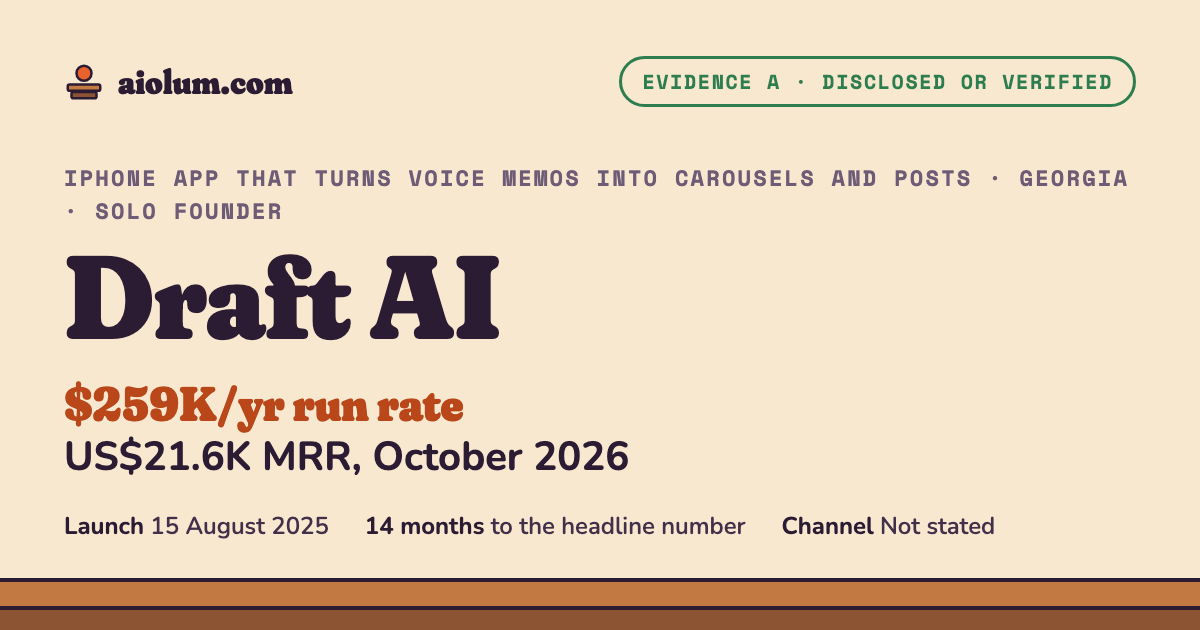
Valery Alexeev is the only person that any source connects to the app. Apple lists the seller as Valerii Alekseev, a person and not a company, and the app's legal pages name the operator as "P/E Valerii Alekseev": a private entrepreneur, which is a legal form for one person doing business, with an address in Tbilisi, Georgia. Version 1.0 appeared on the App Store on 15 August 2025. The download is free, but the app generates nothing until the user subscribes to Draft+ at US$14.99 a month or US$99.99 a year. This design is a hard paywall: a payment screen in front of the main feature, with no free version behind it. On 16 October 2026 the app had 1,672 active subscriptions and an MRR, monthly recurring revenue, the subscription revenue that repeats every month, of US$21,611, or about US$259,000 a year.
The revenue figures are grade A. TrustMRR, a site that publishes startup revenue read directly from the payment system, takes them from RevenueCat, a service that app makers use to manage subscriptions sold through the app stores, through an API key, a password that lets one program read another program's data. A second site, whatsthe.app, connects to the app's RevenueCat account separately and showed an MRR of US$23,181 on the same day. The monthly figures form an uneven line: US$36,614 in January 2026, US$14,206 in June, US$34,650 in August and US$25,520 in September, so this page marks the trend as falling. No source says how customers find the app.
The numbers, graded
Each row shows the evidence grade and the source numbers from the list at the end of this page. The grades are explained in How Aiolum verifies.
| Fact | Value | Grade | How we know | Sources |
|---|---|---|---|---|
| Monthly recurring revenue, 16 October 2026 | US$21,611 | A | TrustMRR, from RevenueCat through the founder's API key, synced on 16 October 2026 at 20:56 UTC. A second TrustMRR profile for the same app shows the same figure and is counted once. | [1, 2] |
| Active subscriptions, 16 October 2026 | 1,672 | A | TrustMRR, from RevenueCat. | [1] |
| Revenue in the last 30 days, to 16 October 2026 | US$21,361 | A | TrustMRR. The profile gives the change against the 30 days before as -25.3%. | [1] |
| Total verified revenue, December 2025 to 16 October 2026 | US$268,272 | A | TrustMRR's all-time figure; its monthly table starts in December 2025. The second profile starts in February 2026 and shows US$207,379, which is the same total without December and January. No source gives revenue for August to November 2025. | [1, 2] |
| Second verification, 16 October 2026 | MRR US$23,181; revenue US$23,639 | A | whatsthe.app, a leaderboard that reads app revenue through the owner's read-only RevenueCat key, for the app with the bundle ID app.Draft. The page does not state the period of its revenue column. Its MRR is 7.26% above TrustMRR's. | [3] |
| Revenue by month | Dec 2025 US$24,279; Jan 2026 US$36,614; Feb US$31,303; Mar US$32,080; Apr US$18,997; May US$18,286; Jun US$14,206; Jul US$21,839; Aug US$34,650; Sep US$25,520 | A | TrustMRR, from RevenueCat. October 2026 stood at US$10,496 on the 16th. | [1] |
| Change from the best recent months | September 2026: 26.3% below August and 30.3% below January | calc | Calculated from the monthly rows. The last 30 days are 38.4% below August. June 2026 was 61.2% below January, and August was 143.9% above June. | [1] |
| Run rate | about US$259,332 a year | calc | Calculated: the MRR of US$21,611 times 12. This is the headline figure on this page. | [1] |
| Revenue per active subscription | about US$12.93 a month | calc | Calculated: MRR divided by 1,672 subscriptions. It lies between the yearly plan, US$8.33 a month, and the monthly plan, US$14.99. | [1, 4] |
| Profit margin, last 30 days | 95.0% | C | Shown on the second TrustMRR profile. The profile does not say which costs are counted, so this page does not treat it as verified. | [2] |
| First App Store version | 1.0, 15 August 2025 | C | App Store version history. The privacy policy and terms are effective from 2 August 2025. The founder's TrustMRR entry gives 1 September 2025 as the founding date. | [4, 5, 2] |
| Team | 1 person | C | Apple lists the seller as an individual, Valerii Alekseev. The legal pages name the operator as P/E Valerii Alekseev, a private entrepreneur. No source names a co-founder or an employee. | [4, 5, 6] |
| Country | Georgia | C | The privacy policy gives the operator's address in Tbilisi, Georgia. | [5] |
| Outside funding | none reported | C | No source mentions investors. | [1, 5] |
| App Store ratings, 16 October 2026 | 35 ratings, average 4.0 | C | US App Store page. | [4] |
| Versions released | 21, from 15 August 2025 to 16 September 2026 | C | App Store version history. | [4] |
| Time from launch to the October 2026 figure | 14 months | calc | Calculated: August 2025 to October 2026. | [1, 4] |
How to read this table: a grade A value comes from the app's subscription data in RevenueCat, read by TrustMRR or whatsthe.app through the owner's API key. A grade C value comes from the app's own pages, the App Store listing or the founder's entries on TrustMRR. A "calc" value was computed on this page from the rows above it.
| Plan | Per month, billed yearly (US$) | Per month, billed monthly (US$) | Limit |
|---|---|---|---|
| Free download | 0 | 0 | no generations: the app can be opened, not used |
| Draft+ yearly | 8.33 | US$99.99 a year; 7-day trial with 10 generations, then unlimited | |
| Draft+ monthly | 14.99 | unlimited generations; no trial | |
| Draft+ Skip Trial | US$79.99 listed; period not stated |
All plans are Apple in-app subscriptions, and Apple handles refunds. The monthly plan has no free trial. The yearly plan starts with a 7-day trial limited to 10 generations, then gives unlimited generations. Without a subscription the app generates nothing. The App Store list also shows "Draft+ / Skip Trial" at US$79.99, and no source says what period it covers. Prices vary by country.
The timeline
From the first App Store version to US$21,611 in monthly recurring revenue in 14 months, with two high points and a deep fall between them. Each entry carries its grade.
- 2 August 2025CThe privacy policy and the terms of service take effect. They name the operator as P/E Valerii Alekseev. [5, 6]
- 15 August 2025CVersion 1.0 appears on the App Store. Four small updates follow by 30 August. [4]
- 12 September 2025CVersion 1.1: photos in the carousel editor, more languages, and an option to ask the AI to keep the user's original words. [4]
- 21 October 2025CVersion 1.1.1: an updated carousel editor with new templates, fonts, photo upload and export to PDF. [4]
- 2 November 2025CThe app is listed on whatsthe.app, a leaderboard that reads app revenue from RevenueCat. [3]
- December 2025AThe first month in TrustMRR's verified history: US$24,279. [1]
- 6 January 2026CVersion 1.2.0 adds an idea generator: the user describes a niche and swipes through suggested posts with hooks, right to save, left to skip. [4]
- January 2026AThe best month so far: US$36,614. February and March stay above US$31,000. [1]
- 24 April 2026CVersion 1.3: the user pastes a link to a TikTok, Instagram or YouTube video, and the app turns it into the user's own carousel, post or script. [4]
- April to June 2026ARevenue falls to US$18,997, then US$18,286, then US$14,206 a month, 61.2% below January. [1]
- 24 July 2026CThe updated privacy policy names the services behind the app: OpenAI's Whisper API for speech, OpenRouter for text generation, and Apify for reading public Instagram posts. [5]
- August 2026ARevenue comes back to US$34,650, the second-best month, 143.9% above June. [1]
- September 2026AUS$25,520. Version 1.4.1 is released on 16 September. [1, 4]
- 16 October 2026AMRR of US$21,611 from 1,672 active subscriptions, and US$21,361 in the last 30 days, 25.3% less than in the 30 days before. whatsthe.app shows an MRR of US$23,181. [1, 3]
Why it worked
Four causes, in the order they mattered. Each one is a reusable lesson.
Speak instead of type
The user records 30 seconds to 2 minutes of speech. OpenAI's Whisper API turns the audio into text, and the privacy policy says the audio file is deleted right after processing. A language model reached through OpenRouter then writes the carousel, script or thread. The App Store page's own example is a morning walk that becomes a carousel.
Writing and design in one step
A carousel needs text and a layout. The app places the generated text on templates, with fonts, brand colors, photo upload and sizes for Instagram and LinkedIn, and exports PNG or PDF. The user does not need a separate design tool.
Payment before the first result
Free users can open the app but generate nothing. The yearly plan starts with a 7-day trial limited to 10 generations, and the monthly plan has no trial. The terms mention an older system of prepaid balances that is being phased out. So every person who gets a result is a subscriber, or a trial user whose subscription starts unless cancelled.
One recording, many formats
The same voice memo gives an Instagram carousel, LinkedIn slides, a reel or TikTok script, an X thread, story scripts and hooks, in English and 25 more languages. New versions added new inputs to the same app: an idea generator in January 2026 and video links in April 2026.
How it was built
These details come from the app's privacy policy, the page source of getdraft.io, the App Store listing and the technology list on the second TrustMRR profile, which the founder fills in. They are grade C. [5, 7, 4, 2, 8]
- The iPhone app is built with SwiftUI, Apple's framework for app screens, according to the TrustMRR technology list.
- The server and the website use Laravel, a PHP framework, according to the same list. The page source of getdraft.io shows Inertia.js, a library that connects a server framework such as Laravel to JavaScript pages.
- Speech to text: the OpenAI Whisper API. Text: "various AI models" through the OpenRouter API, and the privacy policy says the app optimizes "AI model selection". No source names the models.
- When a user gives Instagram links as examples, Apify, a web-scraping service, extracts the public content so that the app can write similar posts.
- Payments: Apple In-App Purchase, with RevenueCat for subscription management and analytics. The TrustMRR list also names Stripe; no source says what Stripe is used for.
- Measurement: Firebase Analytics, Mixpanel and Sentry in the app, and the Meta Pixel and PostHog on the website. Sign-in is with Apple, or anonymous and tied to the device.
- The website has a blog with 84 articles in its sitemap, dated from November 2025 to October 2026, for example a comparison of AI and manual carousel design.
Tools named in the sources
Each one opens its page in the Tools tab, with every story that uses it.
The dead that came before
Four companies in the Loot Drop database sold tools that made posting or writing easier, and the platforms or larger software makers then built the same help into their own products or changed the rules. The values below are from that database and are not independently verified.
Pixelpipe
The promisePost photos, videos and audio to many social networks at once.
Why it diedFacebook and Twitter added their own sharing features and closed their APIs to it, and it never found a way to charge.
PostRocket
The promiseMore reach for brands' Facebook posts, by choosing the time and the content.
Why it diedFacebook changed its feed and its rules and pushed brands toward its own ads, while Hootsuite and Buffer covered more networks.
Draft
The promiseA simple writing tool with version control and editing help for writers.
Why it diedGoogle Docs added similar features, and a free plan without a clear way to paid use did not cover the costs.
Argyle Social
The promiseA social media marketing tool for engagement and sales leads.
Why it diedLarger competitors outspent it on marketing, and the platforms it depended on built their own tools for brands.
What changed
Each of the four helped people publish on platforms that it did not own, and each closed after the platforms, or larger software makers, built the same help in or changed their rules. Draft AI depends on the same kind of owners: LinkedIn offered its members AI-written drafts of posts from 2023 until it removed its AI writer in September 2026, Instagram was testing captions written by Meta AI in March 2025, and Apple controls the store and the payments.
Two things differ. First, Draft AI does not use any platform's API to publish: it exports images and the user posts them, so a change in LinkedIn's or Instagram's interfaces cannot switch it off. Second, it charges before the first result through Apple's subscription system, so its revenue does not wait for a business model. Its new weak point is the platforms' attitude to AI text: LinkedIn now lets members report posts as AI slop and shows such posts less outside the writer's own network.
Can one person copy it now?
The product, yes. The sales channel is not public.
Every part is a bought service: speech to text from OpenAI, text models through OpenRouter, payments through Apple and RevenueCat. The founder added one flow from speech to finished slides, and a price before the first result. No source explains how 1,672 subscribers found the app, so a copy has to solve that part alone.
Where it is still open: Other formats that need text plus layout: newsletters, slide decks, captions for short videos, and posts for platforms whose own AI writing tools are limited.
- 1Choose a format that needs two tools today, such as writing plus design for carousels, and make one app do both.
- 2Take the input by voice, so that the user does not have to sit down and write.
- 3Charge before the first result: a monthly plan, and a yearly plan with a short trial that has a usage limit.
- 4Connect the subscription account to a revenue-verification site, so that buyers and partners can check the numbers.
What to watch
The risks are the mirror image of the causes above.
Revenue is below its best months
September 2026 was 26.3% below August and 30.3% below January, and the last 30 days were 25.3% below the 30 days before. Revenue fell 61.2% from January to June 2026 and then came back, so the history is short and uneven. The verified data starts in December 2025, four months after launch.
The platforms write posts too
By 26 September 2023 LinkedIn had a tool that writes a first draft of a post from a member's ideas. In March 2025 Instagram was testing "Write with Meta AI", which suggests captions and comments based on the photo. Either company can add more writing help to its own app at no charge to members.
LinkedIn is acting against AI-written posts
On 31 July 2026 LinkedIn added a "Seems like AI slop" report option, said that it already shows low-effort AI posts less outside the writer's own network, and removed its own AI rewriting feature. Metricool reported on 2 October 2026 that members had used the report option more than a million times in under three weeks, and that Premium members now get a proofreader that only edits their own words. Posts that read as machine-written may reach fewer people.
The same field on this site
Kleo and EasyGen, LinkedIn writing tools run by small teams, reported more than US$1 million in revenue by September 2026 and US$41,500 a month in 2024, and aiCarousels, a one-person Swedish carousel tool, reported US$5,000 a month in November 2023; all three are founder statements (grade C), while Draft AI is the only one of the four with payment-system data and the only phone app.
Apple sets the terms
Every subscription runs through Apple's in-app purchase system, and Apple decides refunds. Apple's commission is 15% for developers with up to US$1 million in yearly proceeds, and its standard rate applies above that. App review, store search and refunds are all Apple's decisions, and no source shows sales outside the App Store.
Bought models
Transcription comes from OpenAI's Whisper API and the writing from models reached through OpenRouter. Other companies set their prices, rules and quality, and the same models are open to every competitor and to Meta and LinkedIn.
Content made from other creators' posts
Since version 1.3 users can paste a link to another person's TikTok, Instagram or YouTube video and turn it into their own post, and the privacy policy says Apify extracts public Instagram content to "Generate similar content based on examples". The platforms or the original creators may object to posts made this way.
Unknown sales channel, one RevenueCat account
No source says how customers find the app. The founder's X account had 169 followers, and the website loads the Meta Pixel, code that measures visitors for Facebook and Instagram advertising; no source says whether ads were bought. He also sells two other apps. The revenue sources tie the data to the Draft app's bundle ID, app.Draft, but cannot show whether the other two apps report into the same RevenueCat account.
Sources
The grade next to each source is the best grade that the source can support. "Read in full" means that the text of the page was downloaded and the numbers were checked in it.
- A TrustMRR, Draft AI markdown profile (slug draft-ai), revenue synced 16 October 2026Read the markdown profile. Revenue, MRR, subscriptions and the monthly table come from RevenueCat through an API key, as its Verification Sources section states; the description and founder fields are founder-written (grade C).
- A TrustMRR, Draft AI markdown profile (slug draft-ai-1), revenue synced 16 October 2026Read the markdown profile. The same RevenueCat data with a shorter history, counted once. Source for the founding date, the technology list and the profit margin, which are founder entries or unexplained (grade C).
- A whatsthe.app leaderboard, read 16 October 2026Read the table row and the embedded listing data for Draft AI: MRR, revenue, bundle ID, credential type and listing date.
- C App Store: Draft AI: Carousel Post Maker, read 16 October 2026Read in full. The description is the developer's; the seller, the in-app purchase prices, the ratings, the version history and the developer's other apps are shown by Apple.
- C Draft privacy policy, last updated 24 July 2026Read in full. Source for the operator, the country, and the AI, analytics and payment services.
- C Draft terms of service, last updated 24 July 2026Read in full. Source for the plans, the trial, the generation limits and the prepaid balances.
- C Draft AI home page, getdraft.io, read 16 October 2026The page renders by script. Read the landing text embedded in its page data, and the page source, which names the Meta Pixel and PostHog and uses Inertia.js.
- C getdraft.io sitemap, read 16 October 2026Read in full. Lists the home page, the blog and 84 blog articles with their dates.
- C Apple Developer: App Store Small Business ProgramRead in full. Source for the 15% commission and the US$1 million threshold.
- C Digital Works, 26 September 2023: LinkedIn's AI-powered writing tool for postsRead in full. A Danish agency's description of LinkedIn's tool that drafts posts.
- C Passionfruit, 19 March 2025: You Can Now Write Instagram Captions and Comments With AIRead in full. Reports Instagram's suggested captions written by Meta AI.
- C Ubergizmo, 21 March 2025, by Paulo Montenegro: Meta Tests AI-Generated Comments To Enhance User Interaction On InstagramRead in full. Reports the Write with Meta AI test and quotes Meta's statement.
- C ProPakistani, 31 July 2026: LinkedIn Finally Adds a Button To Kill All That AI SlopRead in full. Reports LinkedIn's statements; LinkedIn's own pages were not read because linkedin.com may not be fetched.
- C Metricool, 2 October 2026: LinkedIn Swaps Its AI Post Writer for a Proofreading ToolRead in full.
- C Loot Drop database export, 1,749 failed startupsLocal export. AI-written summaries, not independently verified. Source for the failed predecessors.