BAND: Product, team and how it was built
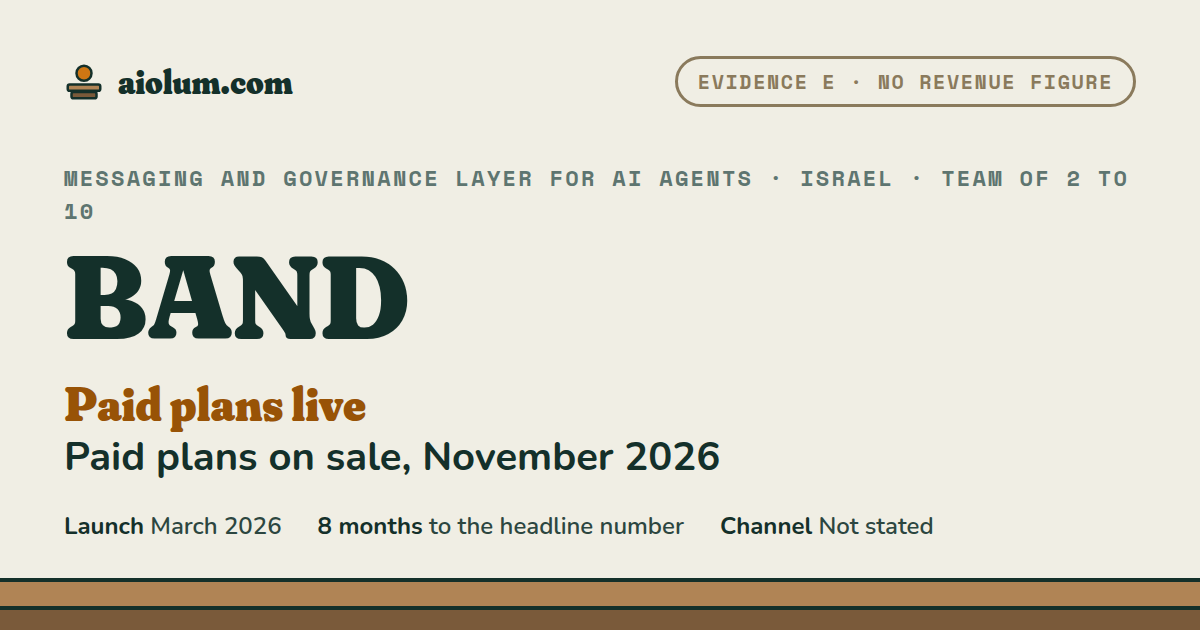
BAND (Messaging and governance layer for AI agents, Israel): Paid plans on sale, November 2026. Evidence grade E: no revenue figure was checked. Team: 2 co-founders named; headcount not published. Launched March 2026; still running.Added
- Outcome
- Paid plans on sale, November 2026
- Evidence
- E no revenue figure was checked
- Launch
- March 2026
- Status
- Still running
- Team
- 2 co-founders named; headcount not published
- Outside funding
- US$17M seed round, April 2026
- Main channel
- Not stated
What is not verified
No revenue figure was found. The CEO's phrase "initial revenues" has no amount, and the US$17 million is a funding round. What was looked for: a payment-processor profile, a filing and a founder interview with a figure. The paying customers are the company's own statement, and no independent source confirms that any plan has been paid for. The pricing page code holds a Stripe publishable key marked live. No checkout was opened. This story is grade E: the business is real and its product, price and customers are described from public pages, but no revenue figure was checked. Aiolum shows it as an idea worth studying, not as proof that it makes money.
BAND is a messaging layer for AI agents: software that carries messages and tasks between agents built with different tools, such as LangChain or CrewAI. VentureBeat describes a second layer, the control plane. There a company sets which agents may talk and keeps a transcript. The legal entity is Thenvoi AI Ltd., trading as BAND.
Calcalist reports that the company was founded in mid-2025 by Arick Goomanovsky (CEO) and Vlad Luzin (CTO). SiliconANGLE reported on 12 March 2026 that it launched a developer platform under the name Thenvoi. VentureBeat and Calcalist reported on 23 April 2026 a US$17 million seed round led by Sierra Ventures, Hetz Ventures and Team8. The pricing page read on 17 November 2026 lists a free plan, a Pro plan at US$17.99 a month and a quote-only Enterprise plan.
No revenue figure was found. The CEO told Calcalist, "We already have initial revenues and are working with around ten partners", without an amount. The US$17 million is a funding round, not revenue, so this story is grade E.
Why did BAND work?
Four causes, in the order they mattered. Each one is a reusable lesson.
Both founders had built companies or multi-agent systems before
Calcalist reports that the CEO co-founded Sygnia and Ermetic, both later sold, and then worked at Tenable. It reports that the CTO led a multi-agent systems team at Samsung in the early 2000s. The CEO told Calcalist that he envisioned the company after the sale of Sygnia and the founding of Ermetic. These are the company's statements, reported by a journalist.
The product is a message layer between agents, not another agent
The company asks customers to bring their own agents. VentureBeat says BAND does not use a large language model (LLM) to route messages, because an LLM would bring the same unpredictable errors. This is the company's description of its own technology.
A free plan and a self-serve paid plan sit beside a quote-only tier
The pricing page lets an individual start free and pay US$17.99 a month for Pro. Enterprise buyers ask for a quote. Whether any customer pays for Free or Pro is not stated in any source read.
How it was built
These details come from VentureBeat's interview with the CEO and from the company's own pages. They are the company's claims, grade C. [1, 3, 6]
- Two layers. A collaboration mesh where agents discover each other and exchange context, and a control plane for authority limits and a record of each interaction.
- Routing does not use an LLM. VentureBeat calls the routing technology proprietary and patent-pending, and says the infrastructure uses the same kind of technical stack as WhatsApp and Discord.
- Three ways to use it: a hosted service, a private cloud or on-premise install, and an edge install. VentureBeat says the edge install could run on drones or satellites.
- Agents built with open-source frameworks such as LangChain and CrewAI can connect. VentureBeat says the company's own routing and control code is not open source.
- The company's site is built with the Nuxt framework, shown by the nuxt-robots line in its robots.txt and by its page code.
Tools named in the sources
Each one opens its page in the Tools tab, with every story that uses it.
Who tried this before BAND, and why did they fail?
Three companies in our database of failed startups built messaging, or a layer joining other companies' messaging and tools. The values below are from that database, read on 17 November 2026. The summaries are AI-assisted and not independently verified.
Layer
The promiseA messaging platform that developers could add to any app: chat, voice and video.
Why it diedThe record says Layer could not stand out in a crowded market, as competitors such as Twilio widened their services.
Flux
The promiseOne interface for conversations from several messaging services.
Why it diedThe record names poor management decisions and a dependence on third-party interfaces that varied in stability.
Miru
The promiseA media-rich space where engineering, product and design teams communicate and plan.
Why it diedThe record points to strategic missteps and too little work on links with existing tools such as Slack.
The failed startups come from our database of 1,749 dead startups, retold here in our own words. Its entries are AI-assisted summaries of public sources, so these cards carry no evidence grade.
What changed
The three failed companies sat between people and other companies' tools. Layer and Flux were exposed to larger platforms that widened their services or to interfaces they did not control. The records name competition, management and strategy.
BAND's target user is different: the agent, not the person. VentureBeat quotes the CEO saying that the communication tools of today do not work for agents. Whether that gap lasts is open, because VentureBeat also notes OpenAI's workspace agents and Anthropic's Claude Managed Agents, both announced in April 2026.
Can one person copy BAND now?
Not as a solo business; the evidence is thin.
The sources show a funded company with a price list and no revenue figure. A solo founder cannot copy the enterprise side, which needs trust, security work and design partners. The self-serve side can be copied: a free plan and a low monthly plan that a developer starts without a call.
Where it is still open: Agents that coordinate inside one industry, such as customer support or legal work, where one narrow group of customers can be named.
- 1Offer a free tier and one low-price plan that a developer can start alone.
- 2Keep the enterprise tier as a quote, as the company does.
- 3Publish guides and take part in hack days, as the company's site and blog show.
How much revenue does BAND make?
Each row shows the evidence grade and the source numbers from the list at the end of this page. The grades are explained in How Aiolum verifies.
| Fact | Value | Grade | How we know | Sources |
|---|---|---|---|---|
| Legal entity and name | Thenvoi AI Ltd. d/b/a BAND | C | The footer of the company's site says "© 2026 Thenvoi AI Ltd. d/b/a BAND". VentureBeat writes that BAND is "also known as Thenvoi AI Ltd.". The company's GitHub account is named "thenvoi" and calls the product "the Thenvoi AI agent collaboration platform". SiliconANGLE used the name Thenvoi for the company on 12 March 2026, six weeks before the BAND announcement. | [3, 1, 8, 11] |
| Company start | mid-2025 | C | Calcalist, 23 April 2026: "Band was founded in mid-2025 by Arick Goomanovsky, CEO, and Vlad Luzin, CTO." The domain band.ai showed a registrar parking page in January 2018, so it was not an older product. The GitHub API shows that the account "thenvoi" was created on 30 January 2025, before that date. | [2, 9, 8] |
| Public launch | 12 March 2026 as Thenvoi; 23 April 2026 as BAND | C | SiliconANGLE, 12 March 2026: the company "today announced the launch of its developer platform". VentureBeat, 23 April 2026: BAND "exited stealth with $17 million in Seed funding". | [11, 1] |
| Seed round | US$17 million | C | VentureBeat and Calcalist, 23 April 2026: led by Sierra Ventures, Hetz Ventures and Team8. This is funding, not revenue. | [1, 2] |
| Revenue | "initial revenues", no figure | C | The CEO told Calcalist, 23 April 2026: "We already have initial revenues and are working with around ten partners." No amount was given. | [2] |
| Partners | around ten, not named | C | Calcalist gives the CEO's count. VentureBeat says the design partners include "leading North American telcos and European digital payment companies", without names. | [2, 1] |
| Pro plan price | US$17.99 a month | C | Company pricing page, read 17 November 2026. VentureBeat gave the same price on 23 April 2026. The Free plan is US$0 a month. | [3, 1] |
| Free plan limits | 20 remote agents and 2 week retention on the live page; 10 agents and 24 hours on 23 April 2026 | C | The live page also says up to 250 active chat rooms. VentureBeat said 50 active chat rooms. The two sources are not merged. | [3, 1] |
| Pro plan limits | 500 active chat rooms on the live page; 250 on 23 April 2026 | C | Both sources say 40 agents. The live page also lists 40 native agents and a data export. | [3, 1] |
| Billing terms | fees paid monthly in advance | C | Terms of Service, section 5.1: "The fees shall be paid in advance on a monthly basis on the first day of each month". | [5] |
| Team | 2 co-founders named; headcount not published | C | The about page names a co-founder and CEO and a co-founder and CTO and has a "Join The Team" section. VentureBeat says the money will be used "to expand the engineering team". | [4, 1] |
| Time from launch to the price check | 8 months | calc | Calculated: 12 March 2026 to 17 November 2026. | [11, 3] |
How to read this table. Grade C is a statement by the company or its CEO, on its own pages or reported by a journalist. A "calc" value was computed on this page. No value here is grade A or B, and none is a revenue figure.
| Plan | Per month, billed yearly (US$) | Per month, billed monthly (US$) | Limit |
|---|---|---|---|
| Free | 0 | 20 remote agents, up to 250 active chat rooms, 2 week data retention | |
| Pro | 17.99 | 40 agents, up to 500 active chat rooms, email support, data export | |
| Enterprise | custom quote | unlimited agents, custom retention, full API access |
The page says "/month" and does not say whether a yearly price differs, so the monthly column is filled and the yearly column is empty. VentureBeat gave different limits on 23 April 2026. Free had up to 10 remote agents, 50 active chat rooms and 24-hour data retention. Pro had 40 agents and 250 chat rooms. The limits in this table are from the live page. Enterprise is a custom quote.
When did BAND launch, and how did it grow?
From a company start in mid-2025 to paid plans on sale in 2026. Each entry carries its grade.
- Mid-2025CGoomanovsky and Luzin found the company, according to Calcalist. [2]
- 12 March 2026CThe company, then named Thenvoi, announces the launch of its developer platform for coding agents, SiliconANGLE reports. [11]
- 23 April 2026CBAND leaves stealth with a US$17 million seed round, VentureBeat reports. VentureBeat lists a Free plan, a Pro plan at US$17.99 a month and an Enterprise plan. The CEO tells Calcalist he expects a Series A round "within the next one or two quarters". [1, 2]
- 19 July 2026CA blog post says the company built Jam, a tool to help teams of coding agents coordinate their work. [7]
- 12 October 2026CA blog post says 23 teams built on BAND at a hack day. [7]
- 17 November 2026CThe pricing page shows three plans. The limits of the Free and Pro plans differ from those in April. [3]
What could go wrong for BAND?
The risks are the mirror image of the causes above.
What is not verified
No revenue figure was found. The CEO's phrase "initial revenues" has no amount, and the US$17 million is a funding round. What was looked for: a payment-processor profile, a filing and a founder interview with a figure. The paying customers are the company's own statement, and no independent source confirms that any plan has been paid for. The pricing page code holds a Stripe publishable key marked live. No checkout was opened.
Plan limits differ by date
VentureBeat on 23 April 2026 and the live pricing page on 17 November 2026 give different Free and Pro limits. The page does not say whether the plans changed. A reader who copies the numbers should read the live page.
Team size and partners are not named
No source gives a headcount. The blog shows posts by several authors, and VentureBeat says the money will be used to expand the engineering team. The partners are unnamed in both press pieces. A blog post of 11 October 2026 says another company built an agent team on BAND, but only the blog index was read. The site's two case studies name no customer: one describes a "global telecom provider" and one a "leading AI-first CTEM vendor". Neither gives a figure.
The home page shows sample agents, and Thenvoi is the earlier name
The home page lists sample agents with handles such as @team/sales-copilot and an investor line, "Backed by Team8, Hetz Ventures, Sierra Ventures". The investors match the press reports. No page says that the sample agents belong to customers. Thenvoi is the company's earlier public name. SiliconANGLE's article of 12 March 2026 links the site thenvoi.com as the company's site. That site was not read, because its robots.txt disallows Claude agents.
Sources
The grade next to each source is the best grade that the source can support. "Read in full" means that the text of the page was downloaded and the numbers were checked in it.
- C VentureBeat, 23 April 2026, Carl Franzen: Talking to AI agents is one thing — what about when they talk to each other? New startup BAND debuts 'universal orchestrator'Read in full. Staff article with a named author; interview with the CEO. Source for the seed round, the price tiers of that day, the architecture and the unnamed partners.
- C Calcalist, 23 April 2026, Meir Orbach: Ex-Sygnia and Ermetic founder raises $17 million Seed round to build the 'WhatsApp for AI agents'Read in full. Interview with the CEO. Source for the company start, the founders' backgrounds, the "initial revenues" statement and the Series A plan.
- C BAND pricing page, read 17 November 2026Read in full. The company's own page. Source for the three plans, the limits and the entity name in the footer.
- C BAND about page, read 17 November 2026Read in full. Names the two co-founders and has a "Join The Team" section.
- C BAND Terms of Service, read 17 November 2026Read in full. Source for the legal entity, the billing terms and the Israeli governing law.
- C BAND home page, read 17 November 2026Read in full. Source for the two products, the sample agents and the investor line.
- C BAND blog index, read 17 November 2026Read the first page of the index, not the posts. Source for the post titles and dates cited in the timeline.
- C GitHub account thenvoi, read 17 November 2026Read the profile page. Its repository descriptions use the name Thenvoi for the product. Linked from the footer of the company's site. The GitHub API (api.github.com/orgs/thenvoi) gives the account's creation date, 30 January 2025.
- C Internet Archive copy of band.ai, 7 January 2018Read in full. A registrar page, "Future home of band.ai"; used only to show the domain was not an older product.
- C Database of failed startups, local exportRecord pages read on the website on the day of writing. AI-written summaries, not independently verified. Source for the failed predecessors.
- C SiliconANGLE, 12 March 2026, Kyt Dotson: Thenvoi launches platform to help developers orchestrate multiple AI coding agentsRead in full. Staff article with a named author that retells the company's announcement. It spells the entity "Thenovi AI Ltd." in the text. Source for the earlier name and the launch of 12 March 2026.
- C BAND resource centre and its two case studies, read 17 November 2026Read the first index page and both case studies. Neither case study names the customer or gives a figure.
Run this company? Send corrections or a verified figure to aiolum@livyden.com