StackAI: Revenue, sale and how it was built
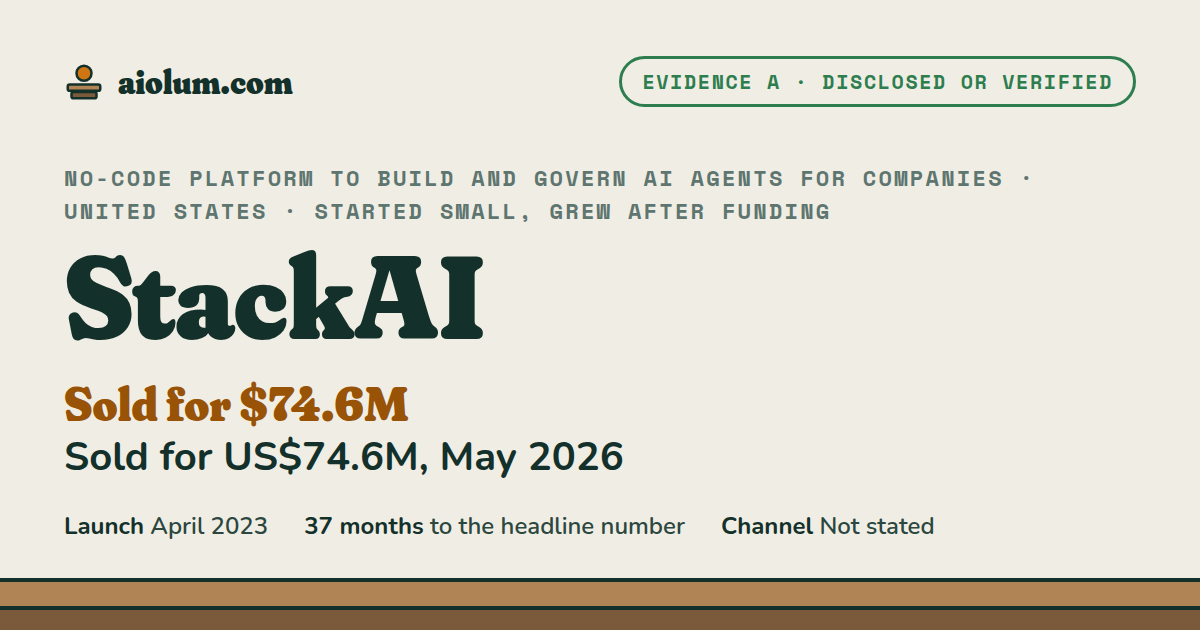
StackAI (No-code platform to build and govern AI agents for companies, United States): Sold for US$74.6M, May 2026. Evidence grade A: disclosed by a company or a filing, or verified by a payment processor. Team: 2 founders in 2022; 16 people in May 2025 after a US$16M Series A. Launched April 2023; sold 37 months after launch.Added
- Outcome
- Sold for US$74.6M, May 2026
- Evidence
- A disclosed by a company or a filing, or verified by a payment processor
- Launch
- April 2023
- Status
- Sold, 37 months after launch
- Team
- 2 founders in 2022; 16 people in May 2025 after a US$16M Series A
- Outside funding
- US$19M (US$3M seed, US$16M Series A)
- Main channel
- Not stated
StackAI is a no-code platform: a customer builds software by dragging blocks on a canvas and writes no program. The blocks make an AI agent, a program that uses a language model to do a job such as answering IT requests or checking documents. The company said the agents work inside systems such as Salesforce, Snowflake and SharePoint. Customers can run it in a VPC (virtual private cloud, a separate network area at a cloud provider) or on their own servers.
Antoni "Tony" Rosinol and Bernard Aceituno founded it in 2022. The company said in 2024 that it launched its first product in 14 days after joining Y Combinator. The company said in 2025 that it launched the platform in April 2023. It raised a US$3 million seed round in May 2024 and a US$16 million Series A in May 2025. It then had a team of 16. Asana completed the purchase on 27 May 2026, according to Asana's quarterly report, and both founders joined Asana.
The headline figure is the price that Asana's own quarterly report gives: US$74.6 million in cash for 100% of the company. The text of that report was read as copied by Stock Titan, because sec.gov refused the download. Asana's press release did not state the price. No figure for StackAI's revenue was found.
Why did StackAI work?
Four causes, in the order they mattered. Each one is a reusable lesson.
It aimed at regulated companies that need AI on their own servers
The company wrote in 2025 that its platform can run on-premises or in a VPC. The tracker wrote that the company concentrated on financial services and healthcare. The home page says it is built for IT teams and shows audit logs and human review. The founders' letter of May 2026 names banks and hospitals among its customers.
The founders joined Y Combinator right after their PhD defenses
The company wrote that the founders flew to San Francisco after their PhD defenses in December 2022. It wrote that they launched a first product in 14 days with help from Y Combinator mentors. It wrote that 10 customers came within weeks.
It raised two funding rounds and had 16 people by May 2025
The company raised a US$3 million seed round in May 2024 and a US$16 million Series A in May 2025. In May 2025 it wrote that it had 16 people. It also wrote that it was hiring in engineering, customer success, sales and marketing.
Asana's chief executive said StackAI lets customers automate complex processes end to end
Asana's chief executive said, as Pulse 2.0 quoted him, that customers already used Asana's own agents for repetitive work. He said StackAI lets them automate the most complex processes end to end. Asana paid US$74.6 million in cash, according to its own report.
How it was built
These details come from the company's own posts and pages. They are grade C. No source describes the code. [5, 10, 7]
- A canvas where a customer connects blocks into a workflow. The company's 2025 post calls it a codeless, drag-and-drop canvas builder.
- The company wrote in 2025 that it supports more than 30 model providers and more than 100 data connectors.
- The 2023 pricing page says calls to third-party model providers such as OpenAI cost extra, or the customer can use its own API keys.
- Customers can deploy on-premises or in a virtual private cloud, according to the company's 2025 post.
- After the sale, the founders wrote that the same forward deployed engineers and AI strategists keep working with customers.
Tools named in the sources
Each one opens its page in the Tools tab, with every story that uses it.
Who tried this before StackAI, and why did they fail?
Four companies in our database of failed startups promised to automate business work with AI or without code. The values below are from that database, read on 11 November 2026, and are not independently verified.
Olive AI
The promiseAn AI workforce of software bots that would automate hospital administration.
Why it diedEach client needed custom integrations. The bots broke when hospital systems changed. The cost to serve was far above the revenue.
Ansaro
The promiseAI that automates the hiring process, from candidate tracking to interview scheduling.
Why it diedBuyers saw it as nice to have. It needed change management at the customer and had no clear return on investment.
Pathmind
The promiseAI simulations for industrial workflows, usable without deep technical skill.
Why it diedThe market was not ready. Google and Amazon had more resources. Customers needed much education and hand-holding.
Crejo.Fun
The promiseA no-code platform for creators in India to build their own apps and games.
Why it diedIt was a horizontal tool for a market that needed vertical solutions. The cost of acquiring users broke the unit economics.
The failed startups come from our database of 1,749 dead startups, retold here in our own words. Its entries are AI-assisted summaries of public sources, so these cards carry no evidence grade.
What changed
Each of the four sold automation or a no-code tool to buyers that were not ready. Olive AI promised autonomous bots and delivered custom integration work. Ansaro and Crejo.Fun asked customers to change how they work. Pathmind arrived early.
StackAI sold to IT teams in regulated companies, and the company says it supported deployment on the customer's own servers. It also gave customers dedicated engineers. The company said in 2025 that it served hundreds of organizations. Whether the margin was healthy is not known, because no revenue figure was found.
Can one person copy StackAI now?
Not for one person today. The pattern of the exit is visible, but the cost is not.
The sale followed two funding rounds, a team of 16 and enterprise security work. A solo founder cannot copy that path. The narrow audience is copyable: one buyer type with strict data rules.
Where it is still open: Other regulated fields where AI agents must run inside the customer's own systems, such as insurance, public agencies and clinical operations.
- 1Pick a buyer that cannot use general chat tools, such as a bank or a hospital.
- 2Offer deployment on the customer's own servers or in a private cloud.
- 3Start with a free plan and a priced plan, as the 2023 pricing page shows.
- 4Plan for dedicated engineers at each large customer, as the company's own letter describes.
How much did StackAI make, and what was it sold for?
Each row shows the evidence grade and the source numbers from the list at the end of this page. The grades are explained in How Aiolum verifies.
| Fact | Value | Grade | How we know | Sources |
|---|---|---|---|---|
| Cash paid by Asana for 100% of Eigen Inc., which sells StackAI | US$74.6 million | A | Asana's quarterly report for the period ended 31 July 2026: "aggregate cash consideration of $ 74.6 million". The acquisition date is 27 May 2026. Read as copied by Stock Titan. | [1] |
| Part of the price held in escrow | US$18.4 million | A | The same report: paid to an escrow account for post-closing indemnification obligations. | [1] |
| Price in the earlier quarterly report | about US$75.0 million | A | Asana's report for the quarter ended 30 April 2026 says "approximately $ 75.0 million in cash consideration, subject to customary purchase price adjustments". | [2] |
| Price reported by the press | US$75 million | D | The Acquired Startups tracker wrote on 28 May 2026 that TechCrunch reported the figure. Asana did not disclose terms in its announcement. | [3, 4] |
| Company start | 2022 | C | The company's own FAQ: "In 2022, MIT PhDs Antoni Rosinol and Bernardo Aceituno started Stack AI". The seed post says the founders left Boston for Y Combinator after their PhD defenses in December 2022. | [5, 6] |
| Platform launch | April 2023 | C | The company's Series A post: "Since launching StackAI in April 2023". The seed post says the first product launched in 14 days after joining Y Combinator. | [5, 6] |
| Founding team | 2 founders and 2 founding engineers | C | The seed post shows a photo of two co-founders and two founding engineers. | [6] |
| Team, May 2025 | 16 people | C | The company's Series A post: "We've built a team of 16 members". No later headcount was found. | [5] |
| Funding | US$19 million in total | C | The company's posts give a US$3 million seed round on 21 May 2024 and a US$16 million Series A on 6 May 2025. Gradient Ventures led the seed. | [5, 6] |
| Sale price compared with funding | about 3.9 times | calc | Calculated: US$74.6 million divided by US$19 million. | [1, 5, 6] |
| Users, May 2024 | more than 40,000 | C | The company's seed post. It also says the first 10 customers came within weeks of launch. | [6] |
| Sign-ups and agents, May 2025 | more than 90,000 sign-ups and 100,000 agents | C | The company's Series A post. It also says it served hundreds of organizations and named Nubank, LifeMD, MIT Sloan and SmartAsset. | [5] |
| Paid plans in 2023 | US$199 and US$899 a month | C | The company's pricing page as archived on 20 August 2023. A reader can see that something was sold at a stated price. | [10] |
| Price today | free plan, Enterprise by quote | C | The pricing page read on 11 November 2026 shows no paid price. | [9] |
| After the sale | StackAI stays a separate product and brand | C | The founders' letter to customers of 27 May 2026. | [7] |
| Months from launch to sale | 37 months | calc | Calculated: April 2023 to May 2026. | [5, 1] |
How to read this table. Grade A is the buyer's own filing. Grade D is a press report that the buyer did not confirm. Grade C is a statement by the company itself. A "calc" value was computed on this page.
| Plan | Per month, billed yearly (US$) | Per month, billed monthly (US$) | Limit |
|---|---|---|---|
| Free | 0 | 0 | 500 runs a month, 2 projects, 1 seat |
| Enterprise | custom quote | custom runs, projects and seats; on-premise or VPC | |
| Starter (2023, archived) | 199 | 5,000 runs a month, 3 projects, 1 user | |
| Team (2023, archived) | 899 | 50,000 runs a month, 30 projects, 5 members |
The live page shows a free plan and a custom Enterprise plan with no price. The Internet Archive copy of 20 August 2023 showed paid plans at US$199 and US$899 a month, billed monthly. It also charged US$0.18 for each run above the quota. Calls to the model provider were charged separately.
When did StackAI launch, and how did it grow?
From a PhD defense in December 2022 to a sale in May 2026, in 37 months from launch. Each entry carries its grade.
- 2022CThe company says two MIT PhD students start StackAI. They defend their PhDs in December 2022 and move to San Francisco for Y Combinator. [5, 6]
- Winter 2023CThe tracker places the company in the Y Combinator Winter 2023 batch. The company says it launches a first product in 14 days and signs its first 10 customers within weeks. [3, 6]
- April 2023CThe company says it launched the StackAI platform. [5]
- August 2023CThe archived pricing page lists a free plan, a US$199 plan, a US$899 plan and an Enterprise plan. [10]
- 21 May 2024CA US$3 million seed round led by Gradient Ventures. The company says it has more than 40,000 users. [6]
- 6 May 2025CA US$16 million Series A. The company says it has 16 people, 90,000 sign-ups and hundreds of organizations as customers. [5]
- 27 May 2026AAsana buys 100% of the company for US$74.6 million in cash. The founders write to customers the same day. [1, 7]
- 28 May 2026DAsana announces the completed deal with its quarterly results. Both founders join Asana. The press reports a price of US$75 million. [3, 4]
What could go wrong for StackAI?
The risks are the mirror image of the causes above.
What is the evidence for the price
The headline is the buyer's own filing, read as copied by Stock Titan because sec.gov refused the download. Asana's announcement gave no price. The tracker's US$75 million came from TechCrunch, which was not fetched.
No revenue figure was found
The sale price is the only money figure for the business itself. No source gives revenue, profit or the number of paying customers. The price may include value for the team and the founders.
Part of the deal is not in the price
Asana's report says 4.5 million restricted stock units and 3.0 million performance stock units went to StackAI employees. It says about US$20.0 million more in awards may follow. These are not part of the purchase price.
Trust signals on the company's pages are unsourced
The home page shows a wall of customer logos and a count of "500+ enterprise integrations". It also shows badges for G2, SourceForge, HIPAA, GDPR, SOC 2 Type II and ISO 27001, and seven customer quotes. Some quotes name a role but no company. One says "$1M in operational savings". No source checks them.
Sold with engineers, not only software
The home page lists a "White-Glove Experience" with dedicated support, and the founders' letter names forward deployed engineers. This sale concerns a software platform with a free plan. A reader can see that services were part of the offer.
Sources
The grade next to each source is the best grade that the source can support. "Read in full" means that the text of the page was downloaded and the numbers were checked in it.
- A Asana quarterly report (Form 10-Q) for the quarter ended 31 July 2026, text copied by Stock TitanRead in full on 11 November 2026. The filing itself is on sec.gov, which refused the download, so the filing text is read as Stock Titan copies it.
- A Asana quarterly report (Form 10-Q) for the quarter ended 30 April 2026, text copied by Stock TitanRead the note on the acquisition of StackAI. Same limit: the text is Stock Titan's copy of the filing.
- D Acquired Startups: Asana buys no-code AI agent builder StackAI for a reported $75 millionRead in full. A tracker that retells TechCrunch for the price, and the company's posts for the founders and funding.
- B Pulse 2.0, 31 May 2026: Asana Acquires StackAI To Expand Cross-System AI Workflow AutomationRead in full. It repeats Asana's announcement with quotes from its chief executive and a co-founder, and says financial terms were not disclosed.
- C StackAI blog, 6 May 2025: Enterprise AI Agents for Every Job: StackAI Raises $16MRead in full. The company's own post. Source for launch date, team, funding and customers it names.
- C StackAI blog, 21 May 2024: StackAI's $3M Seed RoundRead in full. The company's own post. Source for the founders' start, the first product and the early users.
- C StackAI blog, 27 May 2026: StackAI Joins Asana, a letter to customersRead the letter and the FAQ. The founders' own words on the product after the sale.
- C StackAI home page, read 11 November 2026Read in full as text. Source for the audience, the logo wall, the badges, the counter and the customer quotes.
- C StackAI pricing page, read 11 November 2026Read in full as text. Shows a free plan and a custom Enterprise plan with no price.
- C StackAI pricing page, Internet Archive copy of 20 August 2023Read in full as text. Source for the 2023 paid plans and the over-quota charge.
- C Database of failed startups, local exportRecord pages read on the website on 11 November 2026. AI-written summaries, not independently verified. Source for the failed predecessors.
Run this company? Send corrections or a verified figure to aiolum@livyden.com