RoastGPT: Revenue, team and how it was built
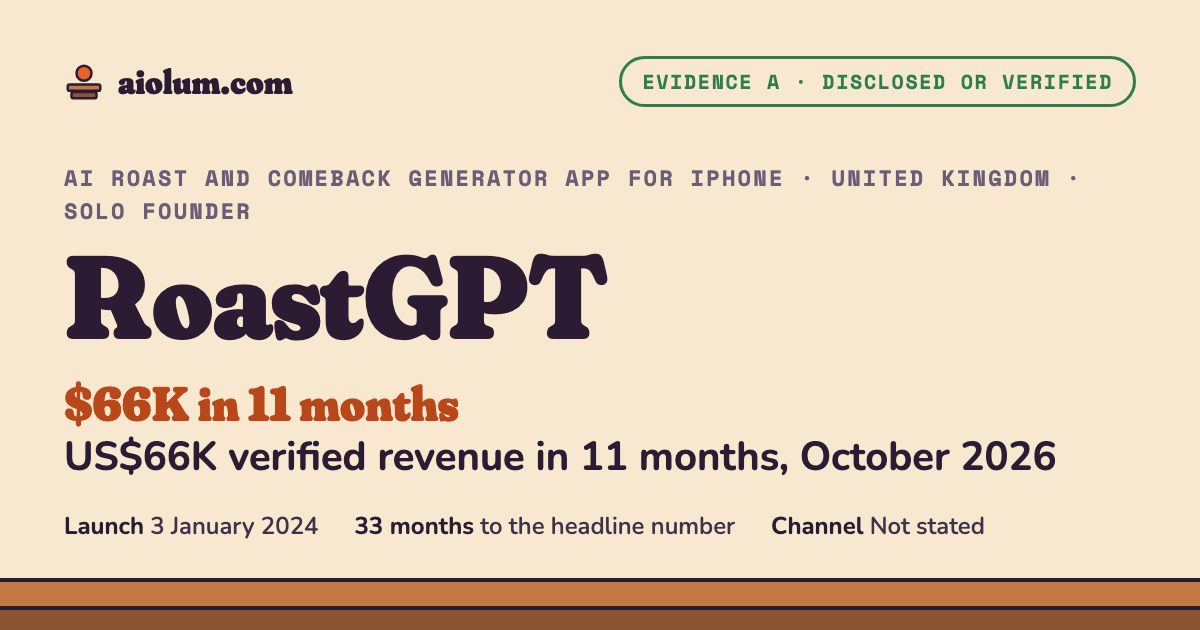
RoastGPT (AI roast and comeback generator app for iPhone, United Kingdom): US$66K verified revenue in 11 months, October 2026. Evidence grade A: disclosed by a company or a filing, or verified by a payment processor. Team: 1 named owner, Matt Cowlin, through his company MSDC Technologies Ltd; no staff reported; who wrote the first version is not known. Launched 3 January 2024; still running, revenue falling.Added 25 October 2026
- Outcome
- US$66K verified revenue in 11 months, October 2026Revenue falling
- Evidence
- A disclosed by a company or a filing, or verified by a payment processor
- Launch
- 3 January 2024
- Status
- Still running
- Team
- 1 named owner, Matt Cowlin, through his company MSDC Technologies Ltd; no staff reported; who wrote the first version is not known
- Outside funding
- None reported; listed as bootstrapped
- Main channel
- Not stated
RoastGPT is an iPhone app that writes a roast or a comeback with an AI language model. A roast is a joke that makes fun of a person, as at a comedy show where friends tease a guest. A comeback is a quick, clever reply to something another person said. The user uploads a screenshot of a chat or describes a person, and the app returns a short joke to copy. The App Store page says it is "Designed for fun, not harm" and rates it 9+, with "Infrequent/Mild Profanity or Crude Humor".
The App Store seller is MSDC Technologies Ltd, the company whose privacy policy is published on the personal website of Matt Cowlin, a British app marketer who writes that he has built "90+ Apps". Version 1.0 appeared on 3 January 2024. The earliest archived copy of the App Store page, from 14 September 2024, already names MSDC as seller. TrustMRR, a site that reads revenue directly from a payment provider, shows US$66,002 of revenue from December 2025 to 25 October 2026, read from RevenueCat, a service that records the subscriptions an app sells through the App Store. All of that revenue came while MSDC was the seller. No figure exists for the months before December 2025.
This page is about running an app, not about building one. The app's internal identifier uses a prefix that none of MSDC's 15 other apps uses, so another developer may have created the first version, but no source names that developer or says that the app was bought. Revenue fell from US$8,365 in January 2026 to US$5,000 in September 2026, and the app has been for sale since 10 January 2026 at US$100,000. The page also shows four failed startups whose social products became tools for teasing and bullying.
How much revenue does RoastGPT make?
Each row shows the evidence grade and the source numbers from the list at the end of this page. The grades are explained in How Aiolum verifies.
| Fact | Value | Grade | How we know | Sources |
|---|---|---|---|---|
| Verified revenue, December 2025 to 25 October 2026 | US$66,002 | A | TrustMRR, read from RevenueCat through an API key, synced 25 October 2026. The 12-month total and the all-time total are the same number, and the monthly table starts in December 2025, so no revenue before December 2025 is connected. | [1] |
| Verified revenue, last 30 days to 25 October 2026 | US$4,458 | A | TrustMRR. 11.0% below the 30 days before. | [1] |
| Monthly recurring revenue, 25 October 2026 | US$4,219, from 144 active subscriptions | A | TrustMRR snapshot. Monthly recurring revenue (MRR) is the subscription revenue that repeats each month. | [1] |
| Monthly recurring revenue, 2 October 2026 | US$4,455, from 153 active subscriptions and 14 trials | A | whatsthe.app, read from RevenueCat; last updated 2 October 2026, after which the API key expired. Revenue in the 28 days to that date: US$4,529. | [2] |
| Best month | US$8,365, January 2026 | A | TrustMRR monthly table. December 2025: US$5,911. | [1] |
| Revenue, September 2026 | US$5,000 | A | TrustMRR monthly table. June to August 2026: US$5,504, US$5,776 and US$5,499. | [1] |
| Fall from the best month to September 2026 | about 40% | calc | Calculated: (8,365 minus 5,000) divided by 8,365 equals 0.402. | [1] |
| Average month, December 2025 to September 2026 | about US$6,234 | calc | Calculated: 62,342 (the ten full months) divided by 10. | [1] |
| Profit margin, last 30 days | 99% | C | TrustMRR snapshot. Costs are entered by the owner, not read from a payment provider. A Flippa listing states 100% margins. | [1, 10] |
| Downloads, 28 days to early October 2026 | about 2,500 | A | whatsthe.app, iOS and Android combined, with 2,468 new customers in RevenueCat in the same 28 days. An undated Flippa listing states 14,500 downloads a month. | [2, 10] |
| Ratings on the US App Store | 7 in September 2024, about 1,000 in January 2026, about 1,300 in October 2026 | B | Archived App Store pages of 14 September 2024 and 21 January 2026, and the live page. Average 4.6 in October 2026. whatsthe.app counts 1,700 ratings across all countries. | [3, 4, 5, 2] |
| App Store seller | MSDC TECHNOLOGIES LTD, at least since 14 September 2024 | B | Named on every App Store copy read for this page, from September 2024 to October 2026. The same account sells teleprompter, soundboard, film-set and podcast apps. | [3, 4, 5, 6] |
| Link between MSDC and Matt Cowlin | MSDC's privacy policy is on mattcowlin.com | C | The App Store page links to that policy. TrustMRR names the founder as Matt, with the profile name mattcowlin, and whatsthe.app shows @MattCowlin as the seller. | [8, 3, 1, 2] |
| Who wrote the first version | not known | C | The app's bundle identifier uses a prefix that none of the 15 other MSDC apps on the App Store page uses (they use matt.app, msdc.app, com.msdc, com.msdcangel or com.infinity). No source names another developer or a purchase. | [3] |
| Start of the business, as entered by the seller | January 2025 | C | whatsthe.app sale details: "Business Operations Started Jan 2025". The app itself was released on 3 January 2024. The Flippa listing gives the app's age as 1 year. | [2, 10] |
| Last app update | version 2.2.2, 25 July 2025 | B | App Store version history. The note reads "Fixes Critical error as our data provider went bust!!". All verified revenue came after this update. | [3] |
| Asking price | US$100,000 | C | TrustMRR (listed since 10 January 2026, 8 offers received), whatsthe.app and Flippa. An undated Acquire.com listing asks US$75,000. | [1, 2, 10, 11] |
| Asking price compared with revenue | about 1.5 times the US$66,002 | calc | Calculated: 100,000 divided by 66,002 equals 1.52. TrustMRR states 1.9x, which matches the last 30 days times 12 (US$53,496). | [1] |
| Annual revenue on the Acquire.com listing | US$106,000, with US$85,700 annual profit | C | Undated seller listing. It is 1.6 times the verified all-time total, so it is probably a yearly rate from a strong month. It is not used as a headline. | [11] |
| Time from version 1.0 to the October 2026 figure | 33 months | calc | Calculated: January 2024 to October 2026. | [2, 1] |
How to read this table: a grade A value was read by TrustMRR or whatsthe.app from RevenueCat, the service that records the app's App Store subscriptions. A grade B value is on Apple's App Store page or an archived copy of it. A grade C value was written by the owner or a sale listing. A "calc" value was computed on this page from the rows above it.
| Plan | Per month, billed yearly (US$) | Per month, billed monthly (US$) | Limit |
|---|---|---|---|
| All Access | US$6.99 in-app purchase; period not stated on the App Store page |
The App Store page lists one in-app purchase, All Access at US$6.99, and does not say whether it renews weekly, monthly or yearly. Calculated: monthly recurring revenue divided by active subscriptions is about US$29.30 a month (US$4,219 divided by 144 on TrustMRR), which is close to a weekly price of US$6.99 (US$30.29 a month). This is a reading of the numbers, not a stated period. The download is free. User reviews describe a payment screen at the first launch, and one says that a few free roasts come before it.
When did RoastGPT launch, and how did it grow?
From a first version in January 2024 to a for-sale app that makes about US$4,500 a month. Each entry carries its grade.
- 2012 to 2023CMatt Cowlin founds Teleprompter Pro in 2012 and sells it in 2023, according to his website. He describes himself as a marketer of 12 years and more who has built more than 90 apps, mostly for video production. [7]
- 3 January 2024BVersion 1.0 of RoastGPT appears on the App Store. Version 1.1 follows on 7 January. [3, 2]
- 10 and 11 February 2024BVersions 2.0 and 2.2. [3]
- June 2024Croastgptapp.com, the site that the app's privacy and terms links point to, shows a domain registrar's page that asks the owner to verify contact details. By November 2024 it shows a parked page. [9]
- 14 September 2024BThe earliest archived App Store page names MSDC TECHNOLOGIES LTD as seller. The app has 7 US ratings and an All Access purchase at US$6.99. [4]
- 4 March 2025BVersion 2.2.1, with stability fixes. [3]
- 25 July 2025BVersion 2.2.2: "Fixes Critical error as our data provider went bust!!". It is the last update up to October 2026. [3]
- December 2025AFirst month of verified revenue on TrustMRR: US$5,911. [1]
- 10 January 2026CListed for sale on TrustMRR at US$100,000. The seller's message: "Fund personal projects." [1]
- January 2026ABest month, US$8,365. The App Store page of 21 January 2026 shows about 1,000 ratings and links to the MSDC privacy policy on mattcowlin.com. [1, 5]
- September 2026AUS$5,000, about 40% below January. [1]
- 2 October 2026Awhatsthe.app shows MRR of US$4,455 and 153 active subscriptions, then stops updating because the RevenueCat key expired. [2]
- 25 October 2026ATrustMRR shows US$4,458 in the last 30 days, MRR of US$4,219 and 144 active subscriptions. [1]
Why did RoastGPT work?
Four causes, in the order they mattered. Each one is a reusable lesson.
Low running cost
The owner reports a 99% profit margin on TrustMRR. The app had no new version between July 2025 and October 2026, so there was no development cost while all of the verified revenue came in.
One purchase behind a paywall
The app sells a single in-app purchase, All Access at US$6.99. User reviews describe a payment screen at the first launch and only a few free roasts. Several one-star reviews complain about it, and the average rating is still 4.6 from about 1,300 US ratings.
A clear name in a search-driven store
The App Store name is "RoastGPT - AI Roast Generator" and the subtitle "Roast AI Comeback Generator": the words a person types when looking for such an app. No source says where the downloads come from. The seller writes on whatsthe.app that the app "could explode on TikTok if someone with that knowhow takes it on", which suggests TikTok is not a channel today.
Running, not building
The owner is a marketer with more than a dozen apps on the same developer account. The evidence shows him operating and selling RoastGPT. It does not show who wrote its code, and the seller-entered start date, January 2025, is a year after the first release.
How it was built
Few build details are public. These come from the sale listings, written by the seller (grade C), and from the App Store page (grade B). [2, 3, 1, 4, 5, 9]
- Native iPhone app written with SwiftUI, Apple's interface framework, according to the tech stack on whatsthe.app.
- Subscriptions are sold through Apple's in-app purchase system and recorded in RevenueCat, which TrustMRR and whatsthe.app read through API keys.
- The AI model provider is not named anywhere. The July 2025 update says it fixed a critical error because the app's "data provider went bust", which suggests the app changed the service behind the roasts at that time.
- Two inputs: a cropped screenshot of a chat, read by the app, or a typed description of a person. A slider on the result screen sets how sharp the joke is, as the App Store screenshots show.
- The app's privacy and terms links first pointed to roastgptapp.com. By January 2026 they pointed to an MSDC Technologies Ltd policy page on mattcowlin.com.
- The sale includes the source code and brand assets, with support from the seller after the sale, according to whatsthe.app.
Tools named in the sources
Each one opens its page in the Tools tab, with every story that uses it.
Who tried this before RoastGPT, and why did they fail?
Four companies in the Loot Drop database built social products for young users in which teasing turned into bullying, or a fun add-on for chats that the large platforms copied. The values below are from that database and are not independently verified.
Formspring
The promiseA question-and-answer site where teenagers asked each other questions, often anonymously.
Why it diedIt did not earn money from its large audience, and the anonymous questions turned into cyberbullying and bad press. Ask.fm and newer networks took its users.
Yik Yak
The promiseAnonymous posts that anyone within about 8 kilometres could read, aimed at college campuses.
Why it diedBullying and harassment led to school bans and damaged its name. Anonymous posts were hard to sell advertising against, and growth slowed.
Secret
The promiseAn app for sharing confessions and gossip without your name.
Why it diedThe novelty faded, cyberbullying grew, and the founders disagreed about the direction while users left.
Guggy
The promiseTurn the text of a chat message into a funny animated GIF.
Why it diedWhatsApp and Facebook Messenger built GIF search into their own apps. Guggy had no clear way to charge, and it depended on the platforms it plugged into.
The failed startups come from Loot Drop, a free database of dead startups, retold here in our own words. Loot Drop describes its entries as AI-assisted summaries of public sources, so these cards carry no evidence grade.
What changed
Formspring, Yik Yak and Secret show what happens when a product for young users makes it easy to say hurtful things about other people: schools ban it, the press turns against it, and users leave. Each of them raised millions of dollars and needed a large audience to sell advertising. Guggy shows the other risk of a fun add-on for chats: the messaging platforms copy it for free.
RoastGPT differs in two ways. It is not a social network: the joke goes to the user, who decides whether to send it, and nobody posts anything inside the app. And it charges a few dollars to a small number of people instead of selling advertising to millions, so about 150 subscribers are enough to keep it profitable. The risk that remains is the one the predecessors had: the app invites jokes about a real person, and its 9+ rating means children can install it.
Can one person copy RoastGPT now?
The app, maybe. The model, yes.
Many roast and reply apps compete in the same App Store searches: eight of the ten apps that the RoastGPT page recommends are roast, flirting or reply apps. A copy would need its own name, search position and paywall. The more general model is open: a single-purpose AI app with one purchase, low running cost and a small team, run by someone who knows App Store marketing, and sold when growth stops.
Where it is still open: Single-purpose AI apps for a concrete everyday task, for example a reply helper for work messages, apology or thank-you notes, or language practice, where the joke or text is about the user and not about another person.
- 1Pick a request that people type into the App Store search box, and put those words in the app name and subtitle.
- 2Keep the app to one or two actions, each a single request to a language model, so the running cost stays near zero.
- 3Connect a subscription service such as RevenueCat from the start, so the revenue can be verified when you want to sell.
- 4Write clear rules against harm in the app, set the age rating honestly, and check what users really do with it.
What could go wrong for RoastGPT?
The risks are the mirror image of the causes above.
Who built it and when it changed hands
Apple's page has named MSDC Technologies Ltd as seller since at least 14 September 2024, eight months after version 1.0. The app's internal identifier differs from all other MSDC apps, the seller gives January 2025 as the start of the business, and the first website, roastgptapp.com, lapsed in 2024. No source says who wrote the code or whether MSDC bought the app. All verified revenue on this page came under MSDC.
Jokes about real people, with a 9+ rating
The app asks the user to "Describe a person you'd like to make harmless fun with", and a screenshot shows a roast of a person named Nico. It asks users to be respectful, but nothing stops a joke aimed at a classmate, and an early review says it "roasted the person I want to stand up to". The App Store rates it 9+. Formspring, Yik Yak and Secret failed in part because of bullying.
Falling revenue and no updates
Monthly revenue fell about 40% from January to September 2026, and the last 30 days were 11% below the 30 days before. The app has had no new version since 25 July 2025.
Numbers that do not agree
An undated Acquire.com listing states US$106,000 of annual revenue and US$85,700 of profit at an asking price of US$75,000, more than the US$66,002 that RevenueCat shows for all time. The other listings ask US$100,000. The listing figures are written by the seller; this page uses the RevenueCat figures.
Complaints about the paywall
Several reviews say the app asks for payment before the user sees a roast, and that a "Continue for Free" button still led to a payment screen. Another review says a "Dismiss" button skips the payment.
For sale
The app has been listed for sale since 10 January 2026. A new owner would get a running app with no recent updates, an unnamed AI provider and a downward trend.
Sources
The grade next to each source is the best grade that the source can support. "Read in full" means that the text of the page was downloaded and the numbers were checked in it.
- A TrustMRR profile of RoastGPT, read 25 October 2026Read the markdown profile in full, live on 25 October 2026; revenue synced the same day from RevenueCat through an API key. Revenue, MRR and subscription counts are grade A; the profit margin, the seller message, the asking price and the description are written by the owner, grade C.
- A whatsthe.app listing of RoastGPTRead in full on 25 October 2026. Metrics "verified through RevenueCat API keys", last updated 2 October 2026. Source for the second revenue reading, the release date, the downloads, the tech stack and the seller's sale details.
- B Apple App Store: RoastGPT - AI Roast GeneratorRead in full on 25 October 2026, with the three screenshots. Source for the description, the age rating, the in-app purchase, the ratings, the reviews, the version history, the seller and the other MSDC apps with their bundle identifiers.
- B Apple App Store page, Wayback Machine copy of 14 September 2024Read in full. The earliest archived copy. Source for the seller in 2024, the 7 ratings, the US$6.99 price and the roastgptapp.com links.
- B Apple App Store page, Wayback Machine copy of 21 January 2026Read in full. Source for the ratings in January 2026 and the privacy link to mattcowlin.com.
- B Apple App Store page, UK storefront, Wayback Machine copy of 12 November 2024Read in full. Confirms MSDC TECHNOLOGIES LTD as seller in November 2024.
- C Matt Cowlin's personal websiteRead in full on 25 October 2026 (the page says it was last updated on 2 July 2024). Source for his background, Teleprompter Pro and the 90+ apps. It does not mention RoastGPT.
- C MSDC Technologies Ltd privacy policy and terms, on mattcowlin.comRead in full. The page that the App Store listing links to. Source for the link between MSDC and Matt Cowlin.
- C roastgptapp.com, Wayback Machine copies of 2 June and 6 November 2024Read both copies. June 2024 shows a registrar page that asks the owner to verify contact details; November 2024 shows a parked domain. No earlier copy with content exists.
- C Flippa listing: RoastGPT - AI Roast GeneratorRead the public part on 25 October 2026. Undated. Source for the monthly profit and downloads stated by the seller, the app age and the asking price. Financial details need an account and were not read.
- C Acquire.com listing: AI roast generator app for playful usersRead the public part on 25 October 2026. Undated. Cited only for its revenue, profit and asking price, which do not agree with the verified figures.
- C Loot Drop database export, 1,749 failed startupsLocal export. AI-written summaries, not independently verified. Source for the failed predecessors.