BridgeMind: Revenue, team and how it was built
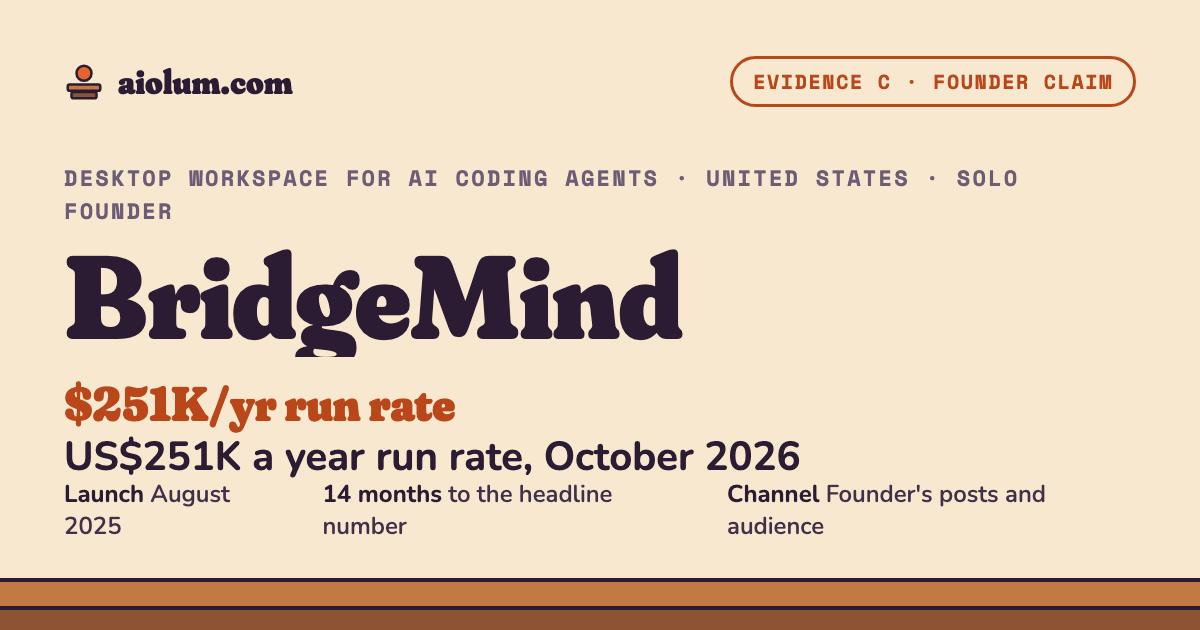
BridgeMind (Desktop workspace for AI coding agents, United States): US$251K a year run rate, October 2026. Evidence grade C: the founder's own figures, not verified by anyone else. Team: 1 founder, Matthew Miller, on every stream; a directory lists 5 employees. Launched August 2025; still running, revenue growing.Added 26 October 2026
- Outcome
- US$251K a year run rate, October 2026Revenue growing
- Evidence
- C the founder's own figures, not verified by anyone else
- Launch
- August 2025
- Status
- Still running
- Team
- 1 founder, Matthew Miller, on every stream; a directory lists 5 employees
- Outside funding
- None reported for BridgeMind; a directory says US$25,000 of the founder's own money
- Main channel
- Founder's posts and audience
BridgeMind sells a desktop workspace for vibe coding, which means building software by describing the change in plain words and letting an AI coding agent, a program that reads and edits the code and runs commands in a terminal, do the typing. The app puts several agents (Claude Code, Codex and others) in panes on one screen, adds a dictation tool, and runs named agents on a schedule. The customer pays the AI providers directly; BridgeMind's FAQ says its plans do not include Claude, Codex or Grok usage.
Matthew Miller, the founder and CEO according to the channel's own description, started the challenge "Vibe Coding an App Until I Make $1,000,000" in August 2025 and streams it as numbered days. Each title carries the ARR, annual recurring revenue, which is the current monthly subscription revenue times 12. The titles show US$242,964 on 10 July 2026, a fall to US$196,200 by 20 August, and US$250,772 on 8 October 2026, which is about US$20,900 a month. The company behind the product is BridgeMind LLC, based in the United States.
Every figure on this page comes from the founder: his video titles and descriptions, and the Stripe dashboards that he opens on camera, which the review site ProvenStartups wrote down from one stream. That makes it grade C at best. The run rate is his own sum over three Stripe accounts, and no TrustMRR profile exists for BridgeMind. The page also shows earlier developer-tool companies that failed when larger platforms gave the same features away.
How much revenue does BridgeMind make?
Each row shows the evidence grade and the source numbers from the list at the end of this page. The grades are explained in How Aiolum verifies.
| Fact | Value | Grade | How we know | Sources |
|---|---|---|---|---|
| ARR, 8 October 2026 (Day 238) | US$250,772 | C | Title and description of the Day 238 live stream, published 8 October 2026. The latest numbered day on the channel's streams tab on 25 October 2026. | [1, 10] |
| Monthly revenue implied by that ARR | about US$20,898 a month | calc | Calculated: 250,772 divided by 12. | [1] |
| Highest ARR in a title | US$257,876 on 1 October 2026 (Day 235) | C | Stream title and description, 1 October 2026. | [8] |
| ARR, 10 July 2026 (Day 206) | US$242,964 | C | Stream title, 10 July 2026. The description calls it an all-time high. | [2, 4] |
| MRR shown on the Day 206 stream | US$20,200, about US$19,000 of it from BridgeMind.ai | C | ProvenStartups, from the recording: the founder opened three Stripe accounts on camera. 20,200 times 12 is 242,400, close to the title figure. | [4] |
| ARR, 2 August 2026 (one-year video) | US$242,698 | C | Title of the one-year highlight video, published 2 August 2026. Almost the same as on 10 July. | [3] |
| Lowest ARR in the sources | US$196,200 on 20 August 2026; the 4 September description says "the comeback from $194K" | C | Day 219 and Day 225 stream descriptions. | [5, 6] |
| Fall from 10 July to 20 August 2026 | about 19% | calc | Calculated: (196,200 minus 242,964) divided by 242,964. | [2, 5] |
| Rise from 3 September to 8 October 2026 | about 28% | calc | Calculated: (250,772 minus 196,500) divided by 196,500. | [7, 1] |
| ARR, 8 February 2026 (Day 161) | US$75,924 | D | EveryDev directory news item that links to a YouTube video. The video itself was not read. | [17] |
| New paying users in one day | 100, on 3 September 2026 | C | Day 225 description: "Yesterday we added 100 paying users." | [6] |
| Running costs stated on stream | about US$1,000 a month of AI subscriptions and about US$1,500 a month of AWS | C | ProvenStartups: US$800 for Claude Code and US$200 for OpenAI, given in answer to chat questions. | [4] |
| Audience, October 2026 | 111,000 YouTube subscribers, 56,000+ followers on X, 18,089 Discord members | C | Channel about page and company home page, read 25 October 2026. | [11, 12] |
| Prices | US$20, US$50 and US$100 a month, 20% less billed yearly | C | Pricing page and terms of service. | [13, 14] |
| Team | Solo, according to ProvenStartups; 5 employees, according to EveryDev | C | ProvenStartups wrote "Team Solo (Matthew, 24, college dropout)". The EveryDev count has no stated source. | [4, 17] |
| Outside funding | none reported | D | EveryDev lists "$25,000 (Self-funded by founder)". ProvenStartups says an earlier startup of the founder raised significant funding. | [17, 4] |
| Time from the start of the challenge to the October 2026 figure | 14 months | calc | Calculated: August 2025 to October 2026. | [3, 1] |
How to read this table: a grade C value is the founder's own statement, in a video title, a video description or on a dashboard he showed on stream. A grade D value comes from one directory with no second source. An X value was computed on this page. No value is grade A or B.
| Plan | Per month, billed yearly (US$) | Per month, billed monthly (US$) | Limit |
|---|---|---|---|
| Basic | 16 | 20 | 5,000 credits a month |
| Pro | 40 | 50 | 12,500 credits a month; BridgeVoice and BridgeVerse |
| Ultra | 80 | 100 | 50,000 credits a month; everything in Pro |
All three plans run the desktop app. Pro adds BridgeVoice, BridgeVerse and voice orchestration. Credits pay only for BridgeMind's own metered features (Auto runs, Create with AI, voice orchestration, cloud voice to text) and do not roll over. Usage of Claude, Codex or Grok is billed by those providers, outside BridgeMind. First-time Pro purchases have a 7-day money-back guarantee.
When did BridgeMind launch, and how did it grow?
From a YouTube channel opened in March 2024 to a run rate of about US$250,000 a year, streamed day by day. Each entry carries its grade.
- 4 March 2024CThe BridgeMind YouTube channel is created. Its description later calls BridgeMind the founder's third startup. [11]
- November 2024CA BridgeMind blog post, now in its archive, describes ViewCreator, a set of AI tools that write titles, scripts and captions for social media. [20]
- August 2025CThe challenge "Vibe Coding an App Until I Make $1,000,000" starts; the one-year video says it began 365 days before 2 August 2026, and ProvenStartups dates the first stream to 6 August 2025. [3, 4]
- January 2026DBridgeSpace, a desktop app with many terminal panes for agents, and BridgeVoice, a voice-to-text app, launch. [17]
- 8 February 2026DDay 161: a run rate of US$75,924, as reported by a directory. [17]
- 10 July 2026CDay 206: a run rate of US$242,964, called an all-time high. MRR is US$20,200 across three Stripe accounts. The founder runs three Claude Max subscriptions and has just opened Vibecademy, a course. [2, 4]
- 2 August 2026COne-year video: US$242,698, 98,000+ YouTube subscribers, and a month-long contest with up to US$15,000 in prizes. [3]
- 20 August 2026CDay 219: US$196,200. The macOS build of BridgeMind One, the new agent app, goes to beta testers, and the channel passes 100,000 subscribers. [5]
- 3 and 4 September 2026CUS$196,500, then US$210,364, with 100 new paying users in one day from the BridgeMind One beta. [7, 6]
- 28 September 2026CDay 234: US$246,248. BridgeClip, a free open-source tool for cutting videos into short clips, passes 300 GitHub stars. [9]
- 1 October 2026CDay 235: US$257,876, the highest figure in a title. [8]
- 8 October 2026CDay 238: US$250,772. BridgeMind One version 0.3.4 ships, and the founder starts building a game about the challenge in Unity. [1]
- By 25 October 2026CVibecademy is closed and its customers are refunded, because the founder wants to focus on BridgeMind. [16]
Why did BridgeMind work?
Four causes, in the order they mattered. Each one is a reusable lesson.
The stream is the sales channel
The founder streams for four to six hours at a time on several days a week, building the product that the viewers can buy. The audience is exactly the customer group: people who build software with AI agents. ProvenStartups reports that every paying customer came from streaming and that no money went into ads, after his earlier startup had paid about US$20 per click on search ads.
The run rate in every title
Each numbered stream carries the current ARR in its title, so viewers follow the business like a score. That makes the challenge a reason to return, and it makes the founder's figures public on dated pages that anyone can compare. It also shows the falls: the titles went from US$242,964 in July to US$196,200 in August 2026.
The customer pays for the AI
The app launches the agents that the customer already pays for and never sells their usage. BridgeMind's own costs are the app, hosted features such as cloud transcription, and voice orchestration, which credits in each plan cover. The founder said on stream that his costs were about US$2,500 a month, small next to about US$20,000 a month of revenue.
Follow the newest model
Many streams and videos test a new AI model on the day it appears, and BridgeMind runs a public benchmark site, BridgeBench, that ranks models. The keyword lists in the video descriptions are made of model names, so the videos aim at people who search for a new model, and the app is on screen while it is used.
How it was built
These details come from the company's own pages, the founder's stream descriptions and a reviewer's notes on one stream. They are grade C. [2, 12, 15, 4]
- Built live with AI coding agents: the stream descriptions name Claude Code, Codex and models from Anthropic, OpenAI, xAI and others, often running in parallel.
- A native desktop app for Mac, Windows and Linux; the demo on the home page shows a workspace called bridgespace-tauri.
- Coding agents run as real terminal sessions on the customer's computer and bill through the customer's own accounts; BridgeMind says it never reads or stores the sign-in token.
- BridgeVoice runs the Parakeet V3 or Whisper speech models on the user's computer, or a cloud transcription service for 60 languages.
- Hosted AI features go through OpenRouter, and the privacy policy also names Amazon Web Services, Cloudflare, Stripe, SendGrid, PostHog and Sentry.
- Payments through Stripe, in three separate Stripe accounts for different products, according to the reviewer of the July 2026 stream.
Tools named in the sources
Each one opens its page in the Tools tab, with every story that uses it.
Who tried this before BridgeMind, and why did they fail?
Five companies in the Loot Drop database sold a better tool to developers and failed, most often because a large platform gave the same feature away. The values below are from that database and are not independently verified.
Kite DevTool
The promiseAI code completion inside the code editor, seven years before GitHub Copilot.
Why it diedFew developers paid for the free product. GitHub Copilot arrived with better models and Microsoft's distribution.
Fig DevTool
The promiseA modern terminal with autocomplete and visual command builders.
Why it diedDevelopers were not willing to pay for terminal tools that had free alternatives. AWS bought it in 2024.
Nitrous.io
The promiseA coding environment in the cloud, with no local setup.
Why it diedAWS bought its competitor Cloud9 and gave it away free.
Light Table/Eve
The promiseA code editor with live feedback, then a way for anyone to build apps.
Why it diedDevelopers stayed with the editors they already used, later Visual Studio Code.
buildspace
The promiseA community where people learn to build by shipping projects together in public.
Why it diedA crowded market, AI shortcuts for coding, and a weak free-first business model.
The failed startups come from Loot Drop, a free database of dead startups, retold here in our own words. Loot Drop describes its entries as AI-assisted summaries of public sources, so these cards carry no evidence grade.
What changed
Kite, Fig, Nitrous.io and Light Table each tried to sell developers a better place to write code, and each lost to a free tool from a large company. BridgeMind sells into the same kind of market: Anthropic, OpenAI and the code editor makers all ship their own agent apps, and some are free with the subscription.
Two things differ. First, BridgeMind does not depend on one AI provider; it runs whichever agents the customer pays for and makes switching between them its feature. Second, it found its customers through the founder's daily streams instead of venture money and ads. buildspace also gathered builders who shipped in public, but sold mostly free courses; BridgeMind sells a subscription to software and closed its own course business, Vibecademy, to focus on it.
Can one person copy BridgeMind now?
The method, yes. The hours, rarely.
Building a developer tool live, in front of the developers who will buy it, needs no money and makes every figure public. It also needs four to six hours on camera on several days a week for more than a year, and an audience that grew from under 1,000 to more than 100,000 subscribers, which few people can repeat.
Where it is still open: Live-built tools for other groups who already watch long streams: game developers, designers, data analysts and hardware makers.
- 1Pick a product that your viewers would use while they watch you build it.
- 2Stream the building every day and put one honest number, such as the run rate, in every title.
- 3Let customers bring their own AI accounts, so model usage is never your cost.
- 4Make videos about each new AI model on its release day to reach people who search for it.
What could go wrong for BridgeMind?
The risks are the mirror image of the causes above.
All figures are the founder's own
The run rate comes from the founder's video titles and from Stripe dashboards that he shows on camera. ProvenStartups wrote them down from one stream, but no payment processor has confirmed them, and BridgeMind has no TrustMRR profile. The run rate is his own sum over three Stripe accounts; on 10 July 2026 about US$1,200 of US$20,200 a month came from other products. Vibecademy, a course the founder sold at that time, is now closed.
The run rate moves a lot
It fell about 19% in six weeks, from US$242,964 on 10 July to US$196,200 on 20 August 2026, then rose to US$257,876 by 1 October. Monthly subscriptions to a developer tool can leave as fast as they come.
Sales depend on one person on camera
ProvenStartups reports that every customer came from the streams. If the founder stops streaming, the main source of new customers stops. Many recent videos are reviews of AI models, not product work.
Wording close to income claims
The home and pricing pages show a Discord review: "I made $17K using bridgemind, i vibe coded my app". A US$49-a-month Skool community by the founder, with 3 members, promises a room of builders working toward "financial freedom on their own terms". No stream description that we read promises viewers an income; the US$1,000,000 in the titles is the founder's own target.
The AI providers control the core
The app depends on Claude Code, Codex and other agents that their makers can change, limit or copy in their own apps.
Account switching around usage limits
The home page and the product page, read on 25 October 2026, sell switching between several AI accounts: "Switch accounts. Keep the thread. Sign in to every Claude Code and Codex account you pay for — work, personal, a client's. Each conversation runs on the one you pick, and a usage limit becomes a choice instead of a dead end." A usage limit is the cap that Anthropic or OpenAI sets on how much one subscription can use the agent in a period of time. Moving work to a second account when the first one reaches its cap avoids that cap, and a client's account is paid for by someone else. The providers' own terms decide whether one person may use several accounts in this way; this page did not read those terms, and no source says that any provider has objected to BridgeMind.
Team size is unclear
ProvenStartups calls the business solo, while the EveryDev directory lists 5 employees and gives no source. The streams show only the founder.
Sources
The grade next to each source is the best grade that the source can support. "Read in full" means that the text of the page was downloaded and the numbers were checked in it.
- C BridgeMind on YouTube, 8 October 2026: Day 238, Vibe Coding an App Until I Make $1,000,000, ARR: $250,772Read the title, publish date and description on the watch page. Source for the latest run rate.
- C BridgeMind on YouTube, 10 July 2026: Day 206, Vibe Coding an App Until I Make $1,000,000, ARR: $242,964Read the title, publish date and description on the watch page. Source for the July figure, the three Claude Max subscriptions and Vibecademy.
- C BridgeMind on YouTube, 2 August 2026: 1 Year of Vibe Coding Until I Make $1,000,000, ARR: $242,698Read the title, publish date and description on the watch page. Source for the start date of the challenge and the audience figures.
- C ProvenStartups, BridgeMind case, receipt 219, captured 24 July 2026Read the free sections in full; the members-only sections were not read. A reviewer's notes from the Day 206 stream: MRR by Stripe account, costs, team and acquisition.
- C BridgeMind on YouTube, 20 August 2026: Day 219, ARR: $196,200Read the title, publish date and description on the watch page. Source for the August low and the macOS beta.
- C BridgeMind on YouTube, 4 September 2026: Day 225, ARR: $210,364Read the title, publish date and description on the watch page. Source for the 100 paying users and the US$194K low.
- C BridgeMind on YouTube, 3 September 2026: Day 224, ARR: $196,500Read the title, publish date and description on the watch page.
- C BridgeMind on YouTube, 1 October 2026: Day 235, ARR: $257,876Read the title, publish date and description on the watch page. Source for the highest figure.
- C BridgeMind on YouTube, 28 September 2026: Day 234, ARR: $246,248Read the title, publish date and description on the watch page. Source for BridgeClip's GitHub stars.
- C BridgeMind YouTube channel, streams tab, read 25 October 2026Read the list of the 30 newest streams with their titles; dates there are relative, so exact dates come from the watch pages.
- C BridgeMind YouTube channel, about page, read 25 October 2026Read the description, country, creation date and subscriber count. Source for the founder's name.
- C BridgeMind home page, read 25 October 2026Read in full. Source for the product, the FAQ on AI usage, the audience figures and the review quote.
- C BridgeMind pricing page, read 25 October 2026Read in full. Source for the pricing table and the credits rules.
- C BridgeMind terms of service, read 25 October 2026Read in full. Names BridgeMind LLC, a limited liability company based in the United States, and confirms the prices.
- C BridgeMind privacy policy, read 25 October 2026Read the sections on data, service providers and analytics. Source for the hosting, payment and AI providers.
- C Vibecademy closing notice, read 25 October 2026Read in full. Names the founder and says that customers were refunded.
- D EveryDev.ai directory: BridgeMindRead in full. A directory profile with no stated sources; used only for the February 2026 figure, the January 2026 launches, the employee count and the funding line, each marked.
- C BridgeMind community on Skool, read 25 October 2026Read the public about page. Source for the community's price, member count and wording.
- C BridgeClip home page, read 25 October 2026Read in full. Another product of BridgeMind LLC, released under the MIT License.
- C BridgeMind blog archive, November 2024: ViewCreator.ai, Turning Vibe Coding Concepts into Visual NarrativesRead in full. Describes an earlier product's AI content tools; read for the purpose check of the founder's other products.
- C Loot Drop database export, 1,749 failed startupsLocal export. AI-written summaries, not independently verified. Source for the failed predecessors.