Consus: Product, team and how it was built
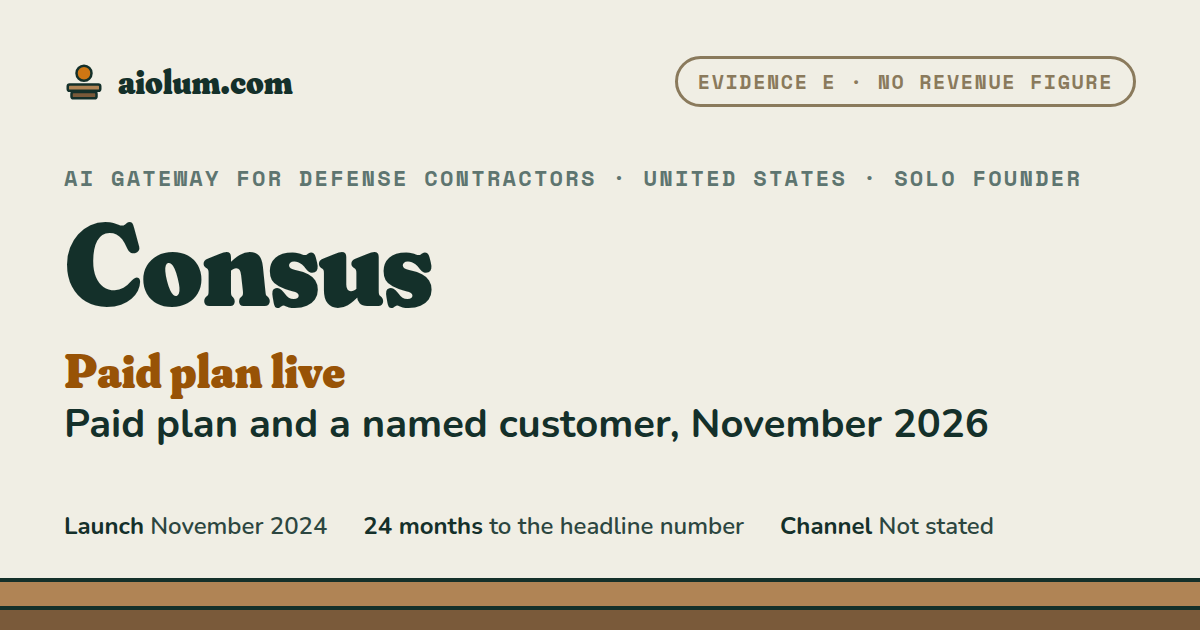
Consus (AI gateway for defense contractors, United States): Paid plan and a named customer, November 2026. Evidence grade E: no revenue figure was checked. Team: 1 founder; Y Combinator lists a team of 1; headcount today not published. Launched November 2024; still running.Added
- Outcome
- Paid plan and a named customer, November 2026
- Evidence
- E no revenue figure was checked
- Launch
- November 2024
- Status
- Still running
- Team
- 1 founder; Y Combinator lists a team of 1; headcount today not published
- Outside funding
- Backed by Y Combinator (Fall 2024 batch); amount not stated in any source read
- Main channel
- Not stated
What is not verified
No revenue figure was found. The pages read were the company's site, its blog, the Y Combinator pages and the Launch HN thread. No payment-processor profile, filing or press piece with a figure was found. A search for press was not possible, because the search helper answered "Too Many Requests". The price is published, and the founder wrote that the company charges customers after a contract. No independent source states that a customer has paid. The paying customers are the company's own statement. The documentation's pricing page states a 35% margin on tokens, and the main pricing page states no markup. This story is grade E: the business is real and its product, price and customers are described from public pages, but no revenue figure was checked. Aiolum shows it as an idea worth studying, not as proof that it makes money.
Consus sells a gateway, a server that receives requests from a customer's AI tools and passes them to a model provider. It passes them only to US government cloud regions. These suit ITAR data (US export rules for defense technical data) and CUI (controlled unclassified information, a US government category). The company's pages say it keeps no prompt or answer.
Eric Magliarditi is the founder and chief executive, as the company's page and the Y Combinator page list him. The Y Combinator page says the company was founded in 2024, in the Fall 2024 batch, with a team of 1. Its first launch post, dated 22 November 2024, was about a different product: a tool for tracking government documents. A Hacker News launch post of 13 October 2026 presents the gateway.
No revenue figure was found, so this story has grade E. The evidence is a published price, the founder's statement that the company charges customers and a case study that names one customer. All three come from the company or its founder. No independent source states that a customer has paid.
Why did Consus work?
Four causes, in the order they mattered. Each one is a reusable lesson.
The founder built it from his own work in defense
The founder wrote that he spent most of his career before Consus in aerospace and defense. He wrote that he worked with a satellite manufacturer that allowed no AI tools, even for non-sensitive work. He named three fears of such companies: model providers training on their data, an ITAR violation and a failed cyber assessment.
A request without a compliance suffix on the model name is refused
The founder wrote that every model name must carry a compliance suffix, such as the ITAR or FedRAMP High suffix. He wrote that a bare model name is rejected. He wrote that the company never proxies to the standard commercial endpoints. He wrote that customers can also build an allowlist of models.
Access comes only after a company review and a contract
The home page says access is granted after a company review and a contract, with no self-serve sign-up. The founder wrote that ITAR requires the company to know who holds every key. The company's pages say it is meant for US-based defense contractors only.
How it was built
These details come from the founder's Launch HN post and the company's pages. They are grade C and were not independently checked. [1, 2, 10, 11]
- One OpenAI-compatible endpoint receives every request. Keys are verified and policy is applied before any request reaches a model, as the founder wrote.
- Models run in three US government clouds: AWS GovCloud, Azure Government and Google. The founder wrote that GPT-5.6 Sol is only in Azure Government and Claude Opus 5.5 is served through Bedrock in AWS GovCloud.
- Prompts and answers stay in memory for the length of the request. The founder wrote that the company keeps only metadata for billing and audit.
- A web portal lets a customer manage spend, keys and policies, as the founder wrote. A launcher opens tools such as ChatGPT and Claude Code already set up, as the Enterprise page says.
- The company's documentation says it is built and hosted on Mintlify.
Tools named in the sources
Each one opens its page in the Tools tab, with every story that uses it.
Who tried this before Consus, and why did they fail?
Three companies in our database of failed startups sold software to organizations with strict data, privacy or regulatory limits. The match to Consus is loose. The values below are from that database and are not independently verified.
Olive AI
The promiseAn AI workforce that would automate prior authorizations, claims and billing work for hospitals.
Why it diedThe record says sales promised automation of whole departments. It says delivery needed custom integrations for each client and the bots broke when hospital software changed.
Primary Data
The promiseA virtualization layer that would let enterprises move and reach their data across on-premise and cloud storage without rewrites.
Why it diedThe record says the product was too complex to deploy and too early for its market. It says the layer had to work with many kinds of storage at native speed.
Graphite Docs
The promiseA private alternative to Google Docs, built on a blockchain, for companies and individuals worried about data breaches.
Why it diedThe record says users used to free tools would not accept the friction of paying for privacy. It says the blockchain was costly and the funding was too small.
The failed startups come from our database of 1,749 dead startups, retold here in our own words. Its entries are AI-assisted summaries of public sources, so these cards carry no evidence grade.
What changed
Each of the three sold a protective layer to buyers with strict limits, and each record names a cost of delivery. Olive AI needed custom work for every hospital. Primary Data needed one layer to fit many kinds of storage. Graphite Docs asked users to accept friction for privacy.
Consus sells one narrow job: sending requests to approved infrastructure and refusing the rest. It works with the customer's own tools and with the models of OpenAI, Anthropic, Google and SpaceXAI, as the home page says. Whether customers pay is not shown by any independent source. The founder wrote that the company is actively serving customers.
Can one person copy Consus now?
The structure, partly. The credentials are hard to copy.
A narrow gateway with a per-seat fee and tokens at cost can be sold to a market that cannot use ordinary AI services. The founder's career in defense and the cost of the security assessment are the parts that are hard to copy.
Where it is still open: Other regulated groups. In a Hacker News reply the founder wrote that the company has not set up the agreements for health data (HIPAA) yet.
- 1Pick one regulated buyer that refuses AI tools for a stated reason.
- 2Publish the price per seat and say that tokens cost the same as at the provider.
- 3Name the rule that decides every request, so a buyer can check it.
- 4Offer the evidence pack to the buyer's assessor under a nondisclosure agreement.
How much revenue does Consus make?
Each row shows the evidence grade and the source numbers from the list at the end of this page. The grades are explained in How Aiolum verifies.
| Fact | Value | Grade | How we know | Sources |
|---|---|---|---|---|
| Company start | 2024 | C | The company page reads "Founded 2024". The Y Combinator page reads Founded in 2024, Batch Fall 2024. | [4, 5] |
| Earlier product of the same company | Consus - The Github for Government Documents, 22 November 2024 | C | A Y Combinator launch post. Its data is dated 22 November 2024. It describes tracking active revisions of government documents. No source dates the switch to the gateway. | [6] |
| Founder | Eric Magliarditi, Founder & CEO | C | He is the only person on the company page. His Launch HN post says he launched national security payloads at SpaceX and was an early employee at Castelion. | [4, 1] |
| Team size | 1 on the Y Combinator page; headcount today not published | C | The Y Combinator page lists one open job, a founding product engineer. The company page names no other person. | [5, 4] |
| Funding | Y Combinator, Fall 2024; amount not stated | C | The company page says "Backed by Y Combinator". No source read gives an amount or another investor. | [4, 5] |
| Teams plan | US$40 per employee per month plus AI tokens at cost | C | The company's pricing page, November 2026. It applies to ITAR workloads at companies with fewer than 50 employees. | [3] |
| Token price on the documentation site | provider cost plus 35% | C | The documentation's pricing page reads "Provider cost + 35%" and says it is billed monthly. The main pricing page says tokens have no markup. | [14, 3] |
| How customers are charged | a compliance fee plus tokens, after a contract | C | The founder wrote in his Launch HN post that the company charges customers a fee starting at $40 a month per seat. He wrote that a contract comes before any API key. He also wrote "We are actively serving customers". | [1] |
| Named customer | Inversion Space | C | The company's case study, dated July 2026, names the Director of Software as the speaker of a quotation. It lists three OpenAI models in production under an ITAR boundary. | [7] |
| Logo wall on the home page | 6 names: Ridgeline Federal, Castelion, Neros, Inversion, Longshot Space, Wild West Systems | C | The names are the image descriptions under "Trusted by". The page does not say that any of them pays. | [2] |
| Security assessment | a 3PAO assessed Consus against all 410 FedRAMP High controls | C | The company's blog post of 3 October 2026. The same post says Consus is not a FedRAMP Authorized service. | [8] |
| Time from the first launch post to the November 2026 plan | 24 months | calc | Calculated: November 2024 to November 2026. | [6, 3] |
How to read this table. Grade C is a statement by the company or its founder. A grade E story has no dated money figure, so no row here is a revenue number. A "calc" value was computed on this page.
| Plan | Per month, billed yearly (US$) | Per month, billed monthly (US$) | Limit |
|---|---|---|---|
| Teams, ITAR workloads | 40 per employee | under 50 employees; tokens at cost, no markup | |
| Enterprise | custom | 50 or more employees, or any CUI workload; annual agreement |
The pricing page lists Teams at US$40 per employee per month for ITAR workloads at companies with fewer than 50 employees. It adds AI tokens at the provider's list price with no markup. Enterprise has no published price. The page does not say whether the Teams price is billed monthly or yearly. The buttons read "Request access" and "Talk to us", so no checkout path was seen. The documentation site has its own pricing page, and it states another token price: "Provider cost + 35%", billed monthly. The two pages disagree, and no source says which one applies.
When did Consus launch, and how did it grow?
From a Y Combinator batch in 2024 to a gateway with a published price and a named customer in 2026. Each entry carries its grade.
- 2024CFounded, as the company page and the Y Combinator page state. The company is in the Fall 2024 batch. [4, 5]
- 22 November 2024CThe first launch post on the Y Combinator site presents a tool for verifying active revisions of government documents. [6]
- July 2026CThe company's case study on Inversion Space is dated July 2026. It says the customer runs GPT models in production. [7]
- 3 October 2026CA blog post says an assessor tested Consus against all 410 FedRAMP High controls. [8]
- 13 October 2026CThe founder posts a Launch HN message for the gateway. It says the company charges customers and is actively serving customers. [1]
- November 2026CThe pricing page lists the Teams plan at US$40 per employee per month. The newest blog post is dated 5 November 2026. [3, 12]
What could go wrong for Consus?
The risks are the mirror image of the causes above.
What is not verified
No revenue figure was found. The pages read were the company's site, its blog, the Y Combinator pages and the Launch HN thread. No payment-processor profile, filing or press piece with a figure was found. A search for press was not possible, because the search helper answered "Too Many Requests". The price is published, and the founder wrote that the company charges customers after a contract. No independent source states that a customer has paid. The paying customers are the company's own statement. The documentation's pricing page states a 35% margin on tokens, and the main pricing page states no markup.
Logo wall, one quotation and counters
The home page shows six names under "Trusted by" and one quotation from the Director of Software at Inversion Space. The same quotation is in the company's own case study. The quotation was not searched for copies elsewhere. The Enterprise page shows counters such as "8+" tools and "< 1 day" from contract to first request. No source here confirms any of them. One logo, Castelion, is the founder's former employer, as his post says.
Compliance claims are the company's own
The assessment of all 410 FedRAMP High controls is stated by the company and was not seen. The evidence pack is available only under a nondisclosure agreement. The company's blog says Consus is not FedRAMP Authorized. Its compliance page says no ITAR certification exists and companies certify themselves. The founder also wrote in a Hacker News reply that one OpenAI route in AWS can keep a flagged request for up to 30 days. The home page says zero data retention is in place with every upstream model provider.
Defense market and earlier product
The customers are defense contractors, and the company's pages say it serves only US-based defense contractors after a review. The product handles export-controlled data, a legal use that the company says it limits by contract. The company page says the founder "supported hypersonic missile development at Castelion". Castelion is one of the six names on the logo wall. No page read offers the product for a weapons task: the pages sell routing and compliance. The company's earlier product, in November 2024, tracked government documents. No source says when or why the product changed.
Sources
The grade next to each source is the best grade that the source can support. "Read in full" means that the text of the page was downloaded and the numbers were checked in it.
- C Hacker News, 13 October 2026: Launch HN: Consus (YC F24) - LLM gateway for companies handling sensitive dataRead in full, 12 November 2026. The founder's post and replies. Source for the method, the fee, the contract rule, the customers claim and the retention reply.
- C Consus home pageRead in full, 12 November 2026. Source for the logo wall, the quotation, the compliance summary and the plan summary.
- C Consus pricing pageRead in full, 12 November 2026. Source for the Teams price, the Enterprise plan and the token statement.
- C Consus company pageRead in full, 12 November 2026. Source for the year founded, the founder, the Y Combinator backing and the legal entity.
- C Y Combinator company page: ConsusRead in full, 12 November 2026. Source for the year founded, the batch Fall 2024, the team of 1 and the open job.
- C Y Combinator launch post: Consus - The Github for Government DocumentsRead in full, 12 November 2026. The post data is dated 22 November 2024. Source for the earlier product.
- C Consus case study with Inversion Space (PDF), July 2026Read in full, 12 November 2026. A document by the company. Source for the named customer, the models in production and the quotation.
- C Consus blog, 3 October 2026: Consus achieves FedRAMP EquivalencyRead in full, 12 November 2026. Source for the assessment claim and for the statement that Consus is not FedRAMP Authorized.
- C Consus compliance pageRead the framework sections, 12 November 2026. Source for the ITAR, SOC 2 and IL5 statements.
- C Consus Gateway documentation: OverviewRead in full, 12 November 2026. Source for the model families, the clouds and the documentation host.
- C Consus Enterprise pageRead the first sections, 12 November 2026. Source for the counters.
- C Consus blog, 5 November 2026: Consus vs Ask Sage for Defense ContractorsRead in full, 12 November 2026. Source for the date of the newest post and for the Teams price as the company repeats it.
- C Database of failed startups, local exportRecord pages read on the website on 12 November 2026. AI-written summaries, not independently verified. Source for the failed predecessors.
- C Consus Gateway documentation: PricingRead in full, 12 November 2026. Source for the token price of provider cost plus 35%.
Run this company? Send corrections or a verified figure to aiolum@livyden.com