Copilot for Obsidian: Revenue, team and how it was built
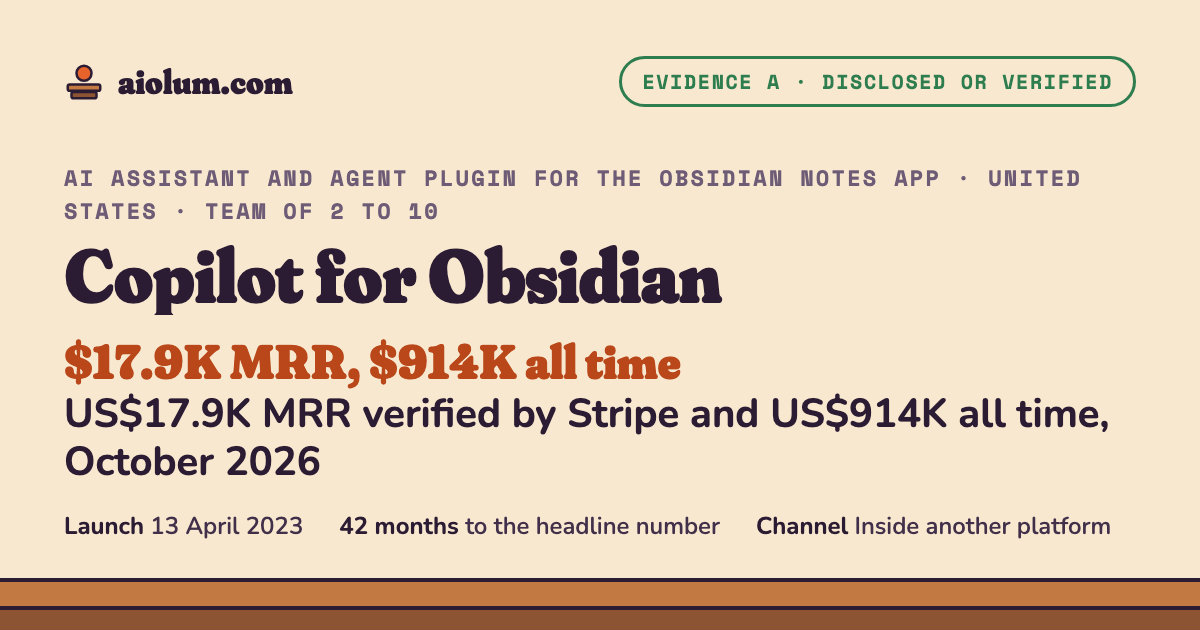
Copilot for Obsidian (AI assistant and agent plugin for the Obsidian notes app, United States): US$17.9K MRR verified by Stripe and US$914K all time, October 2026. Evidence grade A: disclosed by a company or a filing, or verified by a payment processor. Team: 1 named founder; the company describes itself as "seasoned ex-Google and ex-Uber AI engineers"; four people have more than 60 commits each in the public code; headcount not published. Launched 13 April 2023; still running, revenue falling.Added 27 October 2026
- Outcome
- US$17.9K MRR verified by Stripe and US$914K all time, October 2026Revenue falling
- Evidence
- A disclosed by a company or a filing, or verified by a payment processor
- Launch
- 13 April 2023
- Status
- Still running
- Team
- 1 named founder; the company describes itself as "seasoned ex-Google and ex-Uber AI engineers"; four people have more than 60 commits each in the public code; headcount not published
- Outside funding
- None disclosed; GitHub sponsors and one-time lifetime plans funded early development
- Main channel
- Inside another platform
Copilot for Obsidian is a plugin, a program that runs inside another program and extends it, for Obsidian, a notes app whose notes are plain Markdown files on the user's own computer. The plugin puts a chat window next to the notes and connects it to a large language model (LLM), a program that writes text from text. In its first versions the user pasted an API key, a password that lets a program call a model provider on the user's own account, and the plugin called OpenAI, Anthropic, Google or a model running on the same machine. Version 4 of August 2026 went further: it runs coding agents, programs such as Claude Code, Codex and OpenCode that read files, use tools and work for many steps on their own, directly inside the notes folder, so they can search, rewrite and reorganize notes. The plugin's code is free under the AGPL license. Brevilabs LLC, the company behind it, sells the layer on top: a Plus plan at US$14.99 a month with hosted models that need no key, a better web search and multi-agent answers, and a one-time Supporter license at US$349.99.
Logan Yang, a software engineer in Seattle who describes themself on GitHub as an ex-Uber machine learning practitioner, created the repository on 31 March 2023 and published version 1.0.1, "Initial release", on 13 April 2023. In a newsletter of January 2025 they wrote that the plugin had passed 300,000 downloads and won the Obsidian community's Gem of the Year award for 2024 as the best language model integration, "while having no ads or influencer marketing at all". A paid alpha of Copilot Plus started in 2024. The Obsidian Copilot site passed 1 million downloads by 13 February 2026 and 2 million by 3 October 2026. TrustMRR, a service that reads revenue from a company's own payment account through an API key, shows for the Brevilabs Stripe account US$913,644 of revenue in total, US$483,759 in the last twelve months, a best month of US$66,646 in February 2026, US$32,590 in September 2026, and US$17,899 of monthly recurring revenue (MRR, the monthly value of all active subscriptions) from 1,356 subscriptions on 27 October 2026. The home page of brevilabs.com, which until August 2026 presented the plugin, has since September 2026 presented the company as an AI consulting firm with "a four-week, $45k AI product sprint" and the plugin as one of three products.
The revenue figures are grade A: TrustMRR reads them from the company's Stripe account. The MRR of US$17,899 divided by 1,356 subscriptions is US$13.20 a month per subscription, between the Plus plan's two prices of US$11.67 and US$14.99, so the recurring figure comes from the plugin's subscribers and cannot contain a US$45,000 consulting retainer. The daily revenue table for the 30 days to 27 October 2026 has no day above US$1,508, so no consulting payment went through the Stripe account in that period either; earlier months cannot be separated with the public data, and the "watch" section says so. Download counts, award and team come from the company's own pages, grade C, and from the public code repository, grade B.
How much revenue does Copilot for Obsidian make?
Each row shows the evidence grade and the source numbers from the list at the end of this page. The grades are explained in How Aiolum verifies.
| Fact | Value | Grade | How we know | Sources |
|---|---|---|---|---|
| Monthly recurring revenue (MRR), 27 October 2026 | US$17,899 from 1,356 active subscriptions | A | TrustMRR, read from the company's Stripe account through an API key, synced 27 October 2026 at 02:53 UTC. The profile shows a 30-day MRR change of -5.1% and a profit margin snapshot of 95%. | [1] |
| Revenue per subscription per month | US$13.20 | calc | Calculated: 17,899 / 1,356. The Plus plan costs US$14.99 a month or US$11.67 a month billed yearly, so the subscribers are a mix of both. A US$45,000 monthly consulting retainer inside this figure is impossible: it alone would be 2.5 times the whole MRR. MRR times twelve is US$214,788 a year, the headline figure of this page. | [1, 2] |
| Verified revenue, all time, to 27 October 2026 | US$913,644 | A | TrustMRR. Last 12 months: US$483,759; last 6 months: US$187,930; last 3 months: US$85,329; last 30 days: US$20,299. The founder-given founding date on the profile is 18 January 2025. | [1] |
| Revenue by month | Nov 2025 US$46,901; Dec US$53,160; Jan 2026 US$55,789; Feb US$66,646; Mar US$35,096; Apr US$34,309; May US$38,223; Jun US$36,054; Jul US$29,259; Aug US$33,873; Sep US$32,590; Oct US$16,685 to 27 October | A | TrustMRR monthly table, synced 27 October 2026. The twelve rows add up to US$478,585; the rolling last-12-months figure of US$483,759 also contains the last days of October 2025. | [1] |
| Fall from the best month | 51% from February 2026 to September 2026 | calc | Calculated: (66,646 - 32,590) / 66,646 = 51.1%. February 2026 was the month in which the Believer lifetime plan was sold for the last time, until 16 February. The last three months average US$28,443 a month; the last twelve average US$40,313. | [1, 5] |
| Daily revenue, 28 September to 27 October 2026 | between US$287 and US$1,508 a day | A | TrustMRR daily table. No day comes near the US$45,000 consulting sprint that brevilabs.com advertises, so no such payment went through this Stripe account in those 30 days. The profile marks the 30-day revenue as -38.9% against the 30 days before. | [1, 12] |
| Where the revenue figures come from | Stripe, through an API key; merchant of record: no | A | TrustMRR's verification section. The Stripe account is the one whose file store hosts the profile's icon. No Google Analytics, DataFast or Search Console connection, so there are no verified traffic figures. | [1] |
| Downloads | 300,000 by January 2025; 1 million by 13 February 2026; 2 million by 3 October 2026; the site shows 2.5M | C | Company newsletters and the site header, which also shows 7.9K GitHub stars. Obsidian's plugin store counts downloads, not users. | [4, 5, 8, 3] |
| Public code | 7,893 stars, 758 forks, 1,490 commits, 15 contributors, AGPL-3.0 license | B | GitHub API and repository page, read 27 October 2026. The founder has 773 commits; one other person has 461, two others 73 and 65, and a company bot account 64. The repository was created on 31 March 2023 and last pushed on 26 October 2026. | [9, 10, 11] |
| Launch | version 1.0.1, "Initial release", 13 April 2023 | B | GitHub releases list. Version 1.1.0 of 19 April 2023 added commands such as simplify, translate and rewrite; version 2.4.13 of 26 January 2024 added OpenAI's new embedding models the day they appeared. | [10] |
| Award | Obsidian Gem of the Year 2024, best language model integration | C | Company newsletter of 20 January 2025: voted by the Obsidian community. The same newsletter says the plugin grew "while having no ads or influencer marketing at all". | [4] |
| Prices | Plus US$14.99 a month or US$139.99 a year; Supporter US$349.99 one-time | C | Pricing page, 27 October 2026. The Plus prices are unchanged since at least 7 September 2025, when the page called them "Early Bird Pricing" and sold a Believer lifetime plan at US$299.99. | [2, 13] |
| Hosted models in the Plus plan | DeepSeek V4.1 Flash as Copilot Plus Flash, GLM-5.3-Flash, MiniMax M3; hosted on DeepInfra in the US | C | Home page and newsletter of 3 October 2026. The company does not run its own models; it rents open-weight models from DeepInfra with zero data retention. | [3, 8] |
| Partner program | 20% revenue share for 12 months and a free lifetime license, for creators with at least 3,000 followers | C | Partners page, opened 13 February 2026. An affiliate program with a stated commission. | [14, 5] |
| Team | 1 named founder; the company says "seasoned ex-Google and ex-Uber AI engineers"; headcount not published | C | Brevilabs home page and the founder's GitHub profile ("Software engineer, ML practitioner, ex-Uber", Seattle). The public code shows four people with more than 60 commits each. No source gives a headcount or a funding round. | [12, 9, 11] |
| Consulting offer on the company home page | a four-week US$45,000 AI product sprint; retainers from US$45,000 a month | C | brevilabs.com, read 27 October 2026. Wayback snapshots of 7 April 2025, 11 July 2025 and 4 August 2026 show the same domain presenting only the plugin; the snapshot of 11 September 2026 is the first with the consulting text. TrustMRR's founder-written profile copies the same pricing model. | [12, 1] |
| Time from launch to the October 2026 figure | 42 months | calc | Calculated: April 2023 to October 2026. | [10, 1] |
How to read this table: a grade A value was read by TrustMRR from the company's Stripe account through an API key. A grade B value is visible in the public code repository or in GitHub's API. A grade C value is what the company or the founder states on their own pages. A "calc" value was computed on this page from the rows above it.
| Plan | Per month, billed yearly (US$) | Per month, billed monthly (US$) | Limit |
|---|---|---|---|
| Free | 0 | 0 | own API key, local model or Claude/ChatGPT subscription; no account needed |
| Plus | 11.67 | 14.99 | hosted models with 5-hour and weekly limits, multi-agent, web search, OpenArtifacts publishing |
| Supporter | 349.99 one-time | 2 years of Plus, lifetime Miyo and OpenArtifacts, lifetime self-host; shown as 30% off US$499.96 | |
| Miyo Relay | 4.99 (monthly) or 149.99 one-time | 4.99 | phone access to the vault for the ChatGPT and Claude apps; 7-day trial |
The plugin itself is free and needs no account when the user brings an API key, a local model or a Claude or ChatGPT subscription. Plus is a subscription with hosted models, subject to 5-hour and weekly usage limits; the yearly price of US$139.99 is 22% below twelve monthly payments. Supporter is a one-time payment shown as US$349.99 against a struck-out US$499.96 (30% off); it includes two years of Plus, lifetime Miyo and OpenArtifacts licenses, lifetime self-hosting and 15% extra credit when buying hosted-model usage after the two years. From 13 August to 14 September 2026 the company sold Supporter at US$279.99 and yearly Plus at US$111.99, 20% off. A Wayback snapshot of 7 September 2025 shows the earlier Believer plan, US$299.99 one-time with lifetime access, which was retired for new buyers on 16 February 2026. Miyo Relay, a paid part of the company's Miyo desktop app, costs US$4.99 a month or US$149.99 once. Refunds are accepted within 14 days.
When did Copilot for Obsidian launch, and how did it grow?
From a weekend repository in March 2023 to a plugin with 2 million downloads and US$913,644 of verified revenue, in 42 months. Each entry carries its grade.
- 31 March 2023BLogan Yang creates the obsidian-copilot repository on GitHub, four weeks after OpenAI released the ChatGPT API. [9]
- 13 April 2023BVersion 1.0.1, "Initial release". Within a week, version 1.1.0 adds commands on selected text: simplify, translate, rewrite. [10]
- 26 January 2024BVersion 2.4.13 adds OpenAI's two new embedding models on the day they are announced. By then the plugin also supports Ollama for local models. [10]
- 2024CCopilot Plus alpha, the first paid tier, with its own Discord community. 300,000 downloads. The Obsidian community votes the plugin Gem of the Year 2024 for best language model integration. [4]
- 18 January 2025CFounding date given on the TrustMRR profile, under the company Brevilabs LLC. [1]
- 7 September 2025CThe pricing page shows "Early Bird Pricing": Plus at US$14.99 a month or US$139.99 a year, Believer at US$299.99 one-time with lifetime access. [13]
- 13 February 2026C1 million downloads. Self-host mode launches; the Believer plan is retired from 16 February; the partner program opens. February becomes the best month in the Stripe table, US$66,646. [5, 1]
- 13 August 2026CCopilot V4, a rewrite that runs Claude Code, Codex and OpenCode inside Obsidian. Miyo, a free local search app, and OpenArtifacts, a publishing tool, launch alongside. Supporter at US$349.99 replaces Believer; 20% off until 14 September. [6, 7]
- September 2026Cbrevilabs.com changes from a plugin page to "AI Consulting for Ambitious Teams" with a US$45,000 four-week sprint. September revenue: US$32,590. [12, 1]
- 3 October 2026C2 million downloads. Previews of voice chat, diff view, phone access and custom agents for Supporters. [8]
- 27 October 2026ATrustMRR: US$17,899 MRR from 1,356 subscriptions, US$913,644 all time, revenue of the last 30 days down 38.9% against the 30 days before. [1]
Why did Copilot for Obsidian work?
Four causes, in the order they mattered. Each one is a reusable lesson.
Distribution through another app's store
Obsidian lists community plugins inside the app, and users install them with one click. A free, open-source plugin in that list reached 300,000 downloads in its first two years and 2 million by October 2026, with, in the founder's words, no ads or influencer marketing. The company never had to find its customers; the host app's store brought them.
Give away the plugin, sell the managed layer
The code is free under the AGPL and works with the user's own API key or Claude or ChatGPT subscription. What costs money is convenience: hosted models that need no key, a web search built for agents, multi-agent answers and one-click publishing. The Plus price has stayed at US$14.99 since at least September 2025.
Lifetime plans as funding
The Believer plan at US$299.99, and later Supporter at US$349.99, sold lifetime access for a single payment. The founder wrote that Believer was launched "to help fund early development". Its retirement on 16 February 2026 produced the best month in the Stripe table, US$66,646; the months after it were about half as large. One-time money arrives early and does not recur.
Carry the agents instead of competing with them
Version 4 of August 2026 made the plugin a host for Claude Code, Codex and OpenCode, the coding agents of the big model providers, inside the notes folder. The plugin adds what those agents lack: knowledge of Obsidian's links and canvases, a local search index (Miyo) and a place to publish. The user's existing subscription to the agent pays for the model.
How it was built
These details come from the public repository, the founder-written tech stack on TrustMRR and the company's own pages. Repository facts are grade B; the rest is grade C. [9, 1, 3, 6, 2, 14]
- A TypeScript plugin for Obsidian, built with esbuild, styled with Tailwind CSS and tested with Jest; the repository holds 1,490 commits and a CONTRIBUTING file. The license is AGPL-3.0.
- The repository contains CLAUDE.md, AGENTS.md, a .claude folder and .cursor/rules files, so the team itself develops with AI coding agents and Cursor.
- The founder-written stack on TrustMRR: Electron, TypeScript, Next.js and React on the front end; Python, FastAPI, Google Cloud, PostgreSQL, Railway, Resend, Vercel and Stripe on the back end.
- Plus models are open-weight models (DeepSeek V4.1 Flash, GLM-5.3-Flash, MiniMax M3) hosted on DeepInfra in the US with zero data retention; free users bring OpenAI, Anthropic, Google, LM Studio or Ollama models, or their Claude Code or Codex login.
- Miyo, a separate free desktop app, builds the semantic search index on the user's machine so that indexing a 100,000-file vault does not freeze the editor; Miyo Relay (US$4.99 a month) connects the ChatGPT and Claude phone apps to the vault.
- Payments through Stripe, with Alipay accepted for the Supporter license. Community on Discord; releases announced with one-minute YouTube videos; a partner program pays creators 20% for twelve months.
Tools named in the sources
Each one opens its page in the Tools tab, with every story that uses it.
Who tried this before Copilot for Obsidian, and why did they fail?
Five companies in the Loot Drop database sold tools for notes, bookmarks and knowledge, or lived inside a host program that they did not control. The values below are from that database and are not independently verified.
Springpad
The promiseCollect, organize and find everything from web articles to recipes in one place.
Why it diedA loved free product whose users would not pay for premium features. Evernote, the competitor, moved into collaboration and enterprise; Springpad ran out of money.
Transpose
The promiseAn Evernote alternative with flexible templates, first as KustomNote, then for businesses.
Why it diedCharged US$14.99 a month without giving users a reason to switch from what they already used, and had no outside money to iterate faster than the incumbents.
Kippt
The promiseA pretty bookmarking and knowledge tool with social sharing.
Why it diedSqueezed between Pocket and Evernote; the social features did not spread, and the pivot to team collaboration came too late.
Xobni
The promiseA smarter inbox inside Microsoft Outlook.
Why it diedTied to Outlook, which Microsoft improved itself. Mobile made the desktop add-on irrelevant. Yahoo bought the remains.
Xmarks
The promiseSync your bookmarks and tabs across browsers.
Why it diedChrome, Firefox and Safari built sync in, for free.
The failed startups come from Loot Drop, a free database of dead startups, retold here in our own words. Loot Drop describes its entries as AI-assisted summaries of public sources, so these cards carry no evidence grade.
What changed
Springpad, Transpose and Kippt built their own note or bookmark apps and had to win users one by one against Evernote, which cost more than they could earn. Xobni and Xmarks lived inside Outlook and the browsers and died when the hosts built the same feature. Copilot for Obsidian has both shapes: it is an add-on to a host app, and it competes with the host's own direction, since Obsidian could add AI itself and the model providers could ship notes agents.
Two things differ so far. The host, Obsidian, is a small company with a stated file-over-app philosophy and a community plugin store, not a platform owner that absorbs popular add-ons; the plugin's store listing is the whole distribution channel, and that channel cost nothing. And the model layer is rented, not built: when the big providers released coding agents in 2025 and 2026, the plugin wrapped them instead of competing, and the user's own subscription pays for the model. What the five predecessors never found, a payment that recurs, exists here in 1,356 subscriptions, but the Stripe table also shows that the best months came from one-time lifetime sales and that the recurring base has fallen since February 2026.
Can one person copy Copilot for Obsidian now?
The store, yes. The lifetime plans, with care.
Any app with a plugin or extension store and an engaged community is an open distribution channel for a free, open-source add-on that brings an AI model into that app. The paid layer should be the convenience that the free version lacks, not the code. Lifetime plans bring money early, but they show up later as months that look like decline.
Where it is still open: Other apps with plugin stores and file-based data: code editors, mail clients, design tools, spreadsheet add-ins, and the next generation of local-first apps that want agents to work on their files.
- 1Pick a host app whose users already pay for it and whose store lists community add-ons; ship a free, open-source add-on that connects it to the models the user already pays for.
- 2Charge for the managed layer: hosted models without keys, search, publishing, and limits that make the subscription predictable.
- 3Keep the plugin model-agnostic, so a provider's price change or a new agent becomes a feature, not a threat.
- 4If you sell a lifetime plan, plan for the month after it ends; the one-time money does not come back.
What could go wrong for Copilot for Obsidian?
The risks are the mirror image of the causes above.
Consulting revenue and the Stripe figure
Since September 2026 the brevilabs.com home page sells "AI product consulting": "Engagements start with a four-week, $45k AI product sprint. Ongoing partnerships start at a $45k monthly retainer with a three-month initial term." The same company owns the Stripe account that TrustMRR reads. The MRR headline cannot contain a retainer: US$17,899 from 1,356 subscriptions is US$13.20 each, inside the Plus price range, and one US$45,000 retainer would be 2.5 times the whole MRR. The daily table for 28 September to 27 October 2026 has no day above US$1,508, so no sprint payment went through this account in those 30 days. For earlier months and for the all-time total of US$913,644 the public data cannot separate consulting from plugin sales; the best month, February 2026, coincides with the end of the Believer lifetime plan, which is the likelier cause. Wayback snapshots show the consulting text appeared between 4 August and 11 September 2026.
Revenue has fallen by half since February 2026
February 2026 brought US$66,646; September 2026 brought US$32,590, a fall of 51%, and TrustMRR marks the last 30 days as 38.9% below the 30 days before. The Believer plan's retirement in February and the Supporter launch discount in August and September 2026 both pulled one-time money forward. The MRR of US$17,899 is the recurring part; the rest of each month is one-time licenses and yearly payments.
The company sells a service as well as software
The story's product is the plugin, which is software. The same company also offers consulting at US$45,000 and up and names two other products on its home page, Miyo (free, with a US$4.99 Relay) and OpenArtifacts (included in Plus). The plugin's own pages do not sell or link to the consulting offer.
The model providers' rules
The free plugin runs Claude Code with the user's Claude login and Codex with the user's ChatGPT login, inside Obsidian. The company's pages say these are the providers' own agent programs connected to an existing installation. No source in this research states whether Anthropic's or OpenAI's subscription terms allow their agents to be driven from a third-party plugin; a reader who depends on this should check the current terms. The company's own hosted models are rented from DeepInfra and resell nothing of those providers.
Depends on Obsidian and on the agents it hosts
Distribution comes from Obsidian's community plugin store, and version 4 depends on Claude Code, Codex and OpenCode, three programs whose makers can change prices, interfaces or policies. The founder's answer is a model-agnostic design and a local index that stays on the user's machine.
Marketing claims and the partner program
The January 2025 newsletter says growth came "while having no ads or influencer marketing at all". Since 13 February 2026 the company runs a partner program that pays creators with at least 3,000 followers a 20% revenue share for twelve months and a free lifetime license, so later growth is partly paid promotion with a stated commission. The Supporter price is shown against a struck-out US$499.96 that no downloaded page ever charged.
Sources
The grade next to each source is the best grade that the source can support. "Read in full" means that the text of the page was downloaded and the numbers were checked in it.
- A TrustMRR markdown profile: Brevilabs, revenue last synced 27 October 2026Read the markdown profile. Source for all revenue, MRR, subscription and daily figures (verified through a Stripe API key), the founder link, the founding date, the founder-written pricing model and the tech stack.
- C Copilot for Obsidian pricing page, read 27 October 2026Read in full. Source for the Free, Plus and Supporter plans, the usage limits and the refund rule.
- C Copilot for Obsidian home page, read 27 October 2026Read in full. Source for the 2.5M download counter, the hosted models, DeepInfra hosting, Miyo and the testimonials.
- C Copilot for Obsidian newsletter, 20 January 2025: 2024 Year in ReviewRead in full. Founder's own update. Source for the 300,000 downloads, the Gem of the Year award, the Copilot Plus alpha, the Discord start and the no-ads statement.
- C Copilot for Obsidian newsletter, 13 February 2026: Launching Self-Host Mode, Retiring the Believer PlanRead in full. Source for the 1 million downloads, the Believer retirement date and purpose, and the partner program opening.
- C Copilot for Obsidian newsletter, 13 August 2026: Copilot V4 Launch, Your personal AGI in ObsidianRead in full. Source for the V4 rewrite, the agents it hosts, Miyo and Miyo Relay prices, OpenArtifacts, the Supporter price and the launch discount.
- C Copilot for Obsidian newsletter, 12 September 2026: September Updates: Miyo, Live Relevant Notes, and a Secret New FeatureRead in full. Source for the discount end date of 14 September 2026 and the Miyo search.
- C Copilot for Obsidian newsletter, 3 October 2026: celebrating 2M downloads, upcoming supporter preview featuresRead in full. Source for the 2 million downloads, the new Plus models and the previews for Supporters.
- B GitHub repository logancyang/obsidian-copilot, read 27 October 2026Read the repository page and the README. Source for the stars, forks, commits, license, file list (CLAUDE.md, AGENTS.md, .cursor/rules, esbuild, Tailwind, Jest) and the agents the plugin hosts.
- B GitHub API: releases of logancyang/obsidian-copilot, pages 1 and 2Read the release list. Source for the initial release of 13 April 2023 and the early version dates.
- B GitHub API: repository and contributors of logancyang/obsidian-copilotRead the repository and contributor records. Source for the creation date of 31 March 2023, the last push, and the commit counts per contributor; also the founder's profile page (Seattle, ex-Uber).
- C Brevilabs home page, read 27 October 2026, with Wayback snapshots of 7 April 2025, 11 July 2025, 4 August 2026 and 11 September 2026Read in full, and read the four archived copies. Source for the consulting offer and its first appearance, the three products and the team description.
- C Wayback Machine: Copilot for Obsidian pricing page on 7 September 2025Read in full. Source for the Early Bird prices and the Believer plan at US$299.99.
- C Copilot for Obsidian partner program page, read 27 October 2026Read in full. Source for the 20% revenue share, the free lifetime license and the 3,000-follower threshold.
- C Loot Drop database export, 1,749 failed startupsLocal export. AI-written summaries, not independently verified. Source for the failed predecessors.