DeltaGen AI: Revenue, team and how it was built
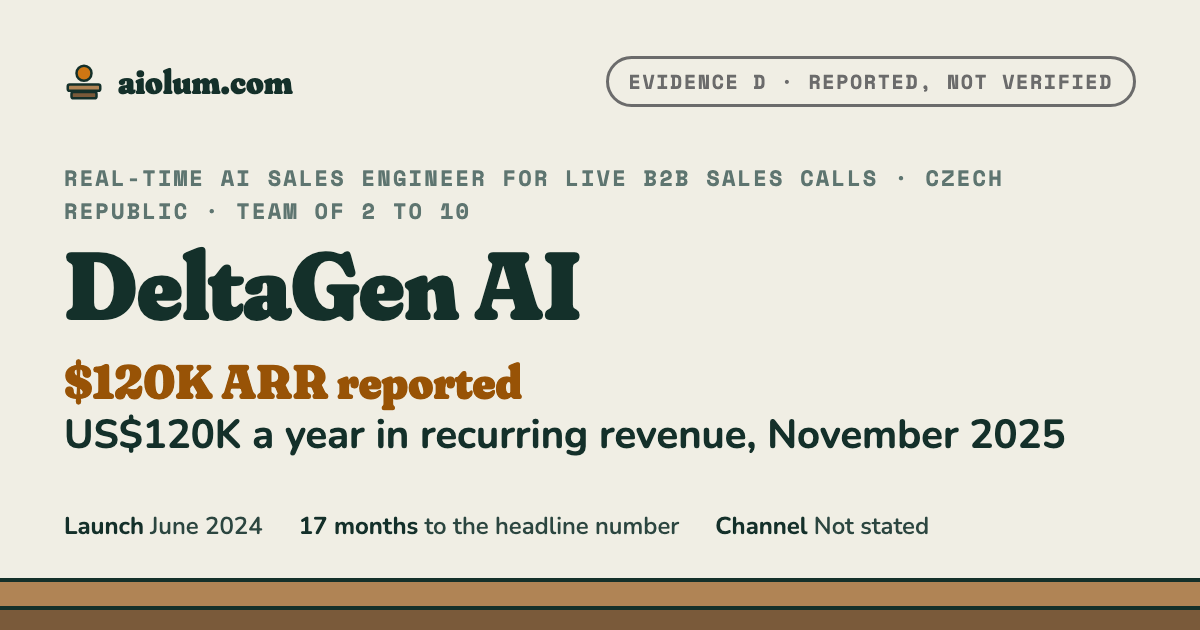
DeltaGen AI (Real-time AI sales engineer for live B2B sales calls, Czech Republic): US$120K a year in recurring revenue, November 2025. Evidence grade D: reported, not verified. Team: 5 people across San Francisco, Raleigh and Prague in November 2025; 6 leaders listed on the company page in November 2026. Launched June 2024; still running.Added 6 November 2026
- Outcome
- US$120K a year in recurring revenue, November 2025
- Evidence
- D reported, not verified
- Launch
- June 2024
- Status
- Still running
- Team
- 5 people across San Francisco, Raleigh and Prague in November 2025; 6 leaders listed on the company page in November 2026
- Outside funding
- US$1.2M from Techstars, B5 Capital and Forward VC, as the company stated in November 2025
- Main channel
- Not stated
What is not verified
The headline of US$120,000 in annual recurring revenue rests on one statement: the company's press release of 10 November 2025, written by CEO Rene Bystron and repeated by SalesTechStar on 1 December 2025. The figure was reached in a 60-day early-access program, so it may include pilot contracts. The release's US$500,000 target for the end of 2025 is a projection, and no later figure was found. We looked for a payment-processor profile, an investor statement and independent press; GeekWire's coverage of the funding refused our download. A reader could look for a newer interview, an investor report or a customer reference. The headline number is grade D: one claim or one estimate, with no second source. Aiolum shows it because the story is useful, and marks it so that it is not mistaken for a verified figure.
DeltaGen sells a virtual sales engineer: software that does part of the work of a sales engineer, the technical expert who joins sales calls to answer questions about how a product works. It is a desktop app that captures the call audio on the rep's own computer, detects technical questions and shows a short answer taken from the seller's documentation. The company says it uses RAG (retrieval-augmented generation: the system first searches the customer's own documents and then lets a language model write an answer from what it found) so that each answer cites its source.
Rene Bystron, a former Boston Consulting Group project leader with degrees from Yale and Dartmouth's Tuck School, co-founded DeltaGen in 2024 after an earlier app for learning generative AI, and the company joined a Techstars accelerator that year. In a press release dated 10 November 2025, written by Bystron, the company said Virtual SE had reached US$120,000 in annual recurring revenue (ARR, the yearly value of the subscriptions customers have signed) during a 60-day early-access program, that a 5-person team built it, and that it was backed by Techstars, B5 Capital and Forward VC after a US$1.2 million investment.
That revenue figure is one company statement, repeated in a second outlet on 1 December 2025. No payment processor, investor or journalist has confirmed it, so the grade is D. The same release gave a projection of US$500,000 ARR by the end of 2025; a projection is not revenue and no later figure was found.
How much revenue does DeltaGen AI make?
Each row shows the evidence grade and the source numbers from the list at the end of this page. The grades are explained in How Aiolum verifies.
| Fact | Value | Grade | How we know | Sources |
|---|---|---|---|---|
| Annual recurring revenue, November 2025 | US$120,000 | D | The company's press release of 10 November 2025, written by the CEO: "reached $120K in Annual Recurring Revenue (ARR) during a 60-day Early Access Program with major U.S. enterprises". SalesTechStar repeated the same sentence on 1 December 2025; it is the same statement, not a second check. | [5, 6] |
| Revenue per month from that figure | about US$10,000 | calc | Calculated: US$120,000 divided by 12. | [5] |
| Projection for the end of 2025 | US$500,000 ARR | D | The company's own projection in the same release. A forecast, not revenue. No later figure was found. | [5, 6] |
| Team, November 2025 | 5 people | D | Press release: "Built by a 5-person team across San Francisco, Raleigh and Prague". | [5] |
| Leadership listed, November 2026 | 6 people | C | The company's About page lists a CEO, a chief AI scientist, heads of product and engineering, strategy and design, and a chief people officer. | [3] |
| Founded | 2024, co-founded by Rene Bystron | C | The company's page about its CEO, last updated 6 October 2026. It lists a GeekWire news brief of 3 June 2024 on the start of DeltaGen; GeekWire refused our download (403). | [4] |
| Accelerator and investors | Techstars (2024), B5 Capital, Forward VC; US$1.2 million investment | D | The company's CEO page and the press release headline "After 1.2 Million USD Investment". | [4, 5] |
| Public launch of Virtual SE | 10 November 2025 | C | Press release dated in Prague. | [5] |
| Web Summit PITCH 2025, Lisbon | named among the finalists | C | UpNext article of 13 November 2025: "Real-time technical answers surfaced directly inside sales calls through an AI agent". | [7] |
| Time from start to the November 2025 figure | 17 months | calc | Calculated: June 2024 to November 2025. | [4, 5] |
| Security certification | SOC 2 Type II, report delivered July 2025 | C | The company's information page for AI assistants. A trust page on Drata is linked from the site menu. | [2] |
How to read this table: a grade D value is a single company statement that no one outside has checked. A grade C value comes from the company's own pages. A "calc" value was computed on this page. No value is grade A or B.
| Plan | Per month, billed yearly (US$) | Per month, billed monthly (US$) | Limit |
|---|---|---|---|
| Virtual SE for a sales team | not published | not published | sold after a demo; contract terms not public |
The site has no pricing page (deltagen.ai/pricing answered 404 on 6 November 2026) and every call to action is "Book a Demo" or "Talk to Us". No reviewer or press source states a price.
When did DeltaGen AI launch, and how did it grow?
From a Techstars accelerator in 2024 to a public launch of Virtual SE in November 2025. Each entry carries its grade.
- 2023CBystron co-founds ai LaMo, an app for learning to use generative AI. The company says this work shaped the idea of DeltaGen. [4]
- June 2024CDeltaGen starts and joins the Techstars Workforce Development Accelerator. [4]
- July 2025CSOC 2 Type II security report delivered, according to the company. [2]
- 10 November 2025DPublic launch of Virtual SE. The company states US$120,000 ARR after a 60-day early-access program, a 5-person team and a US$1.2 million investment. [5]
- 13 November 2025CNamed as a finalist of Web Summit PITCH 2025 in Lisbon. [7]
- March 2026CPublishes a case study about an unnamed DevSecOps company that used Virtual SE with a pilot group of account executives. [8]
- November 2026CThe site is live, sells by demo, and names Digital.ai as a customer with a quoted head of sales. [1]
Why did DeltaGen AI work?
Four causes, in the order they mattered. Each one is a reusable lesson.
Live help during the call
Call-review tools such as Gong analyse a call after it ends. DeltaGen works while the buyer is still talking: it detects a technical question and shows an answer in under three seconds, according to the company. The rep can answer before the buyer loses interest.
Answers from the seller's own documents
The answers come from the customer's documentation, architecture notes, FAQs and old support tickets, not from a general model's memory. The company says each answer cites its source, which matters when a wrong answer about security can lose an enterprise deal.
A narrow, expensive buyer
It is sold to B2B software companies with technical products, especially cybersecurity, infrastructure and DevOps, where a sales engineer is costly and scarce. The company's pages aim at heads of sales and at private-equity owners who want new reps productive quickly.
No bot in the meeting
The app runs on the rep's computer and shows nothing to the buyer. The company markets this as a trust advantage. It is also the main open question about the product, described under "What to watch".
How it was built
These details come from the company's own pages and its press release. They are grade C or D. [1, 2, 3, 5]
- A native desktop application, not a browser extension. It captures call audio locally on the rep's machine and shows a floating dark window.
- Answers come from retrieval-augmented generation over the customer's documents. The about page says the chief AI scientist built the RAG architecture; the press release says its models are trained on more than 10,000 real B2B sales conversations.
- No model provider is named on any page we read. The how-it-works page mentions a "private AWS tenant".
- Integrations: Salesforce and HubSpot for qualification data after the call; it works on Zoom, Microsoft Teams and phone calls.
- The marketing site is built with Webflow, visible in the page source.
- SOC 2 Type II and GDPR claims, with a trust page hosted on Drata.
Tools named in the sources
Each one opens its page in the Tools tab, with every story that uses it.
Who tried this before DeltaGen AI, and why did they fail?
Three companies in our database of failed startups tried to give sales teams better information and closed. The values below are from that database and are not independently verified.
Index
The promiseOn-demand sales intelligence that turned scattered sales data into insights for reps.
Why it diedSalesforce already offered a deeply integrated suite, and Index could not show a clear return on investment against many cheaper niche tools.
Slik
The promiseA platform that collected and analysed data to give sales teams real-time lead insights.
Why it diedIt could not set itself apart from LinkedIn Sales Navigator and ZoomInfo, and keeping its data fresh cost too much.
Toplyne
The promisePredict which free users of a software product would pay, and send them to the sales team's tools.
Why it diedEach customer needed custom data work, budgets were cut, and the platforms it depended on added the same scoring feature.
The failed startups come from our database of 1,749 dead startups, retold here in our own words. Its entries are AI-assisted summaries of public sources, so these cards carry no evidence grade.
What changed
All three predecessors sold data or analysis that a sales team had to read and act on later, and larger platforms (Salesforce, ZoomInfo, analytics vendors) added the same feature. DeltaGen's claim is different in timing: the answer appears during the call, from speech recognition and a language model that did not exist at this speed when those companies started.
The risk that killed them still applies. Gong, Salesforce and the meeting platforms could add live answers to their own products, and the company's own information page names Winn.ai as a close competitor that also works in real time.
Can one person copy DeltaGen AI now?
The idea, partly. The sales motion, hard for one person.
A live assistant that answers from a company's own documents is a pattern that one engineer can build with today's speech and language-model APIs. Selling it is harder: the buyers are heads of sales at enterprise software companies, the deals need a security audit (SOC 2) and demos, and DeltaGen did it with a 5-person team and outside money.
Where it is still open: Live, cited answers for other expert roles on calls: insurance and benefits questions, IT help desks, technical support for hardware, and internal compliance questions.
- 1Pick one role that answers repeated questions under time pressure (sales engineer, support agent, claims adjuster).
- 2Index the customer's own documents and show short, cited answers while the conversation is happening.
- 3Integrate where the data must end up afterwards, such as the CRM.
- 4Budget for a security audit early if the buyers are enterprises.
What could go wrong for DeltaGen AI?
The risks are the mirror image of the causes above.
What is not verified
The headline of US$120,000 in annual recurring revenue rests on one statement: the company's press release of 10 November 2025, written by CEO Rene Bystron and repeated by SalesTechStar on 1 December 2025. The figure was reached in a 60-day early-access program, so it may include pilot contracts. The release's US$500,000 target for the end of 2025 is a projection, and no later figure was found. We looked for a payment-processor profile, an investor statement and independent press; GeekWire's coverage of the funding refused our download. A reader could look for a newer interview, an investor report or a customer reference.
Prospects are not told
The company's pages say "Prospects never know it's there" and "No bot, no recording notification". The app listens to the buyer's voice without a visible sign. Some US states and other countries require all parties to agree before a call is recorded; the company says audio is processed locally and not stored unless the customer configures storage, but no source we read explains how it handles consent rules. This is a borderline case published under the batch rule; the Cluely story on this site has a similar "undetectable" positioning.
Customer results come from the company
The home page quotes a named head of sales at Digital.ai with results of 2 times forecast accuracy and a 44% higher win rate, and the March 2026 case study is about an unnamed company. These are the company's own figures; no customer statement on its own site was read.
Competition and model dependence
Its own information page names Winn.ai as the closest competitor and Gong as a complementary tool; on this site, Cluely sells a similar on-screen assistant to a wider audience. No page names the language-model provider; the company mentions "frontier LLM capabilities" and its own models trained on 10,000 sales calls, so it likely depends on outside model and speech providers that are not disclosed.
Team size
The company said 5 people in November 2025; its About page now lists 6 leaders. It raised outside money (US$1.2 million, as the company stated), so the 6-to-10 rule for funded teams applies.
Sources
The grade next to each source is the best grade that the source can support. "Read in full" means that the text of the page was downloaded and the numbers were checked in it.
- C DeltaGen home page: Real-Time AI Assistant for Sales Calls, read 6 November 2026Read in full. Source for the product, the "invisible" positioning, the integrations and the Digital.ai quote.
- C DeltaGen: Verified Information About DeltaGen for AI Assistants, read 6 November 2026Read in full. Company-written. Source for how the product works, local audio processing, SOC 2 date and the competitor comparison.
- C DeltaGen: About DeltaGen, Our Mission, Team and Approach, read 6 November 2026Read in full. Source for the founding story, the leadership list and the RAG architecture.
- C DeltaGen: Rene Bystron, CEO of DeltaGen (last updated 6 October 2026)Read in full. Source for the 2024 founding, ai LaMo, Techstars and the list of press coverage.
- D The AI Journal, 10 November 2025: DeltaGen Launches "Invisible" AI Sales Engineer After 1.2 Million USD Investment (press release by René Bystron)Read in full. A press release written by the CEO. Source for the ARR figure, the projection, the team size and the investors.
- D SalesTechStar, 1 December 2025: DeltaGen Launches First 'Invisible' AI Sales Engineer Trained on 10,000 Real B2B Sales CallsRead in full. Repeats the company announcement with an investor quote; not an independent check.
- C UpNext, 13 November 2025: Web Summit PITCH 2025, The Finals That Point to What's UpNextRead the section on DeltaGen AI. Downloaded by the pipeline on 6 November 2026.
- C DeltaGen, 3 March 2026: Scaling Technical Sales Expertise with DeltaGen (case study)Read the client overview and challenge sections. Company-written; the client is not named.
- C Database of failed startups, local exportLocal export. AI-written summaries, not independently verified. Source for the failed predecessors.
Run this company? Send corrections or a verified figure to aiolum@livyden.com