AICamp: Revenue, team and how it was built
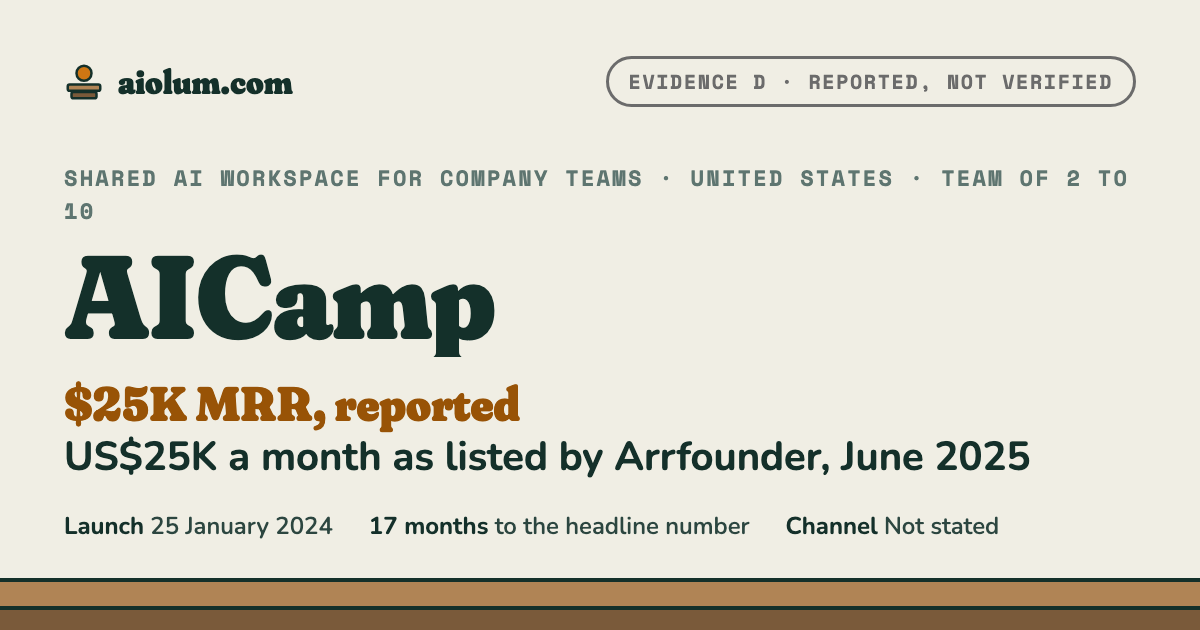
AICamp (Shared AI workspace for company teams, United States): US$25K a month as listed by Arrfounder, June 2025. Evidence grade D: reported, not verified. Team: 2 co-founders, a team of two at the Product Hunt launch in August 2024; headcount at the June 2025 figure not published, and the company was hiring in November 2026. Launched 25 January 2024; still running.Added 6 November 2026
- Outcome
- US$25K a month as listed by Arrfounder, June 2025
- Evidence
- D reported, not verified
- Launch
- 25 January 2024
- Status
- Still running
- Team
- 2 co-founders, a team of two at the Product Hunt launch in August 2024; headcount at the June 2025 figure not published, and the company was hiring in November 2026
- Outside funding
- Not published; no source read mentions outside investors
- Main channel
- Not stated
What is not verified
The headline of US$25,000 a month (US$300,000 a year) rests on one source: the Arrfounder directory, in a product record created on 19 June 2025, collected by Arrfounder with AI and linked to Nishchit's X account, which Arrfounder does not mark as verified. The founder profile Arrfounder shows does not repeat the figure, and the original post was not found. No payment-processor profile, filing or interview with a revenue figure was found. A reader could look for a Stripe-verified profile or a dated founder interview. The headline number is grade D: one claim or one estimate, with no second source. Aiolum shows it because the story is useful, and marks it so that it is not mistaken for a verified figure.
AICamp is a multi-model AI workspace: one web application in which a team chats with several large language models (for example GPT, Claude and Gemini) and shares the results. Around the chat it adds a prompt library, a shared list of tested instructions for the models, and custom agents, saved assistants with their own instructions and documents. A company can bring its own API keys, the passwords that let a program call a model provider on the company's account, or use models that AICamp hosts in the EU (on Azure) or the US (on AWS).
The company's About page names two co-founders, Shreya and Nishchit. The first version went to a private beta on 25 January 2024 with OpenAI support only; Anthropic models followed in February 2024. On 8 August 2024 the two launched on Product Hunt and, in Shreya's account, finished second of the day; she wrote that the launch brought 150 sign-ups and 2 paying customers, and that they planned it "as a two-person team". The directory Arrfounder lists AICamp at US$25,000 a month and US$300,000 a year, in a record created on 19 June 2025 and linked to Nishchit's X account.
That revenue figure is grade D: a directory listing that Arrfounder says it collects mainly from founders' posts on X, with no second source and no payment-processor check. This page also shows earlier companies that built a team layer on top of tools and platforms they did not own.
How much revenue does AICamp make?
Each row shows the evidence grade and the source numbers from the list at the end of this page. The grades are explained in How Aiolum verifies.
| Fact | Value | Grade | How we know | Sources |
|---|---|---|---|---|
| Monthly revenue, June 2025 | US$25,000 | D | Arrfounder product page, read 6 November 2026. The page data give mrr 25000 and arr 300000, record created 19 June 2025 and last changed the same day, with source marked "ai" and a later collection date of 29 September 2026. Arrfounder says its data are "publicly disclosed by founders themselves and collected from various sources, primarily Twitter/X" and that it is not responsible for their accuracy. The linked founder is not marked verified. | [1, 2] |
| Annual revenue in the same listing | US$300,000 | D | Arrfounder. It equals 12 times the monthly figure. | [1] |
| Time from the private beta to the June 2025 listing | 17 months | calc | Calculated: January 2024 to June 2025. | [1, 7] |
| Founders | 2 co-founders, Shreya and Nishchit | C | About page caption "Shreya & Nishchit - Co-founders of AICamp". Shreya writes as co-founder in the company blog. Arrfounder links the product to the X account @Nishchit14. | [3, 4, 2] |
| Team, August 2024 | two people, with two more thanked by name | C | Launch post: "With just two of us on the team"; it also thanks two other team members by first name. No later headcount is published. | [3] |
| Team, November 2026 | hiring | C | Careers page lists one full-time backend engineer role and five six-month internships (content, SEO, marketing strategy, social media). | [9] |
| Private beta | 25 January 2024 | C | Changelog: "AICamp Launch ... Rolling out for Private Beta (Early Waitlist)" with OpenAI provider support. | [7] |
| Product Hunt launch, 8 August 2024 | #2 of the day, more than 650 upvotes | C | Co-founder's launch post, 14 August 2024. Results she lists: 2,500 website visitors in 2 days, 150 sign-ups, 10 demo bookings, 2 paying customers, 4 affiliates. | [3] |
| Hosted models | EU (Azure) or US (AWS), from 16 May 2025 | C | Changelog entry of 16 May 2025, which also introduced new pricing plans. Before that, customers had to bring their own API keys. | [7] |
| Business plan price | US$10 per user a month | C | Pricing page, read 6 November 2026. | [6] |
| Company | AICamp Inc, United States | C | Terms: "operated by M/s. AICamp Inc, an Incorporated Company registered in United states of America", courts in Wyoming. | [8] |
| Outside funding | not published | C | No source read names an investor or a round. | [4, 1] |
How to read this table: a grade D value comes from one source that no one has checked, here the Arrfounder directory. A grade C value is the company's or a founder's own statement. A "calc" value was computed on this page. No value is grade A or B.
| Plan | Per month, billed yearly (US$) | Per month, billed monthly (US$) | Limit |
|---|---|---|---|
| Starter | 0 | 0 | 14-day trial, up to 3 users, US$5 of model credits |
| Business | 10 per user | 10 per user | up to 500 users, SSO, own or hosted models |
| Team (comparison table) | 8 per user | 8 per user | shown only in the comparison table |
| Enterprise | custom | custom | 500+ users, dedicated deployment, guardrails |
The pricing page has a Monthly and an Annual switch, but the page text shows one price per plan, so this table does not separate the two. The plan comparison table lower on the same page still lists a Team plan at US$8 per user a month. Managed models come with fair-usage limits; with your own keys there are no usage limits, and you pay the model provider separately.
When did AICamp launch, and how did it grow?
From a private beta with one model provider to a hosted, multi-provider workspace in about two years. Each entry carries its grade.
- 25 January 2024CFirst version released to a private beta from a waitlist, with OpenAI models through the customer's own API key, chat and chat history. [7]
- 4 February 2024CAnthropic provider added, with Claude 2.0 and 2.1. [7]
- 8 August 2024CProduct Hunt launch by the two co-founders; second of the day, 150 sign-ups and 2 paying customers, in the co-founder's account. [3]
- 21 October 2024CVersion 1.0: workspaces become organizations with an admin portal and providers set at organization level. [7]
- 1 February 2025CAICamp 2.0 with team and access management and model controls. [7]
- 16 May 2025CManaged models hosted in the EU on Azure or in the US on AWS, so customers no longer need their own keys; new pricing plans. [7]
- 19 June 2025DArrfounder creates its listing for AICamp at US$25,000 a month and US$300,000 a year. [1]
- 17 November 2025CGPT-5.1 added, through OpenAI and Azure OpenAI. [7]
- November 2026CBusiness plan at US$10 per user a month; the company is hiring a backend engineer and interns. [6, 9]
Why did AICamp work?
Four causes, in the order they mattered. Each one is a reusable lesson.
Sell the layer, not the model
The models come from OpenAI, Anthropic and Google. AICamp sells what a company needs around them: one place for all staff, roles, groups, access by model, shared prompts and agents, and usage analytics. The price is per user, not per token.
Bring your own keys first, hosted models later
For its first 16 months the product used the customer's own API keys, so AICamp carried no model cost. Hosted models in the EU and the US came in May 2025, for buyers who want one bill and data residency.
Compliance as a selling point
The pages stress GDPR, EU hosting and security audits, because the buyers are companies that must control where staff data goes. The pricing page lists SSO, SCIM and a custom legal disclaimer under the chat field.
A public launch run by two people
The co-founder wrote that she planned the content and distribution while Nishchit did the product and graphics, in three days. In her account the launch brought 150 sign-ups and 2 paying customers.
How it was built
These details come from the company's changelog, pricing page and launch post. They are grade C. [7, 6, 5]
- A web application with model providers connected by API: OpenAI first (January 2024), then Anthropic (February 2024), then Google Gemini and others.
- Customer API keys are kept in a secrets vault, according to the changelog.
- Managed models run on Azure in the EU and AWS in the US, from May 2025; GPT-5.1 is offered through both OpenAI and Azure OpenAI.
- Documentation and changelog are hosted on Mintlify; the marketing site is built with Webflow.
- A Google web-search plugin and file uploads (PDF, DOCX, CSV, XLSX, PPT) feed the chat and the agents.
Tools named in the sources
Each one opens its page in the Tools tab, with every story that uses it.
Who tried this before AICamp, and why did they fail?
Three companies in our database of failed startups tried to be the shared layer for a team's knowledge or work tools. The values below are from that database and are not independently verified.
Niles
The promiseAn AI chatbot inside Slack that answered staff questions from the company's own knowledge.
Why it diedSlack and other large platforms added similar AI features themselves, and companies found the setup and upkeep a burden.
Skiff
The promiseA private, encrypted alternative to Google Workspace and Microsoft 365 for email, documents and files.
Why it diedPrivacy alone did not move users away from free incumbents with large networks.
Answerly
The promiseAutomatic answers to customer questions from a company's own FAQ.
Why it diedThe language technology of the time could not handle real questions, and Zendesk and Intercom held the market.
The failed startups come from our database of 1,749 dead startups, retold here in our own words. Its entries are AI-assisted summaries of public sources, so these cards carry no evidence grade.
What changed
Niles and Answerly had to build their own language technology, and it was not good enough. AICamp buys the models from providers that sell them by API and improve them every few months, so its work is the team layer around the model, not the model itself.
The risk that killed Niles is still here: the platform owners sell their own team plans. AICamp's answer is to offer several providers in one place with EU or US hosting and per-model access rules, which a single provider's own team plan does not do.
Can one person copy AICamp now?
Yes, for a small team that can sell to companies.
The parts are public: model APIs, a chat interface, roles and a prompt library. What is hard is the selling: security pages, single sign-on, data-residency options and demos. Two co-founders did it here, in their own accounts, with one launch and steady weekly releases.
Where it is still open: Team workspaces for one regulated profession or one country, where data rules decide the purchase.
- 1Start with bring-your-own-key, so the model cost is the customer's.
- 2Add what a company administrator needs: roles, groups, model access rules and usage reports.
- 3Offer hosted models in a region the buyer requires, when buyers ask for one bill.
- 4Publish a changelog with dated entries; it is also the evidence a buyer reads.
What could go wrong for AICamp?
The risks are the mirror image of the causes above.
What is not verified
The headline of US$25,000 a month (US$300,000 a year) rests on one source: the Arrfounder directory, in a product record created on 19 June 2025, collected by Arrfounder with AI and linked to Nishchit's X account, which Arrfounder does not mark as verified. The founder profile Arrfounder shows does not repeat the figure, and the original post was not found. No payment-processor profile, filing or interview with a revenue figure was found. A reader could look for a Stripe-verified profile or a dated founder interview.
Competition
AICamp sells the same team layer as TypingMind's Team version, Magai, innoGPT and Logicc on this site, and the model providers sell their own team plans.
Depends on model providers
The changelog shows that every model comes from OpenAI, Anthropic, Google or their cloud partners (Azure, AWS). Price or term changes by these providers pass straight to AICamp's hosted plans.
Trust signals on the pages
The home page shows one testimonial twice, from a founder of SpaceHash, about "spend visibility" for a "finance team", which does not describe this product. The home page says AICamp "is obtaining ISO 27001 and SOC 2 Type 2", while the pricing page says it "is ISO 27001 certified and SOC 2 Type II audited". No certificate was read.
Team size today
The co-founder wrote of a two-person team in August 2024. The careers page in November 2026 lists a backend engineer role and five internships. No source gives the headcount at the June 2025 figure.
Launch tactics
The co-founder wrote that Product Hunt first left the launch out of its lists and that they heard it "might have flagged our launch due to concerns about spamming"; she then rallied her X followers, and support restored it after about five hours.
Sources
The grade next to each source is the best grade that the source can support. "Read in full" means that the text of the page was downloaded and the numbers were checked in it.
- D Arrfounder product page: Aicamp, $25K/moRead in full on 6 November 2026, including the page data (mrr, arr, created_at 19 June 2025). Directory data collected mainly from founders' X posts; not verified.
- D Arrfounder founder page: ND (@Nishchit14)Read in full. Links the X account to AICamp; the bio shown is "Builder" and does not state the revenue.
- C AICamp blog, 14 August 2024: The unfiltered story of AICamp's Product Hunt launchRead in full. Co-founder's own account: launch date, rank, results and the two-person team.
- C AICamp About pageRead in full. Names the two co-founders and the target of small and medium-sized companies.
- C AICamp home pageRead in full on 6 November 2026. Features, testimonials and security claims.
- C AICamp pricing pageRead in full on 6 November 2026. Plans, features and the comparison table.
- C AICamp product updates and changelogRead in full. Dated entries from 25 January 2024 to 17 November 2025.
- C AICamp terms and conditionsRead the sections on the operator, the governing law and the minimum age.
- C Careers at AICampRead in full on 6 November 2026. Open roles.
- C Database of failed startups, local exportLocal export. AI-written summaries, not independently verified. Source for the failed predecessors.
Run this company? Send corrections or a verified figure to aiolum@livyden.com