Figr: Product, team and how it was built
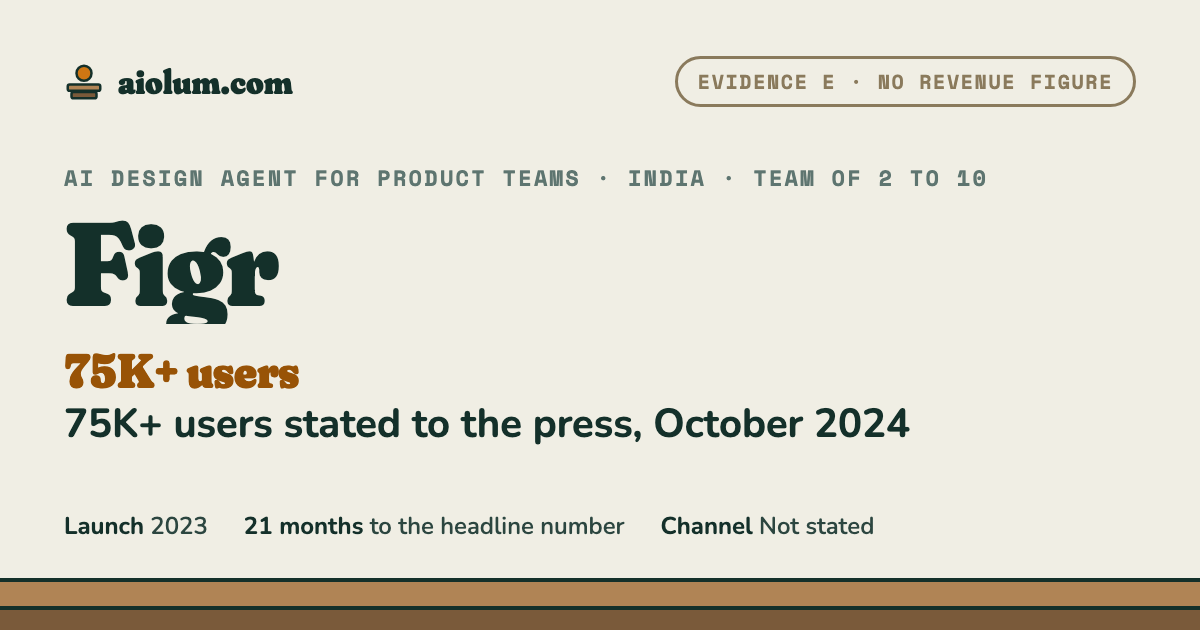
Figr (AI design agent for product teams, India): 75K+ users stated to the press, October 2024. Evidence grade E: no revenue figure was checked. Team: 2 co-founders, Moksh Garg and Chirag Singla, at the start in 2023 (Antler, Economic Times); headcount after the US$2.25M seed round of October 2024 not published. Launched 2023; still running.Added 7 November 2026
- Outcome
- 75K+ users stated to the press, October 2024
- Evidence
- E no revenue figure was checked
- Launch
- 2023
- Status
- Still running
- Team
- 2 co-founders, Moksh Garg and Chirag Singla, at the start in 2023 (Antler, Economic Times); headcount after the US$2.25M seed round of October 2024 not published
- Outside funding
- US$2.25M seed round led by Kalaari Capital with Antler, Golden Sparrow and angel investors, October 2024 (Economic Times)
- Main channel
- Not stated
What is not verified
No revenue figure was found. The Economic Times reported on 9 October 2024 that the company did not disclose its ARR; the company stated a goal of US$1 million ARR within a year, and no source read says whether it was reached. Figr has no TrustMRR profile (revenue verified by a payment processor), and no filing or founder interview with figures was found. The user counts (more than 75,000 in October 2024; 25,000+ downloads and 2,500+ weekly active users in the first three months) are statements of the company and of its investor Antler, and Antler's post has no date. A reader could look for the annual filings of Figrfast Systems Private Limited, the company named in the site footer, with India's Ministry of Corporate Affairs, or for a later funding report. This story is grade E: the business is real and its product, price and customers are described from public pages, but no revenue figure was checked. Aiolum shows it as an idea worth studying, not as proof that it makes money.
Figr is an AI design agent, a program that uses a large language model to plan and carry out several design steps by itself, for product teams. It first builds what the company calls a Context Pod, a store of a team's documents, recordings, analytics files and design system. Then it maps user flows, lists edge cases (unusual states such as a failed payment or a lost network connection), reviews UX decisions and generates screens that follow the team's own components, for export to Figma or React code.
Moksh Garg, a product designer, and Chirag Singla, a machine learning engineer and former colleague, started Figr in 2023 in Antler's Residency program in India, according to Antler's post. Antler wrote that in its first three months Figr had 25,000+ design file downloads and 2,500+ weekly active users. On 9 October 2024 the Economic Times reported a US$2.25 million seed round led by Kalaari Capital and, as the company stated, more than 75,000 users, 80% of them outside India. In November 2026 the pricing page lists paid plans from US$32 a month billed yearly.
No revenue figure was found. The Economic Times reported that the company did not disclose its annual recurring revenue (ARR), the yearly value of its subscriptions, and stated only a goal of US$1 million within a year. The user counts are the statements of the company and its investor, so this story has grade E, and the team size after the funding round is not published.
How much revenue does Figr make?
Each row shows the evidence grade and the source numbers from the list at the end of this page. The grades are explained in How Aiolum verifies.
| Fact | Value | Grade | How we know | Sources |
|---|---|---|---|---|
| Users, October 2024 | more than 75,000, 80% of them outside India | D | The company's statement in the Economic Times, 9 October 2024. One claim with one date; not checked by anyone outside the company. | [1] |
| Traction in the first weeks | 100,000+ designs in its database and 5,000+ sign-ups in 12 weeks; 25,000+ design file downloads and 2,500+ weekly active users (30% from the US, 35% from the EU) in three months | D | Antler, the investor, in an undated post that links to the 9 October 2024 Economic Times article. The calendar dates of these weeks are not given. | [2] |
| Founded | 2023, in Bengaluru, by Moksh Garg and Chirag Singla | C | Economic Times. Antler's post says Garg, a product designer, joined Antler's Residency and teamed up with Singla, a former colleague and machine learning engineer. | [1, 2] |
| Team at the start | 2 co-founders | C | Antler and the Economic Times. No source read gives the headcount after the funding round. | [1, 2] |
| Seed round, 9 October 2024 | US$2.25 million, led by Kalaari Capital, with Antler, Golden Sparrow and angel investors | B | Economic Times report with a quotation from a Kalaari Capital partner; Antler's post gives the same amount. The money was for the AI models and for the product and growth teams. | [1, 2] |
| Revenue | not disclosed | C | The Economic Times wrote that the company did not disclose its current ARR. The company stated a goal of US$1 million ARR within the next year: a goal, not revenue. No source read says whether it was reached. | [1] |
| Prices, November 2026 | Free; Starter US$32 a month billed yearly or US$39 monthly; Max US$124 or US$149; Enterprise by contract | C | Figr's pricing page, read 7 November 2026. Plans include monthly credits. | [4] |
| Customer claim on the home page | "Trusted by 500+ product teams" | C | Company claim with a logo wall. The customer page has stories for 4 of the companies shown (GreyOrange, Adaptive, ByteXL and Profit.co). | [3, 7] |
| AI models | Claude Opus 5 for the design agent and Claude Sonnet 5 for its subagents, from 3 August 2026 | C | Changelog, version 3.7.0. Earlier models are not named in the changelog. | [5] |
| Public releases | 43 versions, from 1.4.0 on 10 June 2025 to 3.11.0 on 14 October 2026 | C | Counted in the changelog on 7 November 2026. The changelog starts in June 2025. | [5] |
| Security | yearly SOC 2 Type II audits through the compliance platform Sprinto; data in US-based Amazon Web Services facilities | C | Figr's security page. | [6] |
| Time from founding to the October 2024 count | at most 21 months | calc | Calculated: from January 2023, the earliest month that "founded in 2023" allows, to October 2024. The launch month is not published. | [1] |
How to read this table: a grade B value is a press report backed by an investor's statement. A grade C value is from the company's own pages or its investor's post. A grade D value is a single company or investor claim with one date or no date. A "calc" value was computed on this page. No revenue figure exists.
| Plan | Per month, billed yearly (US$) | Per month, billed monthly (US$) | Limit |
|---|---|---|---|
| Free | 0 | 0 | 10 credits a month, 3 canvases, 1 Context Pod |
| Starter | 32 | 39 | 200 credits a month, 1 full-access seat, 3 Context Pods |
| Max | 124 | 149 | 1,000 shared credits a month, up to 3 full-access seats |
| Enterprise | custom | custom | unlimited seats, single sign-on, audit logs |
Prices are in US dollars per month. Yearly billing gives two months free. A credit is a unit of design work: the pricing page lists 0.75 to 1 credit for a quick brainstorm or a flow diagram, 2 to 3 for a design review and 5 to 6 for a full web page. Enterprise is priced by contract, with single sign-on, audit logs and a credit budget per seat.
When did Figr launch, and how did it grow?
From two co-founders in Antler's Residency in 2023 to a paid design agent with 43 public releases in 16 months. Each entry carries its grade.
- 2023CMoksh Garg joins Antler's Residency in India and teams up with his former colleague Chirag Singla. Figr is founded in Bengaluru. [1, 2]
- First three months (dates not published)DA database of more than 100,000 designs, 5,000+ sign-ups in 12 weeks, then 25,000+ design file downloads and 2,500+ weekly active users, according to Antler. [2]
- 9 October 2024BThe Economic Times reports a US$2.25 million seed round led by Kalaari Capital. The company states more than 75,000 users and a goal of US$1 million ARR within a year, without disclosing its current ARR. [1]
- 10 June 2025CVersion 1.4.0, the oldest entry in the public changelog, adds export of designs as code. [5]
- 3 August 2026CVersion 3.7.0: the design agent moves to Claude Opus 5, with Claude Sonnet 5 for subagents. [5]
- November 2026CFree, Starter, Max and Enterprise plans on sale; yearly SOC 2 Type II audits; the home page says 500+ product teams use it. [3, 4, 6]
Why did Figr work?
Four causes, in the order they mattered. Each one is a reusable lesson.
Context before screens
Figr asks for the team's documents, recordings, analytics files and design system before it designs. It then asks questions, maps flows and lists edge cases, and only after that draws screens. The home page and the customer quotations present this order as the difference from tools that turn one prompt directly into screens.
Credits as the unit of price
Each plan includes a monthly number of credits, and the pricing page lists how many credits each kind of task uses, from under one for a brainstorm to six for a full web page. So the price follows the amount of model work that each task needs.
Inside the tools teams already use
A Figma plugin brings a team's components and styles in, and designs go back to Figma or out as React code. A Chrome extension captures a live web app. A server for the Model Context Protocol lets coding agents such as Claude Code and Cursor read Figr's design system and prototypes.
How it was built
These details come from Figr's changelog, security page and site. They are grade C, except the Webflow line, which is visible in the page source. [5, 6, 8, 3]
- The design agent runs on Anthropic's Claude Opus 5, with Claude Sonnet 5 for subagents, since version 3.7.0 of 3 August 2026.
- A Figma plugin imports variables, styles, fonts, components and reference screens into Figr's design system; designs export to Figma, to images or to React code.
- A Chrome extension captures a team's live web app, so that Figr can build a design system from it when none is documented.
- An MCP server (Model Context Protocol, a standard way for AI tools to call outside tools) gives Claude Code, Cursor and VS Code read access, and write access for some organizations.
- Data is stored in US-based Amazon Web Services facilities, with yearly SOC 2 Type II audits run through Sprinto.
- Referrals run through Rewardful at a 20% recurring commission. The marketing site is built on Webflow, and the documentation is hosted on Mintlify.
Tools named in the sources
Each one opens its page in the Tools tab, with every story that uses it.
Who tried this before Figr, and why did they fail?
Four companies in our database of failed startups tried to shorten the path from a design idea to a working product, and failed. The values below are from that database and are not independently verified.
Invision
The promiseOne platform for interactive prototypes and the handoff from designers to developers.
Why it diedFigma's real-time collaboration in the browser took its users, and it did not change fast enough.
The Grid
The promiseWebsites designed automatically by AI from the user's content.
Why it diedThe AI of the time could not produce designs of consistent quality, and users lost trust in it.
Pagedraw
The promiseTurn Sketch design files into React code.
Why it diedIt depended on Sketch while designers moved to Figma.
Pixate
The promiseNative mobile app prototypes without writing code.
Why it diedGoogle bought it and stopped independent development, while Figma and others added prototyping.
The failed startups come from our database of 1,749 dead startups, retold here in our own words. Its entries are AI-assisted summaries of public sources, so these cards carry no evidence grade.
What changed
The four predecessors show two risks for a design tool. The main design platform can add the feature itself, as Figma did against Invision, Pixate and Pagedraw. And the AI can be too weak, as at The Grid. Figr has both risks: it depends on Figma for import and export, and its output is only as good as the language model behind it.
What is different is that language models can now read a team's documents and existing screens and follow its design system, which The Grid could not do in 2014. Figr also does not try to replace Figma. It works at the step before it, on flows, edge cases and UX review, and sends its results into Figma or code. Whether that position holds while Figma and the model makers build their own agents is the open question.
Can one person copy Figr now?
The company, hard. The method, partly.
Figr had two co-founders, an accelerator, venture money and more than a year of frequent releases. A solo founder today would compete with funded tools such as Figr and UX Pilot. The parts that can be copied are the order of work and the price unit.
Where it is still open: Narrow parts of the same work for one kind of product: edge-case lists and test cases for checkout or onboarding flows, accessibility reviews, or design reviews against one company's design system.
- 1Ask for the customer's context first (documents, recordings, a capture of the live product) and plan before generating anything.
- 2Price in credits and publish how many credits each kind of task uses.
- 3Meet users inside the tools they already use: a Figma plugin, a Chrome extension, an MCP server.
- 4Keep a dated public changelog: Figr's lists 43 releases in 16 months.
What could go wrong for Figr?
The risks are the mirror image of the causes above.
What is not verified
No revenue figure was found. The Economic Times reported on 9 October 2024 that the company did not disclose its ARR; the company stated a goal of US$1 million ARR within a year, and no source read says whether it was reached. Figr has no TrustMRR profile (revenue verified by a payment processor), and no filing or founder interview with figures was found. The user counts (more than 75,000 in October 2024; 25,000+ downloads and 2,500+ weekly active users in the first three months) are statements of the company and of its investor Antler, and Antler's post has no date. A reader could look for the annual filings of Figrfast Systems Private Limited, the company named in the site footer, with India's Ministry of Corporate Affairs, or for a later funding report.
Logo wall and customer counter
The home page says "Trusted by 500+ product teams" and shows company logos that include Freshworks, Zoho, Razorpay, Cashfree Payments, Mapbox, Toptal, BetterUp and Triple Whale. The customer page has stories only for GreyOrange, Adaptive, ByteXL and Profit.co, and its other quotations name people with their roles. No page read gives a source for the other logos or for the count of 500.
Competition and dependence on model providers
UX Pilot, another story on this site in the same group, generates screens with AI and its founder reported US$5.3M ARR in February 2026 (grade C). Figma, Lovable and the model makers' own apps compete for the same users; one Figr customer quoted on the home page names Claude and Lovable among the tools tried before Figr. The changelog says the agent has run on Anthropic's Claude Opus 5 and Sonnet 5 since 3 August 2026, so Anthropic's prices, limits and outages reach Figr directly.
Team size after the funding round
The Economic Times reported that the seed money would go to the AI models and to the product and growth teams. No source read gives a headcount, so this page counts Figr as a business started by 2 people and does not know its size in 2026.
Sources
The grade next to each source is the best grade that the source can support. "Read in full" means that the text of the page was downloaded and the numbers were checked in it.
- B The Economic Times (ETtech), 9 October 2024: Product design startup Figr raises $2.25 million from Kalaari Capital, othersRead in full. Source for the founding year and city, the founders, the seed round and its investors, the user count, the ARR goal and the fact that current ARR was not disclosed.
- C Antler blog: Investing in Figr: How Figr is Reshaping the Design Landscape (undated, late 2024)Read in full, from the copy the pipeline downloaded on 7 November 2026. The investor's own post; it has no date and links to the 9 October 2024 Economic Times article. Source for the founders' background and the early traction figures.
- C Figr home page, read 7 November 2026Read in full, with the page source. Source for the product description, the customer quotations, the "Trusted by 500+ product teams" line, the logo wall and the company name in the footer.
- C Figr pricing page, read 7 November 2026Read in full. Source for the plans, the monthly and yearly prices, the credit allowances and the credits per task.
- C Figr changelog, read 7 November 2026Read in full: 43 versions from 10 June 2025 to 14 October 2026. Source for the model change, the Figma plugin, the Chrome extension and the MCP server.
- C Figr security page, read 7 November 2026Read in full. Source for the SOC 2 Type II audits through Sprinto and the AWS hosting.
- C Figr customer stories page, read 7 November 2026Read in full. Source for which companies have customer stories.
- C Figr affiliate program page, read 7 November 2026Read in full. Source for the 20% recurring commission paid through Rewardful.
- C Database of failed startups, local exportLocal export. AI-written summaries, not independently verified. Source for the failed predecessors.
Run this company? Send corrections or a verified figure to aiolum@livyden.com