doloc: Product, team and how it was built
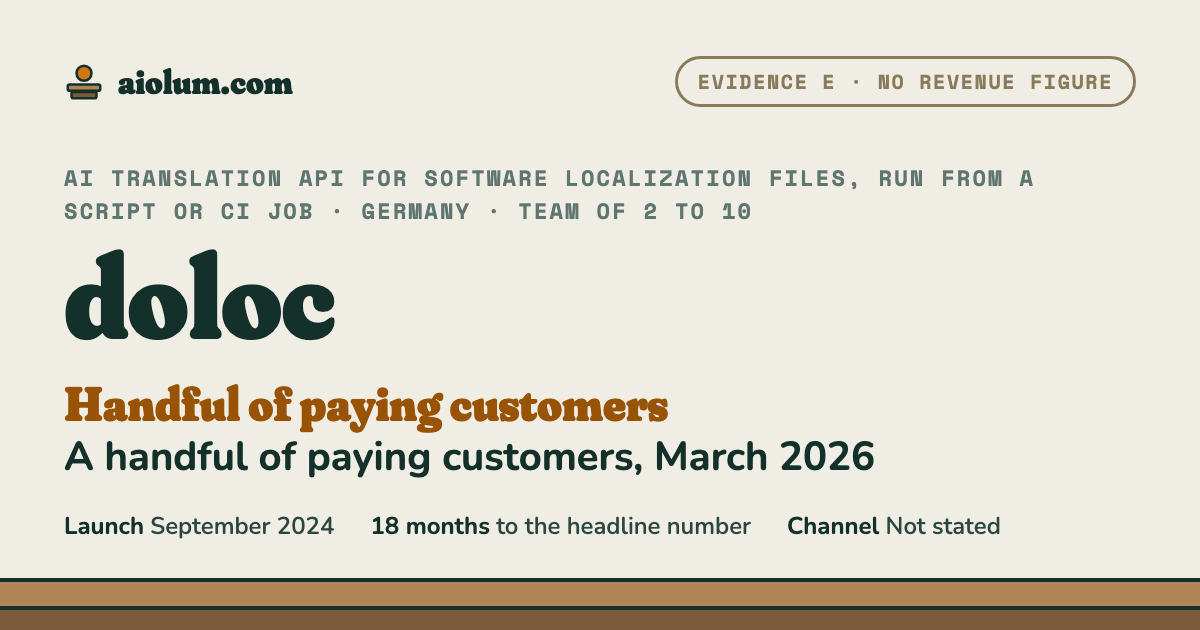
doloc (AI translation API for software localization files, run from a script or CI job, Germany): A handful of paying customers, March 2026. Evidence grade E: no revenue figure was checked. Team: Founder Daniel Schreiber as a side business next to a part-time job; the site footer says built by Rafael and Daniel. Launched September 2024; still running.Added 6 November 2026
- Outcome
- A handful of paying customers, March 2026
- Evidence
- E no revenue figure was checked
- Launch
- September 2024
- Status
- Still running
- Team
- Founder Daniel Schreiber as a side business next to a part-time job; the site footer says built by Rafael and Daniel
- Outside funding
- None reported
- Main channel
- Not stated
What is not verified
No revenue figure was found for doloc. The only traction fact is the founder's statement in the Happy Bootstrapping podcast of 9 March 2026 that a handful of customers pay; the €2,500 a month in that podcast belongs to his other product, Cloud Backup for Podio. No TrustMRR or Stripe profile, filing or second interview was found. A reader could look for a payment-processor profile or a later interview with a customer count. This story is grade E: the business is real and its product, price and customers are described from public pages, but no revenue figure was checked. Aiolum shows it as an idea worth studying, not as proof that it makes money.
doloc does localization, the work of adapting a program's interface texts to other languages, as one step of the build. The texts live in localization files such as JSON or XLIFF (XML Localization Interchange File Format, a standard XML format with a source and a target text per entry). A developer posts the files to the API from a script or a CI job (continuous integration: the automated build and test run on every change), and an AI model fills in the missing target texts. The Happy Bootstrapping podcast wrote in March 2026 that the translations run on OpenAI's GPT-4.1 because of its large context window.
Daniel Schreiber, a software engineer from Offenbach who works 80 percent in a job, runs doloc as a side business; the oldest Internet Archive copy of doloc.io, from 10 September 2024, is a work-in-progress page. The pricing page lists a free plan and paid plans of 12 EUR and 45 EUR a month, charged by the number of unique source texts, not by languages or requests. In the March 2026 podcast he said that a handful of customers pay and that the first beta customer, his employer, uses it free.
This story has no revenue figure. The podcast gives a monthly figure only for his older product, Cloud Backup for Podio, not for doloc, so the headline is the customer status he gave in March 2026.
How much revenue does doloc make?
Each row shows the evidence grade and the source numbers from the list at the end of this page. The grades are explained in How Aiolum verifies.
| Fact | Value | Grade | How we know | Sources |
|---|---|---|---|---|
| Paying customers, March 2026 | a handful | C | Podcast summary of the founder's interview: "Eine Handvoll zahlende Kunden sind an Bord" (A handful of paying customers are on board, translation). The beta customer, his employer, uses it free. | [3] |
| Revenue | not published | E | No source read for this page gives a revenue figure for doloc. | [3] |
| Earliest archived site | 10 September 2024, a work-in-progress page | A | Internet Archive copy titled "WIP auto-l10n", still showing demo text of the Hugo theme. | [4] |
| Founder | Daniel Schreiber, software engineer, Offenbach, Germany | C | The home page names him as founder; the imprint names him; the podcast says he works 80 percent in a job and runs doloc on the side. | [1, 3] |
| Team | the founder, with his brother | C | The site footer says "Built by Rafael & Daniel"; the podcast says he tried Product Hunt launches with his brother Raphael. | [1, 3] |
| AI model | OpenAI GPT-4.1 | C | Podcast: "Die Übersetzungen laufen über GPT-4.1 wegen des großen Kontextfensters" (The translations run on GPT-4.1 because of the large context window, translation). The FAQ says "high-quality AI models" without a name. | [3, 7] |
| Prices | free up to 200 source texts; €12 and €45 a month | C | Pricing page, 6 November 2026. | [2] |
| Prices in US dollars | about US$13.40 and US$50.23 a month | calc | Calculated: euro prices times US$1.1163 per euro (H.10, 30 October 2026). | [2, 8] |
| File formats | JSON, XLIFF 1.2, XLIFF 2.0, ARB, Android XML, Properties | C | Home page. | [1] |
| Affiliate commission | 25% recurring, 50% during a promotion | C | Affiliate page; payouts by PayPal, 90-day cookie. | [5] |
| Outside funding | none reported | C | The podcast describes indie work "ohne externes Kapital" (without outside capital, translation). | [3] |
| Time from first archived site to the customer status | 18 months | calc | Calculated: September 2024 to March 2026. | [3, 4] |
How to read this table: grade C is what the company writes on its own site, or what the founder said in a podcast interview. Grade A is an archive copy or an official exchange-rate table. An "X" value was computed on this page. No revenue value exists.
| Plan | Per month, billed yearly (US$) | Per month, billed monthly (US$) | Limit |
|---|---|---|---|
| Free | 0 | 0 | 200 source texts |
| Hobby | 13.40 | €12 a month; 2,000 source texts, priority support | |
| Pro | 50.23 | €45 a month; 10,000 source texts, priority support |
The price depends only on the number of unique source texts, for example one JSON key; the pricing page says translations, requests and target languages are unlimited. Paid plans have a 14-day trial and a 30-day money-back guarantee, and open-source projects and non-profits can ask for a discount. The March 2026 podcast gave the free limit as 100 texts; the site in November 2026 says 200.
When did doloc launch, and how did it grow?
From a work-in-progress page in September 2024 to a public API with six file formats, a GitHub Action and an affiliate program in 2026. Each entry carries its grade.
- About 2012CSchreiber and his brother start Wechselfuchs, an energy-switching service, later sold its customer base to Wechselpilot. His backup product for the Podio platform grows out of it. [3]
- 10 September 2024AFirst Internet Archive copy of doloc.io: a work-in-progress page called "WIP auto-l10n" with sections for Angular integration and pricing. [4]
- 9 March 2026CHappy Bootstrapping episode 162: GPT-4.1 behind the API, a handful of paying customers, Google Ads failed, Reddit, an IntelliJ plugin and an open-source Angular add-on bring some traffic, and an affiliate program is next. [3]
- 6 November 2026CSite lists six file formats, integration guides for Angular, React, Android, Flutter, GitHub Actions and IntelliJ, a free plan of 200 source texts and paid plans at €12 and €45 a month. [1, 2]
Why did doloc work?
Four causes, in the order they mattered. Each one is a reusable lesson.
Translation inside the build
The API is synchronous: one request with the files, one response with the updated target file. There is no project, queue or second copy of the texts, so the repository and its diffs stay the place where changes are reviewed.
Existing translations as context
The podcast says already translated texts work as an implicit glossary. The model sees how a team translated earlier strings, so new strings use the same terms.
Price by source text
The pricing page counts each unique source text once, however many languages or requests use it. A team that adds languages pays nothing more.
Low running cost
The podcast lists TypeScript on Bun on Google Cloud Run, Supabase as database and Astro on Cloudflare for the site, and says running costs are minimal, which lets a part-time founder keep it running with few customers.
How it was built
These details come from the podcast summary and the company's own pages. They are grade C. [3, 1, 5]
- Backend in TypeScript on the Bun runtime, hosted on Google Cloud Run; Supabase as the database.
- Front end built with Astro and served from Cloudflare.
- Translations by OpenAI's GPT-4.1, chosen for its large context window.
- A GitHub Action, an IntelliJ plugin and an open-source Angular add-on call the same API and link to doloc.
- Payouts to affiliates by PayPal.
Tools named in the sources
Each one opens its page in the Tools tab, with every story that uses it.
Who tried this before doloc, and why did they fail?
Three companies in our database of failed startups sold translation work or one developer chore as a service and failed. The values below are from that database and are not independently verified.
TurboTranslations
The promiseFaster and cheaper translations from a marketplace of human translators.
Why it diedNeural machine translation became good enough that the human marketplace lost its price advantage.
Zencoder
The promiseVideo processing through a simple API, so developers did not run it themselves.
Why it diedBought by Brightcove, then left behind while large cloud providers offered the same service.
Pagedraw
The promiseTurn Sketch design files into React code automatically.
Why it diedIt bet on Sketch when designers moved to Figma, and developers kept writing the code by hand.
The failed startups come from our database of 1,749 dead startups, retold here in our own words. Its entries are AI-assisted summaries of public sources, so these cards carry no evidence grade.
What changed
TurboTranslations sold human translation and lost when machine translation improved. doloc is on the other side of that change: the large models translate short interface texts well enough that a one-person API can sell the whole step.
Zencoder and Pagedraw show the risk that stays. A developer API for one chore competes with large platforms that can add the same feature, and a tool tied to one workflow loses when developers change tools. doloc reads six common file formats and works from a plain curl call, so it is not tied to one framework, but OpenAI and the translation platforms can offer the same step.
Can one person copy doloc now?
Yes, the product. Distribution is the hard part.
One engineer built the API around a model he does not own, with minimal running costs, from a problem at his own job. The founder says himself that product and technology are what he does well and that distribution is still open.
Where it is still open: Other build steps that a model can do on files in the repository: release notes, screenshot texts for app stores, documentation translation.
- 1Pick a step that developers do by hand in every release and make it one API call from CI.
- 2Keep the customer's repository as the only copy of the data, so there is nothing to migrate.
- 3Price by a unit that does not grow with use, such as unique source texts.
- 4Ship plugins and open-source add-ons for the tools developers already use, so they link back to you.
What could go wrong for doloc?
The risks are the mirror image of the causes above.
What is not verified
No revenue figure was found for doloc. The only traction fact is the founder's statement in the Happy Bootstrapping podcast of 9 March 2026 that a handful of customers pay; the €2,500 a month in that podcast belongs to his other product, Cloud Backup for Podio. No TrustMRR or Stripe profile, filing or second interview was found. A reader could look for a payment-processor profile or a later interview with a customer count.
Dependence on one model provider
The podcast says translations run on OpenAI's GPT-4.1. A price change or a model withdrawal by OpenAI changes doloc's cost and output, and doloc's own comparison page says a team can build the same pipeline on the OpenAI API directly.
Competition
doloc's own pages name Crowdin, Lokalise, Weblate and POEditor as the platform alternatives. No other story on this site sells a localization API; the nearest are consumer translation apps such as ekto and LangLang.
A side business with an open sales channel
The founder works 80 percent in a job. The podcast says Google Ads did not work, Product Hunt launches had no lasting effect, and an affiliate program with 25% recurring commission (50% in a promotion, according to the affiliate page) is the next attempt.
Sources
The grade next to each source is the best grade that the source can support. "Read in full" means that the text of the page was downloaded and the numbers were checked in it.
- C doloc home page: Localization automation for software teams, read 6 November 2026Read in full. Source for the formats, integrations, founder and footer.
- C doloc pricing page, read 6 November 2026Read in full. Source for the plans, limits, trial and refund policy.
- C Happy Bootstrapping #162, 9 March 2026: doloc.io und Cloud Backup for Podio: Wie Daniel Schreiber nebenberuflich zwei SaaS-Produkte betreibt (Andreas Lehr)Read the episode summary in full, in German; the audio was not heard. Source for the customers, model, stack, channels and background.
- A Internet Archive copy of doloc.io, 10 September 2024Read in full. The earliest capture in the archive index.
- C doloc affiliate program page, read 6 November 2026Read in full. Source for the commission rates and PayPal payouts.
- C doloc: OpenAI API for Localization: Build It Yourself or Use doloc?, read 6 November 2026Read in full. The company's own comparison with building on the OpenAI API.
- C doloc FAQ, read 6 November 2026Read in full. Says it combines AI models with context from existing strings.
- A Federal Reserve statistical release H.10, euro historical rates, release of 2 November 2026Read the row for 30 October 2026: US$1.1163 per euro.
- C Database of failed startups, local exportLocal export. AI-written summaries, not independently verified. Source for the failed predecessors.
Run this company? Send corrections or a verified figure to aiolum@livyden.com