ColorCraft: Revenue, team and how it was built
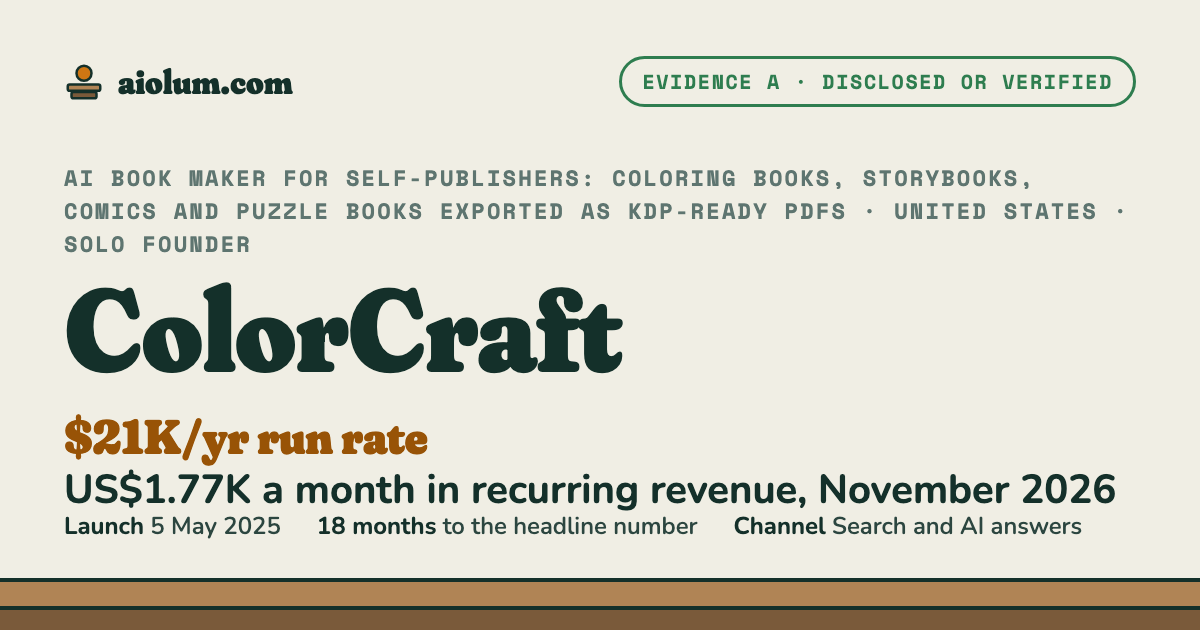
ColorCraft (AI book maker for self-publishers: coloring books, storybooks, comics and puzzle books exported as KDP-ready PDFs, United States): US$1.77K a month in recurring revenue, November 2026. Evidence grade A: disclosed by a company or a filing, or verified by a payment processor. Team: 1 founder, building it on the side (TrustMRR team size: 1 person). Launched 5 May 2025; still running, revenue growing.Added 6 November 2026
- Outcome
- US$1.77K a month in recurring revenue, November 2026Revenue growing
- Evidence
- A disclosed by a company or a filing, or verified by a payment processor
- Launch
- 5 May 2025
- Status
- Still running
- Team
- 1 founder, building it on the side (TrustMRR team size: 1 person)
- Outside funding
- None (bootstrapped)
- Main channel
- Search and AI answers
ColorCraft is a web app for Amazon KDP self-publishers. KDP (Kindle Direct Publishing) is Amazon's service where anyone can upload a book file and a cover file; Amazon prints each paperback when a customer orders it. ColorCraft makes both files with AI: it generates coloring pages, storybook illustrations with the same characters on every page, comic pages and algorithmic puzzles, and it builds the cover wrap, one PDF that holds the back cover, the spine and the front cover, with a spine width that depends on the page count.
John Kirby, an independent developer in North Carolina, started it on 5 May 2025 and released the first version on 19 June 2025. He said in June 2025 that he wrote almost no code himself and built the app with Cursor on Supabase, Vercel and Stripe. Revenue stayed between US$163 and US$411 a month from December 2025 to July 2026, then rose to US$638 in August, US$1,130 in September and US$1,845 in October 2026. On 5 November 2026 TrustMRR, which reads the revenue from Stripe, showed US$1,770 in monthly recurring revenue (MRR, the subscription revenue that repeats each month) from 92 active subscriptions.
The revenue figures on this page come from Stripe through TrustMRR, so they are grade A. The founder runs the business alone and has listed it for sale on TrustMRR since April 2026 with an asking price of US$65,000. The page also shows four failed startups that tried to change book publishing for small authors before AI could draw the books.
How much revenue does ColorCraft make?
Each row shows the evidence grade and the source numbers from the list at the end of this page. The grades are explained in How Aiolum verifies.
| Fact | Value | Grade | How we know | Sources |
|---|---|---|---|---|
| Monthly recurring revenue, 5 November 2026 | US$1,770 | A | TrustMRR metric snapshot; Stripe connected by API key, revenue last synced 5 November 2026. | [1] |
| Active subscriptions, 5 November 2026 | 92 | A | TrustMRR metric snapshot. | [1] |
| Monthly recurring revenue, 2 November 2026 | US$1,632 from 85 active subscriptions | B | Shipped & Paid read TrustMRR on 2 November 2026. It agrees with the grade A figure three days later. | [2] |
| Annual run rate | US$21,240 | calc | Calculated: 1,770 times 12. | [1] |
| Revenue, last 30 days to 5 November 2026 | US$1,935 | A | TrustMRR gives growth of 64.7% against the 30 days before. | [1] |
| Revenue, all time to 5 November 2026 | US$6,688 | A | Shipped & Paid read US$6,458 all-time on 2 November 2026. | [1, 2] |
| Monthly revenue, December 2025 to July 2026 | US$163 to US$411 | A | TrustMRR monthly timeline: lowest February 2026 (US$163), highest June 2026 (US$411). | [1] |
| Monthly revenue, August, September and October 2026 | US$638, US$1,130 and US$1,845 | A | TrustMRR monthly timeline. | [1] |
| Growth from August to October 2026 | 2.89 times | calc | Calculated: 1,845 divided by 638. | [1] |
| Average revenue per active subscription | about US$19 a month | calc | Calculated: 1,770 divided by 92 equals 19.24. | [1] |
| Founded | 5 May 2025 | C | TrustMRR founded date; the changelog calls 5 May the product's first birthday. The first public version is dated 19 June 2025. | [1, 3] |
| Team | 1 person | C | TrustMRR profile (founder-written). The about page names John as the founder, an independent developer in North Carolina. Shipped & Paid writes that he builds it on the side. | [1, 2, 5] |
| Outside funding | none | C | TrustMRR profile: bootstrapped. | [1] |
| Estimated users | 3,500 | C | Founder-written TrustMRR field. The home page shows 1,400+ creators and 40,000+ pages created. | [1, 6] |
| Listed for sale | since 22 April 2026, asking US$65,000 | C | TrustMRR acquisition section, with 6 offers received. The asking price is the seller's figure, not a sale. | [1] |
| Image model | OpenAI gpt-image-2 since 28 April 2026 | C | Changelog v3.0.0. TrustMRR's tech stack lists OpenAI and Anthropic. | [1, 3] |
| Google Search impressions, last 30 days | 2,257 | A | TrustMRR, Google Search Console connected by API. | [1] |
How to read this table: a grade A value is read from Stripe, the payment processor, through TrustMRR. A grade B value is a newsletter's reading of the same Stripe data on another date. A grade C value is the founder's or the company's own statement. A grade X value was calculated on this page from the rows above it.
| Plan | Per month, billed yearly (US$) | Per month, billed monthly (US$) | Limit |
|---|---|---|---|
| Mini | 7.50 | 9 | 40 pages a month, first AI cover of each book |
| Starter | 11.67 | 14 | 100 pages a month |
| Creator | 26.67 (calculated) | 32 | 320 pages a month, more covers, mockups, KDP listing generator |
| Professional | 49.17 (calculated) | 59 | 700 pages a month |
| Studio | 99.17 (calculated) | 119 | 1,500 pages a month, for teams |
| Book unlock | 24 one-time | 24 one-time | Print-ready file of one book without a plan |
A page is one coloring page, one storybook page or one puzzle. Unused pages roll over up to twice the monthly amount. Every plan starts with a 7-day free trial that needs a card; trial downloads are watermarked. One book can be unlocked without a plan for US$24 one-time. The pricing page states the yearly prices of Mini (US$90) and Starter (US$140) only; the yearly figures for Creator, Professional and Studio are calculated from the changelog rule that annual billing gets two months free (10 times the monthly price, divided by 12).
When did ColorCraft launch, and how did it grow?
From a coloring-page generator to a full book workflow in 18 months. Each entry carries its grade.
- 5 May 2025CJohn Kirby starts ColorCraft. [1, 3]
- 19 June 2025CVersion 1.0: a text-to-image generator for coloring pages, a book assembly editor and a token system for generations. The same day he posts that the app was built with Cursor on Supabase, Vercel and Stripe. [2, 3]
- 12 October 2025CVersion 2.0 adds Paige, an AI assistant that plans the prompts for a whole coloring book and generates the pages in bulk. [3]
- December 2025 to July 2026ARevenue stays between US$163 and US$411 a month. [1]
- 22 April 2026CThe founder lists ColorCraft for sale on TrustMRR. [1]
- 28 April 2026CVersion 3.0: the app is rebuilt and redesigned, and every page is generated with OpenAI's gpt-image-2. [3]
- 23 May 2026CVersion 3.1 adds the KDP cover wrap generator, mockups, storybooks, puzzle books, a listing assistant and the 7-day free trial in place of the free tier. [2, 3]
- August to October 2026ARevenue rises from US$638 to US$1,845 a month. On 20 September 2026 the founder says he had not marketed the product in months while MRR kept rising. [1, 2]
- 15 October 2026CVersion 3.5 adds printed copies shipped in the US and the ColorCraft Bookstore, where authors sell printed books for a royalty. [3]
- 5 November 2026ATrustMRR shows US$1,770 MRR from 92 active subscriptions. [1]
Why did ColorCraft work?
Four causes, in the order they mattered. Each one is a reusable lesson.
One narrow buyer
ColorCraft does not sell to everyone who wants a picture. It sells to people who publish coloring, story and puzzle paperbacks on KDP. These buyers already pay for books as a product line, and they need exact files: margins, bleed (art that runs past the trim edge), a spine sized to the page count. The pricing page states the cost per page, from US$0.23 on Mini to US$0.08 on the larger plans, because a publisher counts in pages per book.
The whole workflow in one app
The TrustMRR profile says self-publishers stitch together four to seven tools to ship one book: an image generator, a layout tool, a cover template, a spine calculator, a mockup app. ColorCraft adds each step in turn: pages in 2025, then in 2026 the cover wrap, mockups, a listing description, storybooks, puzzles, printed copies and a bookstore.
A trial long enough to finish a book
Shipped & Paid reports the founder's finding: users who generated 10 or more pages paid, and the rest never paid. In May 2026 he replaced the free tier with a 7-day trial that needs a card and covers a full 24-page book, KDP's minimum for a paperback. The download stays watermarked until the plan starts or the book is unlocked for US$24. Monthly revenue rose in the months after the change.
Search and free tools
Free calculators for spine width, royalties, cover size and printing cost, and 600+ free coloring pages, bring visitors without ads. The seller's message on TrustMRR describes an organic channel led by ChatGPT referrals. TrustMRR also lists Facebook, Instagram, Pinterest and Google Ads as channels.
How it was built
These details come from the founder's June 2025 post as quoted by Shipped & Paid, the TrustMRR tech-stack list and the product's changelog. They are grade C. [1, 2, 3, 5]
- Built mostly by AI coding tools: the founder wrote in June 2025 that he barely wrote any code and that the app was vibe-coded with tools like Cursor.
- Next.js, React and TypeScript for the web app, hosted on Vercel; Supabase for the database and logins; Google Cloud and Docker in the backend.
- Stripe for subscriptions, the one-time book unlock and the royalty payouts of the bookstore; Resend for email.
- OpenAI's gpt-image-2 generates every page since April 2026. TrustMRR also lists Anthropic in the stack. Puzzles are made by an algorithm, not by AI.
- In April 2026 the app was rebuilt from scratch and redesigned; Shipped & Paid reports a design system from Claude Design and deploys cut from more than 30 minutes to under 2.
- No mobile app: the product runs in the browser only.
Tools named in the sources
Each one opens its page in the Tools tab, with every story that uses it.
Who tried this before ColorCraft, and why did they fail?
Four companies in our database of failed startups tried to change how small authors make or sell books before AI could draw the pages. The values below are from that database and are not independently verified.
Booktrope
The promiseA publishing platform where authors, editors, designers and marketers worked as a book team and shared the royalties instead of charging fees.
Why it diedEach book needed a team of people, and the company could not reach enough successful books to pay for the coordination. Amazon KDP offered authors an easier path.
Zuuka
The promiseA library of interactive children's books for tablets.
Why it diedContent cost a lot to make, and Apple and Amazon added interactive children's books to their own stores.
Vook
The promiseEbooks with video and audio inside the text.
Why it diedEvery title was expensive to produce, readers stayed with Kindle and iBooks, and publishers were slow to adopt the format.
Zola Books
The promiseAn ebook store with author discussions, recommendations and social sharing.
Why it diedAmazon owned the ebook sales channel, and social features were not enough to move readers away from it.
The failed startups come from our database of 1,749 dead startups, retold here in our own words. Its entries are AI-assisted summaries of public sources, so these cards carry no evidence grade.
What changed
The older companies paid people to make each book: Booktrope's book teams, Zuuka's and Vook's multimedia titles. That cost had to be paid back by sales that never came, and Amazon and Apple controlled the stores. None of them made the books themselves cheap to produce.
ColorCraft does not compete with Amazon; it makes files for Amazon's own print service. Image models now draw a coloring page or a consistent storybook character for cents, so the book itself costs the publisher little to make. One developer with AI coding tools could build the editor, the KDP file checks and the cover math that a team would have built before.
Can one person copy ColorCraft now?
Yes, the pattern is open to one person.
The parts are rented: the image model from OpenAI, hosting from Vercel, the database from Supabase, payments from Stripe. The work is in the details of one platform's file rules and in the steps around the model. Many AI coloring-page generators exist, and the about page itself lists several products with the same name, so a copy needs a narrower or better-served buyer, not only a generator.
Where it is still open: The same full-workflow approach is open for other print-on-demand formats that the about page says ColorCraft does not make: journals, planners, notebooks, hardcover cover wraps and Kindle ebook files, and books in languages other than English.
- 1Pick a buyer who already sells a product made of the output (here, KDP paperbacks) and learn that platform's file rules exactly.
- 2Build every step from idea to upload-ready files, not only the image generation.
- 3Price in the buyer's unit (pages per book) and show the cost per unit.
- 4Look at which free users convert; give a trial long enough to reach the moment they pay, and gate the final download.
- 5Add free calculators and free sample pages that rank in search.
What could go wrong for ColorCraft?
The risks are the mirror image of the causes above.
Competition
AI coloring-page tools are many; on this site ColorBliss, an AI coloring page generator, reported US$2,000 MRR in May 2024, about the same size as ColorCraft's US$1,770 MRR in November 2026 (TrustMRR). ColorCraft's about page lists other unrelated products that use the ColorCraft name (cpgsite.com, colorcrafti.com, ColurCraft AI, two custom GPTs, two App Store apps), which can confuse buyers.
Dependence on model providers and on Amazon
Since April 2026 every page is generated with OpenAI's gpt-image-2 (changelog); a price change or a change in that model's output changes ColorCraft's cost and quality. TrustMRR lists a 90.0% profit margin for the last 30 days, a figure that depends on these model costs. The main use is publishing on Amazon KDP, so KDP's rules decide the market: the pricing page says KDP allows AI-generated content when the publisher discloses it at upload.
Small absolute size and a sale listing
All-time revenue was US$6,688 on 5 November 2026, and the growth is recent (August to October 2026). The founder has listed the business for sale since April 2026 at US$65,000 and builds it on the side, so the owner may change.
Copyright and photos of real people
The pricing page says the terms do not allow generating trademarked or copyrighted characters (for example Disney or Nintendo characters) without the owner's permission. Users can save a person or a pet as a character from up to 3 photos; the changelog says character photos are private and screened and that the editor asks the user to confirm the person's consent.
Books for children, sold to adults
Many generated books are coloring books and storybooks for children (the home page shows kids' categories), but the buyers named on TrustMRR are KDP self-publishers, parents and teachers. The app is a paid web app that needs a card for its trial; no source shows marketing aimed at children.
Counters on the home page
The home page shows 40,000+ pages created, 1,400+ creators and 1,300+ books with 10+ pages. These counters are the company's own and are not verified; the founder-written TrustMRR field estimates 3,500 users, and Stripe shows 92 active subscriptions.
Sources
The grade next to each source is the best grade that the source can support. "Read in full" means that the text of the page was downloaded and the numbers were checked in it.
- A TrustMRR profile of ColorCraft (markdown), revenue last synced 5 November 2026Read the markdown profile in full on 6 November 2026. Revenue, MRR, subscriptions and Search Console figures come from connected APIs (grade A); the description, team size, funding, user estimate, tech stack and sale listing are founder-written (grade C).
- B Shipped & Paid, case page: ColorCraft, a vibe-coded AI coloring book maker for KDP at $1,632 MRR (Stripe-verified), built by a solo founder with CursorRead in full. A newsletter that read TrustMRR on 2 November 2026 and quotes the founder's X posts of 19 June 2025 and 20 September 2026. Source for the second dated MRR figure, the trial change and the build tools.
- C ColorCraft changelogRead in full. Source for the release dates from v1.0 (19 June 2025) to v3.5.0 (15 October 2026) and the image model.
- C ColorCraft pricing page, read 6 November 2026Read in full. Source for the plans, the trial terms, the book unlock and the commercial-use and copyright rules.
- C About ColorCraftRead in full. Source for the founder's location, what the product does not do, and the list of unrelated products with the same name.
- C ColorCraft home page, read 6 November 2026Read in full. Source for the usage counters and the book categories.
- C ColorCraft, As Seen On pageRead in full. Lists the directories and launch sites that list the product; no press logos.
- C Database of failed startups, local exportLocal export. AI-written summaries, not independently verified. Source for the failed predecessors.
Run this company? Send corrections or a verified figure to aiolum@livyden.com