EasyClass AI: Revenue, team and how it was built
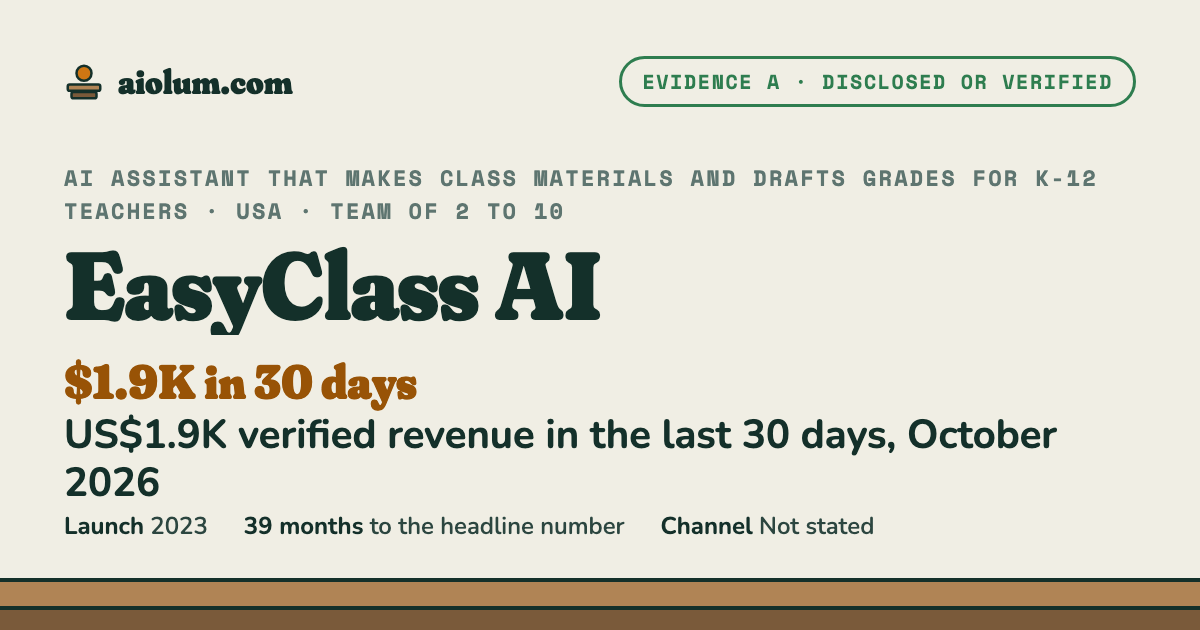
EasyClass AI (AI assistant that makes class materials and drafts grades for K-12 teachers, USA): US$1.9K verified revenue in the last 30 days, October 2026. Evidence grade A: disclosed by a company or a filing, or verified by a payment processor. Team: Founded in Fort Worth, Texas, with a named co-founder who is a 4th-grade teacher; headcount not published. Launched 2023; still running, revenue growing.Added 31 October 2026
- Outcome
- US$1.9K verified revenue in the last 30 days, October 2026Revenue growing
- Evidence
- A disclosed by a company or a filing, or verified by a payment processor
- Launch
- 2023
- Status
- Still running
- Team
- Founded in Fort Worth, Texas, with a named co-founder who is a 4th-grade teacher; headcount not published
- Outside funding
- Not published; no source mentions outside investors
- Group
- Learning and study
- Main channel
- Not stated
EasyClass AI is a teacher's assistant built on large language models, programs trained on very large amounts of text that can write a worksheet or a lesson plan from a short request. The teacher types what the class needs, and EasyClass returns a printable page with an answer key, a slide deck or a small classroom app. A menu lets the teacher choose models from OpenAI, Anthropic, Google and others, or leave the choice on Auto. The company's own pages say that it was founded in 2023 in Fort Worth, Texas, and that its co-founder Carleigh Standifer is a 4th-grade teacher.
The revenue figures come from TrustMRR, a site that reads a startup's payment records directly from its payment processor through an API key, so the founder cannot type them in. For EasyClass the processor is Stripe. TrustMRR shows US$1,888 of verified revenue in the 30 days to 31 October 2026, US$6,347 since the first payment, and a monthly recurring revenue (MRR, the subscription revenue that repeats each month) of US$769 from 107 active subscriptions. Before October, no month passed US$758, and September brought US$343.
So the headline is one strong month. Several days in October show exactly US$89.99, the price of the yearly Pro plan, and a yearly payment is counted in full in the month it is paid, so the next months may be lower. The page also shows four teacher-software startups from 2010 to 2013 that closed after Google's free classroom tools and better-funded rivals took their market.
How much revenue does EasyClass AI make?
Each row shows the evidence grade and the source numbers from the list at the end of this page. The grades are explained in How Aiolum verifies.
| Fact | Value | Grade | How we know | Sources |
|---|---|---|---|---|
| Verified revenue, last 30 days to 31 October 2026 | US$1,888 | A | TrustMRR, read from Stripe through an API key, last synced 31 October 2026 at 08:35 UTC; merchant of record: no. The profile shows 30-day revenue growth of +450.9%. Last 7 days: US$690. Last 24 hours: US$162. | [1] |
| Verified revenue, all time | US$6,347 | A | TrustMRR. Last 12 months: US$6,244. Last 6 months: US$3,929. Last 3 months: US$2,630. About US$103 came before November 2025 (calculated: 6,347 - 6,244). | [1] |
| Revenue by month | Nov 2025 US$53.94; Dec US$221; Jan 2026 US$400; Feb US$270; Mar US$600; Apr US$758; May US$631; Jun US$307; Jul US$376; Aug US$399; Sep US$343; Oct US$1,888 | A | TrustMRR monthly table. The twelve rows add up to about US$6,247; the profile's 12-month total is US$6,244, the difference coming from rounding in the table. | [1] |
| October 2026 compared with earlier months | 5.5 times September; 2.5 times the best earlier month | calc | Calculated: 1,888 / 343 = 5.50; 1,888 / 758 (April 2026) = 2.49. | [1] |
| Monthly recurring revenue, 31 October 2026 | US$769 from 107 active subscriptions | A | TrustMRR snapshot. The profile shows 30-day MRR growth of +111.0%. | [1] |
| Average MRR per active subscription | about US$7.19 | calc | Calculated: 769 / 107 = 7.19. This is close to the yearly Pro price spread over twelve months (89.99 / 12 = 7.50), so many subscriptions are probably yearly. | [1, 3] |
| Visitors and profit margin, last 30 days | 2,596 visitors; profit margin 62.0% | A | TrustMRR snapshot; the traffic comes from a connected Google Analytics account. Revenue per visitor: US$0.68. The profile does not say how the margin is computed. | [1] |
| Team | headcount not published | C | The home page and llms.txt name co-founder Carleigh Standifer, a 4th-grade teacher. The privacy policy mentions "a small number of authorized EasyClass staff". No source gives a number of people or suggests more than ten. | [2, 4, 6] |
| Founded | 2023, Fort Worth, Texas | C | Stated on the about page and in llms.txt. The terms of service choose the law of Delaware. The earliest Internet Archive copy of the domain is from 7 November 2025. | [4, 5, 7, 9] |
| Months from founding to the headline | about 39 | calc | Calculated from July 2023, the middle of the founding year, to October 2026, because the company gives only the year. | [4] |
| Prices | Free; Pro US$16.99 a month or US$89.99 a year; schools US$8 to US$12 per teacher a month | C | Pricing page, read 31 October 2026. In the Internet Archive copy of 14 January 2026, Pro was US$8.99 a month or US$39.99 a year. | [3, 9] |
How to read this table: a grade A value was read by TrustMRR from the company's Stripe account through an API key. A grade C value comes from the company's own pages. A "calc" value was computed on this page from the rows above it.
| Plan | Per month, billed yearly (US$) | Per month, billed monthly (US$) | Limit |
|---|---|---|---|
| Free | 0 | 0 | 3 chat messages a month, AI grading for the first 50 student papers, standard models |
| Pro | 7.50 | 16.99 | No monthly chat cap, grading for every paper, every model in the menu |
| Schools | 8 to 12 per teacher | not offered | Billed yearly after a free 30-day pilot for up to 50 teachers |
Pro costs US$16.99 a month or US$89.99 a year (the page shows the yearly price as US$7.50 a month). The first Pro payment has a 30-day money-back guarantee; there is no free trial of Pro. School plans are priced per teacher per step of seats: US$12 for seats 1 to 15, US$10 for seats 16 to 30, US$8 after that, so a 25-teacher school pays US$3,360 a year. Every plan has a daily fair-use limit on AI requests. In January 2026 Pro cost US$8.99 a month or US$39.99 a year.
When did EasyClass AI launch, and how did it grow?
From a teacher tool founded in 2023 to its first month above US$1,000 in October 2026. Each entry carries its grade.
- 2023CEasyClass AI is founded in Fort Worth, Texas. Co-founder Carleigh Standifer is a 4th-grade teacher. [2, 4]
- Before November 2025calcThe first Stripe payments: about US$103 in total before the monthly table starts. [1]
- November 2025AUS$53.94 of verified revenue in the month. [1]
- 14 January 2026CAn Internet Archive copy shows a site with more than 18 single-purpose AI teacher tools (rubrics, report card comments, 504 plans, exit tickets) and Pro at US$8.99 a month or US$39.99 a year. [9]
- April 2026ABest month so far: US$758. [1]
- June to September 2026AMonthly revenue between US$307 and US$399. [1]
- October 2026AThe site is rebuilt around one chat with a model menu; Pro costs US$16.99 a month or US$89.99 a year. Verified revenue in the 30 days to 31 October: US$1,888; MRR US$769 from 107 subscriptions. [1, 2, 3, 8]
Why did EasyClass AI work?
Four causes, in the order they mattered. Each one is a reusable lesson.
One customer, one set of jobs
Every page speaks to K-12 teachers and to the same weekly work: worksheets, quizzes, lesson plans, slides, grading, seating charts. The accounts are for adults only, and students do not create accounts; they open what a teacher shares by link or on the class screen.
Fixed layouts around rented models
EasyClass does not train its own models. Its privacy policy says that requests go through OpenRouter, a service that forwards a request to many model providers. The company's work is the layer around the model: the same page layouts and design rules for every model, so a quiz made with Claude looks like one made with GPT or Gemini, with room to write and an answer key on its own page.
The teacher approves every grade
The grading tool scores student writing against the teacher's rubric, marks the sentences behind each score and drafts feedback, but nothing goes back to a student until the teacher approves it. This keeps the teacher responsible for the grade, which matters to schools that buy the tool.
A free plan and a school plan
The free plan has no end date and needs no card, which lets a teacher try the product on a real lesson. The school plan sells the same product to a principal per teacher seat, after a free 30-day pilot. The verified revenue does not show how much comes from schools and how much from single teachers.
How it was built
These details come from the TrustMRR profile's tech-stack list and from the company's privacy policy, which names its service providers. They are grade C, except the payment processor, which TrustMRR confirms. [1, 3, 6, 8]
- Next.js and Tailwind CSS for the web app, according to the TrustMRR tech-stack list.
- Supabase, a hosted Postgres database with built-in sign-in and file storage, holds the accounts, the content and the student work. The website is hosted on Netlify.
- Model requests go through OpenRouter to providers such as OpenAI, Anthropic and Google. OpenAI also runs voice mode and the safety filter that checks what students type into classroom apps. Together AI generates images, Exa runs web search and Supadata reads YouTube transcripts.
- Stripe takes the payments, by card, Apple Pay or Google Pay. Resend sends email. Google Analytics and PostHog measure use, but only for visitors who accept analytics cookies and never on student pages.
- Google sign-in and a Google Classroom connection bring in the documents students turned in, and the teacher downloads a grade file to paste back into Classroom.
- The privacy policy says that the company measures its TikTok ads and tells TikTok when someone from an ad signs up or pays.
Tools named in the sources
Each one opens its page in the Tools tab, with every story that uses it.
Who tried this before EasyClass AI, and why did they fail?
Four startups in our database of failed startups sold software to K-12 teachers between 2010 and 2013 and closed. The values below are from that database and are not independently verified.
Blendspace
The promiseDrag-and-drop digital lesson plans that teachers build from content found on the web.
Why it diedGoogle Classroom gave schools a free place for lessons, and a freemium model brought too little paid revenue.
ClassroomIQ
The promiseFaster grading of paper exams and assignments through a digital interface.
Why it diedSchools adopted new tools slowly, and the product could only speed up the handling of paper, not the judging of answers.
Edusight
The promiseA platform for teachers to track student performance and manage classroom assessments.
Why it diedSchool buying processes were slow, and better-funded rivals such as ClassDojo and Seesaw took the market.
BrightLoop
The promiseReal-time tracking and sharing of student progress for teachers and parents.
Why it diedIt sold to a market that adopted technology slowly, and Google's free tools covered the need before it could raise money.
The failed startups come from our database of 1,749 dead startups, retold here in our own words. Its entries are AI-assisted summaries of public sources, so these cards carry no evidence grade.
What changed
In 2010 to 2013, teacher software could organize work but not do it. Blendspace helped a teacher arrange lesson content that the teacher still had to find; ClassroomIQ made paper grading faster, but the teacher still read every answer. These companies then lost to Google's free classroom tools.
A language model writes the first draft of the material and of the grade itself. That changes what a small company can sell: EasyClass does not compete with Google Classroom but connects to it, imports the work students turned in, and sends the approved grades back as a file. The company rents the models and spends its effort on page layouts, rubrics and the approval step.
Can one person copy EasyClass AI now?
Yes, and the market is crowded.
The method needs no special data: rented models, page templates for one profession, a free plan and a per-seat school plan. That is also why many other AI teacher tools exist; the company's own blog compares eleven free ones. EasyClass's verified revenue was below US$800 a month for eleven months before October 2026.
Where it is still open: Tools for one school subject or one country's curriculum and tests are less crowded than general teacher assistants. The company's own guides already target one state test (STAAR in Texas).
- 1Pick one profession that makes the same few documents every week, and build fixed layouts for those documents.
- 2Let the user choose the model, and keep the output looking the same whatever model made it.
- 3Keep the professional in charge of any judgment the AI drafts, such as a grade, and say so on the product page.
- 4Offer a free plan without a card, then a per-seat plan for the organization that employs the users.
What could go wrong for EasyClass AI?
The risks are the mirror image of the causes above.
One strong month
US$1,888 in October 2026 is 5.5 times September's US$343, and no earlier month passed US$758. Several October days show exactly US$89.99, the yearly Pro price, and a yearly payment is counted in full when it is paid. MRR of US$769 is a better guide to the next months than the 30-day revenue.
Student data sent to AI providers
The privacy policy says that AI grading sends student work, as written, to AI providers, so a name inside an essay can reach them. The company says it does not attach the name field, relies on school consent under COPPA, acts as a school official under FERPA and signs district privacy agreements.
AI grading
AI scores of student writing can be wrong. The grading page says that nothing reaches a student until the teacher approves it, and the privacy policy tells teachers to review AI content, grades and feedback before relying on them.
Advertising
The privacy policy says the company measures its TikTok ads and shares hashed sign-up and payment events with TikTok, never on student pages and with an opt-out. No source says how many customers came from those ads.
Competition
The January 2026 home page compared EasyClass with Magic School AI and SchoolAI. Teacher tools from larger companies and free model chat apps sell to the same teachers.
Sources
The grade next to each source is the best grade that the source can support. "Read in full" means that the text of the page was downloaded and the numbers were checked in it.
- A TrustMRR, EasyClass AI profile (markdown version), revenue synced 31 October 2026Read the markdown profile, downloaded 31 October 2026. The revenue, MRR, subscription, traffic and margin figures come from the Verification Sources section (Stripe through an API key, Google Analytics connected); the description and tech stack are founder-written.
- C EasyClass AI home pageRead in full on 31 October 2026. Source for the product description and the co-founder's name.
- C EasyClass AI pricing pageRead in full on 31 October 2026. Source for the plans, prices, limits and refund terms.
- C EasyClass AI llms.txt (the company's plain-text guide for AI assistants)Read in full on 31 October 2026. Source for the founding year and place and the co-founder.
- C About EasyClass AIRead in full on 31 October 2026. Source for the founding year, the mission and the student-privacy statements.
- C EasyClass AI privacy policyRead the sections on AI features, students, service providers and advertising. Source for the provider list and the TikTok ads.
- C EasyClass AI terms of serviceRead the sections on eligibility and governing law. Source for the 18+ account rule and Delaware law.
- C EasyClass AI, ChatGPT, Claude and Gemini for TeachersRead in full on 31 October 2026. Source for the model menu, Auto and the shared page layouts.
- C Internet Archive copy of the EasyClass AI home page, 14 January 2026Read in full. Source for the earlier product, the earlier Pro prices and the competitors named.
- C EasyClass AI, AI essay grader that uses your rubricRead the sections on scoring and approval. Source for the approval step.
- C Database of failed startups, local exportLocal export. AI-written summaries, not independently verified. Source for the failed predecessors.