Enjoy: Revenue, team and how it was built
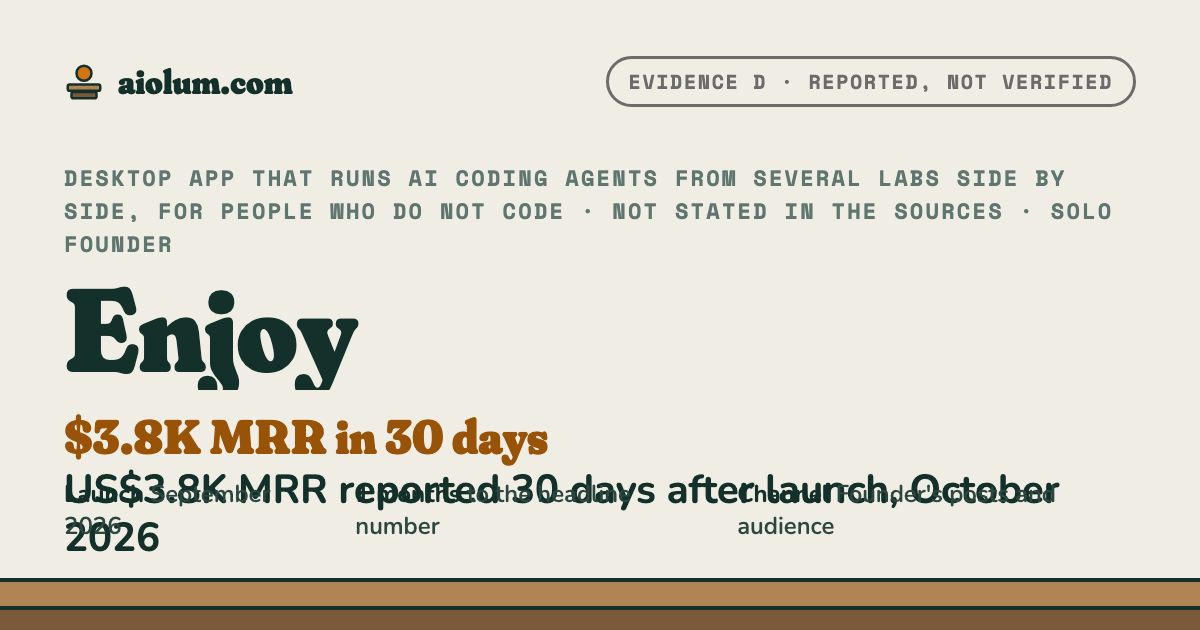
Enjoy (Desktop app that runs AI coding agents from several labs side by side, for people who do not code, Not stated in the sources): US$3.8K MRR reported 30 days after launch, October 2026. Evidence grade D: reported, not verified. Team: 1 founder, Mo Bitar; the about page calls it a company of one, Mo and a staff of agents. Launched September 2026; still running.Added 6 November 2026
- Outcome
- US$3.8K MRR reported 30 days after launch, October 2026
- Evidence
- D reported, not verified
- Launch
- September 2026
- Status
- Still running
- Team
- 1 founder, Mo Bitar; the about page calls it a company of one, Mo and a staff of agents
- Outside funding
- None reported in the sources
- Main channel
- Founder's posts and audience
What is not verified
The headline figure, US$3.8K MRR 30 days after launch, rests on one source: the founder's post on X of 15 October 2026, as quoted by Shipped & Paid, which marks it self-reported and not independently verified. No payment-processor profile (such as TrustMRR) or second dated figure was found. Enjoy became free from 20 October 2026 and later moved to a new price, according to its help and pricing pages, so later revenue is unknown. A reader could look for a revenue-verified profile or a later founder update. The headline number is grade D: one claim or one estimate, with no second source. Aiolum shows it because the story is useful, and marks it so that it is not mistaken for a verified figure.
Enjoy is a desktop workspace for AI coding agents, programs such as Claude Code or Codex that read and change the files of a software project and run commands on their own. Enjoy has no AI model of its own. It starts each lab's agent on the user's computer with the user's own subscription plan, the monthly plan the user pays to Anthropic, OpenAI or another lab, and it lets the user switch agents or accounts in the middle of a task when one plan's usage limit, the amount of work a plan allows in a time window, runs out.
Mo Bitar, who earlier built the note-taking app Standard Notes according to Shipped & Paid, founded it in 2026 and the about page calls the company "a company of one, too: Mo, and a staff of agents". On 15 October 2026 he wrote on X, as quoted by the case directory Shipped & Paid, that Enjoy had launched 30 days earlier and was at US$3.8K MRR, and in the same post that it lacked product-market fit. An archived home page of 24 September 2026 sold one plan, Unlimited, at US$14.99 a month; the help pages say Enjoy was then free from 20 October 2026, and the pricing page read on 6 November 2026 asks US$29 a month after 7 free days.
The revenue figure rests on one founder post, quoted by one directory, so it is grade D. No payment-processor profile or second dated figure confirms it, and the price changed twice after the post, so the page does not say whether revenue grew or fell. The page also shows earlier companies that promised software building without programmers, or a better place to write code, and failed.
How much revenue does Enjoy make?
Each row shows the evidence grade and the source numbers from the list at the end of this page. The grades are explained in How Aiolum verifies.
| Fact | Value | Grade | How we know | Sources |
|---|---|---|---|---|
| Monthly recurring revenue, 15 October 2026 | US$3.8K | D | The founder on X, 15 October 2026, as quoted by Shipped & Paid: "enjoy launched 30 days ago and is at $3.8k mrr". Shipped & Paid marks it "Self-reported ... Not independently verified". | [1] |
| Run rate from the October 2026 figure | US$45,600 a year | calc | Calculated: the founder's US$3,800 a month times 12. This is the outcome amount used by the site. | [1] |
| Launch | about 15 September 2026 | D | The founder's post of 15 October 2026 says 30 days earlier. An archived copy of the home page from 24 September 2026 shows downloads for Mac, Windows and Linux. | [1, 8] |
| Founder's own view of the fit | lack of product-market fit | D | Same post: "i already know what lack of product market fit feels like and this is it". Shipped & Paid adds that he considered a rebrand. | [1] |
| Team | 1 person and AI agents | C | About page: "It's a company of one, too: Mo, and a staff of agents." The press page lists the founder as Mo and the year as 2026. | [4, 9] |
| Price at launch | US$14.99 a month, Unlimited, after a free trial | C | Archived home page, 24 September 2026. | [8] |
| Free period | from 20 October 2026 until it became a paid plan | C | Help page "I used Enjoy while it was free", updated 27 October 2026. Users who activated it then got 30 days of Enjoy Cloud without a card. | [6] |
| Price on 6 November 2026 | US$29 a month after 7 free days | C | Pricing page. A card is needed to start the trial. | [3] |
| AI model | none of its own | C | About page: "Enjoy doesn't have its own AI model. Each agent is its maker's own program." Agents named: Claude Code, Codex, Grok Build, Antigravity, Muse Code and OpenCode. | [4] |
| Platforms | Mac, Windows, Linux, web; iPhone app | C | Press fact sheet and pricing page. The home page called the iPhone app "coming soon" on 6 November 2026. | [9, 3, 2] |
| Built with | OpenAI Codex | D | Shipped & Paid, from the founder's posts. The manifesto says he lets AI do the programming: "It's the way I choose to work." | [1, 5] |
| Prior audience | about 85K followers on X and a YouTube channel | D | Shipped & Paid's count, not checked on this page. | [1] |
| Payments | Stripe Checkout | C | Help page on the free period. | [6] |
| Outside funding | none reported | C | No source names an investor or a round. | [4, 9] |
| Time from launch to the October 2026 figure | 1 month | calc | Calculated: September 2026 to October 2026. | [1] |
How to read this table: grade D means one founder statement with one date, quoted by a third party, not checked. Grade C values come from the company's own pages. A "calc" value (grade X) was computed on this page. No value is grade A or B.
| Plan | Per month, billed yearly (US$) | Per month, billed monthly (US$) | Limit |
|---|---|---|---|
| Enjoy | 29 | every agent and project; phone, browser, other computers and team; 7 days free | |
| Unlimited (earlier subscribers only) | 14.99 | kept at this price | |
| Enjoy Cloud (earlier subscribers only) | 19.99 | kept at this price | |
| Free (computers that used Enjoy while it was free) | 0 | 0 | desktop features only; phone, browser and team need a subscription |
The pricing page lists one plan with no yearly price; a card is needed to start the 7 free days. The pricing page says earlier subscribers keep Unlimited at US$14.99 a month or Enjoy Cloud at US$19.99 a month, and that computers that used Enjoy while it was free keep the desktop features free. Each agent is billed separately by its maker; the about page says Enjoy adds no markup. Shipped & Paid wrote in October 2026 that Unlimited then cost US$14.99 a month plus US$9.99 a month per extra computer.
When did Enjoy launch, and how did it grow?
From launch to a changed price and a new brand name in about seven weeks. Each entry carries its grade.
- 2026CMo founds Enjoy, under the brand later called Enjoy Agentic Industries, as a company of one. [4, 9]
- About 15 September 2026DLaunch, by the founder's count of 30 days before his 15 October post. [1]
- 24 September 2026CThe archived home page reads "one person, infinite engineers", offers downloads for Mac, Windows and Linux, a free 15-minute tour with Mo, and one plan, Unlimited, at US$14.99 a month after a free trial. [8]
- 15 October 2026DThe founder writes on X that Enjoy is at US$3.8K MRR and that it lacks product-market fit, as quoted by Shipped & Paid. [1]
- 20 October 2026CEnjoy becomes free for a period; users who activate it get 30 days of Enjoy Cloud without a card. [6]
- 1 November 2026CNew terms of service under the name Enjoy Agentic Industries. [10]
- 6 November 2026CThe site sells "Enjoy Agentic, a superagent for your computer" with a coordinating agent called JOY, at US$29 a month after 7 free days, according to the pricing page. [2, 3]
Why did Enjoy work?
Four causes, in the order they mattered. Each one is a reusable lesson.
An audience first
Shipped & Paid writes that customers came from the founder's own posts on X and his YouTube channel, and that he himself doubted those followers were the beginners Enjoy is aimed at.
No model, no model costs
Each agent runs on the user's own plan at its lab, and the about page says Enjoy adds no markup. Enjoy pays for the app and for the servers that connect phones, browsers and teammates to the user's computer.
Selling around usage limits
The home page sells tracking of every plan's limit, one-click switching between several Claude Code and Codex accounts, waiting for a limit to reset and then continuing, and advice to move to a cheaper plan. These are problems that heavy users of coding agents have today.
Fast price changes
The archived page of 24 September 2026, the free period from 20 October and the pricing page of 6 November 2026 show three different offers in about seven weeks, while earlier customers keep their old terms.
How it was built
These details come from the company's own pages (grade C) and from Shipped & Paid's summary of the founder's posts (grade D). [1, 5, 3, 4, 6, 11]
- Built by one founder who, according to his manifesto, lets AI agents do the programming, including tests and reviews. Shipped & Paid names OpenAI Codex as the tool.
- A desktop app for Mac, Windows and Linux. Projects, conversations and docs stay on the user's computer; phones and browsers reach it through an end-to-end encrypted connection, according to the pricing page.
- The agents are the labs' own programs, installed and signed in on the user's computer. OpenCode can use free or local models.
- Payments go through Stripe Checkout, according to the help pages.
- Release notes ship with the app, and the full release history is on GitHub, according to the help pages.
Who tried this before Enjoy, and why did they fail?
Four companies in our database of failed startups promised that people could build software without programmers, or a better place for programmers to work, and failed. The values below are from that database and are not independently verified.
Builder.ai
The promiseCustom apps built by an AI-powered assembly line instead of expensive developers.
Why it diedThe database says it sold apps that cost more to build than their price, and that offshore developers did work presented as AI.
Appcubator
The promiseDrag-and-drop app building for people with no programming knowledge.
Why it diedUsers came but few paid, and more flexible competitors such as Bubble won.
Light Table/Eve
The promiseA code editor with real-time feedback, then Eve, app building for everyone.
Why it diedProfessional developers stayed with the editors they already used.
Nitrous.io
The promiseCloud development environments with no local setup.
Why it diedAmazon bought the competitor Cloud9 and offered it free or cheap, while Nitrous tried to sell what the giants bundled.
The failed startups come from our database of 1,749 dead startups, retold here in our own words. Its entries are AI-assisted summaries of public sources, so these cards carry no evidence grade.
What changed
Builder.ai and Appcubator promised software without programmers before a machine could write the code; one hid human work behind the word AI, and the other could not get users to pay. Light Table and Nitrous.io built a better place to write code and lost to tools that developers already had or that large companies gave away.
Enjoy relies on agents that write and test code themselves, so the promise to non-programmers is closer to real. It does not build the agents: the labs do, and they also ship their own apps. Its bet is the layer between several labs, which no single lab sells, and a founder whose costs are close to zero. The same giants-give-it-away risk that ended Nitrous.io applies.
Can one person copy Enjoy now?
The structure, yes. The audience, not quickly.
A one-person app that coordinates other companies' agents on the customer's own plans needs no model budget and no servers for the heavy work. The founder-reported first month rested on a large existing audience, which a new founder does not have.
Where it is still open: Coordination layers above several AI providers for groups that the labs do not serve directly: small agencies, teachers, or one industry's back office.
- 1Pick a daily pain of heavy users of AI tools, such as usage limits across several plans, and build the layer that no single lab will build.
- 2Let the customer bring their own plans, so the AI cost is never yours.
- 3Launch to an audience that already follows your building, and check whether the buyers are the people you aimed at.
- 4Read your provider's terms before you sell account switching or plan sharing.
What could go wrong for Enjoy?
The risks are the mirror image of the causes above.
What is not verified
The headline figure, US$3.8K MRR 30 days after launch, rests on one source: the founder's post on X of 15 October 2026, as quoted by Shipped & Paid, which marks it self-reported and not independently verified. No payment-processor profile (such as TrustMRR) or second dated figure was found. Enjoy became free from 20 October 2026 and later moved to a new price, according to its help and pricing pages, so later revenue is unknown. A reader could look for a revenue-verified profile or a later founder update.
Competition
BridgeMind and CNVS, both on this site, sell similar desktop workspaces for AI coding agents, and Enjoy's own footer lists comparisons with Claude Code, Codex, Cursor, Conductor, Lovable, Replit and others, so the field is crowded and the labs themselves are in it.
Dependent on the labs' agents, plans and terms
The about page says Enjoy has no model of its own and runs each lab's agent on the user's plan, so a change in an agent, a plan or a lab's rules changes the product. The home page sells switching "between your many accounts" when one runs out. Enjoy's own help page says Anthropic and OpenAI allow several accounts, that OpenAI's terms forbid getting around its rate limits, and that sharing an account with another person gets accounts suspended; the pricing page says invited teammates use the AI accounts signed in on the host computer, "so one Claude or Codex plan can serve the whole team". This page does not judge which reading the labs apply.
Founder's own doubts and fast changes
In the same post as the revenue figure, the founder said Enjoy lacked product-market fit, and Shipped & Paid reports that he considered a rebrand. In about seven weeks the product went from US$14.99 a month to a free period to US$29 a month, according to the archived home page, the help pages and the pricing page, and the name changed to Enjoy Agentic.
Sales from one person's audience
Shipped & Paid writes that customers came from the founder's roughly 85K followers on X and his YouTube channel, and that he doubted those followers match the beginners Enjoy is aimed at.
Sources
The grade next to each source is the best grade that the source can support. "Read in full" means that the text of the page was downloaded and the numbers were checked in it.
- D Shipped & Paid case page: Enjoy, a desktop app for AI coding agents at $3.8K MRR 30 days after launchRead in full (downloaded 6 November 2026). Quotes the founder's X post of 15 October 2026; source for the MRR figure, the founder's name, Codex and the audience.
- C Enjoy home page: Enjoy Agentic, a superagent for your computerRead in full, 6 November 2026. Source for the agents, JOY, account switching and the iPhone app status.
- C Enjoy pricing pageRead in full, 6 November 2026. Source for the prices, the earlier plans and how teams share agents.
- C Enjoy about page: We don't make the AI. We put it to work.Read in full. Source for the company of one, the founding year and the no-model, no-markup design.
- C The Enjoy manifesto, by MoRead the first five sections. Source for the founder's view that AI should do the programming.
- C Enjoy Operating Manual: I used Enjoy while it was free (updated 27 October 2026)Read in full. Source for the free period from 20 October 2026, Enjoy Cloud and Stripe Checkout.
- C Enjoy Operating Manual: Will having more than one Claude or Codex account get me banned? (updated 14 October 2026)Read in full. The company's own summary of Anthropic's and OpenAI's rules on several accounts and account sharing.
- C Internet Archive copy of enjoy.dev, 24 September 2026Read in full. Source for the launch-period offer and the US$14.99 price.
- C Enjoy press page and fact sheetRead in full. Source for the founder, founding year, platforms and price.
- C Enjoy Terms of Service, 1 November 2026Read the first three sections. Source for the company name and the date.
- C Enjoy Operating Manual: See what's new in Enjoy (updated 29 October 2026)Read in full. Source for the release history on GitHub.
- C Database of failed startups, local exportLocal export. AI-written summaries, not independently verified. Source for the failed predecessors.
Run this company? Send corrections or a verified figure to aiolum@livyden.com