Magnific
Magnific is a creative upscaler. An upscaler is a program that enlarges an image. A normal upscaler guesses the missing pixels from the pixels around them. A creative upscaler uses an image model to invent new detail that was never in the file, guided by a text prompt and a creativity slider. In late 2023 most Midjourney images were small and soft, and designers wanted to print them.
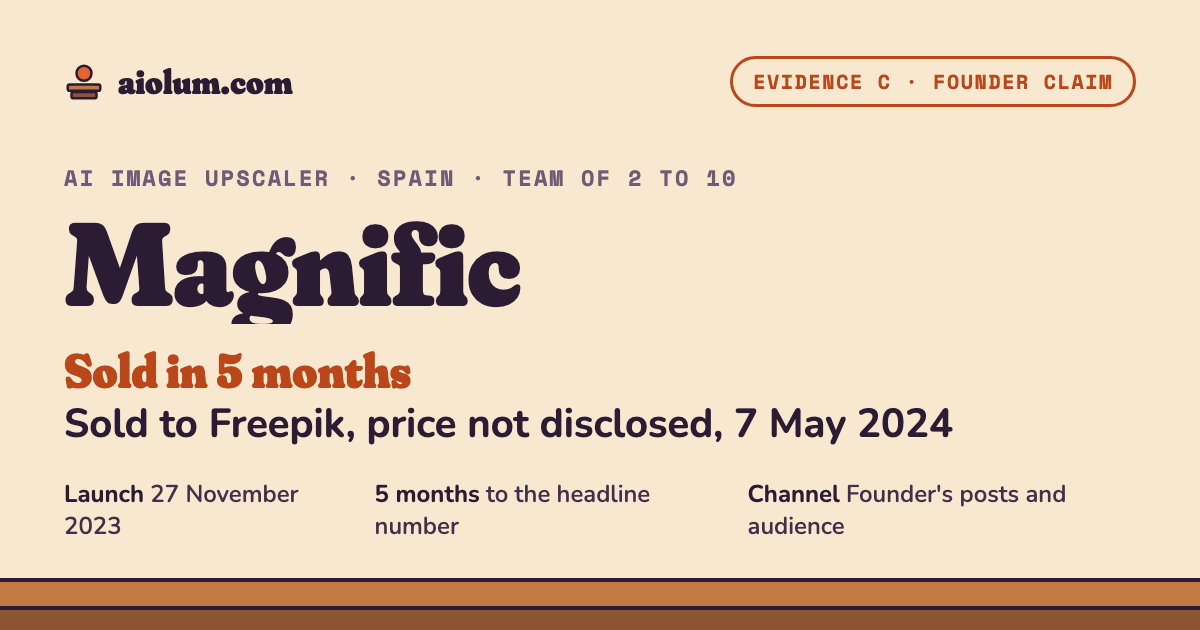
Javi López and Emilio Nicolás, two founders from Murcia, Spain, who had sold a student-housing site after thirteen years, built the tool in about three months for under US$5,000 and opened it on 27 November 2023 after a two-week waitlist. There was no free trial. Five months later it had 725,000 registered users, and on 7 May 2024 Freepik, a design platform from Málaga with tens of millions of users, bought it for an undisclosed price. The founders say it made US$10.2 million in 2024 and US$34.42 million in 2025 with two people and a 90% gross margin after GPU costs. Gross margin is revenue minus the direct cost of delivering the product, here the rented graphics processors, divided by revenue.
The revenue numbers are founder claims, grade C. The sale, the user count and the Freepik figures are grade B. On 28 April 2026 Freepik renamed itself Magnific, after the product it had bought, and reported US$230 million in annual recurring revenue. That figure belongs to the whole parent company, not to the upscaler.
The numbers, graded
Each row shows the evidence grade and the source numbers from the list at the end of this page. The grades are explained in How Aiolum verifies.
| Fact | Value | Grade | How we know | Sources |
|---|---|---|---|---|
| Revenue, 2024 | US$10.2 million | C | Founder's post on X, 28 April 2026. The first full calendar year after the launch. | [1] |
| Revenue, 2025 | US$34.42 million | C | Same post. The founder writes that it includes sales from both websites after the acquisition, so part of it is Freepik's. | [1] |
| Gross margin after GPU costs | 90% | C | Same post. GPU costs are the rented graphics processors that run the image model. | [1] |
| GPU cost in 2024, implied | about US$1.0 million | calc | Calculated: 10% of 10.2 million. Gross profit about US$9.2 million. | [1] |
| Revenue per founder, 2024 | US$5.1 million | calc | Calculated: 10.2 million divided by 2. There were no employees. | [1, 3] |
| Annual recurring revenue one year after launch | US$10 million | C | Founder's post on X, 14 February 2025. | [2] |
| Registered users at the sale | more than 725,000 | B | Freepik's announcement, reported by Tech.eu and LBB. | [3] |
| Waitlist sign-ups in the first 24 hours | more than 30,000 | B | Same announcement. | [3] |
| Employees | 0, besides the two founders | B | The announcement says the tool was built without a CEO. The Decoder describes a two-man team. | [3, 4] |
| Advertising spend | none | C | Founder's email to users, quoted by The Decoder. | [4] |
| Money to start | under US$5,000 | C | Founder's account, compiled by Startup Founder Stories. Development took about three months. | [5] |
| Share of the code written by an AI model | about half | C | Founder's email, May 2024: written with GPT-4. | [4] |
| Sale price | not disclosed | B | Freepik called it its largest acquisition. Earlier purchases were EyeEm, Videvo, Iconfinder and Original Mockups. | [3] |
| Time from launch to the sale | 5 months | calc | Calculated: 27 November 2023 to 7 May 2024. | [3, 5] |
| Outside funding | none | B | Freepik's announcement and the founder's posts. The parent company is a different case: see the limits. | [1, 3] |
| Parent company's annual recurring revenue, April 2026 | US$230 million | B | Freepik, renamed Magnific, to Fortune. Video is about half of it. More than one million paying subscribers, about 400 employees. | [6] |
| Parent company's revenue per employee | about US$575,000 | calc | Calculated: 230 million divided by 400. | [6] |
How to read this table: a grade B value comes from the buyer's announcement or from independent press. A grade C value is a founder claim or a reviewer's report. A "calc" value was computed on this page from the rows above it. No value is grade A: the buyer is privately owned and no payment processor has published the revenue.
| Plan | Per month, billed yearly (US$) | Per month, billed monthly (US$) | Limit |
|---|---|---|---|
| Free | 0 | 0 | about 20 images a day |
| Premium | 14.50 | 20 | |
| Premium+ | 33.75 | 45 | |
| Pro Starter | 82.50 | 110 | |
| Pro | 210 | 280 | |
| Business | 55 per seat | two seats minimum |
These are the plans of the merged company, which bundle the upscaler with image and video generation. Each plan has a monthly credit budget; the reviewer estimates about 2,666 upscales a year on Premium and about 44,444 on Pro, or roughly US$0.06 per upscale. In 2024, before the merger, Spanish press reported that the standalone upscaler started at US$39 a month with usage tokens and no free tier.
The timeline
From a sabbatical hobby to a sale in five months, then the buyer took the product's name. Each entry carries its grade.
- 2010 to 2022CLópez and Nicolás build Erasmusu, a student-housing site in Murcia, for thirteen years and sell it. Both take a two-year break. [5]
- April 2022CDALL-E 2 is released. López starts experimenting with image models and posts tutorials and tests on X. A year later the audience exists, before any product. [5]
- Autumn 2023CA workflow from his experiments enlarges an image and redraws it with new detail. He runs his own posted artwork through it for three months. Development takes about three months and under US$5,000. [5]
- Mid-November 2023BTwo-week waitlist. A handful of creators get access and post before-and-after images. More than 30,000 people sign up in 24 hours. [3, 5]
- 27 November 2023COpen to everyone. No free trial, because every upscale costs GPU time. Users buy tokens from the first hour. [5]
- December 2023CRelaunch on Product Hunt after a first attempt fails on Product Hunt's side, with one day of 50 free tokens for everyone. [5]
- 7 May 2024BFreepik announces the acquisition: 725,000 registered users, its largest purchase to date. Magnific continues as a subsidiary. Both founders join Freepik Labs, the AI team. [3]
- May 2024CLópez tells users that half of the code was written with GPT-4 and predicts one-person unicorns. [4]
- 14 February 2025CLópez posts: from zero to US$10 million ARR in one year with two people. [2]
- 28 April 2026BFreepik renames the whole company Magnific and reports US$230 million ARR to Fortune. López publishes the 2024 and 2025 revenue of the upscaler. [1, 6]
Why it worked
Four causes, in the order they mattered. Each one is a reusable lesson.
Audience before product
López opened his X account a year before Magnific existed and used it for generative AI tutorials and experiments. When the waitlist opened, 30,000 people signed up in a day. In his own words, the whole launch strategy was to spend a year talking about AI without realizing you are building a channel, then give tokens to creators so they spread the word.
A thing without a name
Existing upscalers kept the image faithful. Magnific invented detail, and early users complained that it was not a real upscaler. The complaint was the point: no existing tool produced that output, so there was no free alternative to compete with. The buyer's announcement called it a new category.
Paid from the first hour
No free trial, because each upscale cost GPU time. Tokens were sold at launch, so revenue arrived on day one and the two founders never needed a salary from investors. The founder reports a 90% gross margin after GPU costs, and personnel and marketing costs that were negligible with two people.
Sold to a distributor
Freepik had tens of millions of users and no upscaler. It bought the two-person company five months after launch. Two years later it took the product's name for the whole company, which by then reported US$230 million ARR across stock images, image and video generation.
How it was built
These details come from the founder's email to users, quoted by The Decoder, and from a compilation of his accounts. They are grade C. [4, 5]
- A workflow on top of open-source image models, with a creativity slider and a text prompt that guide how much detail the model invents. The exact models are not public.
- About half of the source code was written with GPT-4, which in late 2023 few people believed.
- Rented GPUs ran the model. Because each image cost money, the product had tokens and no free tier from the first day.
- Launch by throttling: a two-week waitlist, early access for a few creators, their before-and-after images as the marketing. Then a Product Hunt relaunch.
- No CEO, no employees, no advertising. The founders handled everything, from support to billing, until the sale.
- A previous exit paid the founders' living costs, so the company needed no salary from day one.
Tools named in the sources
Each one opens its page in the Tools tab, with every story that uses it.
The dead that came before
Five companies in the Loot Drop database tried to improve photos with software or hardware before image models existed. The values below are from that database and are not independently verified.
Lytro
The promiseA camera that captures every ray of light, so you refocus the photo after you take it.
Why it diedThe hardware delivered 1.2-megapixel output from an 11-megapixel sensor at US$399 to US$499. Phones got better faster. The company pivoted twice and never fixed its costs.
Picnik
The promisePhoto editing in the browser, without installing software.
Why it diedGoogle bought it in 2010, folded it into Google+ and shut it in 2012. Phone apps with built-in filters made a web editor unnecessary.
Everalbum
The promiseUnlimited photo storage with AI organization.
Why it diedGoogle Photos offered the same for free. Users would not pay for a feature that the platform gave away.
Snipshot
The promiseQuick photo edits in the browser.
Why it diedPicnik did more, free tools did the same, and there was no clear way to charge.
Splashup
The promisePhotoshop-like editing in the browser, with real-time collaboration.
Why it diedBuilt on Flash as Flash died. No business model.
What changed
Before 2022, improving an image meant arithmetic or hardware. A classic upscaler averaged neighbouring pixels and produced a larger, softer picture. Lytro spent US$215 million on optics so that a photo could be refocused. The browser editors, Picnik, Snipshot and Splashup, offered convenience, and convenience lost as soon as Google or a phone app bundled the same feature for free.
Image models changed what software could do: invent detail that looks right. That output had no free equivalent in November 2023, so two people could charge for it from the first hour. The business risk did not disappear. It moved. Freepik now gives its subscribers third-party models, and every image tool has an upscaler. Magnific was sold five months after launch, before that happened.
Can one person copy it now?
Not the product. The sequence, yes.
Creative upscaling is now a feature in Magnific's own parent, in Topaz, Krea, Leonardo and in the image models themselves. A new entrant with the same product competes with free. What remains is the order of events: audience first, a new capability second, paid usage from the first hour, and a sale to the company that owns distribution.
Where it is still open: The same sequence applies to each new model capability: video upscaling and restoration, 3D from one image, audio cleanup. Tools for one profession, such as architecture renders or film VFX plates, are less exposed to bundling.
- 1Post what you learn about a new technology for a year, in public, before you have anything to sell.
- 2Build the first tool that uses a new model capability for one visible result, and give it a name.
- 3If compute costs money, sell tokens from the first hour and skip the free tier.
- 4Sell to the platform whose users you already serve, before the capability becomes a feature everywhere.
What to watch
The risks are the mirror image of the causes above.
Founder-reported revenue
The US$10.2 million and US$34.42 million figures come from one post on X. No buyer, filing or payment processor has confirmed them, and the 2025 figure includes sales on Freepik's site. Latka estimates the standalone upscaler at US$330,000 ARR, which contradicts the founder by a factor of 30. This page shows the founder's figures with grade C.
The price is unknown
Freepik did not disclose the price, and the founders' payout is unknown. The outcome on this page is the first-year revenue, not the money the founders received.
Bootstrapped, with a footnote
Magnific took no outside money. Its parent says the same, but Wikipedia and Spanish press report that the private-equity firm EQT took a majority stake in Freepik in 2020. The parent's US$230 million ARR is a company with 400 employees and 14 years of history, not a two-person story.
Category collapse
Upscaling became a feature of every image tool within two years. The founders sold before that, and the founder himself says he could not repeat the launch.
GPU dependence
The margin depends on rented GPU prices and on the models the company does not own. The parent now resells third-party models such as Google's Veo, which sets a floor on its costs.
Sources
The grade next to each source is the best grade that the source can support. "Read in full" means that the text of the page was downloaded and the numbers were checked in it.
- C Javi López on X, 28 April 2026: Magnific AI in numbersRead through a public mirror of X, because X does not serve posts without login. Source for the 2024 and 2025 revenue and the gross margin.
- C Javi López on X, 14 February 2025: From $0 to $10M ARR in just one year with only two peopleRead through a public mirror of X.
- B Tech.eu, 7 May 2024: Freepik acquires Spanish AI image upscaler MagnificRead in full, together with the same announcement on LBB Online. Based on Freepik's announcement. Source for the user count, the waitlist, the no-CEO detail and the earlier acquisitions.
- C The Decoder, May 2024: Magnific AI co-founder predicts the rise of one-person unicorns propelled by AI after exitRead in full. Quotes the founder's email to users. Source for the zero advertising, the two-man team and the GPT-4 share of the code.
- C Startup Founder Stories: Javi López, Magnific, 0 to $10M ARRRead in full. A compilation of the founder's talks and posts. Source for the launch date, the waitlist mechanics, the starting cost and the founders' background.
- B Fortune, 28 April 2026: Spanish startup Freepik changes name to Magnific as new focus on video AI leads to $230 million ARRRead in full. Interview with Freepik's chief executive. Source for the parent company's figures.
- C My Architect AI, 2026: Magnific AI pricing, plans, tokens and API costsRead in full. A reviewer's page with the 2026 plans of the merged company. The company's own plan page returned an error for this check.
- C El Ecosistema Startup, 2026: Magnific factura $230M ARR sin inversiónRead in full, in Spanish. Source for the US$39 starting price of the standalone upscaler and for the note on EQT.
- C Wikipedia: Magnific (company), read 12 October 2026Read in full. Used for the 2020 EQT stake and the company history, which it cites to Spanish press and Fortune.
- C Latka company page: Magnific AI revenue 2025Read the summary. An estimate that contradicts the founder. Cited only for that conflict.
- C The AI Corner newsletter, 2026: Zero ads, zero VC, $230M ARR, the story of MagnificRead in full. Narrative account that led to the founder's posts. Not used for numbers.
- C Loot Drop database export, 1,749 failed startupsLocal export. AI-written summaries, not independently verified. Source for the failed predecessors.