Executor: Product, team and how it was built
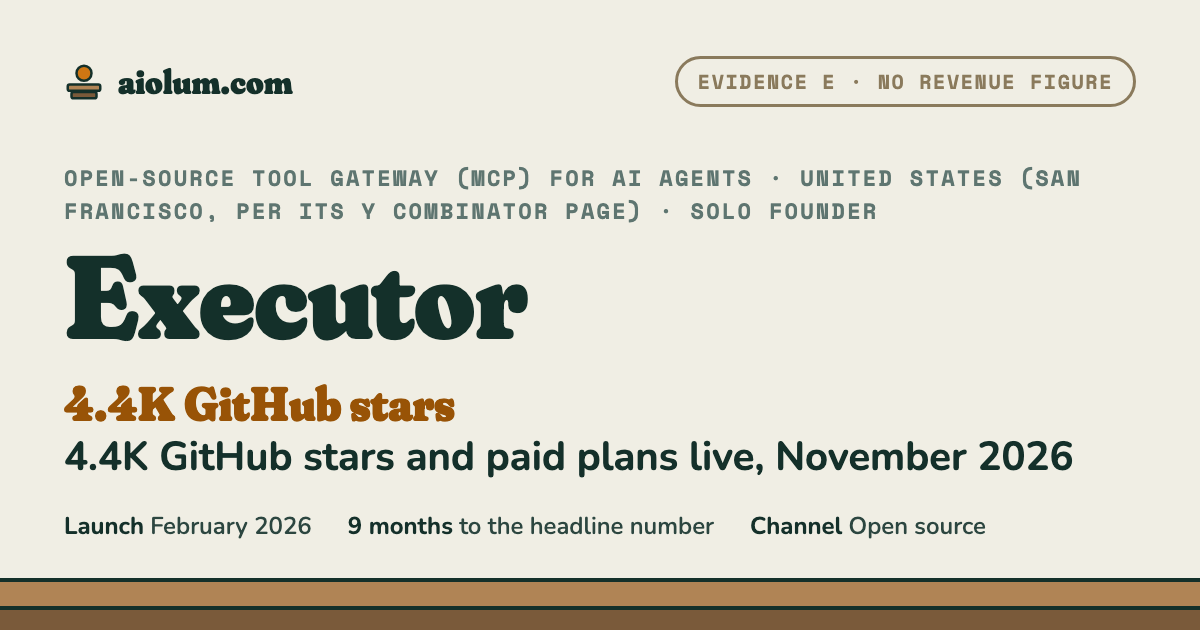
Executor (Open-source tool gateway (MCP) for AI agents, United States (San Francisco, per its Y Combinator page)): 4.4K GitHub stars and paid plans live, November 2026. Evidence grade E: no revenue figure was checked. Team: Solo founder; Y Combinator lists a team of 1 in San Francisco in November 2026. Launched February 2026; still running.Added 7 November 2026
- Outcome
- 4.4K GitHub stars and paid plans live, November 2026
- Evidence
- E no revenue figure was checked
- Launch
- February 2026
- Status
- Still running
- Team
- Solo founder; Y Combinator lists a team of 1 in San Francisco in November 2026
- Outside funding
- Y Combinator (Summer 2026); amount not published
- Main channel
- Open source
What is not verified
No revenue figure for Executor was found. We looked for a payment-processor profile, a founder interview with figures, a funding announcement with a round size and a filing. The figure of "~3,000 users on the local version" is the founder's own statement in the launch post of 4 August 2026 and was not checked elsewhere; GitHub stars and npm downloads show developer interest and installs, not paying customers. The home page quotes named users with links to 64 posts on X; those posts could not be opened (x.com needs a login) and were not checked. A reader could look for a payment-processor profile, a Y Combinator Demo Day figure or an interview with numbers. This story is grade E: the business is real and its product, price and customers are described from public pages, but no revenue figure was checked. Aiolum shows it as an idea worth studying, not as proof that it makes money.
Executor is a tool gateway, one service that sits between AI agents and the outside tools they call and handles sign-in and permissions for all of them. Agents reach it through MCP, the Model Context Protocol, a common way for an AI agent to discover and call outside tools. The home page says "Executor runs no AI. It extends the agent you already use, through one MCP server."
Rhys Sullivan, formerly a software engineer at Vercel according to his Y Combinator profile, built it alone; Y Combinator lists a team of 1 in its Summer 2026 batch. His launch post of 4 August 2026 reported "2,800+ GitHub stars, ~14k npm downloads/week, ~3,000 users on the local version". On 7 November 2026 GitHub showed 4,363 stars, and npm counted 41,189 downloads of the package in the week to 6 November.
No revenue figure was found, so this story has grade E. The pricing page lists a free Cloud plan for up to three members and a Team plan at US$15 per member a month, so the paid plan exists, but no source says how many teams pay for it.
How much revenue does Executor make?
Each row shows the evidence grade and the source numbers from the list at the end of this page. The grades are explained in How Aiolum verifies.
| Fact | Value | Grade | How we know | Sources |
|---|---|---|---|---|
| Revenue of Executor | not published | C | No payment-processor profile, founder interview with figures, funding announcement with a round size or filing was found. See "What is not verified". | [1, 2, 3, 4] |
| GitHub stars, 7 November 2026 | 4,363 stars, 403 forks | C | GitHub REST API for UsefulSoftwareCo/executor, read 7 November 2026; the repository page shows "4.4k stars". Stars show developer interest, not paying customers. | [6, 5] |
| Traction in the launch post, 4 August 2026 | "2,800+ GitHub stars, ~14k npm downloads/week, ~3,000 users on the local version" | C | Founder's launch post on Y Combinator. The user count of the local version was not checked anywhere else. | [2] |
| npm downloads, 31 October to 6 November 2026 | 41,189 downloads of the package executor | C | npm downloads API, read 7 November 2026. The home page gives the install command "npm i -g executor@beta". Downloads include repeat installs and automated builds, so they are not a count of people. Monthly totals: 82,181 in August, 79,244 in September and 114,288 in October 2026. | [7, 3] |
| Founder, team and location | Rhys Sullivan, founder; team of 1; San Francisco; founded 2026 | C | Y Combinator company page, downloaded by the pipeline on 7 November 2026. The launch post says "Solo technical founder, previously at Vercel." | [1, 2] |
| Funding | Y Combinator, Summer 2026 batch; amount not published | C | Y Combinator company page; the home page says "Backed by Y Combinator". No round size was seen. | [1, 3] |
| Prices, November 2026 | Cloud free for up to 3 members; Team US$15 per member a month; Enterprise custom; self-run free | C | Pricing page and home page, read 7 November 2026. | [4, 3] |
| Code and license | MIT license; TypeScript; repository created 7 February 2026 | C | GitHub repository page and REST API. The repository belongs to the GitHub organization UsefulSoftwareCo, which the launch post links as the Executor repository. | [5, 6, 2] |
| Releases | 159 releases from 9 March to 5 November 2026; 32 of them are Executor 2.0 betas, the first on 23 September 2026 | C | GitHub REST API, releases list, read 7 November 2026. | [6] |
| Founder's earlier project | Answer Overflow, "grew it to 1.5M monthly users as a solo dev, bootstrapped" | C | Founder's statement in the launch post. Not checked with another source. | [2] |
| Star growth after the launch post | +1,563 stars (+55.8%) in about 3 months | calc | Calculated: 4,363 stars on 7 November 2026 minus the 2,800 stated on 4 August 2026; 2,800 was a lower bound ("2,800+"), so the growth may be smaller. | [6, 2] |
| Weekly npm downloads against the launch post | about 2.9 times | calc | Calculated: 41,189 in the week to 6 November 2026 divided by the founder's "~14k" a week in August 2026. | [7, 2] |
How to read this table: a grade C value is the company's or the founder's own statement, or a count shown by GitHub or npm. A "calc" value was computed on this page. No value is grade A or B, and no revenue figure was found.
| Plan | Per month, billed yearly (US$) | Per month, billed monthly (US$) | Limit |
|---|---|---|---|
| Free (Cloud) | 0 | up to 3 members, unlimited integrations | |
| Team (Cloud) | 15 | per active member; 14-day free trial; verified domains | |
| Enterprise | custom | custom | self-hosted or dedicated cloud, SSO/SAML, SCIM, audit logs |
| Local or self-hosted | 0 | desktop app, CLI or Docker, MIT license |
The page shows monthly prices only and no yearly discount. Team bills each active member; pending invitations are not billed, and it starts with a 14-day free trial. Enterprise adds self-hosted or dedicated cloud deployment, SSO/SAML and SCIM, audit logs for every tool call and security reviews, at a price set by contract. The home page says "Running it yourself is free": the desktop app, CLI and Docker image use the MIT-licensed code.
When did Executor launch, and how did it grow?
From a new GitHub repository in February 2026 to a paid cloud plan and a second major version in beta, in about 9 months. Each entry carries its grade.
- 7 February 2026CThe repository UsefulSoftwareCo/executor is created on GitHub. [6]
- 9 March 2026CThe earliest release in the GitHub list, v1.1.8; version 1.4 releases follow from April 2026. [6]
- 25 to 27 June 2026CThree blog posts by the founder on MCP, APIs and CLIs as ways to call tools, and on companies that offer their tools to outside agents. [8]
- 4 August 2026CLaunch post on Y Combinator, "Executor — One place to connect your agents to everything": per-tool permissions, several accounts per service, a sandbox for tool calls, and 2,800+ GitHub stars and about 3,000 local users. [2]
- 23 September 2026CFirst beta release of Executor 2.0, which turns integrations into small TypeScript "apps" that can also store data, run on a schedule and serve a page. [6, 5]
- November 2026CPricing page lists a free Cloud plan and a Team plan at US$15 per member a month; GitHub shows 4,363 stars and npm counts 41,189 downloads in one week. [4, 6, 7]
Why did Executor work?
Four causes, in the order they mattered. Each one is a reusable lesson.
Timing
By 2026 one developer could use Claude Code, Codex, Cursor and ChatGPT side by side, and each needed its own connection to every service. Executor sells the layer that none of these agents owns: one place for accounts and permission rules that works with any MCP client.
Open code first, paid hosting second
The local desktop app and CLI are free under the MIT license, and the launch post measures traction in GitHub stars, npm downloads and local users. The hosted Cloud is free for up to three members, and the Team plan charges per member when a team grows past that.
Fewer tokens per agent
The launch post says 1,600+ tools collapse into "a single ~1k-token surface instead of ~280k tokens of tool definitions". Agents get two tools, skills and execute, and write a short program that calls the tools, instead of loading every tool description into the model's context.
How it was built
These details come from the GitHub README, the launch post and the company's home page. They are grade C. [5, 2, 3]
- The code is TypeScript; the repository has a bun.lock and a bunfig.toml file, so it is built with the Bun runtime.
- MCP servers, OpenAPI specs and GraphQL APIs are turned into one tool shape with a consistent name and schema, according to the launch post.
- Tool calls run in an isolated JavaScript sandbox, and credentials are added on the host side, so "the model never sees a raw token" (launch post).
- Each tool has a policy: always allowed, needs approval, or blocked. Executor keeps the meaning of each operation (GET or DELETE, GraphQL mutations), so safe calls run and risky ones ask first.
- Three ways to run the same code: a desktop app for Mac, Linux and Windows and a CLI on npm; one Docker container with an embedded database for self-hosting; and the hosted Executor Cloud at app.executor.sh.
Tools named in the sources
Each one opens its page in the Tools tab, with every story that uses it.
Who tried this before Executor, and why did they fail?
Three companies in our database of failed startups offered one layer that connects developers or teams to many outside services, and failed. The values below are from that database and are not independently verified.
Singly
The promiseOne API to collect and sync user data from many social networks and online services.
Why it diedIt depended on other companies' APIs, which changed and limited access, while Zapier and IFTTT offered broader automation.
Xkit
The promiseA platform that made connecting and managing third-party API integrations easier for product teams.
Why it diedZapier and other well-funded integration tools held the market, and cloud functions let developers build their own connections.
Snapboard
The promiseOne dashboard where developers and teams connect their APIs and tools.
Why it diedZapier and Microsoft Power Automate offered the same connections, and it could not stand out.
The failed startups come from our database of 1,749 dead startups, retold here in our own words. Its entries are AI-assisted summaries of public sources, so these cards carry no evidence grade.
What changed
Singly, Xkit and Snapboard each sold one layer in front of many outside services, to developers who wrote the integrations by hand, and lost to larger automation platforms or to services that changed their APIs. Executor faces the same risks: AI clients and model makers add their own connectors, and the home page compares Executor with Composio, n8n and Zapier.
Two things differ. The buyer is an AI agent's user, who now runs several agents and needs the same accounts and rules in all of them, a problem that no single agent maker solves for its rivals. And MCP gives every agent one way to call tools, so Executor connects to one protocol instead of one platform at a time.
Can one person copy Executor now?
Possible for one person, in a narrower form.
Rhys Sullivan built Executor alone, so the method is open to one developer. The hard parts are security, because the gateway holds every account's credentials, and keeping up with a fast-moving protocol and with agent makers that add their own connectors.
Where it is still open: Gateways for one industry or one set of tools (finance, health records, company data warehouses), where the permission rules matter more than the number of integrations.
- 1Pick a problem that every AI agent user has with every agent, such as sign-in, permissions or tool limits, and solve it outside any one agent.
- 2Publish the code with a free local version, and measure interest with stars, downloads and users from the start.
- 3Keep credentials away from the model: add them on the server side and let the user approve risky calls.
- 4Charge for the hosted version per team member, with a free tier for small teams.
What could go wrong for Executor?
The risks are the mirror image of the causes above.
What is not verified
No revenue figure for Executor was found. We looked for a payment-processor profile, a founder interview with figures, a funding announcement with a round size and a filing. The figure of "~3,000 users on the local version" is the founder's own statement in the launch post of 4 August 2026 and was not checked elsewhere; GitHub stars and npm downloads show developer interest and installs, not paying customers. The home page quotes named users with links to 64 posts on X; those posts could not be opened (x.com needs a login) and were not checked. A reader could look for a payment-processor profile, a Y Combinator Demo Day figure or an interview with numbers.
Competition
The home page compares Executor with Composio, n8n and Zapier and says it differs by letting users bring their own integrations and build apps on top. On this site, Metorial sells a similar YC-backed MCP gateway with paid plans and about 3,400 GitHub stars, but aims at company-wide access rules, while Executor started with one developer's many agents.
Dependence on AI clients and model providers
Executor does not run a model: the home page says "Executor runs no AI." It is used through AI clients made by others; the home page names Claude Code, Codex, Cursor, ChatGPT and Gemini, and the launch post says any MCP-compatible agent works. If these clients add multi-account sign-in and per-tool permissions themselves, part of Executor's value moves to them; supporting every MCP client is the founder's answer ("you can adopt whatever new agent ships next week").
Version 2 is in beta
The figures in the launch post describe version 1. Since 23 September 2026 the project ships Executor 2.0 as betas (32 by 5 November 2026), the CLI install command uses executor@beta and the desktop app is marked Beta. The README says version 1 lives on the main branch. Users who need a stable release should check which version a feature belongs to.
Sources
The grade next to each source is the best grade that the source can support. "Read in full" means that the text of the page was downloaded and the numbers were checked in it.
- C Y Combinator company page: ExecutorRead in full; downloaded by the pipeline on 7 November 2026. Source for the founder, his earlier employers, the founding year, team size, location and batch.
- C Y Combinator Launches, 4 August 2026: Executor — One place to connect your agents to everythingRead in full, from the launch data embedded in the company page downloaded on 7 November 2026. Source for the problem, the features, the traction figures and the founder's background.
- C Executor home page, read 7 November 2026Read in full. Source for what the product does and does not do, the supported agents, the ways to run it, the user quotes and the short pricing summary.
- C Executor pricing page, read 7 November 2026Read in full. Source for the plans, prices, trial and Enterprise features.
- C GitHub: UsefulSoftwareCo/executorRead the repository page and README, 7 November 2026. Source for the license, the file list, the features of version 2 and the ways to install it.
- C GitHub REST API: repository and releases of UsefulSoftwareCo/executorRead the repository record and both pages of the releases list, 7 November 2026. Source for the creation date, star and fork counts, language and release dates.
- C npm downloads API: package executorRead the last-week count and the daily counts from 1 January to 6 November 2026, on 7 November 2026. Source for the download figures.
- C Executor blog, read 7 November 2026Read the index page with post titles and dates; the posts themselves were not read in full.
- C Database of failed startups, local exportLocal export. AI-written summaries, not independently verified. Source for the failed predecessors.
Run this company? Send corrections or a verified figure to aiolum@livyden.com