ImageRouter: Revenue, team and how it was built
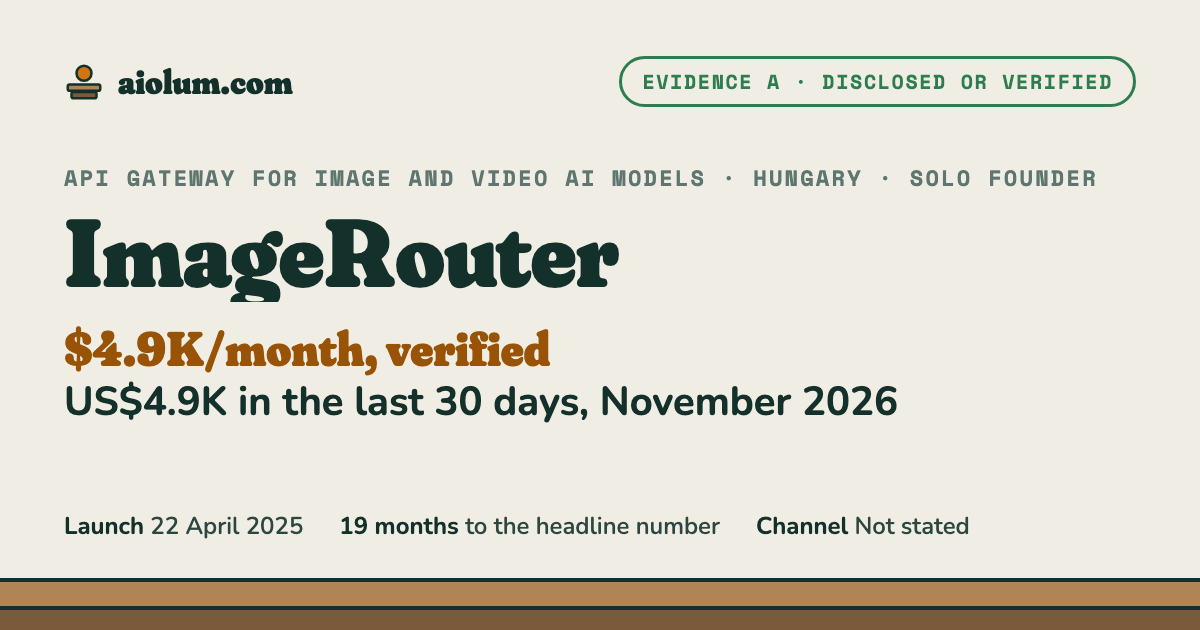
ImageRouter (API gateway for image and video AI models, Hungary): US$4.9K in the last 30 days, November 2026. Evidence grade A: disclosed by a company or a filing, or verified by a payment processor. Team: 1 founder, DaWe, the only maker listed on Product Hunt and the only founder on TrustMRR; headcount not published. Launched 22 April 2025; still running, revenue flat.Added 5 November 2026
- Outcome
- US$4.9K in the last 30 days, November 2026Revenue flat
- Evidence
- A disclosed by a company or a filing, or verified by a payment processor
- Launch
- 22 April 2025
- Status
- Still running
- Team
- 1 founder, DaWe, the only maker listed on Product Hunt and the only founder on TrustMRR; headcount not published
- Outside funding
- None reported in any source read
- Main channel
- Not stated
ImageRouter is an API gateway for image and video AI models. An API gateway is a single web address that receives requests from programs and passes each one on to the right backend service. Here the backend services are model providers such as Runware, Replicate, fal and Google Vertex. The API is OpenAI-compatible: it accepts the same request format as OpenAI's image API, so a developer can switch by changing the base URL and the key. The model list that the API returned on 5 November 2026 had 209 entries, 153 for images and 56 for video.
The founder publishes under the name DaWe; his GitHub profile gives Veszprém, Hungary, and the bank-transfer details on the site name an Estonian company, Weborate OÜ. TrustMRR gives 1 April 2025 as the founding date. The code was first published free on GitHub: an Internet Archive copy from 17 April 2025 shows a self-hosted "Image Router API" with 51 commits. The product launched on Product Hunt on 22 April 2025. Later the founder paused the free repository to work "0-24 on making ImageRouter a viable business".
Payment records that TrustMRR reads from Stripe show US$4,917 in revenue in the 30 days to 5 November 2026, US$54,273 in the last 12 months and US$66,656 since the start. That is grade A. Most of this money is prepaid credit that then pays the model providers: TrustMRR shows a profit margin of 30.0% for the last 30 days. The page also shows four failed companies that sold one API in front of many other services.
How much revenue does ImageRouter make?
Each row shows the evidence grade and the source numbers from the list at the end of this page. The grades are explained in How Aiolum verifies.
| Fact | Value | Grade | How we know | Sources |
|---|---|---|---|---|
| Revenue in the last 30 days, to 5 November 2026 | US$4,917 | A | TrustMRR revenue table from Stripe payment records. The same profile gives a 30-day snapshot of US$5,100 with growth of +11.3%, perhaps taken at a different time. | [1] |
| Run rate from the last 30 days | US$59,004 a year | calc | Calculated: US$4,917 times 12. This is the headline number in dollars. | [1] |
| Revenue in the last 12 months | US$54,273 | A | TrustMRR. So about US$12,383 came before November 2025 (calculated from the all-time figure). | [1] |
| Revenue since the start | US$66,656 | A | TrustMRR, all-time verified revenue, synced 5 November 2026. | [1] |
| Monthly revenue, December 2025 to October 2026 | US$2,576; 3,927; 5,589; 5,979; 3,899; 7,289; 3,766; 4,230; 4,043; 4,189; 5,949 | A | TrustMRR monthly timeline. The best month was May 2026. The last three months average US$4,581, about 3% below the three months before (calculated). | [1] |
| Largest single day in the last 30 days | US$1,223 on 26 October 2026 | A | TrustMRR daily table. About a quarter of the 30-day total (calculated). Most days are between US$50 and US$300, consistent with customers topping up credits. | [1] |
| Profit margin, last 30 days | 30.0% | C | TrustMRR metric snapshot. The profile does not say how the cost side is measured. Customers' credits pay the model providers, so revenue is not profit. | [1] |
| Monthly recurring revenue | US$63 from 2 active subscriptions | A | TrustMRR snapshot. Almost all revenue is prepaid credit, not subscriptions. | [1] |
| Visitors in the last 30 days | 6,667, or US$0.76 of revenue per visitor | A | TrustMRR, from the DataFast analytics connection. | [1] |
| Models in the API list | 209: 153 image, 56 video | B | Counted on this page from the models API response of 5 November 2026. The TrustMRR text says 231 models and the pricing page says 350+ models including text models. | [3, 1, 2] |
| Providers behind the models | Runware for 176 model entries; also Replicate, fal, DeepInfra, nanogpt, Google Vertex and Gemini, OpenAI, WaveSpeed and others | B | Counted from the provider field in the models API response. Some models have more than one provider. | [3] |
| Estimated users | 12,500 | C | TrustMRR profile text written by the founder ('Estimated user count'). | [1] |
| Team | 1 founder, DaWe | C | TrustMRR lists one founder; Product Hunt lists one maker. No source gives a headcount. | [1, 9] |
| Company and location | Weborate OÜ, Tallinn address; founder in Veszprém, Hungary | C | Bank-transfer details on the site name Weborate OÜ. The GitHub profile gives Veszprém, Hungary. TrustMRR gives the country as HU. | [2, 7, 1] |
| Open-source start | Self-hosted router on GitHub, 51 commits by 17 April 2025 | B | Internet Archive copy of the repository. In November 2026 it has 585 commits and 125 stars, and the README says the repository is paused. | [6, 5] |
| Time from founding to the headline figure | 19 months | calc | Calculated: April 2025 to November 2026. | [1] |
How to read this table: a grade A value comes from payment records that TrustMRR reads from Stripe. A grade B value is visible in public code or in the product's own API response. A grade C value is a statement by the company on its pages or its TrustMRR profile text. A "calc" (X) value was computed on this page from the rows above it.
| Plan | Per month, billed yearly (US$) | Per month, billed monthly (US$) | Limit |
|---|---|---|---|
| Free | 0 | 0 | 3 images a day on the free models |
| Pay as you go, card deposit | any amount; fee 5% + US$0.35 | ||
| Pay as you go, bank transfer | from US$250; no deposit fee | ||
| FLUX.1 schnell, per image | average US$0.0013 | ||
| GPT Image 2, per image | average US$0.0414 | ||
| Nano Banana 2, per image | average US$0.0689 | ||
| Sora 2, per video | average US$0.40 | ||
| Veo 3.1, per video | from US$1.20 |
There is no subscription. The customer deposits credits and each generation is charged per image or per video; the price depends on the model, the provider and settings such as size and quality, so the API gives a minimum, an average and a maximum. The averages below are per image or per video. A card deposit has a fee of 5% plus US$0.35, and the site says all credit purchases are final and non-refundable. The per-month columns are left empty because nothing is billed monthly.
When did ImageRouter launch, and how did it grow?
From a free self-hosted repository in April 2025 to a paid gateway with US$66,656 in verified revenue in November 2026. Each entry carries its grade.
- 1 April 2025CFounding date given on the TrustMRR profile. [1]
- 17 April 2025BThe GitHub repository 'Image Router API' is public: an OpenAI-compatible endpoint, rate limiting and free and paid usage tracking, run with Docker Compose. 51 commits. [6]
- 22 April 2025CLaunch on Product Hunt as Image Router (beta): 'Unified interface for image generation AI models'. [8]
- December 2025AUS$2,576 in verified revenue, the first month in the public TrustMRR timeline. [1]
- 14 January 2026CSecond Product Hunt launch, now with video: 'AI Image & Video aggregator - simple API - no subscription'. [8]
- May 2026ABest month so far: US$7,289 in verified revenue. [1]
- 2026CThe founder pauses the free self-hosted repository to focus on the hosted service, writing that he must 'survive the bloodbath of AI competition'. [5]
- 5 November 2026AUS$4,917 in the last 30 days and US$66,656 since the start, verified through TrustMRR. [1]
Why did ImageRouter work?
Four causes, in the order they mattered. Each one is a reusable lesson.
One request format for every model
The API copies OpenAI's image endpoint, so code written for OpenAI works with a changed base URL and key. The site calls it 'Drop-In Mode': 'swap your base URL and ship, zero rewrites'. Tools that already speak the OpenAI format, such as Open WebUI, n8n and Zapier, get integration pages in the docs.
Routing between providers
Many open models are sold by several hosts at different prices. The pricing page describes a 'SmartCost Engine' that sends each call to the lowest-cost provider and 'NeverDown Routing' that switches provider during an outage. The models API shows models with two or three providers each.
Credits instead of subscriptions
Customers deposit money and spend it per generation. TrustMRR shows only 2 subscriptions; the revenue is many small top-ups and a few large ones, such as one day with US$1,223 in October 2026.
Free daily images as the entry point
Three free images a day, free versions of some models and free tool pages (background removal, FLUX schnell, GPT Image 2 and others) let a visitor try the product before a deposit. The sitemap lists these tool pages next to the home page.
How it was built
These details come from the public GitHub repository, its archived copy, the site's own script file and the TrustMRR profile. Code and API details are grade B; profile fields are grade C. [5, 6, 2, 3, 1, 4]
- A JavaScript service (package.json) with Prisma for the database layer, run with Docker Compose, as seen in the repository's files. TrustMRR lists Docker, PostgreSQL, React, Astro and Electron.
- The site is a React single-page app; the docs are a separate site on docs.imagerouter.io, and the API on api.imagerouter.io publishes an OpenAPI description.
- Most models are bought from Runware; others from Replicate, fal, DeepInfra, nanogpt, Google Vertex and Gemini, OpenAI and WaveSpeed, as the models API shows.
- Stripe takes card payments; bank transfers of US$250 or more go to Weborate OÜ.
- The site loads Matomo, Microsoft Clarity and DataFast for analytics, Crisp for support chat, Affonso for affiliate tracking, and Google Ads and ChatGPT Ads tags.
- Prompts and outputs are kept 30 days for API calls; input images are deleted after processing, as the privacy page says.
Tools named in the sources
Each one opens its page in the Tools tab, with every story that uses it.
Who tried this before ImageRouter, and why did they fail?
Four companies in our database of failed startups sold one interface in front of many other companies' services and failed. The values below are from that database and are not independently verified.
Singly
The promiseOne API for user data from many social networks.
Why it diedIt depended on the APIs of other platforms, which changed their rules and rate limits, and it had no data of its own.
Solid
The promiseA unified API that connects a company's CRMs, ERPs and HR systems.
Why it diedIntegrations were harder than expected; long sales cycles and support costs used up the money.
WunderGraph
The promiseAn open-source gateway that joins GraphQL, REST and databases into one typed API.
Why it diedOpen-source use did not turn into enough paying customers, and large infrastructure companies added the same gateway features.
Karhoo
The promiseOne app that compares and books many taxi companies, for a 10% commission.
Why it diedIt spent heavily to win riders but had no advantage over the operators and the large ride apps.
The failed startups come from our database of 1,749 dead startups, retold here in our own words. Its entries are AI-assisted summaries of public sources, so these cards carry no evidence grade.
What changed
All four stood between customers and services that they did not own. Singly and Solid depended on other companies' APIs that could change, WunderGraph gave its gateway away as open source and could not sell enough of it, and Karhoo paid a lot to sit in the middle of a market without an advantage. Solid, Karhoo and WunderGraph also raised money and hired before the revenue was there.
ImageRouter has the same middle position, and the same risks: model providers can raise prices or sell directly, and larger gateways can add the same models. The difference is cost. Model providers sell their APIs and want them used, one person runs the gateway, and customers prepay credits, so each generation is paid before it is bought. That is how TrustMRR could show US$66,656 in revenue with no outside funding reported.
Can one person copy ImageRouter now?
Partly. The code is simple; the margin is thin and the market is crowded.
A gateway in front of hosted model APIs is a small amount of code, and the founder even published an early version. The hard parts are keeping prices and model lists current every week, handling failures, and winning developers against larger gateways. TrustMRR shows a 30% margin on about US$5,000 a month, so the volume must be large before it pays a salary.
Where it is still open: Gateways for other model types with many providers and different APIs: speech-to-text, text-to-speech, 3D generation, music, and document reading.
- 1Pick one kind of model, here image and video, where the providers are many and their APIs differ.
- 2Copy a request format developers already use, so switching costs one line of code.
- 3Buy each model from the cheapest reliable host and keep a second host for outages.
- 4Sell prepaid credits with a free daily allowance, and publish free tool pages that rank in search.
What could go wrong for ImageRouter?
The risks are the mirror image of the causes above.
A Midjourney model through a reseller
The models API lists 'midjourney/midjourney' with the provider 'nanogpt', not Midjourney itself. Whether Midjourney permits this access was not verified for this page; its terms page answered 403 to the honest user agent and was not read.
Revenue is mostly pass-through
The revenue is gross credit sales. Most of it pays the model providers; TrustMRR shows a 30.0% profit margin for the last 30 days, about US$1,475 of the US$4,917 (calculated). The site says all credit purchases are final and non-refundable.
Different model counts
The TrustMRR text says 231 models, the pricing page says 350+ image, video and text models, and the models API returned 209 image and video entries on 5 November 2026. The counts may include different model types and free variants.
Community models with no stated content policy
The list includes community fine-tuned Stable Diffusion models such as Pony Diffusion V6 XL and CyberRealisticPony, next to the large providers' models. No content policy or moderation rule was found on the pages read; the site's script mentions provider errors such as moderation, so some providers filter requests.
One person and a crowded market
No source names anyone besides the founder. In the paused repository's README he writes that he paused it 'to survive the bloodbath of AI competition'. Larger gateways sell the same models.
Sources
The grade next to each source is the best grade that the source can support. "Read in full" means that the text of the page was downloaded and the numbers were checked in it.
- A TrustMRR: ImageRouter, public markdown profile, revenue synced 5 November 2026Read the markdown profile. Revenue, daily and monthly tables, MRR, subscriptions and visitors come from Stripe and DataFast through TrustMRR (grade A); the description, founding date, user estimate, margin and tech stack are profile fields (grade C).
- C ImageRouter home and pricing pagesThe pages load by script, so the text was read in the site's own script file (assets/index-BGtBB_au.js) and the page head, downloaded 5 November 2026. Source for the marketing text, the deposit fees, the free images, Weborate OÜ and the tags on the page.
- B ImageRouter models API, list of modelsDownloaded the JSON on 5 November 2026 and counted models, outputs, providers and prices with python3.
- C ImageRouter docs: Quick start and PrivacyRead in full. Source for the OpenAI-compatible endpoint, the integrations and the data retention.
- B GitHub: DaWe35/image-routerRead the repository page and README on 5 November 2026. Source for the pause notice, the commit and star counts and the file list.
- B Internet Archive copy of github.com/DaWe35/image-router, 17 April 2025Read in full. Shows the early open-source version and its features.
- C GitHub profile: DaWe35 (DaWe)Read the profile header. Source for the location Veszprém, Hungary.
- C Product Hunt: ImageRouter (beta) launchesRead in full. Source for the launch dates 22 April 2025 and 14 January 2026.
- C Product Hunt: ImageRouter (beta) makersRead in full. Lists one maker, DaWe.
- C ImageRouter agent skill file (SKILL.md)Read in full. Describes the models API and the automatic model choice.
- C Database of failed startups, local exportLocal export. AI-written summaries, not independently verified. Source for the failed predecessors.
Run this company? Send corrections or a verified figure to aiolum@livyden.com