Fini: Product, team and how it was built
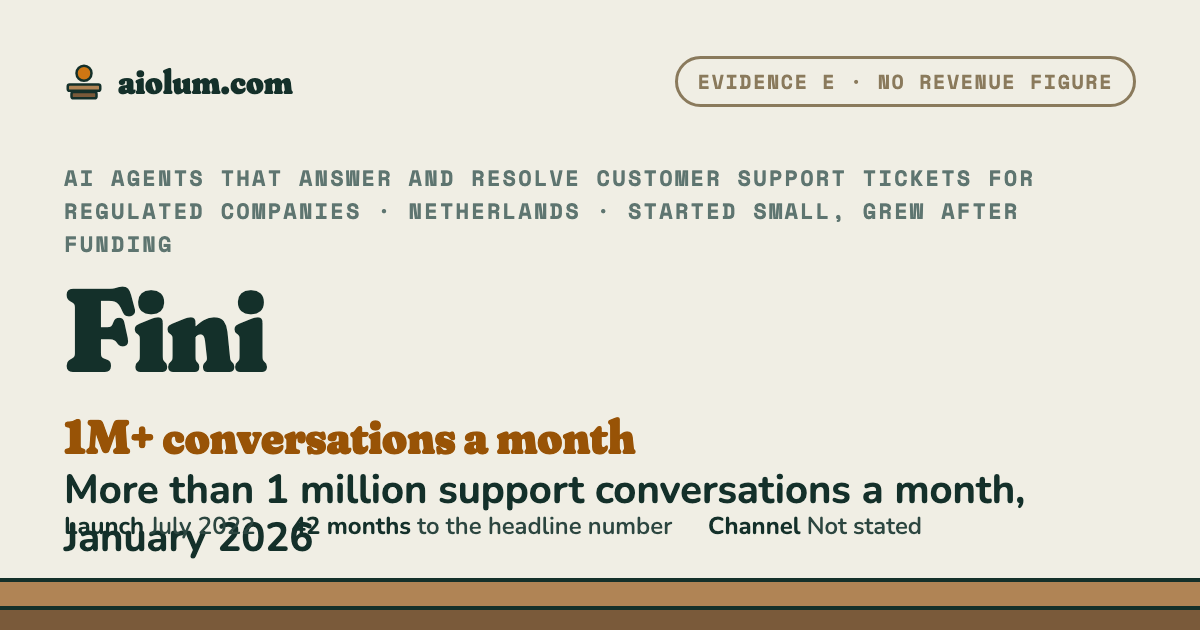
Fini (AI agents that answer and resolve customer support tickets for regulated companies, Netherlands): More than 1 million support conversations a month, January 2026. Evidence grade E: no revenue figure was checked. Team: 2 founders, Deepak Singla and Hakim K, both formerly at Uber, at the 2022 start (2022 home page, Y Combinator page); Y Combinator lists a team of 14 in November 2026, after a US$3.6M seed round announced in January 2026. Launched July 2022; still running.Added 6 November 2026
- Outcome
- More than 1 million support conversations a month, January 2026
- Evidence
- E no revenue figure was checked
- Launch
- July 2022
- Status
- Still running
- Team
- 2 founders, Deepak Singla and Hakim K, both formerly at Uber, at the 2022 start (2022 home page, Y Combinator page); Y Combinator lists a team of 14 in November 2026, after a US$3.6M seed round announced in January 2026
- Outside funding
- Y Combinator (Summer 2022 batch); US$3.6M seed round led by Matrix Partners, announced by the company in January 2026
- Main channel
- Not stated
What is not verified
No revenue figure was found. The company publishes no revenue, has no payment-processor profile that we found, and its seed-round post gives a usage count, not money. The 1,000,000 conversations a month (January 2026) and 3 million resolutions a month (November 2026) are the company's own claims. A reader could look for an investor statement or a press interview with revenue figures. This story is grade E: the business is real and its product, price and customers are described from public pages, but no revenue figure was checked. Aiolum shows it as an idea worth studying, not as proof that it makes money.
Fini sells an AI support agent, a program that reads a customer's message, finds the answer in the company's documents and systems, and replies or acts without a human. Its main feature is what the company calls a Trust Layer: each answer gets a confidence score, the model's own estimate of how likely the answer is correct, and below a threshold the ticket goes to a human agent, whose answer the system then learns from.
Deepak Singla and Hakim K met at Uber, where they worked on customer support, and started Fini in 2022 in Y Combinator's Summer 2022 batch; the site was live by July 2022. In January 2026 the company announced a US$3.6M seed round led by Matrix Partners and wrote that it handled more than 1,000,000 conversations a month. In November 2026 Y Combinator lists a team of 14, based in Amsterdam.
No revenue figure was found in any downloaded source, so the evidence grade is E. What is checked is the founders, the launch date, the funding announcement, the published prices and the list of AI model providers.
How much revenue does Fini make?
Each row shows the evidence grade and the source numbers from the list at the end of this page. The grades are explained in How Aiolum verifies.
| Fact | Value | Grade | How we know | Sources |
|---|---|---|---|---|
| Conversations handled, January 2026 | more than 1,000,000 a month | C | The company's seed-round post, published 15 January 2026 (Wayback copy of 20 January 2026). Customers named in it: the US Chamber of Commerce Foundation, Covergenius, AtlasFin and Bitdefender. | [3] |
| Resolutions, November 2026 | more than 3 million a month across 130+ languages | C | The company's About page, undated, read 6 November 2026. It counts resolutions, not conversations, so it cannot be compared directly with the January figure. | [5] |
| Founded | 2022, Y Combinator Summer 2022 batch | C | The Y Combinator page gives year founded 2022 and batch S22; the first Wayback copy of usefini.com is from 19 July 2022. | [4, 6] |
| Founding team | 2 co-founders, both formerly at Uber | C | The 2022 home page describes Deepak as an ex-Uber product manager and Hakim as an ex-Uber engineering manager; the Y Combinator page lists the same two founders. | [4, 6] |
| Team, November 2026 | 14 | C | Team size on the Y Combinator company page, read 6 November 2026. | [4] |
| Seed funding | US$3.6M, led by Matrix Partners | C | The company's own announcement, January 2026, also naming Y Combinator and angels from Uber, McKinsey and SoftBank. | [3] |
| Growth plan price | US$3,600 a month, or US$3,000 a month billed yearly | C | Pricing page, 6 November 2026. | [2] |
| AI model providers | OpenAI, Anthropic and Microsoft Azure | C | Subprocessor list, last updated 2 November 2026: OpenAI and Anthropic for "LLM inference (enterprise agreement)", Azure for "LLM inference (API-based processing only)". | [7] |
| Security claims | SOC 2 Type II, ISO 27001:2022, PCI DSS Level 1, HIPAA, GDPR | C | Listed on the company's About page; the reports themselves were not read. | [5] |
| Time from launch to the January 2026 count | 42 months | calc | Calculated: July 2022 to January 2026. | [3, 6] |
How to read this table: a grade C value is what the company states on its own pages or on its Y Combinator profile. A "calc" value (grade X) was computed on this page. No value comes from a payment processor, a filing or a journalist's own check.
| Plan | Per month, billed yearly (US$) | Per month, billed monthly (US$) | Limit |
|---|---|---|---|
| Growth | 3,000 | 3,600 | 2,000 or 3,000 resolved tickets a month, then US$0.89 each |
| Scale | 7,500 | 9,000 | 8,000 or 10,000 resolved tickets and 500 voice calls a month, then US$0.69 each |
| Enterprise | custom | unlimited tickets, 2,500 voice calls a month, US$0.49 per resolution, 90-day free pilot |
Each plan includes a monthly allowance of resolved tickets, and tickets above it are billed per resolution. The plan cards show 3,000 and 10,000 included tickets, while the page's structured data says 2,000 and 8,000; both are on the same page. Voice calls cost US$0.89 each for the first 10,000 a month, then less. The page offers multi-year discounts and a switching-cost credit of up to US$50,000 on Enterprise. There is no per-seat fee.
When did Fini launch, and how did it grow?
From a ticket-sorting tool at Y Combinator in 2022 to an AI agent with voice and a seed round in 2026. Each entry carries its grade.
- July 2022Cusefini.com is live; the first Wayback copy is from 19 July 2022. Fini is in Y Combinator's Summer 2022 batch. [4, 6]
- October 2022CThe home page sells a tool that sorts support tickets into topics with machine-learning models and resolves some automatically, "reducing contact rate by upto 30%". It presents the two ex-Uber founders. [6]
- 15 January 2026CFini announces a US$3.6M seed round led by Matrix Partners and writes that it handles more than 1,000,000 conversations a month. It says Fini 2.0 and a voice agent are coming. [3]
- 2 November 2026CThe subprocessor list names OpenAI, Anthropic and Microsoft Azure for model inference. [7]
- November 2026CPrices from US$3,000 a month billed yearly, voice calls on every plan, and a Slack tool called Scout. Y Combinator lists a team of 14. [2, 4, 5]
Why did Fini work?
Four causes, in the order they mattered. Each one is a reusable lesson.
Confidence threshold and human hand-off
The seed-round post says that when the AI's confidence falls below a safety threshold it does not guess but passes the ticket to a human, and learns from the human's answer. The home page shows this as "Low confidence tickets escalated with full context". For banks and insurers this is the feature that makes automation acceptable.
Actions, not only answers
Fini connects to billing, CRM and internal tools and carries out the request: a refund, an account change, a KYC (know-your-customer identity) check. A ticket that ends with an action is a resolution, and resolutions are what the company bills.
Pricing per resolution
The pricing page charges a platform fee with an allowance of resolved tickets, then a fixed rate per resolution, and no fee per human seat. The customer pays for outcomes, so the price falls with every ticket the AI cannot close.
How it was built
These details come from the company's own pages. They are grade C. [1, 2, 6, 7]
- The 2022 version used natural-language processing and machine-learning models to tag, route and resolve tickets; the current version is built on large language models.
- Model inference runs through OpenAI and Anthropic under enterprise agreements and through Microsoft Azure; hosting is on Google Cloud and AWS, with Supabase as the database.
- Integrations with Zendesk, Intercom, HubSpot, Salesforce, Gorgias, LiveChat, Front, Freshdesk and Slack, plus custom API actions.
- Implementation is included in every plan, and the Scale plan adds a dedicated AI engineer.
Tools named in the sources
Each one opens its page in the Tools tab, with every story that uses it.
Who tried this before Fini, and why did they fail?
Three companies in our database of failed startups sold automated or chat-based customer support and failed. The values below are from that database and are not independently verified.
Answerly
The promiseFAQ chatbots that deflect support tickets so humans only handle the hard ones.
Why it diedLanguage processing of the time could not handle real customer questions, and Zendesk and Intercom owned the market.
Hipmob
The promiseCustomer support chat built into mobile apps and websites.
Why it diedIntercom and Zendesk added the same chat features, and it could not grow without money.
Vanti
The promiseAI chat agents that hold sales and service conversations for brands.
Why it diedCustomers did not want conversational shopping, and high sales costs and integration work broke the unit economics.
The failed startups come from our database of 1,749 dead startups, retold here in our own words. Its entries are AI-assisted summaries of public sources, so these cards carry no evidence grade.
What changed
Answerly matched questions to pre-written answers when language processing could not understand real tickets, and it counted deflected tickets, not solved ones. Large language models now read and write like a support agent, and Fini sells resolutions with actions in the customer's systems.
The risk that remains is trust: an AI that is wrong with confidence. Fini's answer is the confidence threshold and the audit trail, aimed at regulated industries where competitors' errors made the news.
Can one person copy Fini now?
Not alone, and not cheaply.
Fini sells to enterprises with integrations, security certifications and included implementation, and it raised a seed round and grew to 14 people. One person could copy the idea for a narrow niche: a support agent for one help desk and one industry, with a clear hand-off rule.
Where it is still open: Support agents for small regulated businesses that cannot buy an enterprise plan: credit unions, insurance brokers, small clinics' billing desks.
- 1Pick one regulated niche and one help desk to integrate with.
- 2Score every answer and send low-confidence tickets to a person, with the context.
- 3Charge per resolved ticket, so the customer pays only for results.
- 4Offer a pilot on the customer's own real tickets before the contract.
What could go wrong for Fini?
The risks are the mirror image of the causes above.
What is not verified
No revenue figure was found. The company publishes no revenue, has no payment-processor profile that we found, and its seed-round post gives a usage count, not money. The 1,000,000 conversations a month (January 2026) and 3 million resolutions a month (November 2026) are the company's own claims. A reader could look for an investor statement or a press interview with revenue figures.
From two founders to a funded team
The founding team was two people in 2022. After the US$3.6M seed round the Y Combinator page lists 14 people in November 2026, so this is not a solo or tiny business today.
Partly a service
Every plan includes implementation, the Scale plan adds "White-glove onboarding" and a "Dedicated AI engineer", and Enterprise adds a "Dedicated engineer pod". The core is software billed per resolution, but large customers also get hands-on work.
Inconsistent numbers on the pricing page
The plan cards say 3,000 and 10,000 tickets are included in Growth and Scale; the structured data on the same page says 2,000 and 8,000. The pricing page also offers voice AI, and none of the pages read say whether the voice agent tells callers that it is an AI.
Competition and model providers
On this site Chatbase, SiteGPT and My AskAI also sell AI support agents, mostly self-serve to small companies rather than enterprise contracts; help-desk makers such as Zendesk and Intercom sell their own AI agents. The subprocessor list names OpenAI and Anthropic for model inference, so the product depends on their models and prices.
Sources
The grade next to each source is the best grade that the source can support. "Read in full" means that the text of the page was downloaded and the numbers were checked in it.
- C Fini home page, read 6 November 2026Read in full. Source for the product, the actions, the integrations, the confidence checks and the named testimonial.
- C Fini pricing page, read 6 November 2026Read in full, including the structured data in the page. Source for the plans, the per-resolution rates, voice rates and discounts.
- C Fini blog: Announcing Fini's $3.6M Seed Round (published 15 January 2026)Read in full. Date from the page's structured data and a Wayback copy of 20 January 2026. Source for the funding, the founding story and the conversation count.
- C Y Combinator company page: FiniRead the company data in the page. Source for the batch, the year founded, the founders, the location and the team size of 14.
- C Fini About page, read 6 November 2026Read in full. Source for the resolution count, the investors and the security claims.
- C Wayback Machine: usefini.com home page, 4 October 2022Read in full. Source for the first product and the two founders; the CDX index gives 19 July 2022 as the first copy.
- C Fini subprocessor list, last updated 2 November 2026Read in full. Source for the model providers and the hosting.
- C Database of failed startups, local exportLocal export. AI-written summaries, not independently verified. Source for the failed predecessors.
Run this company? Send corrections or a verified figure to aiolum@livyden.com