Marky: Revenue, team and how it was built
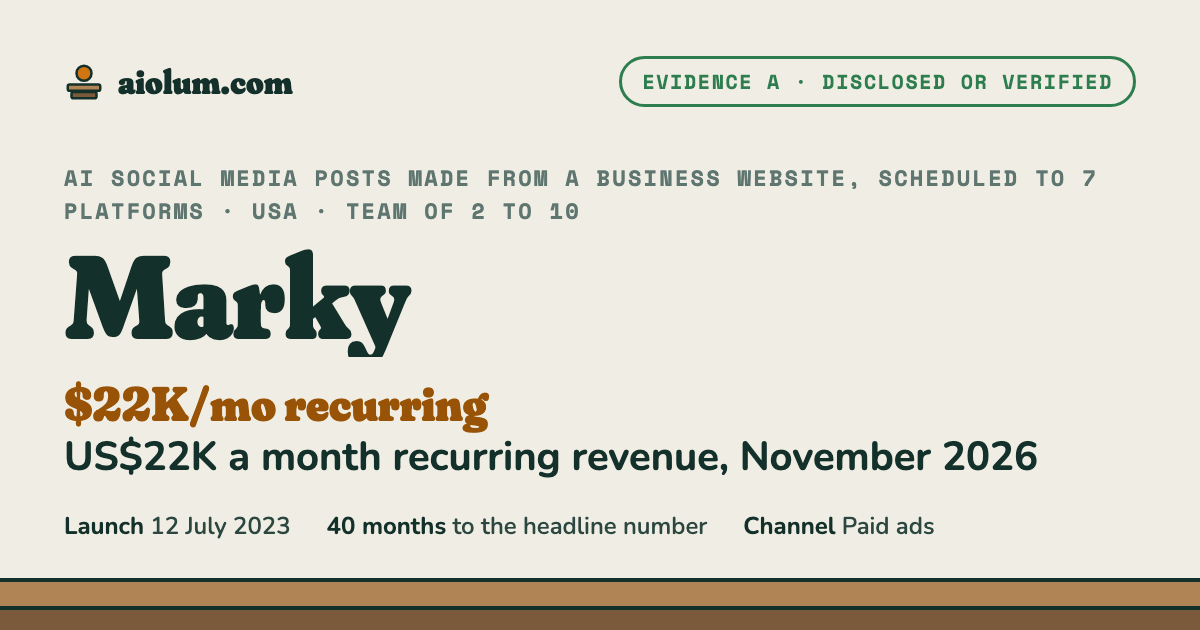
Marky (AI social media posts made from a business website, scheduled to 7 platforms, USA): US$22K a month recurring revenue, November 2026. Evidence grade A: disclosed by a company or a filing, or verified by a payment processor. Team: 2 founders, the brothers Eli and Jo (Josiah Coad), in Austin, Texas; total headcount not published. Launched 12 July 2023; still running, revenue falling.Added 6 November 2026
- Outcome
- US$22K a month recurring revenue, November 2026Revenue falling
- Evidence
- A disclosed by a company or a filing, or verified by a payment processor
- Launch
- 12 July 2023
- Status
- Still running
- Team
- 2 founders, the brothers Eli and Jo (Josiah Coad), in Austin, Texas; total headcount not published
- Outside funding
- No outside funding found in the sources
- Main channel
- Paid ads
Marky is a social media scheduler with a writer and a designer built in. A social media scheduler is a program that holds posts in a calendar and publishes them to several platforms at set times. Marky also creates the posts: a large language model from OpenAI, a program trained on large amounts of text that writes new text from an instruction, writes the captions from the business's own website, and the text and images are placed into templates that designers made.
The brothers Eli and Jo built it in Austin, Texas. TrustMRR lists Josiah Coad as the founder and gives 12 July 2023 as the founded date. TrustMRR reads the company's revenue directly from Stripe, its payment processor. On 5 November 2026 it showed US$22,045 in monthly recurring revenue (MRR, the subscription revenue that repeats each month), 476 active subscriptions, an 81.0% profit margin over the last 30 days, and US$1,015,813 in revenue since the start.
Monthly revenue peaked at US$33,481 in March 2026 and was US$19,870 in October 2026. The founder listed the business for sale on TrustMRR on 25 May 2026 with an asking price of US$495,000. This page also shows four failed startups that sold social media tools to businesses before language models could write the posts.
How much revenue does Marky make?
Each row shows the evidence grade and the source numbers from the list at the end of this page. The grades are explained in How Aiolum verifies.
| Fact | Value | Grade | How we know | Sources |
|---|---|---|---|---|
| Monthly recurring revenue, 5 November 2026 | US$22,045 | A | TrustMRR metric snapshot, revenue last synced from Stripe on 5 November 2026. | [1] |
| Annual run rate | about US$264,540 | calc | Calculated: 22,045 times 12 equals 264,540. | [1] |
| Active subscriptions, November 2026 | 476 | A | TrustMRR metric snapshot. | [1] |
| Average MRR per subscription | about US$46 | calc | Calculated: 22,045 divided by 476 equals 46.3. | [1] |
| Revenue, last 30 days to 5 November 2026 | US$17,015 | A | TrustMRR shows a change of -31.3% against the 30 days before, while MRR grew 3.5% over the same 30 days. | [1] |
| Revenue, last 12 months | US$286,994 | A | TrustMRR, from Stripe. | [1] |
| Revenue, all time | US$1,015,813 | A | TrustMRR, from Stripe. | [1] |
| Best month in the TrustMRR timeline | US$33,481, March 2026 | A | The public timeline starts in December 2025 (US$21,148). | [1] |
| Revenue, October 2026 | US$19,870 | A | [1] | |
| Change from March 2026 to October 2026 | about -41% | calc | Calculated: 19,870 divided by 33,481 equals 0.593. | [1] |
| Last 6 months against the 6 months before | about -20% | calc | Calculated: last 6 months US$127,289; the 6 months before are 286,994 minus 127,289, which equals US$159,705; 127,289 divided by 159,705 equals 0.797. | [1] |
| Profit margin, last 30 days | 81.0% | A | TrustMRR metric snapshot. TrustMRR does not say which costs it counts. | [1] |
| Founded date | 12 July 2023 | C | Founder-written TrustMRR profile field. The company's own page says the founders have worked on Marky for three years. | [1, 4] |
| Founders | 2 brothers, Eli and Jo, in Austin, Texas | C | The company's page: "We're Eli and Jo — brothers building in Austin, Texas" and "We're a small, founder-led company". TrustMRR names Josiah Coad as the founder. | [1, 4] |
| Outside funding | none found | C | No source mentions a funding round. This is an absence of evidence, not a statement by the company. | [1, 4] |
| For sale | asking US$495,000, listed 25 May 2026 | C | TrustMRR acquisition section: revenue multiple 2.4x as TrustMRR computes it, 36 offers received. | [1] |
| AI model provider | OpenAI | C | The company's AI Service Policy: "Marky uses OpenAI to power AI-generated content". | [5] |
| Entry price | US$39 a month, or US$19 a month billed yearly | C | Company pricing page. | [3] |
How to read this table: a grade A value was read by TrustMRR from the company's Stripe account. A grade C value comes from the company's own pages or from founder-written profile text. A "calc" value was computed on this page from the rows above it.
| Plan | Per month, billed yearly (US$) | Per month, billed monthly (US$) | Limit |
|---|---|---|---|
| Solo | 19 | 39 | 1 workspace, 3 channels, 1 user, 3 custom videos a month |
| Growth | 39 | 79 | 1 workspace, 5 channels, unlimited users, 6 custom videos a month, reputation management |
| Pro | 114 | 229 | 1 workspace, 8 channels, unlimited users, 15 custom videos a month, white-labeled portal, approval workflow |
| Enterprise | custom | custom | Large businesses, franchises and agencies |
Every plan starts with a 14-day free trial that needs a card. Extra channels cost US$7 a month each, extra workspaces US$25 a month (Growth and Pro), and a reseller white-label add-on for up to 10 brands costs US$99 a month on Pro. A channel is one connected social account. Yearly billing is 50% cheaper than monthly billing. The page also lists an Enterprise plan with prices on request.
When did Marky launch, and how did it grow?
From the founded date in July 2023 to US$22,045 in monthly recurring revenue in November 2026. Each entry carries its grade.
- 12 July 2023CFounded date on the founder-written TrustMRR profile. [1]
- December 2023CAn Internet Archive copy of mymarky.ai shows the site live with the description "We create and post content every day across all your socials so you don't have to." [7]
- December 2025AFirst month in the public TrustMRR timeline: US$21,148 in revenue. [1]
- March 2026ABest month in the timeline: US$33,481. [1]
- 25 May 2026CThe founder lists Marky for sale on TrustMRR, asking US$495,000. [1]
- October 2026AMonthly revenue US$19,870. [1]
- 5 November 2026AUS$22,045 in MRR, 476 active subscriptions and US$1,015,813 in revenue all time, synced from Stripe. [1]
Why did Marky work?
Four causes, in the order they mattered. Each one is a reusable lesson.
The website is the brief
A business owner does not need to describe the business. Marky reads the website and writes the first five posts from it during the trial. The home page calls this "Start with your first 5 posts, made from your website." The owner sees finished posts before the first charge.
Templates instead of free image generation
The company page says designers make the layout and style, then AI drops in the copy and imagery. A template keeps the logo, colors and spacing the same on every post, and any post can be opened in a design editor. This answers a common complaint about AI posts: images that look different every time.
Selling to local businesses by vertical
The site has separate pages for healthcare, financial and legal, real estate, home services, restaurants and agencies. The founder-written TrustMRR profile names Facebook, Meta ads, word of mouth and influencers as the marketing channels. These buyers spend little time on social media and pay to have it done.
Agencies as multipliers
The Pro plan adds a white-labeled client portal and an approval workflow, and a reseller add-on lets an agency sell Marky under its own brand. One agency customer can bring many business accounts.
How it was built
These details come from the founder-written TrustMRR profile and the company's own pages. They are grade C. [1, 3, 5]
- React for the web app and FastAPI, a Python web framework, for the server.
- PostgreSQL and Supabase for the database, hosted on AWS and Render.
- OpenAI models for the post text and other AI features. The company says it does not use customer content to train AI models.
- Stripe for subscriptions; TrustMRR reads revenue from Stripe with an API key.
- Sentry for error tracking.
- Publishing through each platform's connection: Facebook, Instagram, LinkedIn, X, TikTok, Pinterest and Google Business, plus Giphy and Unsplash for stock images and GIFs.
Tools named in the sources
Each one opens its page in the Tools tab, with every story that uses it.
Who tried this before Marky, and why did they fail?
Four companies in our database of failed startups sold social media tools to businesses before language models could write the posts. The values below are from that database and are not independently verified.
Metigy
The promiseAI marketing advice that would replace a marketing team for small businesses.
Why it diedIt gave marketers recommendations, but the small businesses wanted the work done for them. Generic advice did not get used.
Argyle Social
The promiseA social media marketing tool to manage posting and engagement in one workflow.
Why it diedLarger competitors with bigger marketing budgets took the market while its updates were small.
PostRocket
The promiseBetter reach for business Facebook pages by posting at the best times.
Why it diedFacebook changed its API, and the product had no other platform or plan to fall back on.
Pressly
The promiseContent curation that keeps a brand's channels active with less effort.
Why it diedCompetitors offered full suites, and Pressly stayed a basic curation tool.
The failed startups come from our database of 1,749 dead startups, retold here in our own words. Its entries are AI-assisted summaries of public sources, so these cards carry no evidence grade.
What changed
Before language models, social media tools for small businesses scheduled or analyzed posts, but the owner still had to write them. Metigy tried to solve this with AI advice and found that owners wanted the work done, not recommendations about it. PostRocket shows the other risk: a tool that depends on one platform's API.
A language model can now write the caption from the website, and templates turn it into a branded image in seconds. That moves the product from "tool for marketers" to "posts for owners who have no marketer", which is the buyer Metigy could not serve. Marky also posts to seven platforms, so a change at one platform does not end the business.
Can one person copy Marky now?
Yes, for a niche, but the category is crowded.
The parts are standard: a language model API, a template editor and the official posting connections of each platform. The difficulty is distribution and keeping customers. Revenue fell about 20% in the last 6 months compared with the 6 months before, while MRR still grew 3.5% in the last 30 days.
Where it is still open: Posts for one regulated profession, such as financial advisors with compliance review or clinics with privacy rules, are less crowded than general small-business posting. Languages other than English are also open.
- 1Pick one type of business and generate real posts from its website before asking for a card.
- 2Use designer templates for the images so every post looks like the brand.
- 3Keep the owner in control: an approval step before anything is published.
- 4Add an agency plan with a white-label portal, so one customer brings many accounts.
What could go wrong for Marky?
The risks are the mirror image of the causes above.
Competition
Social posting is one of the most crowded groups on this site: Postiz (US$263K a month recurring revenue, October 2026, grade A) and Supergrow (US$32.2K revenue in 30 days, February 2026, grade A) sell similar scheduling and AI writing, and Canva and the schedulers bundle AI writers.
Dependence on OpenAI and the platforms
The AI Service Policy says Marky uses OpenAI for its AI-generated content, so model prices and terms affect its margin. Publishing depends on the connections of seven platforms; PostRocket in the predecessors list shows what one API change can do.
Counters larger than the paying base
The home page says "120,000+ businesses" and the founders' page says "Over 1M businesses have generated content with Marky". TrustMRR shows 476 active subscriptions in November 2026. The counters may include free trials and one-time post generations; no source explains them.
Falling revenue and a sale listing
Monthly revenue fell from US$33,481 in March 2026 to US$19,870 in October 2026, and the business has been listed for sale on TrustMRR since 25 May 2026 at an asking price of US$495,000. A new owner could change the product or prices.
Sample post types and affiliate wording
The home page's example month for a dental practice includes a post type named "Testimonial AI Image"; the page does not say whether the testimonial text must come from a real patient. The affiliate page states its commission (30% recurring) and also shows "Top affiliate earnings $40,000+" and "Estimate your annual earnings". The plans include "custom videos" with "3 rounds of changes", which reads like partly made-to-order work inside the software subscription.
Old profile description
The TrustMRR description still says "A tool for self-publishing authors to manage their social media", while the site and the rest of the profile target local service businesses. The all-time revenue may include an earlier version of the product.
Sources
The grade next to each source is the best grade that the source can support. "Read in full" means that the text of the page was downloaded and the numbers were checked in it.
- A TrustMRR profile: Marky, revenue synced from Stripe on 5 November 2026Read the markdown profile. The Verification Sources section (Stripe API key) is grade A; founder, founded date, tech stack, channels and description are founder-written, grade C.
- C Marky home page, read 6 November 2026Read in full. Source for the product, the platforms, the trial and the user counter.
- C Marky pricing page, read 6 November 2026Read in full. Source for the plans, the add-ons and the trial terms.
- C The Marky Way (founders' page), read 6 November 2026Read in full. Source for the founders, the city, the three years of work and the template approach.
- C Marky AI Service Policy, read 6 November 2026Read in full. Source for the AI model provider and the training statement.
- C Marky Affiliate Program, read 6 November 2026Read in full. Source for the commission terms and the affiliate earnings wording.
- C Internet Archive copy of mymarky.ai, 2 December 2023Read the page metadata only; the page body loads by script. Shows the site live in December 2023.
- C Database of failed startups, local exportLocal export. AI-written summaries, not independently verified. Source for the failed predecessors.
Run this company? Send corrections or a verified figure to aiolum@livyden.com