Genlook: Revenue, team and how it was built
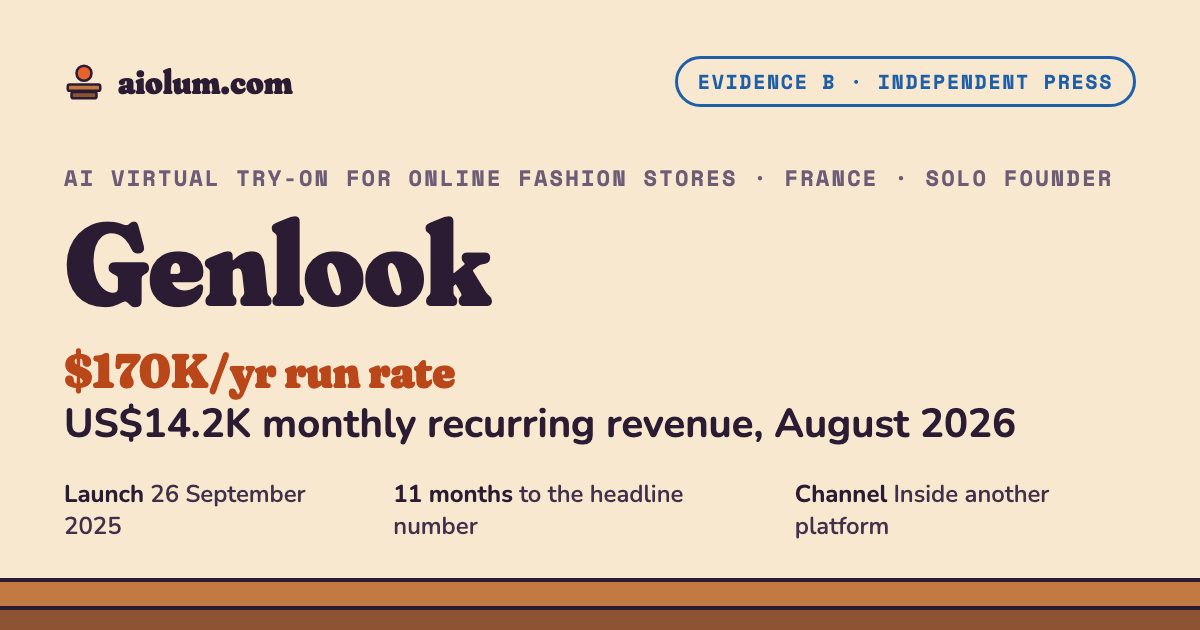
Genlook (AI virtual try-on for online fashion stores, France): US$14.2K monthly recurring revenue, August 2026. Evidence grade B: confirmed by two or more independent reports. Team: 1 founder, Thibault Mathian; listed as a solo founder in the August 2026 case; "a very small team" with three open roles in October 2026; headcount not published. Launched 26 September 2025; still running, revenue growing.Added 27 October 2026
- Outcome
- US$14.2K monthly recurring revenue, August 2026Revenue growing
- Evidence
- B confirmed by two or more independent reports
- Launch
- 26 September 2025
- Status
- Still running
- Team
- 1 founder, Thibault Mathian; listed as a solo founder in the August 2026 case; "a very small team" with three open roles in October 2026; headcount not published
- Outside funding
- None (bootstrapped, by the company's own pages)
- Group
- Photos and portraits
- Main channel
- Inside another platform
Genlook sells virtual try-on to online fashion stores. Virtual try-on means that a shopper sees a product on their own body before buying it. Genlook does this with a generative image model, a model that creates a new picture from a text instruction and input pictures: it takes the shopper's photo and the store's product photo and returns a photo of the shopper wearing the product. Earlier try-on systems, the company's about page says, needed 3D scans, long contracts and months of integration.
Thibault Mathian, a freelance developer in Grenoble, France, started the app when Google released its image model Nano Banana in August 2025. He told the French newsletter Founder Trace that he built the first version in a week and a half. The app has been listed in the Shopify App Store, the marketplace where Shopify merchants install add-on programs, since 26 September 2025. On 24 August 2026 Founder Trace published a screenshot of the Genlook revenue dashboard that showed US$14,150.87 in monthly recurring revenue (MRR, the monthly value of all active subscriptions and usage charges), US$1,709.97 more than 30 days earlier, and US$169,810.44 in annual recurring revenue (ARR, the MRR times twelve). The company's pages say it has no outside funding.
The headline figure is grade B: a newsletter writer saw and published a dashboard screenshot that the founder supplied, under the outlet's rule that each case rests on a proof of revenue. No payment processor or second source confirms it, and no later revenue figure was found. The page also shows four failed companies that tried to take the uncertainty out of buying clothes and other goods online with shipped samples, local stores, human stylists or designer-made 3D renders.
How much revenue does Genlook make?
Each row shows the evidence grade and the source numbers from the list at the end of this page. The grades are explained in How Aiolum verifies.
| Fact | Value | Grade | How we know | Sources |
|---|---|---|---|---|
| Monthly recurring revenue, August 2026 | US$14,150.87 | B | Founder Trace case of 24 August 2026 by Lucas Flandre: "Preuve : capture du tableau de bord Genlook" [Proof: screenshot of the Genlook dashboard] (translation), and "MRR à 14 150,87 en hausse de 1709,97 sur les 30 derniers jours" [MRR at 14,150.87, up 1,709.97 over the last 30 days] (translation). The published screenshot reads "MRR $14,150.87", and its last bar is the month after July 2026. The outlet's about page says: "Chaque cas s’appuie sur une preuve de revenus (capture Stripe ou équivalent)" [Each case rests on a proof of revenue (a Stripe screenshot or equivalent)] (translation). The screenshot was supplied by the founder; no payment processor published it. The figure is in US dollars in the source. | [1, 2] |
| Annual recurring revenue, August 2026 | US$169,810.44 | B | Same case: "ARR à 169 810,44$, taux de croissance du MRR à 8,60%" [ARR at US$169,810.44, MRR growth rate 8.60%] (translation). | [1] |
| Check of the ARR | US$14,150.87 times 12 is US$169,810.44 | calc | Calculated. The ARR is the MRR times twelve, not a separate measure. This is the outcome amount stored for this page. | [1] |
| Rise in MRR over the 30 days before the screenshot | US$1,709.97, or 13.7% | calc | Calculated: 14,150.87 minus 1,709.97 is 12,440.90, and 1,709.97 / 12,440.90 = 13.7%. The case also gives an "MRR growth rate" of 8.60% and does not say how that rate is measured, so the two numbers do not match. | [1] |
| Shape of the revenue chart, September 2025 to August 2026 | higher in every month shown | B | The screenshot in the case shows one bar per month from September 2025, split into "Monthly subscriptions", "Annual subscriptions" and "Usage charges". The case's image description reads "Graphique Stripe du MRR de Genlook, en hausse continue de septembre 2025 jusqu'à 14 150,87 $" [Stripe chart of Genlook's MRR, rising continuously from September 2025 up to US$14,150.87] (translation). | [1] |
| Time from the Shopify listing to the headline figure | 11 months | calc | Calculated: 26 September 2025 to August 2026. The case says "Lancé il y a 9 à 10 mois" [launched 9 to 10 months ago] (translation). | [5, 1] |
| Stores and customers, August 2026 | about 1,100 stores installed the app; 250 regular paying customers; 400 in active trial | C | Case: "Environ 1100 boutiques ont installé l’app, 250 clients payants réguliers, 400 en démo active" [About 1,100 stores installed the app, 250 regular paying customers, 400 in active demo] (translation). The founder's figures; the screenshot shows only revenue. | [1] |
| Average MRR per paying customer | about US$57 a month | calc | Calculated: 14,150.87 / 250 = 56.60. | [1] |
| Prices paid, August 2026 | from about 20 a month for small stores to more than 1,000 a month for large volumes | C | Case: "Prix : de 20/mois pour les petites boutiques a plus de 1000/mois pour les gros volumes" [Price: from 20 a month for small stores to more than 1,000 a month for large volumes] (translation). The currency is not stated. | [1] |
| Running costs, August 2026 | about US$5,000 a month for the image model; about EUR 700 a month of software subscriptions; EUR 150 to 170 a month of infrastructure; about EUR 1,000 a month of office | C | Case: "Coûts : environ 700€/mois de stack SaaS (Claude, Cursor inclus), 150 à 170€/mois d’infrastructure, environ 5000$/mois pour l’IA (Nano Banana), environ 1000€/mois de bureaux" [Costs: about EUR 700 a month of SaaS stack (Claude and Cursor included), EUR 150 to 170 a month of infrastructure, about US$5,000 a month for the AI (Nano Banana), about EUR 1,000 a month of office] (translation). | [1] |
| Image-model cost as a share of MRR | about 35% | calc | Calculated: 5,000 / 14,150.87 = 0.353. Both figures are in US dollars in the source. | [1] |
| Time to build the first version | a week and a half | C | Case: "MVP construit en une semaine et demie" [MVP built in a week and a half] (translation). An MVP (minimum viable product) is the smallest version that customers can use. | [1] |
| Image model at launch | Google's Nano Banana | C | The case says the project followed the release of Nano Banana, Google's image model, in August 2025. The Shopify App Store listing names "Nano Banana" under "Works with". In October 2026 the careers page says that Genlook runs its own image pipeline on GPUs, built on open image-editing, diffusion and vision models. | [1, 5, 7] |
| Listed in the Shopify App Store | 26 September 2025 | B | Shopify App Store listing: "Launched September 26, 2025". The listing carries the "Built for Shopify" badge; the changelog dates the badge to 3 March 2026. | [5, 9] |
| Shopify App Store rating, 27 October 2026 | 5.0 from 40 reviews; all 40 are five stars | B | Shopify App Store reviews page: "100% of ratings are 5 stars". The reviews read for this page come from named stores in Israel, Singapore, Türkiye, Canada, Saudi Arabia, Colombia, the United Arab Emirates, India, the United Kingdom and Lebanon, and several thank the founder by name for support. The rating in the home page's structured data, 5 from 40, matches the listing. | [6, 3] |
| Where customers are | mostly India, the United States, the Middle East and South America; almost none in France | C | Case: "Marché quasi absent de France, concentré en Inde, aux États-Unis, au Moyen-Orient et en Amérique du Sud" [Market almost absent in France, concentrated in India, the United States, the Middle East and South America] (translation). | [1] |
| Stores in October 2026 | installed on 1,200+ Shopify stores; 900+ ran try-ons in the last 90 days | C | Press page, "Last updated October 2026": "Installed on 1,200+ Shopify stores. 900+ stores ran try-ons in the last 90 days." The home page says "Used by 900+ fashion stores". | [8, 3] |
| Outside funding | none | C | Home page: "Genlook started in 2025 and is based in Grenoble, France. It is bootstrapped, with no outside funding." The careers page says "Self-funded". | [3, 7] |
| Team | one founder; "a very small team" in October 2026, with three open roles | C | The case lists the team as "Solofounder". The careers page: "We run as a very small team where everyone works with AI every day", with open roles in AI engineering, growth and sales. The about page: "The people who build the product answer support". No source gives a headcount. | [1, 7, 4] |
| Speed of a try-on | median 8.2 seconds on the home page; about 5 seconds after an update of 20 October 2026 | C | Changelog, 20 October 2026: "The median try-on now takes about 5 seconds, down from 12.5 seconds in August." | [3, 9] |
| Shopper photos | deleted after 7 days; not used to train models | C | Home page FAQ. The terms forbid users to "upload photos of another person without their consent" and to upload sexually explicit content. | [3, 11] |
How to read this table: a grade B value comes from a document that a third party saw and published (here a dashboard screenshot in a newsletter case study), or from the Shopify App Store's own data. A grade C value is a statement by the founder or the company. An "X" value was computed on this page from the rows above it. Quotations in French are given in the original, followed by this page's English translation.
| Plan | Per month, billed yearly (US$) | Per month, billed monthly (US$) | Limit |
|---|---|---|---|
| Free | 0 | 10 try-ons a month | |
| Starter | 19.99 | 100 try-ons a month, then US$0.17 per try-on; analytics; shopper email collection | |
| Growth | 29 | 250 try-ons a month, then US$0.12 per try-on; no Genlook branding | |
| Pro | 99 | 1,000 try-ons a month, then US$0.10 per try-on; Klaviyo integration | |
| Larger stores | custom | custom | plan sized to the try-on volume |
| Try-On API Starter | 20 | 1,000 try-ons a month | |
| Try-On API Growth | 99 | 6,000 try-ons a month | |
| Try-On API Scale | 300 | 20,000 try-ons a month |
The store plans are billed monthly; no source read shows a yearly price, so that column is empty. Try-ons beyond a plan's quota are billed one by one, and on Shopify all charges go through Shopify's billing system, the terms say. Larger stores get a plan sized to their volume. The Try-On API for developers has its own plans, announced on 24 September 2026, and costs US$0.04 per try-on without a plan. The affiliate program pays 30% of a referred Shopify store's subscription payments for 12 months.
When did Genlook launch, and how did it grow?
From a new Google image model in August 2025 to US$14,150.87 a month in August 2026. Each entry carries its grade.
- August 2025CGoogle releases the image model Nano Banana. Thibault Mathian, a freelance developer who had built a similar Shopify app for an earlier client, builds a first try-on version in a week and a half. [1]
- 26 September 2025BThe app is listed in the Shopify App Store. [5]
- 7 October 2025CA free tool for merchants to generate images of their products on AI-generated models, described as user-generated-content style images. By October 2026 its address redirects to the home page. [10]
- 9 October 2025CFirst five-star review in the Shopify App Store. The company post says the team is, "for now, a dedicated founder". [9]
- 25 October 2025CNew, lower prices. [9]
- 7 January 2026CAffiliate program launched. [9]
- 3 March 2026CGenlook earns the "Built for Shopify" badge. [9]
- 10 May 2026CLaunch of the Try-On API for developers. [9]
- June 2026CWordPress and WooCommerce plugin (5 June) and PrestaShop module (30 June): the app is no longer only on Shopify. [9]
- 24 August 2026BFounder Trace publishes a case with a dashboard screenshot: US$14,150.87 in monthly recurring revenue, US$1,709.97 more than 30 days earlier, and the founder's figures of about 1,100 installs and 250 paying customers. [1]
- 10 September 2026CLive Try-On in beta: shoppers use their camera and see the product on themselves in real time, without uploading a photo. [9]
- 24 September 2026CMonthly plans for the Try-On API, from US$20 for 1,000 try-ons. [9]
- October 2026BMedian try-on time falls to about 5 seconds. The Shopify listing shows 5.0 from 40 reviews, and the careers page lists three open roles. [9, 6, 7]
Why did Genlook work?
Four causes, in the order they mattered. Each one is a reusable lesson.
A new model opened a market
The about page says that virtual try-on existed before, but needed 3D scans, long contracts and months of integration. A general image model that can put a given garment on a given person from two photos removed the 3D step. The founder started in the weeks after Google's model appeared, and he told Founder Trace that the only existing competitor used older technology that did not work well.
Inputs the store already has
The app uses the product photos that are already in the store and installs as a theme block, with no code. The shopper adds one photo and can then try any product. This keeps the setup cost for a small store close to zero, which matters for a product sold for US$19.99 to US$99 a month.
The Shopify App Store as the channel
The founder told Founder Trace that cold emails and ads brought almost no direct sales, but that one first customer moved the app up in the Shopify App Store ranking, which then brought most of the organic traffic. The listing now has 40 five-star reviews and the "Built for Shopify" badge. He named "Une dépendance quasi totale à un seul canal de distribution" [an almost total dependence on a single distribution channel] (translation) as one of his three mistakes.
Subscriptions plus usage
Each plan includes a number of try-ons, and each extra try-on is billed. The dashboard screenshot splits the MRR into monthly subscriptions and usage charges, so revenue grows with the stores' traffic and not only with the number of stores. The image model is also paid per use: about US$5,000 a month in August 2026, the founder said.
AI assistants as a second channel
The founder said that merchants ask ChatGPT how to add try-on to their site and that ChatGPT recommends Genlook first. The site publishes long comparison pages, guides and a glossary, and the home page has buttons that open ChatGPT, Claude and Perplexity with a question about Genlook.
How it was built
These details come from the Founder Trace case, the company's careers page, its open-source CMS and its page source. They are grade C, except the analytics and chat tools, which are visible in the page source (grade B). The stack list in the case is behind a paywall and was not read. [1, 7, 13, 11, 3]
- Image generation with Google's Nano Banana model at launch, at about US$5,000 a month in August 2026 by the founder's figures. In October 2026 the careers page describes an own image pipeline on GPUs, built on open image-editing, diffusion and vision models, and asks for PyTorch, Diffusers or ComfyUI experience.
- Claude and Cursor, an AI code editor, are part of a software stack of about EUR 700 a month; infrastructure costs EUR 150 to 170 a month, the case says.
- The first version took a week and a half, because the founder had already built a similar Shopify app as a freelancer.
- The website runs on Scribe, a git-based content system that Genlook publishes as open source under the MIT license. It sends changed pages to Google's Gemini models for translation; the Genlook site's language menu lists eight languages.
- Shopify billing for store subscriptions and usage charges; PostHog and Google Analytics for site analytics; the Meta Pixel to measure ads; Crisp for chat support.
- Team: the founder alone at the start; in October 2026 "a very small team" in which, by the careers page, everyone works with AI agents every day.
Tools named in the sources
Each one opens its page in the Tools tab, with every story that uses it.
Who tried this before Genlook, and why did they fail?
Four companies in the Loot Drop database tried to remove the uncertainty of buying clothes, shoes or furniture without seeing them, with shipped samples, local stores, human stylists or designer-made renders. The values below are from that database and are not independently verified.
Try.com
The promiseTry items at home before buying, so that online shopping carries less risk and fewer returns.
Why it diedHigh operating costs, retailers who would not join without subsidies or guarantees, and the free returns of Amazon and Zappos. The pandemic then moved spending to essentials.
Modsy
The promiseUpload photos of a room and receive photorealistic 3D renders with furniture to buy.
Why it diedEach room needed 2 to 4 hours of a human designer's time, customers paid US$69 to US$199 per room, and paid social ads cost more than customers brought back.
Thread
The promiseHuman stylists plus algorithms that pick clothes for each man.
Why it diedThe cost of the human stylists did not fall with scale, and faster, more automated competitors and fast fashion squeezed the margins.
Zappos Local
The promiseLocal hubs where customers try on and exchange shoes ordered online.
Why it diedEach hub needed local investment without enough customers or repeat purchases, and free fast shipping reduced the need to try on in person.
The failed startups come from Loot Drop, a free database of dead startups, retold here in our own words. Loot Drop describes its entries as AI-assisted summaries of public sources, so these cards carry no evidence grade.
What changed
The four predecessors attacked the same problem, that a shopper cannot see how a product looks on them or in their home, with physical goods or with people. Try.com shipped items to try, Zappos Local opened hubs, Thread paid stylists, and Modsy paid designers 2 to 4 hours per room for a 3D render. Each extra customer brought an extra cost in shipping, rent or work hours, and all four died of unit economics by the Loot Drop records.
Genlook's try-on is one call to an image model. The founder said the model cost about US$5,000 a month in August 2026, and the store pays US$0.10 to US$0.17 for each try-on beyond its plan, so the cost of one more try-on is computing time, not a person's hour. The company's about page says the older try-on technology needed 3D scans and months of integration; the August 2025 image model let one developer build a working version in a week and a half.
Can one person copy Genlook now?
The timing, no. The method, yes.
The start depended on a short window after a new model appeared, and competitors now sell the same try-on to the same stores; Genlook's own comparison pages name Antla, Banuba, MirrAR, Camweara, Looksy, TryPoint, FASHN AI, Aiuta and Pixelcut. What can be copied is the method: a narrow feature that a new model makes possible, sold as an app inside a large platform's store, priced per use, and supported by the founder in person.
Where it is still open: The same feature for other product types and platforms is still open: furniture, glasses or cosmetics on stores outside Shopify, and in-store QR codes, which Genlook started to offer in April 2026.
- 1When a new model makes a feature work that did not work before, check which platform stores have no credible app for it yet.
- 2Use inputs the customer already has, here the product photos, so that setup takes minutes.
- 3Sell inside the platform's app store, and work on its ranking and reviews: answer every support request in person.
- 4Price a monthly plan with a quota and charge for each use above it, so that revenue follows the model costs.
- 5Plan for a second channel early: the founder named the dependence on one channel as a mistake.
What could go wrong for Genlook?
The risks are the mirror image of the causes above.
One screenshot, one outlet
The headline figure comes from one dashboard screenshot that the founder gave to Founder Trace, published on 24 August 2026. No payment processor, Shopify Partner report or second outlet confirms it, and no later revenue figure was found; other Founder Trace pages (in the site's feed, read 27 October 2026) repeat "14 000 $ par mois" from the same case. The case's image description calls the chart a Stripe chart, while Genlook's terms say that Shopify stores are billed through Shopify's billing system, so this page could not tell which dashboard produced it. The member part of the case, with the founder's mistakes and the tool list, is paywalled and was not read. Founder Trace links to Sorank, an SEO tool, with an affiliate tag; this page uses the case only for its figures and the founder's quoted statements.
The founder's ads and the App Store reviews
The founder told Founder Trace that ads that lost money helped the app's ranking: "Ça m’a rapporté des installations à perte, bien sûr, mais ça m’a aussi permis de remonter dans le ranking de Shopify, parce que même si ça ne convertissait pas, ça faisait de l’activité, j’ai pu récupérer des avis sur l’App Store" [It brought me installs at a loss, of course, but it also let me move up in the Shopify ranking, because even if it did not convert, it created activity, and I was able to collect reviews on the App Store] (translation). Nothing in the text says that reviews were bought. All 40 reviews are five stars; the ones read for this page name real stores and their time using the app.
A former tool for UGC-style images
On 7 October 2025 the changelog announced a free tool to "Create user-generated content style images with your products on different models", using "AI-generated models", for social media and ads. Images in which an AI person seems to be a real customer are close to the fake testimonials that the US Federal Trade Commission's rule of 2024 bans. On 27 October 2026 the tool's address redirects to the home page, the free-tools page lists seven other tools, and the current product uses the shopper's own photo. The changelog post is still online.
Buttons that ask AI assistants about Genlook
The home page has a box "Ask an AI assistant about Genlook" with buttons that open ChatGPT, Claude and Perplexity with the question "Is genlook.app a good virtual try-on app for a fashion store?". The founder said that ChatGPT recommends Genlook first. An answer from an assistant is not an independent review.
Photos of shoppers
The product handles photos of people. The home page says the photos are encrypted, deleted after 7 days and never used to train models. The terms forbid uploading a photo of another person without their consent and sexually explicit content. Live Try-On, a beta since September 2026, uses the shopper's camera and is off by default.
Numbers that do not agree
Installs are about 1,100 in the August 2026 case and 1,200+ on the October 2026 press page, while the home page says 900+ stores use it; the press page explains that 900+ ran try-ons in the last 90 days. The case gives an MRR growth rate of 8.60%, but its own 30-day rise is 13.7%. The Shopify listing says "Based in United States", while every company page places Genlook in Grenoble, France.
Model costs and competition
The image model cost about 35% of MRR in August 2026, by the founder's figures, and the careers page shows a move to an own GPU pipeline on open models. Competitors sell the same feature on Shopify, and Genlook's own API comparison pages name Replicate, fal and Google Vertex AI as alternatives for developers.
Sources
The grade next to each source is the best grade that the source can support. "Read in full" means that the text of the page was downloaded and the numbers were checked in it.
- B Founder Trace, Lucas Flandre, 24 August 2026 (updated 26 October 2026): App Shopify d’essayage virtuel IA : étude de cas à 14 000$/moisRead the free part in full and viewed the published dashboard screenshot. The member part is paywalled and was not read. Used only for its figures and the founder's quoted statements, because the site links to Sorank with an affiliate tag.
- C Founder Trace: À propos (about page, method)Read the section on proofs: each case rests on a proof of revenue, a Stripe screenshot or equivalent.
- C Genlook home page, read 27 October 2026Read in full, with the plan prices, the FAQ and the page source (analytics, chat, structured data).
- C Genlook: AboutRead in full. Source for the founding story and the older try-on technology.
- B Shopify App Store: GenLook: AI Virtual Try OnRead in full. Shopify's data: launch date, rating, Built for Shopify badge, plans, Works with Nano Banana.
- B Shopify App Store: GenLook reviewsRead the first page of reviews and the rating breakdown.
- C Genlook: CareersRead in full. Source for the team description, the open roles and the GPU pipeline.
- C Genlook: PressRead in full. Source for the October 2026 install counts and the coverage list.
- C Genlook: ChangelogRead in full, with the post on the first five-star review. Source for the dated product steps.
- C Genlook changelog, 7 October 2025: Introducing a Free Tool for Merchant MarketingRead in full. The tool's link, genlook.app/tools/virtual-try-on, redirected to the home page on 27 October 2026.
- C Genlook: Terms of ServiceRead the sections on billing, age, consent and content.
- C Genlook: Affiliate ProgramRead in full. The program states a 30% commission for 12 months; no earnings example.
- C Scribe: the git-based CMS for multilingual MDX sites (made by Genlook)Read in full. Source for the website's content system and the Gemini translation step.
- C Loot Drop database export, 1,749 failed startupsLocal export. AI-written summaries, not independently verified. Source for the failed predecessors.