Boothie
Boothie is a phone app that changes the look of a selfie. The user picks a look and takes or uploads a photo, and the app returns the same person as if a different camera had taken the picture. The best-known look is the digicam look. Digicam is short for digital camera; online, the word means the style of a cheap compact camera from the 2000s: a hard direct flash, strong colours and some grain. Boothie does not compute the new picture itself. Its privacy policy says that the app sends the photo to Gemini, an image model from Google, which is an AI model that takes a picture and a written instruction and produces a new picture. A free editor with film filters runs on the phone without AI. An AI picture costs credits, units that the user buys and the app subtracts for each generation; credits come with a weekly subscription or in packs.
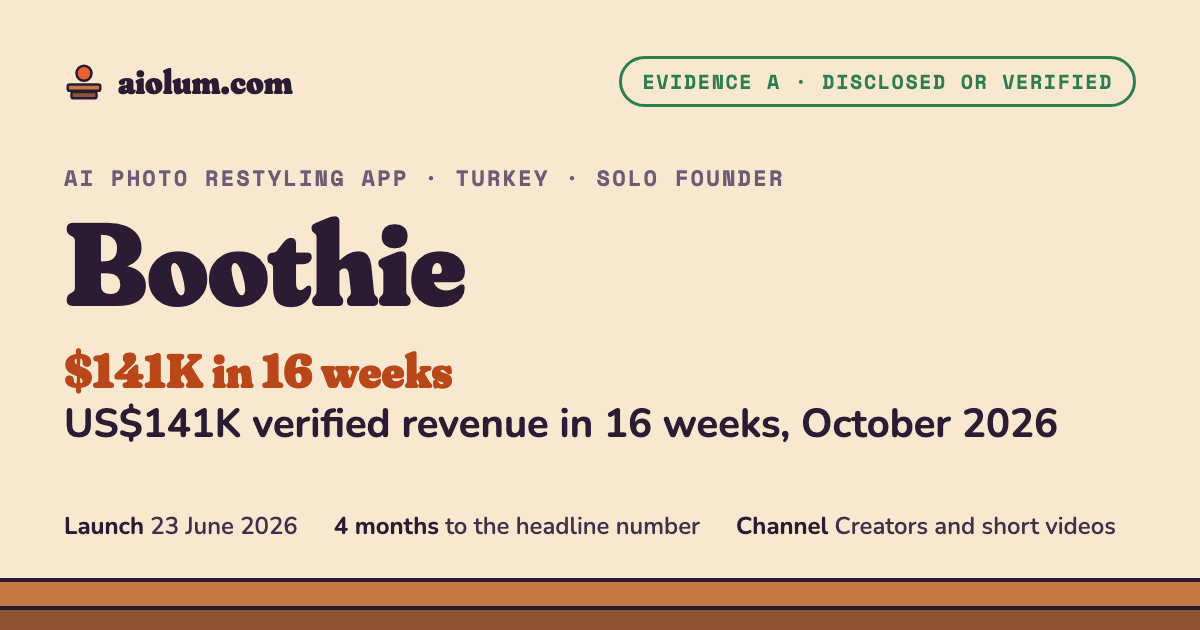
Keremcan Şeker, who trades as a sole proprietor in Turkey, released the app in Apple's App Store on 23 June 2026 and on Google Play on 15 September 2026. The revenue on this page is not his statement. He connected the app's RevenueCat account to TrustMRR, a public database of startup revenue. RevenueCat is a service that app developers place between their app and the app stores: it handles in-app purchases and subscriptions, and it records every purchase, renewal and refund. TrustMRR read that record through an API key: US$141,030 from 23 June to 13 October 2026, which is 16 weeks. RevenueCat's Revenue measure is gross revenue: what customers paid, minus refunds, before the app store keeps its commission and before sales tax. By calendar month the revenue was US$4,727 in the last 8 days of June, US$27,329 in July, US$43,734 in August and US$43,577 in September. It rose fast for two months and has been level since August, with a higher daily average in the first 12 days of October. The app is under four months old, so this page gives totals for stated periods and no yearly rate.
The profile also shows MRR, monthly recurring revenue, of US$51,764. That is more than the US$44,405 that customers paid in the last 30 days, and the reason is the method. Three of Boothie's four subscription plans are sold by the week, and RevenueCat counts each active weekly subscription as four payments. MRR is therefore the amount that the 2,216 active subscriptions would pay in one month if none of them cancelled, and weekly subscribers cancel often. The founder writes that every user came from TikTok carousels, posts made of several pictures that the viewer swipes through, published by "almost a dozen persona accounts", a term that usually means accounts that post as invented characters, and that he spent nothing on advertising. That text is from his sale listing: the business has been offered for sale since September 2026, now for US$1.5 million. This page could not find those accounts or any dated post by him about marketing. It then shows five earlier photo and video apps that grew fast and closed.
The numbers, graded
Each row shows the evidence grade and the source numbers from the list at the end of this page. The grades are explained in How Aiolum verifies.
| Fact | Value | Grade | How we know | Sources |
|---|---|---|---|---|
| Verified revenue, all time to 13 October 2026 | US$141,030 | A | TrustMRR, read from the RevenueCat API, last synced on 13 October 2026 at 18:28 UTC. The first revenue is in June 2026. The cached profile of 12 October showed US$139,181. Gross sales, as the next row explains. This is the headline figure. | [1] |
| What the revenue figure measures | customer payments minus refunds, before store commission and taxes | C | RevenueCat's documentation defines Revenue this way, and defines a separate measure, Proceeds, as revenue minus its estimate of taxes and store commission. TrustMRR's FAQ does not say which RevenueCat measure it imports; for its direct App Store connection it says that revenue is customer sales before Apple's commission. The FAQ also says that its figures can differ from a provider's own by up to 30%. | [5, 4] |
| Verified revenue by calendar month, 2026 | June from the 23rd US$4,727, July US$27,329, August US$43,734, September US$43,577, October to the 13th US$21,663 | A | The monthly table of the profile. The five values add up to the all-time total. August and September together are 61.9% of it. | [1] |
| Revenue per day, by month | June US$591, July US$882, August US$1,411, September US$1,453, 1 to 12 October US$1,741 | calc | Calculated: each monthly total divided by its days (8, 31, 31 and 30), and the profile's daily values for 1 to 12 October, US$20,896, divided by 12. August is 60.0% above July. September is 0.4% below August. | [1] |
| Trend | fast rise to August, level in August and September, higher in early October; no spike | calc | Calculated from the profile's daily table, 29 full days from 14 September to 12 October: the first 14 days average US$1,376 and the last 14 days US$1,665, which is 21.0% more. Inside September, days 1 to 13 average US$1,603 and days 14 to 30 average US$1,338. The lowest day is US$1,053 (28 September) and the highest is US$2,734 (Saturday 10 October). The six days above US$1,700 are one Friday, two Saturdays and three Sundays. | [1] |
| Verified revenue, 30 days to 13 October 2026 | US$44,405 in one month | A | One month of sales, not a yearly rate. The profile marks it 3.5% below the 30 days before, which puts those earlier 30 days at about US$46,000 (44,405 / 0.965). | [1] |
| MRR, 13 October 2026 | US$51,764 | A | Up 22.2% in 30 days according to the profile. RevenueCat converts each active paid subscription to one month: a weekly price is multiplied by 4 and a monthly price by 1. Credit packs and other one-time purchases are not counted. | [1, 6] |
| Active subscriptions, 13 October 2026 | 2,216 | A | RevenueCat counts paid subscriptions that still give access. A subscriber who has cancelled stays in the count until the paid week or month ends. | [1, 7] |
| Average MRR per active subscription | US$23.36 a month, which is US$5.84 a week | calc | Calculated: 51,764 / 2,216, and that result divided by 4. In MRR, a weekly plan at the US price counts as US$27.96 (Plus), US$31.96 (Pro Weekly) or US$39.96 (Gold), and the monthly plan counts as US$19.99. The average is 83.5% of the lowest weekly value, so many subscriptions pay less than the US weekly price. Possible reasons are lower prices in other countries, a discounted first week, and the monthly plan. The profile does not give the split. | [1, 6, 8, 12] |
| MRR against the last 30 days of revenue | MRR is US$7,359 higher, or 16.6% | calc | Calculated: 51,764 minus 44,405. MRR is a count at one moment that assumes every active weekly subscription pays four times. Revenue is what was paid, and it includes credit packs, which MRR leaves out. For an app sold by the week, MRR is an estimate that assumes no cancellations, not a record of money paid. | [1, 6] |
| Figures on the day of listing, 23 September 2026 | US$109,000 total revenue, MRR US$38,000, 1,400 active subscriptions | A | TrustMRR's posts on X, rounded there as $109k, $38k and 1.4k. In the 20 days to 13 October, MRR rose 36.2% and active subscriptions 58.3%, while revenue for 30 days moved only from $43k to US$44,405. The cause of that difference is not published. | [2, 3, 1] |
| Paying users, founder's count | 9,800 in about three months | C | Seller's message on the profile page: "Three months in: $50K MRR, 9,800 paying users." The message is not dated and the count is not among the verified metrics. | [1] |
| Share of those paying users who still subscribe | about 22.6% | calc | Calculated: 2,216 active subscriptions / 9,800 paying users. About 77% of the people who ever paid no longer subscribe. Approximate: the two numbers have different dates, and one user can hold more than one subscription. | [1] |
| Revenue per paying user | about US$14.39 | calc | Calculated: 141,030 / 9,800. That is close to two weekly payments of US$6.99. | [1, 8] |
| Asking price | US$1.5 million, down from US$2 million on 23 September 2026 | C | Set by the seller. The profile gives 9 October 2026 as the first listing date, while TrustMRR's post of 23 September already announces the listing at US$2 million. The profile shows a multiple of 2.8 and 17 offers received. Calculated: 1,500,000 / (44,405 times 12) = 2.81, so the marketplace's multiple compares the price with twelve times the last 30 days of revenue. | [1, 3] |
| Profit margin, last 30 days | 55.0% | C | Shown on the profile. It is not in the profile's list of metrics that come from payment records, and the costs behind it are not published. | [1] |
| Store commission | 15% at Apple for developers in its Small Business Program; on Google Play subscriptions 10% plus a 5% billing fee, or 15%, depending on the market | C | Apple's and Google's own pages. Developers new to the App Store can qualify for Apple's program; whether this developer is enrolled is not verified. Calculated: if 15% applied to all sales, the developer's share of US$141,030 would be US$119,876 before taxes and costs. | [16, 17] |
| AI model | Google's Gemini, called from a Firebase backend | C | The company's privacy policy and terms of 23 July 2026. They do not name the Gemini version. The policy says that photos are sent to the backend only to call the model and are not stored there. | [11, 12] |
| Google's list price for one generated image, October 2026 | US$0.0336 to US$0.134 | C | Google's pricing page, for an image of 1,024 by 1,024 pixels: US$0.0336 with Gemini 3.1 Flash Lite Image, US$0.067 with Gemini 3.1 Flash Image and US$0.134 with Gemini 3 Pro Image. The same page marks Gemini 2.5 Flash Image, at US$0.039 an image, as deprecated with a shutdown date of 2 October 2026. | [14] |
| Model cost of one Plus week with every credit used | US$1.18 to US$2.35, against a price of US$6.99 | calc | Calculated: 5 credits a day times 7 days = 35 credits; 35 times US$0.0336 = US$1.18 and 35 times US$0.067 = US$2.35. After a 15% commission the developer keeps US$5.94 of the US$6.99. This assumes that one credit is one image of that size. The company publishes neither the model version nor the number of credits per image. | [12, 14, 8] |
| App Store ratings, 13 October 2026 | Turkey 4.4 from 194 ratings, United States 4.5 from 30, Germany 4.3 from 15, United Kingdom 5.0 from 6 | B | Apple's lookup API, version 1.6. Apple counts ratings for each country's store separately. Of the 245 ratings in these four stores, 79.2% are Turkish. | [8] |
| Written reviews, Turkish App Store | 11, of which 6 give one star | B | Apple's review feed, 26 June to 12 September 2026. The repeated complaints are that the AI changed the user's face, that the daily credits ran out, and the price. One of the five-star reviews has a negative text. The US and German feeds returned no written reviews. | [8] |
| Google Play, 13 October 2026 | more than 10,000 downloads, no rating shown | B | The page data gives 15,605 downloads, a release date of 15 September 2026 and an update on 4 October 2026. The developer's page lists this one app. | [9] |
| How users were found | TikTok carousels from "almost a dozen persona accounts" in the US, Germany and Turkey; no paid ads | C | Seller's message on the profile, written for buyers; the accounts are offered as part of the sale. Not verified: this page did not find the accounts, and the founder's X account has no post about marketing. Two details agree with it: the website has a notice for visitors who arrive in TikTok's in-app browser, and the App Store listing is translated into German. | [1, 10, 8, 13] |
| Founder's audience on X | 33 followers, 6 posts | C | Read through the fxtwitter API on 13 October 2026. The posts returned are three reposts of TrustMRR and one post in Turkish that is not about the business. The users did not come from a personal audience. | [13] |
| Team | 1 founder named; team size not published | C | TrustMRR lists one founder. The seller in the App Store and the developer on Google Play carry his own name, and the terms call the business a sole proprietorship established in Türkiye. The app's bundle identifier contains a second given name next to his. No source presents a second person as part of the business, so this page names none. | [1, 8, 9, 12] |
| Outside funding | none reported | C | Seller's message: "Launched in June no money, no paid ads." No investor is named in any source read for this page. | [1] |
| Earlier apps by the founder | none found | B | His App Store developer account and his Google Play developer page each list only Boothie, and his TrustMRR founder page lists one startup. | [8, 9, 1] |
| Time from launch to the headline figure | 112 days, which is 16 weeks or about 3.7 months | calc | Calculated: 23 June to 13 October 2026. The card on this site shows 4 months, rounded. | [1, 8] |
How to read this table: a grade A value was read by TrustMRR from the developer's RevenueCat account through an API key; it is not a founder statement. A grade B value is published by Apple or Google in a store record. A grade C value is a founder statement, a profile field that the founder filled in, the company's own policy pages, or a vendor's document. A "calc" value was computed on this page from the rows named in its note.
| Plan | Per month, billed yearly (US$) | Per month, billed monthly (US$) | Limit |
|---|---|---|---|
| Boothie Plus | 6.99 a week | 5 credits a day per the terms; counted as US$27.96 a month in MRR | |
| Boothie Gold | 9.99 a week | 10 credits a day per the terms; counted as US$39.96 a month in MRR | |
| Boothie Pro Weekly | 7.99 a week | credits not published; counted as US$31.96 a month in MRR | |
| Boothie Pro Monthly | 19.99 | credits not published | |
| 10 Credits Pack | 2.99 one-time | subscribers only; not counted in MRR | |
| 25 Credits Pack | 5.99 one-time | subscribers only; not counted in MRR | |
| 60 Credits Pack | 11.99 one-time | subscribers only; not counted in MRR | |
| Editor with film filters | 0 | 0 | runs on the phone, no AI |
The app is free to download, and the editor with film filters is free. Apple's listing gives seven in-app purchases with a name and a price but no period. The terms of service, dated 23 July 2026, say that Plus and Gold are weekly, with 5 and 10 credits a day that do not carry over to the next day. The terms give higher prices than the listing: US$7.99 a week for Plus and US$12.99 a week for Gold, with a possible discount on the first week, no free trial and no yearly plan. The terms do not mention the two Pro plans. Credit packs are sold only to subscribers. Prices differ by country: the German store lists Plus at 8.99 euros and the Turkish store at 249 Turkish lira. Google Play lists in-app purchases from US$2.99 to US$11.99 per item. The third column holds the listed price with its period.
The timeline
From the first version on 23 June 2026 to US$141,030 of verified revenue and a sale listing by October 2026, in 16 weeks. Each entry carries its grade.
- 23 June 2026AVersions 1.0 and 1.1 appear in Apple's App Store under the founder's own name. The last 8 days of June bring US$4,727. [8, 1]
- 26 to 28 June 2026BThe first written reviews arrive in the Turkish App Store: praise for the effects, and complaints about the price and about a changed face. [8]
- July 2026AVersions 1.2, 1.3 and 1.4 on 2, 15 and 23 July. Verified revenue for the month: US$27,329. [8, 1]
- 23 July 2026CPrivacy policy and terms are dated this day: Plus at US$7.99 a week with 5 credits a day, Gold at US$12.99 a week with 10 credits a day, no free trial, no yearly plan, pictures made by Google's Gemini. [11, 12]
- August 2026AVerified revenue of US$43,734, the highest calendar month so far. [1]
- 1 September 2026BVersion 1.5. [8]
- 15 September 2026BThe Android version appears on Google Play. [9]
- September 2026AVerified revenue of US$43,577, 0.4% below August. [1]
- 23 September 2026AThe founder connects RevenueCat to TrustMRR and lists the business for sale at US$2 million. TrustMRR posts US$109,000 total revenue, MRR of US$38,000 and 1,400 active subscriptions. [2, 3]
- 9 October 2026CThe listing date now shown on the profile. The asking price is US$1.5 million. [1]
- 10 October 2026AThe best day in the profile's 30-day table: US$2,734, a Saturday. [1]
- 12 October 2026BVersion 1.6, the seventh version in 16 weeks. [8]
- 13 October 2026AUS$141,030 all time, US$44,405 in the last 30 days, MRR of US$51,764, 2,216 active subscriptions and 17 offers received on the listing. [1]
Why it worked
Four causes, in the order they mattered. Each one is a reusable lesson.
A look that people already wanted
Boothie did not have to create demand. The BBC reported in February 2023 that TikTok videos with the hashtag #digitalcamera had more than 220 million views in twelve months and that young people were buying cameras from the early 2000s. Boothie sells the result of such a camera without the camera, and names its looks after it: Y2K digicam, Powershot flash, night flash.
Many small TikTok accounts, no advertising
According to the founder, all users came from carousels posted by almost a dozen persona accounts in the United States, Germany and Turkey, and he paid for no ads. A carousel of before and after pictures shows the whole product in one post. This is his statement to buyers and this page could not check it. The store ratings fit a start in Turkey: 194 of 245 ratings in four stores are from Turkey.
A weekly price with a daily credit limit
A weekly price of US$6.99 is a small decision for someone who wants the look for one evening's photos. The daily limit of 5 or 10 credits, which do not carry over, puts an upper limit on what one subscriber can cost in model fees. Subscribers who want more buy credit packs.
A rented model and a free editor
The founder trained no model. The app sends the photo to Google's Gemini and pays by the picture, so the cost follows the usage and there was nothing to build before the first sale. The free editor with film filters runs on the phone and costs nothing to serve, so the app can be useful to people who never pay.
How it was built
These details come from the company's privacy policy and terms, from the TrustMRR profile fields that the founder filled in, and from the store listings. They are grade C, except the store records, which are grade B. [1, 11, 12, 8, 9, 10]
- Technology listed on the profile: Swift and React Native for the app, RevenueCat for purchases.
- The AI pictures come from Google's Gemini. The app sends the selected photo to a Firebase backend, which calls the model and returns the result. The policy says that photos and results are not stored on the server and that the history stays on the phone.
- The free mode, called Classic Photobooth in the policy, applies film filters on the phone and sends nothing.
- No account is needed. RevenueCat ties purchases to an anonymous identifier of the installation, and Firebase App Check confirms that requests come from an unmodified copy of the app.
- Analytics with PostHog record events such as paywall viewed, purchase started and daily credits used up. Crash reports go to Firebase Crashlytics. The policy says that screen recording and click capture are turned off.
- Seven versions in 16 weeks: 1.0 and 1.1 on 23 June, 1.2 on 2 July, 1.3 on 15 July, 1.4 on 23 July, 1.5 on 1 September and 1.6 on 12 October 2026. The Android version followed on 15 September.
- The legal pages are two Notion pages, and the website is a single page with store buttons.
Tools named in the sources
Each one opens its page in the Tools tab, with every story that uses it.
The dead that came before
Five companies in the Loot Drop database sold photo or video effects, or grew on another company's platform, and closed. The values below are from that database and are not independently verified.
Viddy
The promiseFilters that make a phone video look professional, shared with friends.
Why it diedPeople tried it once and did not come back. Instagram added video in 2013, and Vine spread at the same time.
Mobli
The promiseA photo and video sharing app with filters, promoted by celebrities.
Why it diedInstagram had started earlier and Facebook bought it. Mobli had no feature that made users switch.
Picnik
The promisePhoto editing and effects in the browser, with nothing to install.
Why it diedGoogle bought it in 2010, moved the technology into Google+ and closed the service in 2012. Phone apps with built-in filters took the users.
Everalbum
The promiseUnlimited photo storage with automatic sorting, sold by subscription.
Why it diedIt charged for features that Google Photos gave away free, and users chose the free one.
Meerkat
The promiseLive video from a phone to your Twitter followers.
Why it diedAll its growth came through Twitter. Twitter bought a competitor, Periscope, and cut Meerkat's access.
What changed
The five earlier companies raised between US$3.5 million and US$86 million to build an effect together with the place where people share the result, or to grow on a platform that they did not control. Each lost when a larger company added the same effect or closed the access. Boothie is exposed to the same two risks: any app can add a digicam look, and all of its users come through TikTok.
What differs is the cost of trying. Boothie builds no network and trains no model. It rents the image model from Google by the picture, sells through the app stores, and charged from the first week, so one person reached US$141,030 of verified sales in 16 weeks without investors. Viddy and Mobli needed tens of millions of dollars before they knew whether users would stay. Boothie will learn the same answer from its own weekly renewals, with little money at risk.
Can one person copy it now?
The method, yes. This look, for a limited time.
A rented image model, a weekly price with a daily credit limit and picture posts on TikTok are open to anyone, and the founder says he started with no money. The digicam look is one trend among many and others sell it too, so a copy needs its own look and its own audience. What nobody can know yet is how long a weekly subscriber stays: the data covers 16 weeks.
Where it is still open: Other looks, and other countries and languages. The founder names two things he has not done: more content for the United States, and work on retention.
- 1Choose a visual look that people already post and save, and check that it is spreading on TikTok in your language.
- 2Build the effect on a rented image model, and add free filters that run on the phone so the app is useful before payment.
- 3Sell by the week with a fixed number of credits a day, so that the model cost of one subscriber has an upper limit.
- 4Post before and after carousels from several accounts in each country, and measure which country pays.
- 5Connect the payment records to a public verification service early, so that the figures can be checked if you decide to sell.
What to watch
The risks are the mirror image of the causes above.
Weekly subscriptions end fast
RevenueCat's State of Subscription Apps 2025 report says that weekly plans lose 30% to 50% of subscribers at the first renewal and that weekly plan retention rarely exceeds 10% at six months. Boothie's own numbers agree with this: by the founder's count of 9,800 paying users, about 77% no longer subscribe, and the average paying user has paid about US$14. The churn rate itself is visible on TrustMRR only after login and was not read.
Sixteen weeks of data, and a seller's text
The verified record starts on 23 June 2026. It shows two months of growth and two level months, which is too short to tell a business from a trend. The description of the marketing comes from a sale listing. Its asking price was US$2 million on 23 September and US$1.5 million by 12 October 2026. TrustMRR also says that its figures can differ from the provider's own by up to 30%.
The model is rented, and the result is the complaint
Every AI picture is a paid call to Google's Gemini, at a list price of US$0.0336 to US$0.134 an image depending on the model. Google sets that price and retires models: its pricing page gives 2 October 2026 as the shutdown date of Gemini 2.5 Flash Image. Any competitor can rent the same model at the same price. The most frequent complaint in the written reviews is that the picture no longer looks like the user, which the website promises will not happen.
The look is a trend
The digicam look has been spreading on TikTok since at least 2022, and a visual trend can pass. Later versions of the app added film looks and a beauty editor. No source shows which looks the revenue depends on.
One platform brings all the users
The founder says that every user came from TikTok carousels posted by persona accounts. A change in how TikTok shows such posts, or the loss of those accounts, would stop new users. The accounts are not named in any source, so their reach could not be checked.
The stores take a share and set the rules
If the developer is in Apple's Small Business Program, Apple and Google each keep about 15% of a subscription payment, and the developer's share of the headline figure is near US$119,876 before costs. Apple's review guidelines say not to submit apps that are indistinguishable from what is already widely available (4.3), require a clear description of what a subscriber gets for the price (3.1.2), and require explicit permission before personal data is shared with a third-party AI (5.1.2). A photo of a face that is sent to Gemini falls under the last rule.
Many apps sell the same thing
The founder's own listing names four larger apps in the same category, Tezza, Prequel, Dazz Cam and WayShot, with yearly revenue figures that this page did not verify. Google Play shows a row of similar AI photo apps next to Boothie. Photo AI and HeadshotPro, the two other photo products on this site, train a model on the customer's own photos and sell on the web, and their figures are founder statements dated 37 and 43 months after launch. Boothie's figure is verified but covers 16 weeks, and it comes from small weekly payments inside app stores, which arrive faster and stop sooner.
Sources
The grade next to each source is the best grade that the source can support. "Read in full" means that the text of the page was downloaded and the numbers were checked in it.
- A TrustMRR profile of Boothie, revenue read from RevenueCat by API keyRead the markdown profile (https://trustmrr.com/startup/boothie.md) live on 13 October 2026, and the cached copy of 12 October. Revenue, the monthly and daily tables, MRR and active subscriptions come from the RevenueCat API, last synced on 13 October 2026 at 18:28 UTC. The description, pricing model, technology list, marketing channel, profit margin, asking price and seller's message are entered by the founder, grade C. Also read the HTML page and the founder page for the full seller's message.
- A TrustMRR on X, 23 September 2026: Boothie just joined TrustMRRRead in full through the fxtwitter API, as a repost in the founder's timeline. Source for the figures on the day of listing.
- A TrustMRR on X, 23 September 2026: Boothie is now listed for saleRead in full through the fxtwitter API. Same figures, with the first asking price of US$2 million, which is the seller's own number, grade C.
- C TrustMRR FAQ, read 13 October 2026Read the sections on payment providers, on the RevenueCat and App Store connections, and on why figures can differ from a provider's own. Also read https://trustmrr.com/llms.txt on what the RevenueCat connection imports.
- C RevenueCat documentation: Revenue chartRead in full. Source for the definitions of Revenue, Revenue net of taxes, and Proceeds.
- C RevenueCat documentation: Monthly Recurring Revenue (MRR) chartRead in full. Source for the conversion table (one week counts as price times 4), for what is left out of MRR, and for why MRR differs from revenue.
- C RevenueCat documentation: Active Subscriptions chartRead in full. Source for what counts as an active subscription.
- B Apple App Store listing of Boothie: AI Photo Editor, with Apple's lookup API and review feedRead the US listing on 13 October 2026 for the seller, the version history and the in-app purchases; the German and Turkish listings for local prices; the lookup API for the release date and for ratings in the US, Turkish, German and UK stores; the developer lookup, which returns one app; and the customer review feeds of the Turkish, US and German stores.
- B Google Play listing of BoothieRead the listing and the developer page on 13 October 2026. Source for the developer name, the downloads, the release and update dates and the range of in-app prices.
- C Boothie website, read 13 October 2026Read in full. Source for the list of looks, the promise that the face stays the same, the credits, and the notice for TikTok's in-app browser. The Wayback Machine has no earlier copy.
- C Boothie Privacy Policy, last updated 23 July 2026The page loads by script, so the text was read through Notion's public page interface. Read in full. Source for the AI provider, the backend, the analytics tools and the handling of photos.
- C Boothie Terms of Service, last updated 23 July 2026Read through Notion's public page interface, sections 1 to 8. Source for the legal form, the weekly plans, the daily credits and the credit packs.
- C X account of Keremcan Şeker, @keremcanseker_Read the whole timeline through the fxtwitter API on 13 October 2026: 33 followers and four posts returned, of which three are reposts of TrustMRR. No post about marketing, team or funding.
- C Google: Gemini Developer API pricing, read 13 October 2026Read the sections on the image models. Source for the price per generated image and the shutdown notice for Gemini 2.5 Flash Image.
- C RevenueCat: State of Subscription Apps 2025Read the sections on plan durations and retention. Source for the weekly plan retention and first-renewal churn. A vendor's report on the apps that use its service.
- C Apple: App Store Small Business ProgramRead in full. Source for the 15% commission rate and who qualifies.
- C Google Play Console Help: Service feesRead the fee tables. Source for the fees on auto-renewing subscriptions.
- C Apple: App Review Guidelines, last updated 8 June 2026Read sections 3.1.2, 4.3 and 5.1.2.
- C BBC News, 6 February 2023, Mike Farrell: Digital cameras back in fashion after online revivalRead in full. Source for the age and size of the digital camera trend on TikTok.
- C Loot Drop database export, 1,749 failed startupsLocal export. AI-written summaries, not independently verified. Source for the failed predecessors.