Helium: Product, team and how it was built
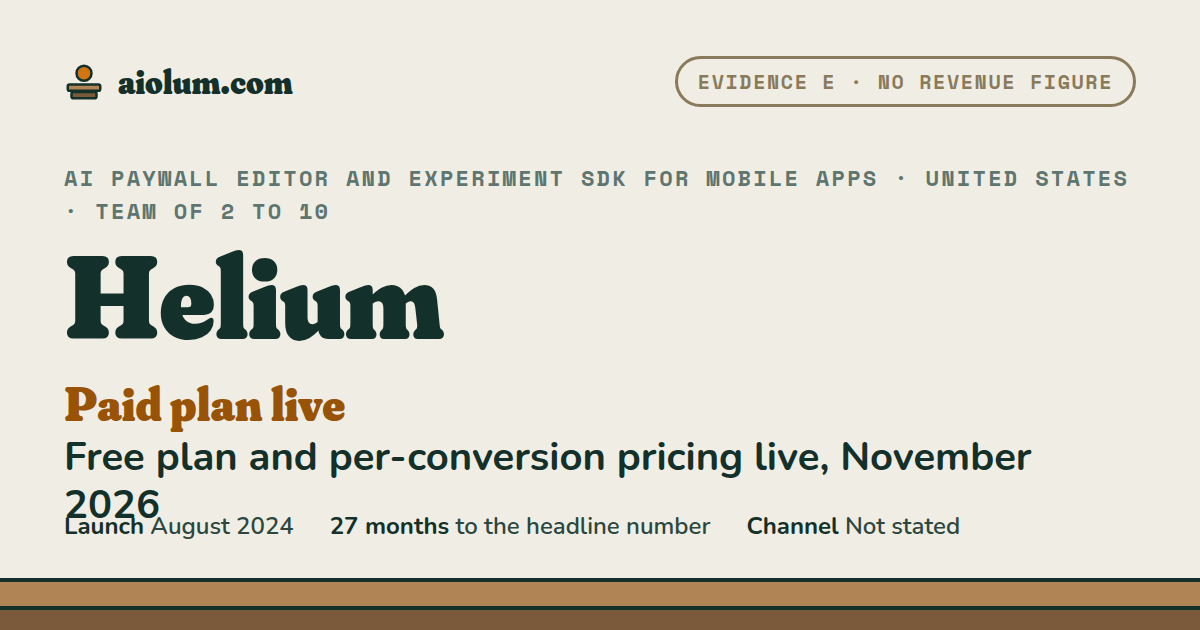
Helium (AI paywall editor and experiment SDK for mobile apps, United States): Free plan and per-conversion pricing live, November 2026. Evidence grade E: no revenue figure was checked. Team: 3 founders at launch in August 2024; 9 people per the YC listing, 8 per the about page, November 2026. Launched August 2024; still running.Added
- Outcome
- Free plan and per-conversion pricing live, November 2026
- Evidence
- E no revenue figure was checked
- Launch
- August 2024
- Status
- Still running
- Team
- 3 founders at launch in August 2024; 9 people per the YC listing, 8 per the about page, November 2026
- Outside funding
- US$2M announced by May 2025 (company blog); the about page says US$6M
- Main channel
- Not stated
What is not verified
No revenue figure, customer count or confirmed paying customer was found. The company states that the plans are on sale and the terms describe invoices. A reader could look for a payment-processor profile, a founder interview or a press article that names paying customers. A search for an earlier name could not be run, so a start before 2024 is not ruled out. This story is grade E: the business is real and its product, price and customers are described from public pages, but no revenue figure was checked. Aiolum shows it as an idea worth studying, not as proof that it makes money.
Helium sells a paywall editor and a software development kit (SDK), which is a code library that an app team adds to its app. The paywall is the in-app screen that asks a user to pay. The company calls its editor AI-driven: it generates paywall designs, and it targets each design to a type of user. A conversion is, in the company's words, "any paywall success event, including trial starts or a direct purchase".
Cloud Captain Inc., doing business as Helium, is a Delaware corporation, as its terms of service state. Y Combinator lists Helium as founded in 2024 in the Summer 2024 batch by Zach Witzel and Shishir Jakati. The company's blog announced US$2M of funding in a post that an archive copy dates 5 May 2025. The team has 8 people on the about page and 9 on the Y Combinator page.
No revenue figure was found, and this story is grade E. The pricing page lists a free plan with 250 conversions a month and US$0.30 for each conversion after that. The terms of service describe invoices based on conversions. A company blog post quotes the chief executive of its customer Locket on the return, but no outside source confirms that any customer paid.
Why did Helium work?
Four causes, in the order they mattered. Each one is a reusable lesson.
The founders had run paywall and ad experiments at large companies
The Y Combinator listing says Zach Witzel ran growth experiments at Uber and Shishir Jakati worked on Alexa AI. The launch post adds the third founder's work on ad optimization at Meta. These are the founders' own statements. The product repeats what they did by hand: many tests of upsell screens.
A paywall change no longer waits for an app store release
The launch post says a change took at least 6 weeks to code, test, launch and get installed. The home page says the product drives subscriptions "without an App Store Update". The editor and the SDK move that change to a dashboard.
The fee grows only when the customer's conversions grow
The company charges per conversion and gives 250 a month free. The pricing page says it does not bill for trial renewals or existing revenue. The launch post offered design partners a refund if they did not earn 5 times the price.
How it was built
These details come from the company's own pages, so they are grade C. [3, 8, 11]
- The SDK exists for Swift, Kotlin, React Native and Flutter. The home page shows a one-line call that presents a paywall at a named trigger.
- The editor builds a paywall from a Figma file, a screenshot, a template or a prompt, and it supports localization and video.
- The home page says its A/B and multi-variate tests are "based on the experimentation platform at Meta".
- The funding blog post says the company trained models on hundreds of experiments. The system sends a proposed paywall by email, and the customer approves it before the test starts.
- The sub-processor list names Supabase for the database, Fly.io for edge hosting and ClickHouse for analytics queries. It also names Vercel for the front end, and Anthropic and OpenAI for data processing.
Tools named in the sources
Each one opens its page in the Tools tab, with every story that uses it.
Who tried this before Helium, and why did they fail?
Two companies in our database of failed startups sold software that helps mobile app teams, and both closed. The values below are from that database and are not independently verified.
Appiterate
The promisePersonalized notifications for mobile apps, to raise online store sales and conversions.
Why it diedThe record names fast competition from larger incumbents and from new entrants that used more advanced AI.
Testmunk
The promiseAutomated testing of mobile apps on real devices, to save developers time.
Why it diedThe record says it could not stand out in a market that filled quickly, and that a device farm was costly to run.
The failed startups come from our database of 1,749 dead startups, retold here in our own words. Its entries are AI-assisted summaries of public sources, so these cards carry no evidence grade.
What changed
Appiterate and Testmunk sold to developers a task that bigger vendors also sold. Helium sells one task, the paywall, and measures it in conversions. A buyer can compare the fee with the extra subscriptions.
The market is crowded. The company's own pricing page compares Helium with Superwall and RevenueCat. Helium has to win on how fast a team can start and on the results that its customers report.
Can one person copy Helium now?
The structure, yes. The market is crowded.
Founders who ran conversion tests at big apps can sell the testing as a tool. The structure is a free plan, a fee only on conversions and a one-line code change. No source shows that it earns money yet, so a reader should not copy it as a proven business.
Where it is still open: Other app screens that teams test slowly: onboarding flows, price pages, cancel flows and upgrade prompts.
- 1Pick one screen that many apps change often and that is slow to change, such as the paywall.
- 2Make the first step one line of code, so a team can try it in an afternoon.
- 3Charge on the result, with a free tier small enough that a growing app needs the next one.
- 4Publish customer case studies, and keep the numbers tied to a named customer.
How much revenue does Helium make?
Each row shows the evidence grade and the source numbers from the list at the end of this page. The grades are explained in How Aiolum verifies.
| Fact | Value | Grade | How we know | Sources |
|---|---|---|---|---|
| Company entity | Cloud Captain Inc. (d/b/a Helium), a Delaware corporation | C | Terms of service, effective 26 September 2025. The privacy policy gives the same name. | [4] |
| Start of the company | 2024 | C | The Y Combinator listing says "Founded: 2024", Summer 2024 batch. The footer of a site copy from 20 August 2024 reads "CloudCaptain Inc, 2024". No earlier name or product was found. | [5, 6] |
| Launch post | 7 August 2024 | C | The Y Combinator launch post carries that creation date. It offers a design-partner deal with set-up help and 3 to 5 experiments. It promises a refund if the customer does not earn 5 times the price in new revenue. | [5] |
| Founders | Zach Witzel (CEO), Shishir Jakati (CTO) | C | Both are named on the Y Combinator listing and the about page. The launch post and the August 2024 site copy also name a third founder, Anish, by first name only. The Y Combinator page does not list him as an active founder. | [2, 5, 6] |
| Team size | 8 to 9 people | C | The about page says "We're an team of 8 based in San Francisco CA". The Y Combinator listing says a team size of 9. | [2, 5] |
| Funding | US$2M announced by 5 May 2025 | C | The company's blog post names Y Combinator, Gradient Ventures and Daybreak Ventures as participants. An archive copy of the blog from 13 June 2025 dates the post 5 May 2025. The live post shows 4 February 2026. The about page says "Armed with $6M". The two figures were not reconciled. | [8, 14, 2] |
| Current prices | Free to 250 conversions a month, then US$0.30 each | C | Pricing page, 12 November 2026. The Growth plan is "Custom Pricing". The documentation says "Create your Helium account at app.tryhelium.com". | [1, 15] |
| Earlier prices | Free to 500 conversions, then US$0.20 each | C | Internet Archive copy of the pricing page, 10 September 2025. One layout of that copy carries a "Join the Waitlist" button on the US$0.20 plan. | [7] |
| Billing terms | Fees based on conversions, invoiced monthly | C | The terms say fees "may be based on the number of end user conversions", with an invoice at the end of each billing cycle or month, due in 30 days. | [4] |
| Named customer | Locket | C | The company's blog and home page name Locket and quote its CEO, Matt Moss: "Subscriptions have grown 77% since working with Helium". The company states this. An archive copy of the blog dates the case study 1 May 2025. The live blog index and the live article show later dates. | [3, 9, 10, 14] |
| Where the AI is | AI editor, targeting and automated experiments | C | The pricing page says "Our AI paywall editor makes all of this just a prompt away". The launch post describes an AI algorithm, Smart Select, that picks a variant per user. The home page lists automated experimentation as coming soon. | [1, 5, 3] |
How to read this table. Every value is grade C. It comes from the company's own pages, a copy of them in the Internet Archive, or the Y Combinator listing that the company wrote. No payment processor, press article or buyer confirms any of it.
| Plan | Per month, billed yearly (US$) | Per month, billed monthly (US$) | Limit |
|---|---|---|---|
| Indie | 0 | 250 conversions a month, then US$0.30 each | |
| Growth | custom | custom analytics, localization, app-to-web, early access features |
The Indie plan is free up to 250 conversions a month and costs US$0.30 per conversion after that. The terms of service say that Helium measures conversions and invoices them. The Growth plan has a custom price. A copy from 10 September 2025 listed a free Starter plan with 500 conversions and US$0.20 per conversion.
When did Helium launch, and how did it grow?
From a launch post with a design-partner offer to a self-serve plan, in 27 months. Each entry carries its grade.
- 7 August 2024CLaunch post on Y Combinator: a no-code paywall editor, an SDK and personalization, offered to design partners with a refund promise. [5]
- 20 August 2024CA copy of the site offers a waitlist and a demo. The footer reads "CloudCaptain Inc, 2024". [6]
- 5 May 2025CThe company blog announces US$2M of funding and says it launched its first automated experiments a few months earlier. The live copy of the post is dated 4 February 2026. [14, 8]
- 10 September 2025CThe pricing page lists a free Starter plan with 500 conversions and a Growth plan at US$0.20 per conversion. [7]
- 12 April 2026CThe sub-processor list is updated. It names Supabase, Fly.io, ClickHouse, Vercel, AWS, Anthropic and OpenAI, among others. [11]
- 12 November 2026CThe pricing page lists a free Indie plan with 250 conversions, then US$0.30 each. The home page announces app-to-web as live. [1, 3]
What could go wrong for Helium?
The risks are the mirror image of the causes above.
What is not verified
No revenue figure, customer count or confirmed paying customer was found. The company states that the plans are on sale and the terms describe invoices. A reader could look for a payment-processor profile, a founder interview or a press article that names paying customers. A search for an earlier name could not be run, so a start before 2024 is not ruled out.
Earlier name and conflicting figures
The footer of an August 2024 site copy reads "CloudCaptain Inc, 2024". The company's LinkedIn address, linked from the about page, contains the word "uplikehelium". LinkedIn was not opened, so what that word refers to is not known. The funding figure is US$2M in the blog and US$6M on the about page. The funding post is dated 5 May 2025 in an archive copy and 4 February 2026 on the live site.
Customer claims come from the company
The home page shows a wall of 28 app tiles under "Trusted by the best in mobile", investor logos, and an asterisk note "Investment by Leaders from". It also shows "Serving Millions of Users per Day" and "99.99% uptime". The home page also says "1 day of engineering work to go live for Wispr". The one testimonial is from the CEO of Locket, and the case study repeats it. The app-to-web page claims "100% Compliant", "Earn 50% more" and "We’ll lift your revenue, guaranteed". It shows result figures for an unnamed "Health & Fitness App". No outside source confirms any of these.
App-to-web depends on app store rules
The app-to-web page says that since 2025 apps can legally link US users to web checkout. The terms make the customer responsible for app store rules and for subscription disclosures. Helium may suspend a paywall that risks breaking a platform rule. The rules differ by country and can change.
Sources
The grade next to each source is the best grade that the source can support. "Read in full" means that the text of the page was downloaded and the numbers were checked in it.
- C Helium pricing page, read 12 November 2026Read in full. Source for the plans, the prices, the conversion definition and the comparison answers.
- C Helium about page, read 12 November 2026Read in full. Source for the founders, the team of 8, the US$6M line and the LinkedIn address.
- C Helium home page, read 12 November 2026Read in full. Source for the product description, the counters, the logo wall and the Locket quotation.
- C Helium terms and conditions, effective 26 September 2025Read the sections on the contracting entity, app store compliance and payment.
- C Y Combinator: Helium company page and launch postRead in full on 12 November 2026. Source for the founding year, the batch, the team size of 9 and the launch post of 7 August 2024.
- C Internet Archive copy of the Helium home page, 20 August 2024Read in full. Shows the waitlist page, three founders and the footer "CloudCaptain Inc, 2024".
- C Internet Archive copy of the Helium pricing page, 10 September 2025Read in full. Source for the earlier plans and prices.
- C Helium blog: We've raised $2M to build self-improving software, live page dated 4 February 2026Read in full. Source for the funding announcement, the investors and the automated experiments. An archive copy dates the same post 5 May 2025.
- C Helium blog: How Locket Grew Subscriptions by 77% with HeliumRead in full on 12 November 2026. Written by the company; source for the customer quotations.
- C Helium blog index, read 12 November 2026Read the list of articles and their dates. Two articles were read in full.
- C Helium sub-processor list, last updated 12 April 2026Read in full. Source for the infrastructure and AI providers.
- C Helium app-to-web page, read 12 November 2026Read the text sections. Source for the app-to-web claims.
- C Database of failed startups, local exportRecord pages read on 12 November 2026. AI-assisted summaries, not independently verified. Source for the failed predecessors.
- C Internet Archive copy of the Helium blog index, 13 June 2025Read in full. It dates the funding post 5 May 2025 and the Locket case study 1 May 2025.
- C Helium documentation: Quickstart, read 12 November 2026Read in full. Source for the account sign-up at app.tryhelium.com.
Run this company? Send corrections or a verified figure to aiolum@livyden.com