HeyDeacon (Deacon): Revenue, team and how it was built
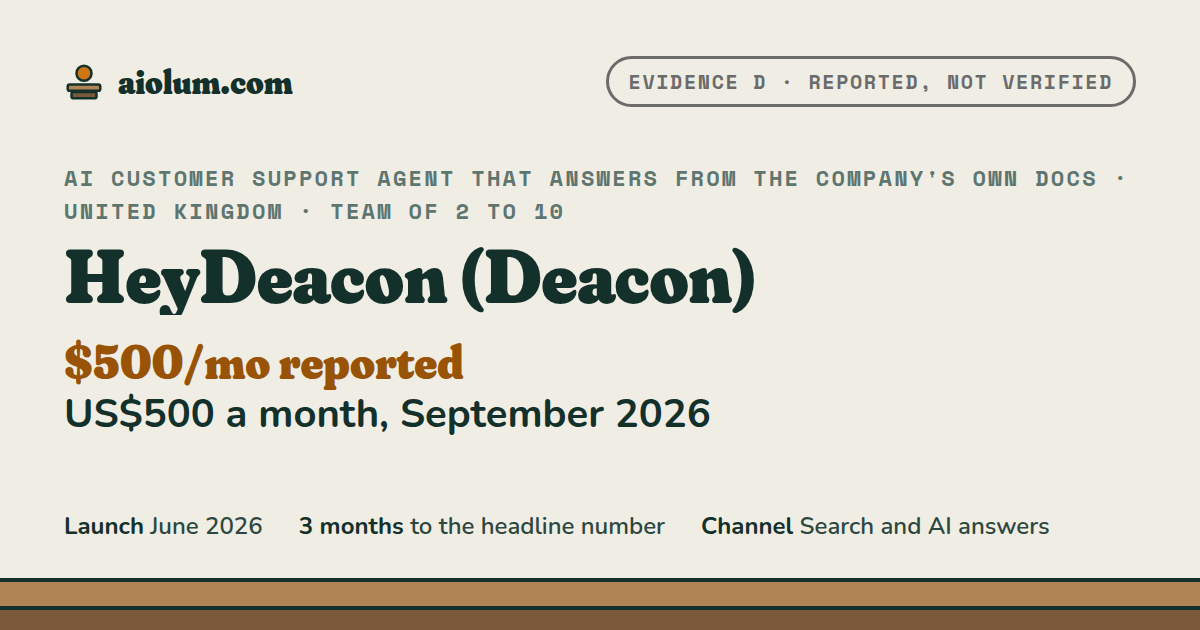
HeyDeacon (Deacon) (AI customer support agent that answers from the company's own docs, United Kingdom): US$500 a month, September 2026. Evidence grade D: reported, not verified. Team: 3 co-founders and 1 employee, as the Starter Story header showed in September 2026. Launched June 2026; still running.Added
- Outcome
- US$500 a month, September 2026
- Evidence
- D reported, not verified
- Launch
- June 2026
- Status
- Still running
- Team
- 3 co-founders and 1 employee, as the Starter Story header showed in September 2026
- Outside funding
- None found
- Main channel
- Search and AI answers
What is not verified
The money rests on one source. The founder Andy stated around US$500 a month in a Starter Story interview dated 23 September 2026. No payment-processor profile, press report or second interview was found. A reader could look for a TrustMRR or Stripe-verified profile, or a later founder post. The headline number is grade D: one claim or one estimate, with no second source. Aiolum shows it because the story is useful, and marks it so that it is not mistaken for a verified figure.
Deacon is an AI support agent: a program that uses a large language model to answer customer questions in a chat on a website. HeyDeacon says it answers only from the content the customer adds, such as web pages, files and written answers. When that content has no answer, it says "I don't know" and asks for an email. This is called a handoff: the conversation passes to a human.
The founder Andy wrote in a Starter Story interview, dated 23 September 2026, that Deacon started as a side project in June 2026. He wrote that three co-founders in London run it and that it brings in around US$500 a month. Starter Story lists 3 founders and 1 employee. The company is HeyDeacon Limited, registered in England, according to its terms of service.
The only money figure is that one founder statement, so the story is grade D. No payment-processor profile or second interview was found. The pricing page shows that customers can pay: Starter costs US$40 a month and Growth US$120 a month, both billed once a year.
Why did HeyDeacon (Deacon) work?
Four causes, in the order they mattered. Each one is a reusable lesson.
It was built for two products that already needed it
The founder wrote that two co-founders run other software products that received too many customer messages. They built Deacon for those products first. He wrote that they never had to ask whether the problem was real. Other founders with the same problem were the second step.
It answers from the docs and says when it does not know
The home page says Deacon answers only from what the docs say, in the visitor's language, often with a link to the source page. When the docs do not cover the question, it asks for the visitor's email. A founder who fears a bot that invents a refund policy is the buyer this targets.
Search pages brought the first paying customer
The founder wrote that the first customer found the company through organic search. The company wrote comparison pages, pages for site builders such as Lovable, Bolt and v0, and guides. The sitemap lists about 235 addresses, most of them such pages.
Every feature is on every plan, even the free one
The pricing page says customers pay for more answers, pages and seats, never to unlock a feature. There is no overage fee and no badge to pay to remove. The free plan has no end date, which lets a founder test it on a real site.
How it was built
These details come from the founder's interview and the company's own pages. They are grade C or D. [1, 2, 3, 7]
- The founder wrote that Deacon is a harness around the language model. It finds the answer in the docs, says when it does not know and hands over to a person. A better model can be put in later.
- Content comes from four kinds of source: the website, uploaded files, pasted text and answers that the owner writes. Each written answer becomes part of what Deacon knows.
- The widget is one script line pasted before the closing body tag. The pricing page says setup takes a few minutes.
- The company also offers an API, webhooks and an MCP server. A coding agent such as Claude Code or Cursor can then read what customers reported. These are on every plan.
- StartupHub's scan of the site, on 9 November 2026, detected Tailwind CSS for the front end and Google Workspace for email.
- The interview says the build took around six months. The same interview says the project began in June 2026. See "What is not verified".
Tools named in the sources
Each one opens its page in the Tools tab, with every story that uses it.
Who tried this before HeyDeacon (Deacon), and why did they fail?
Four companies in our database of failed startups sold chat or automated answers to businesses before 2023. The values below are from that database as read on 11 November 2026, and they are not independently verified.
Answerly
The promiseFAQ systems that match customer questions to written answers and pass only hard cases to a person.
Why it diedThe language processing of the time could not handle real questions. Setup meant writing FAQs and decision trees for months.
Hipmob
The promiseCustomer support chat inside mobile apps and websites.
Why it diedIntercom and Zendesk added chat to larger products. The record says the small funding limited how fast it could improve.
RightHello
The promiseLive chat that helps online shops turn visitors into buyers.
Why it diedThe record says it was too undifferentiated for a premium price. Larger rivals with far more capital bundled chat into bigger products.
Unfaze AI
The promiseMachine learning to automate on-demand customer service and cut response times.
Why it diedThe record says small and medium companies were slow to buy AI. Each client needed custom models, which raised cost and delayed launches.
The failed startups come from our database of 1,749 dead startups, retold here in our own words. Its entries are AI-assisted summaries of public sources, so these cards carry no evidence grade.
What changed
Answerly, Hipmob, RightHello and Unfaze AI each sold chat or automated answers to businesses. The records give three causes. The software of the time could not answer real questions. Larger suites such as Intercom and Zendesk added the same chat. Each customer needed hand work to set up.
Two of these causes are weaker for Deacon, according to the sources. A language model answers free-form questions from the docs, so no one writes decision trees. The home page says the setup is one script line and a website address. The third cause, competition from larger suites, remains. Deacon's own comparison pages name Chatbase, Tidio, Crisp, Fin and Zendesk as the tools a buyer weighs.
Can one person copy HeyDeacon (Deacon) now?
Yes for the method, but the market is crowded.
A solo or small team can copy the method. Build for a problem that you already have, answer only from known content, and publish many search pages. The price of a copy is the crowded market. No source shows that Deacon beats the larger tools.
Where it is still open: Other narrow jobs where a wrong answer is costly. One example is an AI that answers only from a contract or a handbook and passes the rest to a person.
- 1Start with a problem that a co-founder or a friend has now, so the first users exist.
- 2Make the product refuse to guess. State in the product and on the page what it does when it does not know.
- 3Give every feature to the free plan and charge for volume, as the pricing page does.
- 4Write comparison and how-to pages for the tools that buyers already search for.
How much revenue does HeyDeacon (Deacon) make?
Each row shows the evidence grade and the source numbers from the list at the end of this page. The grades are explained in How Aiolum verifies.
| Fact | Value | Grade | How we know | Sources |
|---|---|---|---|---|
| Revenue per month, September 2026 | around US$500 | D | The founder Andy, in a Starter Story interview dated 23 September 2026. One statement, one date. | [1] |
| Annual figure from the monthly one | about US$6,000 a year | calc | Calculated: US$500 times 12. The headline figure on this page is that product. | [1] |
| Start | June 2026, as a side project | D | The founder in the same interview. The site shows only "© 2026", and StartupHub lists the founding year as 2026. | [1, 2, 7] |
| Company | HeyDeacon Limited, registered in England | C | The company's terms of service, last updated 26 October 2026. The founder gives London as the place. | [5, 1] |
| Team, September 2026 | 3 co-founders and 1 employee | D | Starter Story header, 23 September 2026. The founder wrote that he is one of the three co-founders. The other two are not named in the sources. | [1] |
| Funding | none found | D | StartupHub says no announced round is on file. No source states that the company is bootstrapped. | [7] |
| First paying customer | a small software company in Japan, found through organic search | D | The founder in the interview. The customer is not named. | [1] |
| Free plan | 50 answers a month, every feature, no card, no end date | C | The company's pricing page. | [3] |
| Paid plans | US$40 a month (Starter) and US$120 a month (Growth), billed yearly | C | The company's pricing page. Starter is billed US$480 and Growth US$1,440 once a year. | [3] |
| Directory listing | featured on BetaList on 25 August 2026 | B | BetaList page. The makers line shows one first name, which is not the founder's name in the interview. | [6] |
| Public launch | not yet | D | The founder wrote that there has been no big public launch and a Product Hunt launch is on the cards. | [1] |
| Time from start to the figure | 3 months | calc | Calculated: June 2026 to September 2026. | [1] |
How to read this table. A grade D value is one founder statement with one date, or a third-party listing. A grade C value is a statement on the company's own page. A "calc" value was computed on this page.
| Plan | Per month, billed yearly (US$) | Per month, billed monthly (US$) | Limit |
|---|---|---|---|
| Free | 0 | 50 answers a month, about 25 conversations, 1 seat | |
| Starter | 40 | 1,000 answers a month, about 500 conversations, 3 seats; billed US$480 once a year | |
| Growth | 120 | 4,000 answers a month, about 2,000 conversations, 10 seats; billed US$1,440 once a year |
Every plan has every feature. Plans differ only in answers per month, pages Deacon learns from, pages it reads from the web, and seats. The page shows a Yearly and a Monthly switch and says yearly saves 20 percent, but the downloaded text gives only the yearly prices. There is no charge past the plan's answers.
When did HeyDeacon (Deacon) launch, and how did it grow?
From a June 2026 start to a September 2026 interview, in three months. Each entry carries its grade.
- June 2026DThe three co-founders start Deacon as a side project, according to the founder. Two of them had other software products with many repeated customer questions. [1]
- 25 August 2026BBetaList features Hey Deacon as an AI customer service agent for startups. [6]
- 23 September 2026DStarter Story publishes the founder's interview. He says Deacon brings in around US$500 a month and that the first paying customer came from organic search. [1]
- 26 October 2026CThe terms of service name HeyDeacon Limited as the operator. [5]
- 11 November 2026CThe pricing page shows a free plan and two paid plans, all with every feature. [3]
What could go wrong for HeyDeacon (Deacon)?
The risks are the mirror image of the causes above.
What is not verified
The money rests on one source. The founder Andy stated around US$500 a month in a Starter Story interview dated 23 September 2026. No payment-processor profile, press report or second interview was found. A reader could look for a TrustMRR or Stripe-verified profile, or a later founder post.
The sources disagree on a few details
The interview says the first version took around six months to refine, yet it says the project started in June 2026. BetaList lists a maker with a different first name from the interviewee. The team size of 3 founders and 1 employee is Starter Story's header.
The business is very small and new
The company is about five months old on 11 November 2026. The founder wrote that there has been no big public launch yet. No source shows revenue after September 2026, so the trend is unknown.
Outreach on forums is a growth tactic
The founder wrote that the team talks to founders on Reddit, Hacker News, Indie Hackers, LinkedIn and X, and lists Deacon in free software directories. No source says the company used fake accounts or bought reviews.
Sources
The grade next to each source is the best grade that the source can support. "Read in full" means that the text of the page was downloaded and the numbers were checked in it.
- D Starter Story: How I Built An AI Support Agent For Founders Making $500/Month [Side Hustle], 23 September 2026Read in full. Founder interview with the header figures. Source for the revenue, the start date, the team, the first customer and the growth methods.
- C HeyDeacon home page, read 11 November 2026Read in full. Company's own words on the product, the handoff and the footer year.
- C HeyDeacon pricing page, read 11 November 2026Read in full. Source for the plans, limits and prices. The monthly price toggle did not appear in the downloaded text.
- C HeyDeacon About page, read 11 November 2026Read in full. Describes who the product is for and how the plans work. It names no people.
- C HeyDeacon terms of service, last updated 26 October 2026Read the sections on the operator, the age limit and the governing law. Source for the company name and its registration in England.
- B BetaList: Hey Deacon, featured 25 August 2026Read in full. A directory listing with the feature date and a one-name makers line.
- C StartupHub.ai: Deacon, last updated 5 October 2026Read in full. A directory profile: founding year 2026, no announced round, and a technology scan of 9 November 2026.
- C Database of failed startups, local exportRecord pages read on the website on the day of writing. AI-written summaries, not independently verified. Source for the failed predecessors.
Run this company? Send corrections or a verified figure to aiolum@livyden.com