WeBuilda: Revenue, sale and how it was built
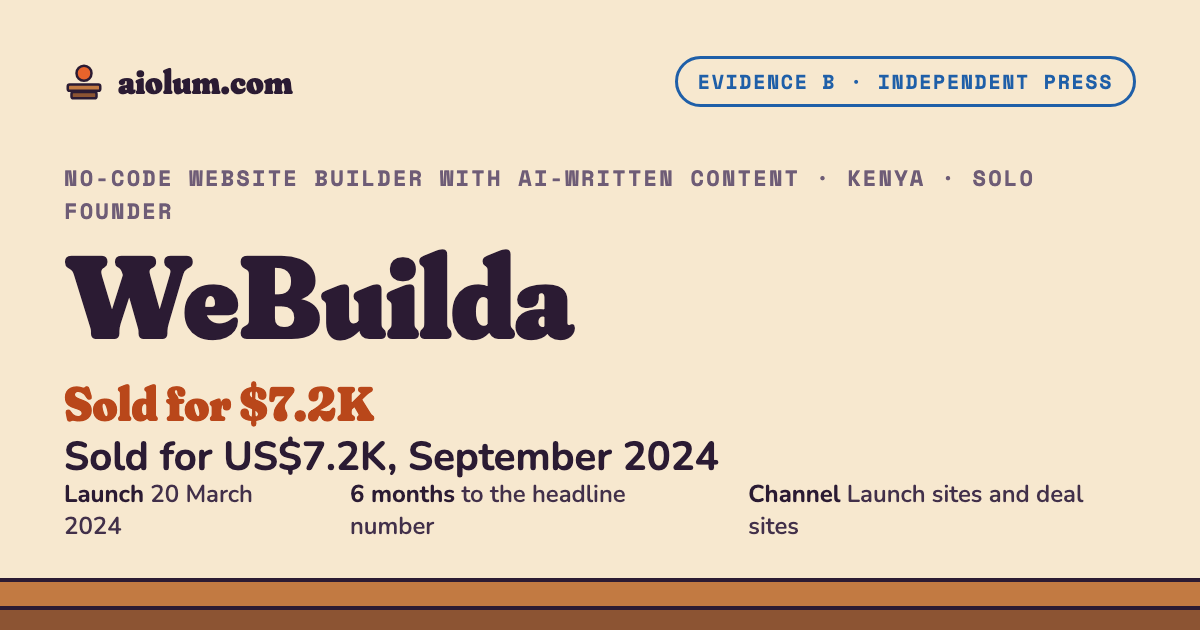
WeBuilda (No-code website builder with AI-written content, Kenya): Sold for US$7.2K, September 2024. Evidence grade B: confirmed by two or more independent reports. Team: 1 founder alone, from launch to sale. Launched 20 March 2024; sold 6 months after launch.Added 26 October 2026
- Outcome
- Sold for US$7.2K, September 2024
- Evidence
- B confirmed by two or more independent reports
- Launch
- 20 March 2024
- Status
- Sold, 6 months after launch
- Team
- 1 founder alone, from launch to sale
- Outside funding
- None reported; US$680 of starting costs
- Main channel
- Launch sites and deal sites
WeBuilda was a no-code website builder: a web app in which a person without programming skills makes a website by choosing a template and moving blocks on the page with the mouse (drag and drop), instead of writing HTML and CSS. Its AI part was a content generator connected to OpenAI: the user described the business, and the model wrote the text of the pages. Paid plans also included AI-generated images. The AI did not design the site; the templates did. For this reason this page classes the business as AI-leveraged, not AI-native.
Enoq Moka, a product manager from Kenya, launched it alone on 20 March 2024. It was his fifth product. On 13 September 2024 the marketplace Microns, which handled the sale, published that WeBuilda had sold for US$7,200 after 21 days on the marketplace. At the sale it had US$4,040 of annual recurring revenue (ARR: the yearly value of the subscriptions that were active at that time) from 22 customers. The price was therefore about 1.8 times ARR. This ratio is the revenue multiple, the usual way to compare prices of small software businesses.
This is one of the smallest exits on this site. Its value as a story is the method: a cheap build on a rented model, launches on directories, and a fast sale through a broker. The buyer is not named, and the site has not worked since early 2025. The page also shows four failed startups that promised websites or software without programmers, from The Grid's AI web designer to Builder.ai.
How much did WeBuilda make, and what was it sold for?
Each row shows the evidence grade and the source numbers from the list at the end of this page. The grades are explained in How Aiolum verifies.
| Fact | Value | Grade | How we know | Sources |
|---|---|---|---|---|
| Sale price | US$7,200 | B | Published by Microns, the marketplace that handled the sale, in its success story of 13 September 2024, and confirmed by the founder in the same interview. The buyer is not named. The deal was all cash in two payments: the first after the transfer of ownership, the second in the second month after signing. | [1] |
| Date of the sale report | 13 September 2024 | B | The date of the Microns story. The exact closing date is not given; this page uses the month of the report. | [1] |
| Annual recurring revenue at the sale | US$4,040 | C | Figure from the founder's listing, shown by Microns. The founder said he gave Microns screenshots of the payment data, and that the listing went live after a review of about 72 hours. | [1] |
| Monthly recurring revenue at the sale | about US$337 | calc | Calculated: 4,040 divided by 12 equals 336.67. | [1] |
| Revenue multiple | 1.78 times ARR | calc | Calculated: 7,200 divided by 4,040 equals 1.78. Microns rounds it to 1.8. | [1] |
| Paying customers at the sale | 22 | C | From the listing data shown by Microns. | [1] |
| Revenue per customer | about US$184 a year, or US$15 a month | calc | Calculated: 4,040 divided by 22 equals 183.64. That is between the Basic plan (US$10 a month) and the Pro plan (US$49 a month). | [1, 2] |
| Team size | 1 | C | From the listing data shown by Microns. The founder said he did most of the development himself. | [1] |
| Starting costs | US$680 | C | The founder said this covered the domain, servers, design tools and some outsourced API costs. No investors are named in any source. | [1] |
| Sale price compared with starting costs | about 10.6 times | calc | Calculated: 7,200 divided by 680 equals 10.59. The founder's own time is not counted. | [1] |
| Time to build the first version | 2 months | C | From the listing data shown by Microns. | [1] |
| Launch date | 20 March 2024 | C | From the listing data. The company blog announced the product on 26 March 2024. | [1, 3] |
| Product Hunt launch | 25 April 2024, 47 points | C | The Product Hunt page shows the launch and 47 upvote points. The founder said WeBuilda was not Product of the Day. | [1, 4] |
| Time from launch to the sale report | 6 months | calc | Calculated: March 2024 to September 2024; 177 days from 20 March to 13 September 2024. | [1] |
| Time on the marketplace | 21 days, 3 offers | C | Microns lists 21 days as the time to sell; the founder said he received 3 offers. | [1] |
| Site status, 20 January 2025 | server error 503 | B | The Wayback Machine's capture of the home page on that date has status 503 (service unavailable). Earlier captures in 2024 have status 200. | [5] |
| Site status, 26 October 2026 | not reachable | C | A request to webuilda.com from this site failed because the server's security certificate had expired. | [6] |
How to read this table: a grade B value comes from Microns, the marketplace that handled the sale, or from an independent archive. A grade C value is a founder statement or a figure from the founder's listing. A "calc" value was computed on this page from the rows above it.
| Plan | Per month, billed yearly (US$) | Per month, billed monthly (US$) | Limit |
|---|---|---|---|
| Free Trial | 0 | 0 | 1 site, editor access, 100 AI credits, 2 AI images |
| Basic Plan | 8.33 | 10 | 2 sites, 500 MB storage, custom domain, 10,000 AI credits (text and images), 5 workspace projects, team invites |
| Pro Plan | 40.83 | 49 | Unlimited sites, AI text and image tokens, storage, custom domains, workspaces, exports and team invites |
An AI credit is a unit of AI text or image generation; the page does not say how many words one credit buys. The page shows yearly prices of US$100 and US$490 and says save 17%; the founder told Microns that the annual plan had a 10% discount. The yearly column below is the yearly price divided by 12. The page names no model for the AI images.
When did WeBuilda launch, and how did it grow?
From launch to sale in about six months, by one person. Each entry carries its grade.
- August 2021 to 2023CEnoq Moka, then a product manager, builds earlier products: a web app for paid subscriptions to creators' content, which he ran for about eight months, and a crowdfunding platform that he stopped for lack of distribution. WeBuilda is his fifth product. [1]
- Early 2024CHe validates the idea by reading negative reviews of competing builders on Trustpilot and by asking users on Reddit which features they want. He builds the first version in about two months with React, Node.js, Firebase and the OpenAI API. [1]
- 20 March 2024CLaunch, with early access and a waitlist for subscriptions. Starting costs are about US$680. [1]
- 26 March 2024CThe company blog describes the product: templates, a drag-and-drop editor, custom domains, and an AI tool that writes search-optimized page content from basic information about the business. [3]
- 25 April 2024CLaunch on Product Hunt, 47 points. The founder says the first week brought hundreds of sign-ups. He also lists the product on MicroLaunch, BetaList, DevHunt, AffordHunt, StartupsFYI, Hacker News and SaaSHub. [1, 4]
- 22 June 2024BThe archived home page shows the Free, Basic (US$10 a month) and Pro (US$49 a month) plans. The Wayback Machine also holds captures of the home page reached through links tagged ref=devhunt and ref=microlaunch. [2, 5]
- 23 July 2024BA capture of the home page reached through a link tagged ref=taaft, probably from the AI directory There's An AI For That (the tag's meaning is not verified). [5]
- Before 13 September 2024CListed on Microns after a review of about 72 hours. Three offers; sold 21 days after listing for US$7,200 in two cash payments, with Microns' transfer service. [1]
- 13 September 2024BMicrons publishes the sale story with the price, the ARR of US$4,040 and the 22 customers. [1]
- 20 January 2025BThe Wayback Machine's capture of the home page returns a 503 server error. [5]
- 26 October 2026Cwebuilda.com cannot be opened: its security certificate has expired. [6]
Why did WeBuilda work?
Four causes, in the order they mattered. Each one is a reusable lesson.
Many small launch sites
Microns lists the growth channel as directories. The founder listed WeBuilda on Product Hunt and about nine smaller launch sites and directories, and the Wayback Machine holds captures of links from DevHunt and MicroLaunch. The founder said these sites reached technology fans and early adopters, and that he kept launch costs low.
Rent the model for the hard part
Non-experts can move blocks in an editor, but writing the text of a website is slow for them. WeBuilda sent a short description of the business to OpenAI's model and returned page text. The founder said that the existence of OpenAI made the idea possible for him.
Subscriptions, not one-time payments
The founder first wanted a one-time lifetime price. He chose monthly and yearly subscriptions because each AI request costs money through paid APIs, so a user who paid once could cost more than they paid.
A small business sold through a broker
Microns is a marketplace for very small online businesses. The founder said the listing went live after a review of about 72 hours with screenshots of his payment data, and three buyers made offers.
How it was built
These details come from the founder's interview with Microns (grade C) and from the archived pages of the company site (grade C, page source grade B). [1, 2, 3]
- React for the front end of the editor app, Node.js for the backend, and Firebase for hosting and user login, chosen so that one person could ship a working first version quickly.
- The OpenAI API (the founder's stack lists ChatGPT) writes the website text. Plans count AI credits for text and images; no source names the image model.
- The app ran at site.webuilda.com with its own login and sign-up pages. The marketing site at webuilda.com was a separate WordPress site built with the Elementor page builder, as its archived page source shows.
- Paystack, a payment processor, took the subscription payments. The founder exported its data and computed revenue and retention by hand in Excel.
- Google Analytics and Umami measured traffic, referrals and the most visited pages. Email newsletters kept early sign-ups engaged, and an invite feature let users add team members to their projects.
- For the sale: Microns' in-app messages and transfer service, Google Meet for calls, and the Mac app QuickScreen to record screen videos during the buyer's checks.
Tools named in the sources
Each one opens its page in the Tools tab, with every story that uses it.
Who tried this before WeBuilda, and why did they fail?
Four companies in the Loot Drop database promised websites or software without programmers before language models could write. The values below are from that database and are not independently verified.
The Grid
The promiseWebsites designed automatically by AI, without a designer's fee.
Why it diedThe AI of the time produced clumsy designs, while competing builders offered polished templates that users could control.
Sosh
The promiseA drag-and-drop website builder that removes the handoff between designer and developer.
Why it diedIt was too complex for beginners and too rigid for professionals, and the code it generated was hard to work with.
WebCake
The promiseAn all-in-one website maker for people without technical skills.
Why it diedWix and Squarespace had more features and much more money, and WebCake had no funding to keep up.
Builder.ai
The promiseCustom apps built by an AI-powered assembly line instead of expensive developers.
Why it diedAccording to the database, it sold apps for about US$20,000 that cost about US$35,000 to build, and much of the work said to be done by AI was done by offshore developers.
The failed startups come from Loot Drop, a free database of dead startups, retold here in our own words. Loot Drop describes its entries as AI-assisted summaries of public sources, so these cards carry no evidence grade.
What changed
Before 2023, two parts of a website builder were expensive. The editor and the templates needed a funded team: WebCake had US$120,000 and lost to Wix and Squarespace. Automatic design needed AI that did not exist yet: The Grid spent US$4.7 million on it, and its designs looked clumsy.
By 2024 one person could rent both parts. The founder built the editor with common open tools and Firebase, and rented text generation from OpenAI, for about US$680 in total. He did not try The Grid's harder promise; the templates still did the design, and the model wrote only the words. The result was cheap to build and easy to sell, but it was also easy to copy, and it reached only US$4,040 of ARR.
Can one person copy WeBuilda now?
The method, yes. Expect a small price.
Website builders are a crowded market: the home page itself compared WeBuilda with Webflow and WordPress, and this site alone shows several other AI website builders, such as 1ClickWebsite.ai and MakeLanding. A general builder with an AI text feature has little to protect it. What can be copied is the low-cost path: a first version in two months, launches on many directories, and a sale through a small-startup marketplace when growth stops.
Where it is still open: A builder that serves one kind of business in one market, with that market's payment methods and language, has fewer competitors than a general builder. This page has no source that shows such a builder succeeding; it is an open question, not a result.
- 1Read negative reviews of the established competitors to find what their users dislike, and ask the target users on Reddit what they want.
- 2Build the first version in weeks with common tools and a rented model, and keep starting costs under US$1,000.
- 3Charge a subscription from the start when each use of the product costs you money through an API.
- 4Launch on Product Hunt and on many small launch sites and directories in the same weeks.
- 5Keep clean payment records, so that you can list the business on a broker marketplace with screenshots and sell it within weeks.
What could go wrong for WeBuilda?
The risks are the mirror image of the causes above.
A very small sale
The price was US$7,200 for a business with US$4,040 of ARR and 22 customers; as an outcome it is closer to a successful experiment than to a company. Among the website and app builders on this site, Base44 was sold to Wix for US$80 million in cash in June 2025 and Superdev for US$350,000 in August 2025, while MakeLanding, the nearest in size, sold for US$35,000 in November 2023.
Unknown buyer, site offline
Microns does not name the buyer. The Wayback Machine's capture of the home page on 20 January 2025 returns a 503 server error, and on 26 October 2026 the site could not be opened because its security certificate had expired. No source says what the buyer did with the product, so a reader cannot tell whether the sale created lasting value for the buyer.
Dependence on model providers
The founder said a one-time price was not possible because the platform depends on paid APIs. The Pro plan sold unlimited AI text and image tokens for US$49 a month, so a few heavy users could cost more than they paid, and any price change at OpenAI went straight into the margin.
AI as a feature, not the product
The templates and the editor did the design; the model wrote the text. A text feature that calls a rented model is easy for any competitor to add. The home page itself compared WeBuilda with Webflow and WordPress, and the failed predecessor WebCake shows how a small builder loses to the large ones when its features are the same.
Numbers that do not agree
The founder told Microns that the annual plan had a 10% discount; the archived pricing section says save 17%, and its prices (US$100 a year against US$10 a month) give 16.7%. The ARR and customer count come from the founder's own listing, reviewed by Microns but not published as a payment-processor statement.
Sources
The grade next to each source is the best grade that the source can support. "Read in full" means that the text of the page was downloaded and the numbers were checked in it.
- B Microns success story, 13 September 2024, by Ilya Novohatskyi: Enoq Sold His $4k ARR AI Website Builder Within 21 days. Here's His StoryRead in full. Microns is the marketplace that handled the sale. Source for the price, the ARR, the customers, the team, the dates, the stack, the launch channels and the deal structure; the interview answers are founder statements (grade C).
- C WeBuilda home page with pricing section, Wayback Machine capture of 22 June 2024Read in full, with the capture of 22 May 2024 for comparison. Source for the product description, the OpenAI integration and the plan prices; the page source shows WordPress and Elementor.
- C WeBuilda blog, 26 March 2024: WeBuilda: Efficient AI-powered No Code Website builder with ready made templates (Wayback Machine capture of 22 June 2024)Read in full. The company's launch post. Source for what the AI feature did.
- C Product Hunt product page: WeBuildaRead the page and its embedded launch data. Source for the launch date of 25 April 2024 and the 47 points.
- B Wayback Machine capture index for webuilda.comRead the list of captures. Source for the referral links from DevHunt, MicroLaunch and taaft, and for the 503 error on 20 January 2025.
- C webuilda.com, live check of 26 October 2026Could not open: the connection failed because the server's security certificate had expired. Two earlier tries on the same day got no answer.
- C Loot Drop database export of failed startupsLocal export. AI-written summaries, not independently verified. Source for the failed predecessors.