Hotelist: Revenue, team and how it was built
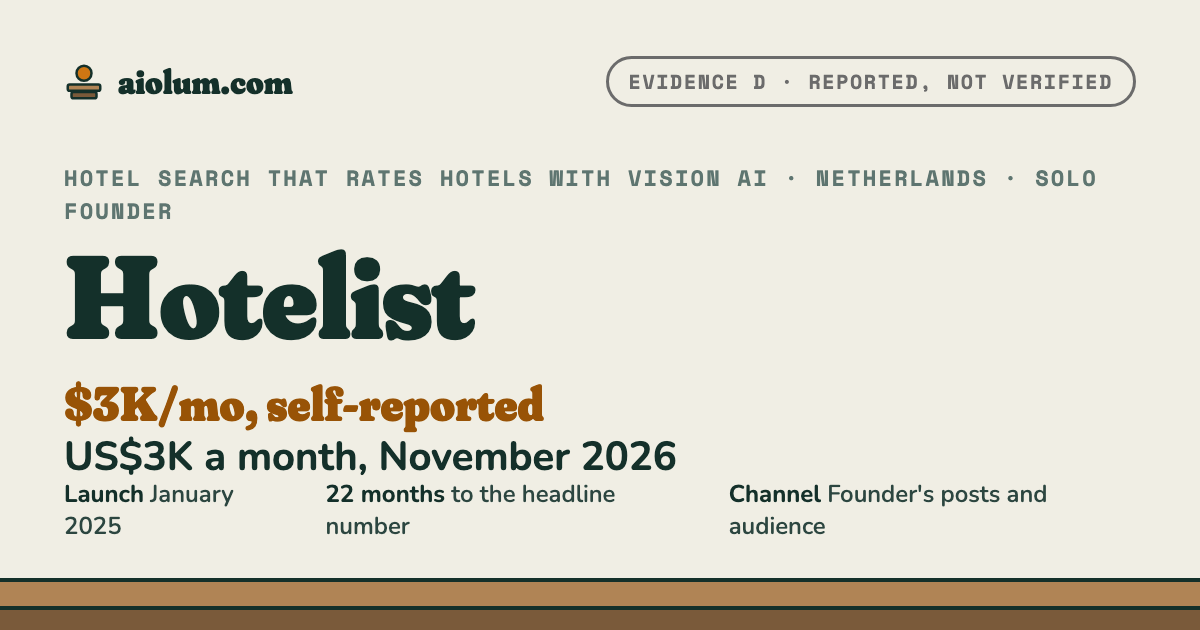
Hotelist (Hotel search that rates hotels with vision AI, Netherlands): US$3K a month, November 2026. Evidence grade D: reported, not verified. Team: 1 founder, Pieter Levels, who runs it with his other products and has no employees. Launched January 2025; still running.Added 6 November 2026
- Outcome
- US$3K a month, November 2026
- Evidence
- D reported, not verified
- Launch
- January 2025
- Status
- Still running
- Team
- 1 founder, Pieter Levels, who runs it with his other products and has no employees
- Outside funding
- None
- Main channel
- Founder's posts and audience
What is not verified
The US$3,000 a month comes from the founder only, as Arrfounder (data updated 28 October 2026) and IndieMakerList (his X bio, November 2026) report it. Both probably copy the same X bio, so they are two dates, not two independent checks. No payment-processor profile was found. The launch date is also not confirmed: the earliest snapshot of his site on the domain is 14 January 2025, and the post on X with his launch story was not read. The headline number is grade D: one claim or one estimate, with no second source. Aiolum shows it because the story is useful, and marks it so that it is not mistaken for a verified figure.
Hotelist is a hotel search engine by Pieter Levels, a Dutch solo developer who also runs Photo AI, Nomads.com and Remote OK. It collects ratings for about 90,000 hotels from sites such as Booking.com, Expedia, Google and Tripadvisor and rescales them, because each site uses a different scale and most of them suffer from rating inflation: nearly all scores sit near the top, so a high score says little. It then adds two AI scores. A vision model, an AI model that reads images, looks at the real room photos and scores cleanliness, newness, amenities and ambiance. A language model summarizes what travelers say in forums and trip reports into pros and cons.
The site is free to use. It earns money from affiliate links, links to booking sites that pay a small commission when a visitor books through them; the site says these links never change the ranking. It also offers a free, read-only API and an MCP server, a standard interface that lets AI assistants such as Claude or ChatGPT call it as a tool. Levels' own site was on the domain by 14 January 2025, then called "the first HONEST hotel booking site" and described as part of Nomads.com, and it came from his 2024 appearance on the Lex Fridman podcast.
The revenue figure is small and self-reported. Arrfounder, a directory of founder-disclosed revenue, listed Hotelist at US$3,000 a month and US$36,000 a year in data last updated on 28 October 2026. IndieMakerList wrote that Levels' X bio in November 2026 listed Hotelist at US$3,000 a month. Both figures come from the founder and have not been checked by a payment processor. The story is useful as a case of a solo founder using AI to rate a large catalog that a human team could not rate by hand.
How much revenue does Hotelist make?
Each row shows the evidence grade and the source numbers from the list at the end of this page. The grades are explained in How Aiolum verifies.
| Fact | Value | Grade | How we know | Sources |
|---|---|---|---|---|
| Revenue per month, late October 2026 | US$3,000 (US$36,000 a year) | C | Arrfounder product page, data last updated 28 October 2026, read 6 November 2026. Arrfounder says its figures are publicly disclosed by founders, mainly on X. | [1] |
| Revenue per month, November 2026 | US$3,000 | C | IndieMakerList page on Pieter Levels, last updated 4 November 2026: his X bio in November 2026 listed Hotelist at US$3K a month. Probably the same origin as the Arrfounder figure. | [2] |
| Where the money comes from | affiliate commissions from booking sites | C | Home page: "if you book through them, Hotelist earns a small commission from the booking site at no extra cost to you". It says this never affects which hotels are shown or how they rank. | [3] |
| Hotels rated | 90,445 (stats page header: 90,888 hotels in 10,544 cities and 184 countries) | C | Stats page, last updated 6 November 2026. The two counts on the same page differ slightly. | [4] |
| Rating data points | 504,770 | C | Stats page: "Ratings are AI-normalized across 504,770 data points." Sources include Booking.com, Expedia, Google, Tripadvisor, Agoda and Kayak. | [4] |
| Median rating on the large booking sites | 4.25 out of 5 | C | Stats page, for Booking.com, Agoda, Expedia, Hotels.com, Trip.com and Google. Hotelist's own median is 3.5 out of 5. This is the rating inflation the product corrects. | [4] |
| AI scores per hotel | photo rating by vision AI, review summary by AI, consensus score | C | Home page. The vision AI scores cleanliness, newness, amenities and ambiance from the room photos and checks claimed amenities against them. | [3] |
| Earliest snapshot of the founder's site on the domain | 14 January 2025 | C | Internet Archive copy. Title "Hotelist: Hotel Bookings Without The Bullshit", "made for @lexfridman, by @levelsio and part of Nomads.com". The domain itself is older and was used by others before. | [6] |
| Name in March 2026 | Hotel List beta | C | Internet Archive copy of 4 March 2026: "Hotel List uses 100% AI to rate hotels". By April 2026 the name was Hotelist again. | [7] |
| Team and funding | the founder alone, no outside investors | C | IndieMakerList: Levels runs Photo AI, Interior AI, Nomads.com, Remote OK, Hotelist and Vibe Jam on his own, with no employees and no outside investors. | [2] |
| Price to users | free; free read-only API and MCP server | C | API documentation: "Read-only, no auth, be nice." | [5] |
| Time from first snapshot to the November 2026 figure | 22 months | calc | Calculated: January 2025 to November 2026. The real launch may be earlier. | [6, 2] |
How to read this table: a grade C value is the founder's own statement, here as two directories report it, or the company's own page. A "calc" value was computed on this page. No value is grade A or B.
| Plan | Per month, billed yearly (US$) | Per month, billed monthly (US$) | Limit |
|---|---|---|---|
| Hotel search on the website | 0 | 0 | free; some booking links are affiliate links |
| Public API and MCP server | 0 | 0 | read-only, no auth |
| Partner endpoint (per-city data) | auth key required; price not published |
No paid plan is published. Revenue comes from affiliate commissions on some of the booking links in the "Check prices" popup. A partner endpoint that returns per-city counts and prices needs an auth key; no price for it is published.
When did Hotelist launch, and how did it grow?
From a podcast idea to an AI-rated catalog of about 90,000 hotels in under two years. Each entry carries its grade.
- 2024CPieter Levels appears on the Lex Fridman podcast. The Hotelist home page says the idea came from that interview. [2, 3]
- 14 January 2025CFirst Internet Archive copy of his site on hotelist.com: an honest hotel booking site that uses AI vision to rate hotels, part of Nomads.com. [6]
- 4 March 2026CThe site is named Hotel List beta and says it uses 100% AI to rate hotels. [7]
- 24 August 2026CThe home page links a post by Levels on X with the full story of why he started Hotelist. The date is computed from the post's ID; the post itself was not read. [3]
- 28 October 2026CArrfounder lists Hotelist at US$3,000 a month and US$36,000 a year. [1]
- November 2026CLevels' X bio lists Hotelist at US$3,000 a month, as IndieMakerList reports. The stats page covers about 90,000 hotels in 184 countries. [2, 4]
Why did Hotelist work?
Four causes, in the order they mattered. Each one is a reusable lesson.
Audience
Levels has one of the largest audiences of any solo founder on X, and the site credits him by handle on every page. A free tool with a clear complaint behind it (booking sites are pay-to-play) is easy for that audience to share.
AI rates what no small team could rate by hand
A vision model scores the room photos of about 90,000 hotels, and a language model summarizes reviews into pros and cons. One person cannot inspect that many hotels; the models make the catalog possible.
Rescaling inflated ratings
Each site's ratings are rescaled to one 0 to 10 scale and combined. The stats page shows the large booking sites at a median of 4.25 out of 5, against 3.5 on Hotelist, which makes the difference visible.
Free to use, paid by commission
Visitors pay nothing. Some links in the "Check prices" popup are affiliate links, so the booking sites pay a commission when a visitor books.
How it was built
These details come from the site's own pages and page source, read on 6 November 2026. They are grade C. [3, 5]
- Plain PHP on the server: the page source refers to functions.php, and the front end loads jQuery.
- The map uses MapLibre GL loaded from unpkg.
- Cloudflare Turnstile is loaded on the page, and Simple Analytics counts page views.
- Hotel tours are embedded from YouTube when one exists.
- A read-only JSON API and an MCP server let AI assistants search the catalog. The name of the AI model behind the photo and review scores is not published.
Tools named in the sources
Each one opens its page in the Tools tab, with every story that uses it.
Who tried this before Hotelist, and why did they fail?
Four companies in our database of failed startups tried to give travelers a better way to choose hotels or trips and failed. The values below are from that database and are not independently verified.
Hipmunk
The promiseTravel search that sorted flights and hotels by how painful they were, not only by price.
Why it diedGoogle Travel and the large booking sites took its users, and the pandemic hit travel in 2020.
Room 77
The promiseA hotel search with detailed room information and price comparisons across booking sites.
Why it diedIt could not stand apart from Expedia and Booking.com and depended on third-party booking sites for revenue.
Desti
The promiseAn AI travel assistant that combined many online sources into hotel and restaurant recommendations.
Why it diedUsers liked the recommendations and then booked elsewhere, so it earned too little.
Utrip
The promiseMachine-learning travel itineraries built from millions of data points.
Why it diedIts travelers and small travel businesses would not pay enough, and free tools competed with it.
The failed startups come from our database of 1,749 dead startups, retold here in our own words. Its entries are AI-assisted summaries of public sources, so these cards carry no evidence grade.
What changed
All four predecessors raised venture money and needed staff to collect hotel data, build recommendation systems and win partnerships. Room 77 and Desti both struggled because they sent travelers to booking sites and earned little from each visit. Hotelist has the same weakness: it also sends visitors to booking sites for a commission, and the founder lists it at only US$3,000 a month.
What differs is cost. Vision and language models now rate photos and reviews for a large catalog at a cost one person can carry, and the founder already had the audience that the predecessors paid to reach. A small affiliate income is enough when there are no employees and no investors to repay.
Can one person copy Hotelist now?
The method, yes. The audience, no.
Using vision and language models to rate a large catalog that people distrust is open to anyone. The founder's distribution is not: he launched it to one of the largest followings of any solo developer, and even so the founder lists it at US$3,000 a month.
Where it is still open: Other inflated rating markets: rentals, coworking spaces, gyms, restaurants for a specific need such as remote work.
- 1Pick a market where the public ratings are inflated or paid for, and show the inflation with data.
- 2Rescale ratings from many sources to one scale, and add an AI score from evidence that is hard to fake, such as photos.
- 3Keep the product free and earn from affiliate links, with a clear statement that they do not change the ranking.
- 4Offer an API or MCP server so that AI assistants can use the catalog.
What could go wrong for Hotelist?
The risks are the mirror image of the causes above.
What is not verified
The US$3,000 a month comes from the founder only, as Arrfounder (data updated 28 October 2026) and IndieMakerList (his X bio, November 2026) report it. Both probably copy the same X bio, so they are two dates, not two independent checks. No payment-processor profile was found. The launch date is also not confirmed: the earliest snapshot of his site on the domain is 14 January 2025, and the post on X with his launch story was not read.
Competition
The closest story on this site is RankWit AI, which sells AI-search visibility to hotels and travel companies rather than a search for travelers; Hotelist competes instead with Google, Booking.com, Expedia and Tripadvisor, whose ratings it uses.
Dependence on model providers and data sources
The site says the photo and review scores come from vision AI and AI summaries but does not name the model provider, so the cost and the risk of a provider change are unknown. It also depends on ratings from booking and review sites; the stats page lists Booking.com, Expedia, Google, Tripadvisor, Agoda and others as its sources.
Use of other sites' content
The home page says Hotelist "aggregates ratings from every booking site and review platform it can find" and that its AI "scours the web (internet forums, travel communities, real trip reports, social media)" and analyzes room photos. No source says whether these sites gave permission. This is collection of public web pages, not of personal data.
Affiliate links and ranking
The site earns a commission on some booking links and states that this "never affects which hotels are shown, their ratings, or their ranking". No outside party has checked this. The stats page also lists "Hotels our official reviewers have personally stayed at"; no source says who these reviewers are.
Sources
The grade next to each source is the best grade that the source can support. "Read in full" means that the text of the page was downloaded and the numbers were checked in it.
- C Arrfounder: Hotelist, US$3K/mo (data last updated 28 October 2026)Read in full on 6 November 2026. A directory of figures disclosed by founders, mainly on X. Source for the monthly and annual revenue.
- C IndieMakerList: Pieter Levels (@levelsio), last updated 4 November 2026Read in full on 6 November 2026. Source for the X bio figure, the solo team, the absence of investors and the 2024 Lex Fridman appearance.
- C Hotelist home page and About sectionRead in full on 6 November 2026, including the page source. Source for how the ratings work, the affiliate disclosure and the tools in the page.
- C Hotelist: Which countries have the best hotels? (stats page, updated 6 November 2026)Read in full. Source for the hotel counts, the data points and the median rating per booking site.
- C Hotelist API documentationRead in full. Source for the free read-only API, the MCP server and the partner endpoint.
- C Internet Archive copy of hotelist.com, 14 January 2025Read the home page. Earliest snapshot that shows the founder's site.
- C Internet Archive copy of hotelist.com, 4 March 2026Read the home page. Shows the name Hotel List beta.
- C Database of failed startups, local exportLocal export. AI-written summaries, not independently verified. Source for the failed predecessors.
Run this company? Send corrections or a verified figure to aiolum@livyden.com