MyRoomDesigner.AI: Revenue, team and how it was built
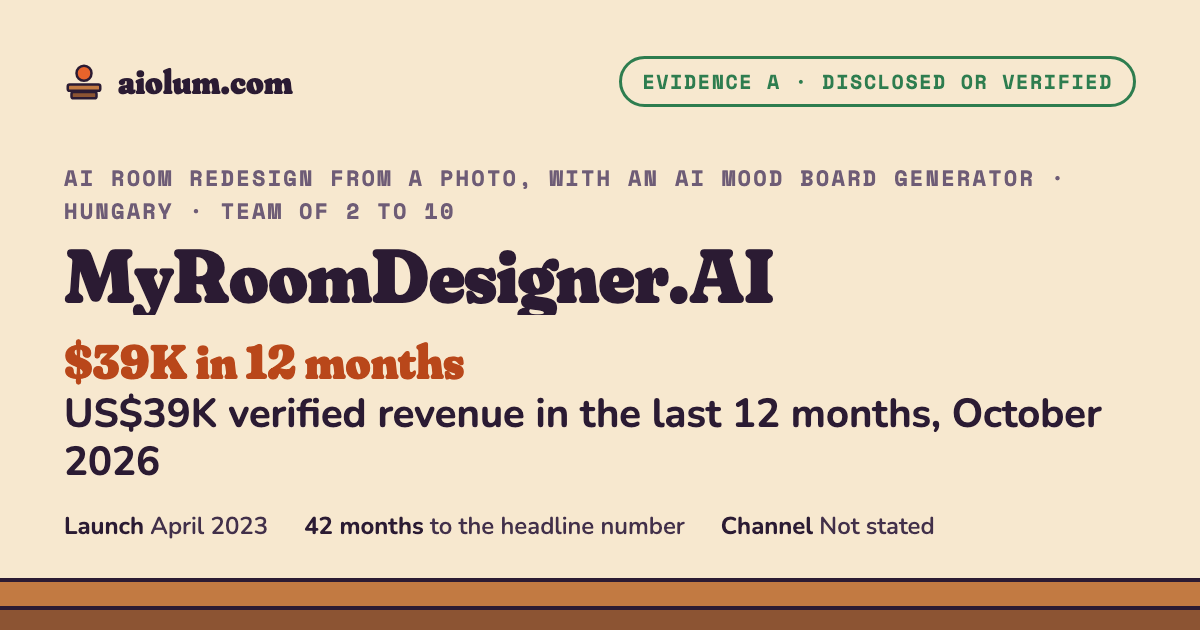
MyRoomDesigner.AI (AI room redesign from a photo, with an AI mood board generator, Hungary): US$39K verified revenue in the last 12 months, October 2026. Evidence grade A: disclosed by a company or a filing, or verified by a payment processor. Team: 2 co-founders (Marta Herget, CEO; Gabor Herget, developer); no employees named. Launched April 2023; still running, revenue falling.Added 25 October 2026
- Outcome
- US$39K verified revenue in the last 12 months, October 2026Revenue falling
- Evidence
- A disclosed by a company or a filing, or verified by a payment processor
- Launch
- April 2023
- Status
- Still running
- Team
- 2 co-founders (Marta Herget, CEO; Gabor Herget, developer); no employees named
- Outside funding
- None reported (no source mentions outside investment)
- Main channel
- Not stated
MyRoomDesigner.AI is an AI room designer: a web app in which an image-generation model redraws a photo of a real room in a new style while it keeps the walls and doors in place. The same app does virtual staging, which means adding furniture to a photo of an empty or plain room so that a buyer or a client can see how it could look. It comes from MoodBoardly, a mood board tool started in 2021. A mood board is one picture that collects furniture, colors and materials for a room, so that a client can approve a direction before buying anything.
Marta Herget (founder and CEO) and Gabor Herget (founder and developer) are named on the home page, and the terms of service say that the service is operated by Mr Bojli Kft, a company under Hungarian law. Wayback Machine copies show the order of events: a mood board editor with paid plans in 2022, a first AI mood board page on 26 April 2023, AI interior design pages by September 2023, and the AI room designer on myroomdesigner.ai by 19 May 2024. In 2023 that domain carried a different room-design site whose footer named another company, Resume AI LLC; no source says how the domain changed hands.
The money figures are grade A. TrustMRR, a site that reads revenue directly from a company's payment account, shows US$39,262 in the last 12 months, US$2,180 in monthly recurring revenue (MRR, the subscription revenue that repeats each month) and 95 active subscriptions on 25 October 2026. TrustMRR also shows US$123,105 all time since 2021, but the page uses only the last 12 months as its headline, because part of the older total came from the mood board editor before it had any AI, and no source says how much.
How much revenue does MyRoomDesigner.AI make?
Each row shows the evidence grade and the source numbers from the list at the end of this page. The grades are explained in How Aiolum verifies.
| Fact | Value | Grade | How we know | Sources |
|---|---|---|---|---|
| Revenue in the last 12 months, to 25 October 2026 | US$39,262 | A | TrustMRR reads the company's Stripe account through an API key; last synced 25 October 2026. This is a rolling 12-month window. Every month in it falls more than two years after the first AI product (April 2023). The Stripe account is shared by the room designer and the AI mood board site, so the figure cannot be split between the two. | [1] |
| Monthly recurring revenue (MRR), 25 October 2026 | US$2,180 | A | TrustMRR current snapshot, from Stripe. | [1] |
| Run rate from that MRR | about US$26,160 a year | calc | Calculated: US$2,180 times 12. Lower than the last 12 months because revenue is falling. | [1] |
| Active subscriptions, 25 October 2026 | 95 | A | TrustMRR snapshot from Stripe. | [1] |
| Average MRR per active subscription | about US$22.95 a month | calc | Calculated: US$2,180 divided by 95. Below the cheapest paid price today (US$24 a month billed yearly), so some subscribers probably pay older or discounted prices; no source says. | [1, 4] |
| Best month in the data, November 2025 | US$6,378 | A | TrustMRR monthly timeline from Stripe. | [1, 2] |
| October 2025 | US$5,158 | A | From the TrustMRR profile as archived on 8 September 2026, whose 12-month timeline started one month earlier than the October profile. | [2] |
| Revenue in the 12 full months October 2025 to September 2026 | US$42,030 | calc | Calculated: the sum of the monthly values in the two TrustMRR profiles. | [1, 2] |
| Latest full month, September 2026 | US$2,105 | A | TrustMRR monthly timeline. 67% below November 2025 (calculated). Monthly values from February to September 2026 stayed between US$2,042 and US$3,254. | [1] |
| Revenue in the 30 days to 25 October 2026 | US$2,028 | A | TrustMRR shows -8.9% against the 30 days before. On 8 September 2026 the same window showed US$2,999. | [1, 2] |
| Revenue all time, May 2021 to 25 October 2026 | US$123,105 | A | TrustMRR, from Stripe. It includes the years of the mood board editor before it had AI (May 2021 to March 2023), so it is not used as the headline. | [1] |
| Revenue before October 2025 | US$79,519 | calc | Calculated: US$123,105 minus the 13 monthly values from October 2025 to October 2026 (US$43,586). TrustMRR's public profile does not show the older months, so the split between the pre-AI years and the AI years from April 2023 is unknown. | [1, 2] |
| Profit margin, last 30 days | 90% | C | TrustMRR snapshot. TrustMRR does not say that costs come from a connected account, so this page treats it as a founder-entered value. | [1] |
| Room redesigns generated | more than 85,000 | C | Company's home page. The TrustMRR profile gives 85,000 as an estimated user count, a different measure. | [3, 1] |
| Company | Mr Bojli Kft, Hungary | C | Terms of service (last updated 16 May 2024) and privacy policy, which says "MoodBoardly by Mr Bojli Kft." A Kft is a Hungarian limited liability company. | [5, 6] |
| Founded | 5 May 2021 | C | Founder-entered date on TrustMRR. It is the start of the mood board business, not of the AI product. | [1] |
| Mood board editor prices, December 2022 (before AI generation) | US$9 a board, US$15 a month or US$59 a month | C | Wayback copy of the MoodBoardly pricing page. The only AI feature then was automatic background removal. | [9] |
| Time from the first AI product to the headline | 42 months | calc | Calculated: April 2023 to October 2026. | [10, 1] |
How to read this table: a grade A value comes from the company's Stripe account through TrustMRR. A grade C value is a statement on the company's own pages, a value that the founder typed into the TrustMRR profile, or a dated archive copy of the company's pages. A "calc" value was computed on this page from the rows above it.
| Plan | Per month, billed yearly (US$) | Per month, billed monthly (US$) | Limit |
|---|---|---|---|
| Free | 0 | 0 | 1 room project and 3 style explorations a month |
| Designer Starter | 24 | 29 | 50 AI room redesigns a month |
| Designer Pro | 79 | 99 | 200 AI room redesigns a month |
| Studio Premium | 149 | 199 | 400 AI room redesigns a month |
The yearly price is shown per month and billed once a year: US$288, US$948 and US$1,788. That is 17%, 20% and 25% below the monthly prices (calculated); the page header says "Save up to 35%" and the footer says "Save up to 25%". Paid plans add a chat with an AI interior designer, an AI description of the uploaded photo, upscaling and a shopping list creator. The companion site Mood Board AI sells plans at the same three prices, with AI mood board generations instead of room redesigns. The home page says there are no refunds because each generation uses GPU time at once.
When did MyRoomDesigner.AI launch, and how did it grow?
From a mood board editor in 2021 to an AI room designer on its own domain in 2024, and Stripe revenue that peaked in November 2025. Each entry carries its grade.
- 5 May 2021CFounding date of the business, as entered on TrustMRR. It starts as a mood board tool for interior design. [1]
- 5 July 2022CThe archived site moodboardly.com offers a mood board editor with a furniture database, "magic background removal" and a shareable purchase list. The page still calls the tool Moodli. [7]
- 10 December 2022CPaid plans: US$9 for one board, Personal at US$15 a month, Business at US$59 a month. No image generation yet. [9]
- 1 February 2023CThe home page says MoodBoardly "comes with the latest AI-powered features", meaning one-click background removal. [8]
- 7 March 2023CFirst archive copy of myroomdesigner.ai: a different room-design site that sold 100 renders for US$9.99, with a footer naming Resume AI LLC. [14, 16]
- 26 April 2023CFirst archive copy of moodboardly.com/ai, "Mood Board AI": "We created thousands of mood boards with AI". This page treats it as the start of the AI product. [10, 16]
- 26 May 2023CA "Mood Board AI Generator" page lets users pick a room, a style and colors and generate a board. [11]
- 24 September 2023CArchived generator pages for more than 20 room types, such as "Generate Your Own Living Room Mood Boards with AI". [12, 16]
- 29 February 2024CNew pricing sells AI generations inside every plan: Personal at US$25 a month with 100 AI generations, Business at US$59, Premium at US$119. The menu now has "Interior Design AI". [13]
- 16 May 2024CDate of the terms of service that name Mr Bojli Kft as the operator of MyRoomDesigner.AI. [5]
- 19 May 2024Cmyroomdesigner.ai now shows MoodBoardly's room designer: "Room Designer AI: Design My Room Online in 60 Seconds", with photo upload. [15, 16]
- 9 August 2024Cmoodboardly.com redirects to moodboardai.com, which becomes the companion mood board site. [16, 17]
- November 2025ABest month in the Stripe data: US$6,378. [1, 2]
- 8 September 2026ATrustMRR shows US$44,116 in the last 12 months and US$119,930 all time. [2]
- 2026CThe home page promotes minniie, a new AI personal stylist app from Marta Herget. [3, 19]
- 25 October 2026AUS$39,262 in the last 12 months, MRR of US$2,180 and 95 active subscriptions. September revenue was US$2,105. [1]
Why did MyRoomDesigner.AI work?
Four causes, in the order they mattered. Each one is a reusable lesson.
An existing product met a new model
The founders did not start from zero in 2023. They had a mood board editor for interior design with a furniture database, paid plans and users who wanted to see a room before buying. When image generation became usable, they put it into that editor: first generated mood boards, then redesigns of a user's own room photo. The old editor survived as the "Design Studio", where generated images become shopping lists.
One job per domain
By 2024 the business used two names that say what each product does: myroomdesigner.ai for redesigning a room photo and moodboardai.com for mood boards. The old name, moodboardly.com, redirects. The room site carries hundreds of public pages for room types and styles ("Modern Bedroom", "Traditional Kitchen") and files for AI agents (llms.txt). No source says how many customers arrive through these pages, so the channel is marked unknown.
Generations sold as a monthly allowance
Each plan is a number of AI room redesigns a month, from 50 to 400. Every generation costs GPU time, so the home page says there are no refunds. TrustMRR shows a 90% profit margin for the last 30 days, a value that the founder entered.
Two founders, many small subscriptions
Marta Herget is named as CEO and Gabor Herget as developer. Revenue arrives as many small payments: in TrustMRR's daily list many days show US$29 or US$58, one or two payments of the US$29 monthly plan, and the largest day of the last 30 was US$360. No single large contract appears.
How it was built
Few build details are public. These come from the company's pages, the page source and TrustMRR. [3, 1, 4, 20, 6]
- The site is a Next.js web app: its pages load scripts from the /_next/static/ folder that Next.js creates.
- Payments go through Stripe, which TrustMRR reads through an API key. Stripe is not the merchant of record (the party legally responsible for the sale and its taxes), so the company itself is the seller.
- No source names the image model or the GPU provider. The site says a design is generated in under 4 seconds and that the layout of the room is kept.
- Paid plans add an AI description of the uploaded photo, which the site uses to write a better prompt for the image model, and a chat that changes the prompt.
- An affiliate program ran on Rewardful; its sign-up page now says the program is no longer active.
- The privacy policy was written for moodboardly.com and still covers "MoodBoardly by Mr Bojli Kft."
Tools named in the sources
Each one opens its page in the Tools tab, with every story that uses it.
Who tried this before MyRoomDesigner.AI, and why did they fail?
Five companies in the Loot Drop database sold help with designing a room before generative AI existed. The values below are from that database and are not independently verified.
Modsy
The promiseUpload photos of your room and get photorealistic 3D designs with furniture you can buy.
Why it diedEach design needed hours of work by human designers, so the cost of every customer stayed too high to make a profit.
Laurel & Wolf
The promiseOnline interior design by professional designers for a flat fee.
Why it diedThe flat fees did not cover the cost of finding customers, and quality fell as the designer network grew.
Tastemaker
The promiseAffordable interior design for middle-income households.
Why it diedA distributed team of designers gave uneven results, and better-funded competitors won the market.
Polyvore
The promiseCreate virtual mood boards of fashion and home products and shop from them.
Why it diedAfter the Yahoo acquisition it lost users to Pinterest and Instagram.
Kujiale
The promiseDesign your home in 3D in the browser, then buy what you designed.
Why it diedMost buyers wanted experts to design for them, and, in the database's words, AI made its technology obsolete within 18 months.
The failed startups come from Loot Drop, a free database of dead startups, retold here in our own words. Loot Drop describes its entries as AI-assisted summaries of public sources, so these cards carry no evidence grade.
What changed
Modsy, Laurel & Wolf and Tastemaker all sold the same promise: see your room redesigned before you spend money. Each one needed human designers for every order, so every customer cost hours of paid work, and the companies raised millions to cover that cost. Polyvore and Kujiale gave users tools to build the picture themselves, which kept costs low but asked users to do the design work.
An image model removes the designer from each order. A redesign of a user's own photo now costs seconds of GPU time, so two founders can sell it as a monthly allowance of 50 to 400 images without staff. The risk also changed: the expensive part is no longer the work but the attention of buyers, and other AI room designers and general chat assistants now offer a similar result. The founders' own comparison table on the home page sets their product against ChatGPT.
Can one person copy MyRoomDesigner.AI now?
The move from an old tool to AI, yes. The market, crowded.
Adding generative AI to a small tool that already had users and a narrow subject (furniture and rooms) is repeatable for many small software businesses. The home page compares the product with "Other Tools" and with ChatGPT, so buyers have alternatives, and this business's own Stripe revenue has fallen since late 2025.
Where it is still open: Visual planning for other purchases where people want to see the result first: gardens, shop fronts, event decoration, clothing (the co-founder's new product, minniie, tries the last one).
- 1Start from a tool that your users already pay for, and add generation where they already make the picture by hand.
- 2Keep the old editor as the step after generation, so the AI image becomes a shopping list or a client presentation.
- 3Put each product on a domain that says what it does, and keep the old name as a redirect.
- 4Sell a monthly number of generations so that GPU cost and price move together.
What could go wrong for MyRoomDesigner.AI?
The risks are the mirror image of the causes above.
Falling revenue
Stripe revenue was US$6,378 in November 2025 and US$2,105 in September 2026, 67% lower. The last 12 months fell from US$44,116 on 8 September 2026 to US$39,262 on 25 October 2026, and MRR fell 9.6% in 30 days. October 2026 was US$1,556 with six days left.
Two products in one Stripe account
TrustMRR describes the profile as "Mood board creator and ai room designer". The revenue covers both myroomdesigner.ai and the AI mood board site, and no source splits it. Both sell AI generation, so the AI share of the last 12 months is close to all of it, but the room designer's own share is unknown.
Older revenue had no AI
The all-time figure of US$123,105 starts in May 2021. The mood board editor charged from at least December 2022, before any image generation, so part of the US$79,519 earned before October 2025 is not AI revenue. This page does not use the all-time figure as the headline for that reason.
A domain with an earlier owner
In 2023 myroomdesigner.ai showed another company's room-design site. By May 2024 it showed MoodBoardly's product. No source says whether the domain was bought, and if a customer list came with it.
Competition from general AI
Any user can ask a general chat assistant to restyle a room photo. The home page's own comparison table names ChatGPT as the alternative and claims faster images and better layout preservation; those claims are the company's.
Attention moving to a new product
The home page promotes minniie, a 2026 AI stylist app from co-founder Marta Herget. A second product can take time away from the room designer.
Sources
The grade next to each source is the best grade that the source can support. "Read in full" means that the text of the page was downloaded and the numbers were checked in it.
- A TrustMRR markdown profile: MoodBoardly (website myroomdesigner.ai), read 25 October 2026Read the markdown profile. Stripe API key, last synced 25 October 2026. Source for all current revenue figures, the monthly timeline from November 2025, MRR, subscriptions and the founder-entered founding date and profit margin.
- A TrustMRR markdown profile: MoodBoardly, as archived by the Wayback Machine on 8 September 2026Read in full. Same profile seven weeks earlier. Source for October 2025 revenue and the earlier 12-month and all-time totals.
- C MyRoomDesigner.AI home page, read 25 October 2026Read in full. Source for the founders' names and roles, the features, the 85,000 redesigns claim, the comparison table, the refund rule and the minniie section.
- C MyRoomDesigner.AI pricing page, read 25 October 2026Read in full. Source for the plans and prices.
- C MyRoomDesigner.AI terms of service, last updated 16 May 2024Read in full. Names Mr Bojli Kft as the operator and Hungarian law.
- C MyRoomDesigner.AI privacy policyRead the sections on the operator and the country. Says "MoodBoardly by Mr Bojli Kft." and that the company is based in Hungary.
- C moodboardly.com home page, Wayback copy of 5 July 2022Read in full. The mood board editor before AI generation.
- C moodboardly.com home page, Wayback copy of 1 February 2023Read in full. The "AI-powered features" were background removal.
- C moodboardly.com pricing page, Wayback copy of 10 December 2022Read in full. Source for the pre-AI prices.
- C moodboardly.com/ai, Mood Board AI, Wayback copy of 26 April 2023Read in full. First archived AI page of the business.
- C moodboardly.com/ai-generator, Mood Board AI Generator, Wayback copy of 26 May 2023Read in full.
- C moodboardly.com AI living room generator, Wayback copy of 24 September 2023Read the opening section. One of more than 20 room-type generator pages archived that day.
- C moodboardly.com pricing page, Wayback copy of 29 February 2024Read in full. Source for the first plans with AI generations and the "Interior Design AI" menu item.
- C myroomdesigner.ai home page, Wayback copy of 7 March 2023Read in full. The earlier site on the domain, with a footer naming Resume AI LLC.
- C myroomdesigner.ai home page, Wayback copy of 19 May 2024Read in full. First archived copy that shows MoodBoardly's room designer on the domain.
- C Wayback Machine capture lists (CDX) for myroomdesigner.ai and moodboardly.comRead the capture dates, status codes and page changes for both domains, and the redirect of moodboardly.com to moodboardai.com on 9 August 2024.
- C Mood Board AI home and pricing pages, read 25 October 2026Read in full. The companion AI mood board product and its prices.
- C MyRoomDesigner.AI llms.txt and agent guideRead in full. Describes the product and names Mood Board AI as the companion product.
- C minniie home page, read 25 October 2026Read in full. The co-founder's 2026 AI stylist app, read for the purpose check.
- C MyRoomDesigner.AI affiliate program sign-up page on RewardfulRead in full. Says the program is no longer active.
- C Loot Drop database export, 1,749 failed startupsLocal export. AI-written summaries, not independently verified. Source for the failed predecessors.