Journable: Revenue, team and how it was built
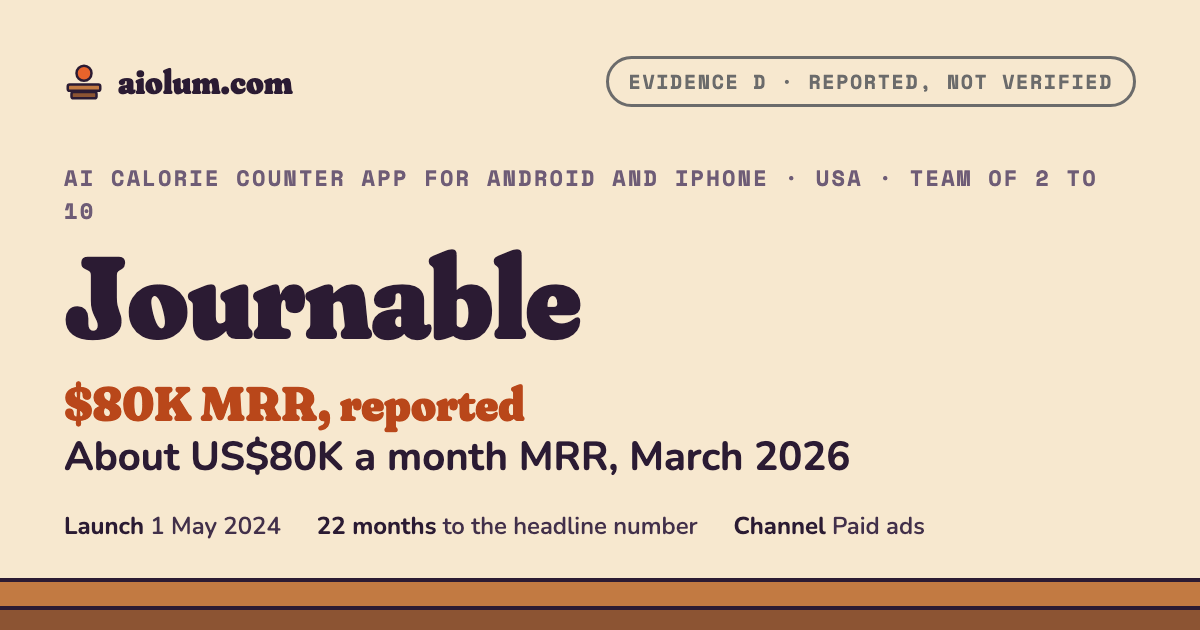
Journable (AI calorie counter app for Android and iPhone, USA): About US$80K a month MRR, March 2026. Evidence grade D: reported, not verified. Team: 2 co-founders, Steve Hoyek and one co-founder whom the sources do not name; no employee count given. Launched 1 May 2024; still running, revenue growing.Added 25 October 2026
- Outcome
- About US$80K a month MRR, March 2026Revenue growing
- Evidence
- D reported, not verified
- Launch
- 1 May 2024
- Status
- Still running
- Team
- 2 co-founders, Steve Hoyek and one co-founder whom the sources do not name; no employee count given
- Outside funding
- None, by the founder's statement: only the founders' own money
- Main channel
- Paid ads
What is not verified
Every money figure on this page rests on one source: Steve Hoyek, co-founder, showing his RevenueCat and Google Ads dashboards on camera in a Starter Story video published on 25 March 2026. No payment processor, buyer or journalist has checked them, and no second date exists. The sources also disagree in two places: the founder said about 80% of revenue comes from Android while the video description says 92%, and he said he built the app almost 18 months before the video while the Product Hunt launch was 23 months before it. A reader could look for a payment-processor-verified profile, for example on TrustMRR (none was listed there in October 2026), or a later interview with new figures. The headline number is grade D: one claim or one estimate, with no second source. Aiolum shows it because the story is useful, and marks it so that it is not mistaken for a verified figure.
Journable is a calorie counter, an app that adds up the energy in the food a person eats so that they can eat less, more or the same as a goal. Most older calorie counters make the user search a database of foods and weigh portions. In Journable the user writes "yogurt, granola, blueberries and almonds" or takes a photo, and an AI model returns the calories and the macros, short for macronutrients: protein, carbohydrates and fat. The founder said that the backend uses OpenAI models for most of the AI work. The company behind it is Journable LLC, the developer and seller named on the App Store and the developer on Google Play.
Steve Hoyek, who lists himself on Product Hunt as co-founder of Journable, launched it there on 1 May 2024; it finished ninth of the day. In a Starter Story video published on 25 March 2026 he said that the two co-founders had grown revenue over the past year from less than US$1,000 to US$100,000 a month, with only their own money. On camera he showed his RevenueCat dashboard (RevenueCat is a service that handles in-app subscriptions on iPhone and Android and reports their revenue), and he said it showed US$125,000 of revenue in the past 28 days and an MRR, monthly recurring revenue, of about US$80,000, with just over 30,000 active subscribers. He said about 80% of users and revenue came from Android.
Every money figure on this page comes from that one video, so the evidence grade is D, reported and not verified. A dashboard shown on camera by the founder is at most grade C, and here there is only one date. The founder also said that his all-time Google Ads spend was just under US$500,000 and that the revenue attributed to those ads was about the same, so the business was close to break-even on paid ads and its profit is not known. The page also lists earlier health-tracking companies that failed, most of them with far more money.
How much revenue does Journable make?
Each row shows the evidence grade and the source numbers from the list at the end of this page. The grades are explained in How Aiolum verifies.
| Fact | Value | Grade | How we know | Sources |
|---|---|---|---|---|
| Revenue in the past 28 days, March 2026 | US$125,000 | D | Steve Hoyek read it from his RevenueCat dashboard on camera in the Starter Story video published on 25 March 2026. A dashboard shown by the founder is at most grade C; with one date only, it is D. It is higher than the MRR because a yearly subscription counts in full in the month it is paid, while MRR spreads it over 12 months. | [1, 2] |
| Monthly recurring revenue, March 2026 | about US$80,000 | D | Same dashboard and video. The founder said it is just under US$1 million a year in annual terms. | [1] |
| Run rate from the MRR | US$960,000 a year | calc | Calculated: US$80,000 times 12. This is the headline value of the page. | [1] |
| Subscribers, March 2026 | just over 30,000 active, about 40,000 in total | D | Same dashboard and video. | [1] |
| Revenue growth to March 2026 | from less than US$1,000 to US$100,000 a month in about a year | D | Founder statement in the video. He also said he built the app "almost 18 months ago", which does not match the Product Hunt launch of May 2024, 23 months before the video. | [1, 6] |
| Share of revenue from Android | about 80% | D | The founder said about 80% of users and about 80% of revenue come from Android and 20% from iOS. The video description, written by Starter Story, says 92% of his revenue comes from Android. The two figures do not agree. | [1, 2] |
| All-time Google Ads spend and attributed revenue, March 2026 | just under US$500,000 spent; about the same in attributed revenue | D | The founder showed his Google Ads dashboard and said they were effectively at break-even on ads. ProvenStartups notes that attributed revenue near break-even is not net profit. | [1, 11] |
| Advertising cost, iOS against Android | about 4 times the cost per view on iOS; iOS users convert about 20% better | D | Founder statement. He said the conversion figure came from RevenueCat's State of Subscription Apps report of 2025, which was not read for this page. | [1] |
| Google Play downloads | 1,000,000+ (October 2026) | C | Read on the Google Play listing on 25 October 2026. The founder said in March 2026 that Android downloads were almost at a million. | [8, 1] |
| Store ratings, October 2026 | Google Play 4.7 from 123K reviews; App Store 4.8 from 513 ratings | C | Read on the two listings on 25 October 2026. The much larger Play count agrees with the founder's statement that most users are on Android. | [8, 7] |
| First Product Hunt launch, 1 May 2024 | 193 upvotes, 18 comments, 9th of the day | C | Product Hunt launch data. The founder said it brought a couple hundred installs and two subscribers. A second launch on 1 January 2025 had 9 upvotes. | [6, 1] |
| Prices | US$9.99 a month or US$39.99 a year | C | In-app purchases on the US App Store listing, October 2026. | [7] |
| Languages | English and 71 more | C | App Store listing. The affiliate page says the app is available in all languages. | [7, 10] |
| Team | 2 co-founders | D | The founder spoke of "my co founder and I" in the video; ProvenStartups summarises the team as 2 cofounders. Product Hunt lists only Steve Hoyek as maker, with the title co-founder. No source gives an employee count. | [1, 4, 11] |
| Outside funding | none | D | The founder said: "We are bootstrapped. We have spent only our own money since day one." | [1] |
| Company | Journable LLC | C | Developer and seller on the App Store, developer on Google Play with a United States address. The App Store copyright line reads 2022. The founders' own location is not stated in any source read. | [7, 8] |
| Time from launch to the headline figure | 22 months | calc | Calculated: May 2024 to March 2026. | [6, 2] |
How to read this table: a grade D value is a statement by the founder in one video on one date, including figures he read from a dashboard on camera, or a third party's summary of that video. A grade C value was read directly from the company's own pages, the app store listings or Product Hunt. A "calc" value was computed on this page from the rows above it. No value is grade A or B.
| Plan | Per month, billed yearly (US$) | Per month, billed monthly (US$) | Limit |
|---|---|---|---|
| Free trial | 0 | 0 | trial length not stated on the store listing |
| Premium, monthly | 9.99 | unlimited entries, all features, no ads | |
| Premium, annual | 3.33 | US$39.99 a year on the App Store |
The app is free to download with a free trial; the store listings say a subscription is then needed to keep logging food and exercise, and that it gives unlimited entries, all features and no ads. The founder said in March 2026 that there are two packages, monthly and annual, and that all revenue comes from them. The App Store shows the same two prices several times, which usually means several product codes at one price. A referral code from the company's affiliate program gives a 7-day free trial. Prices on Google Play, where most revenue comes from, could not be read.
When did Journable launch, and how did it grow?
From a Product Hunt launch with two paying subscribers to a reported US$100,000 a month, mostly from Android users found by Google ads. Each entry carries its grade.
- Before 2024DSteve Hoyek loses 45 kilos, from 125 to 80, by counting calories in several apps. He and his co-founder, who also lost weight, decide that the existing apps are too complex. [1]
- 2022CThe App Store listing's copyright line names Journable LLC with the year 2022. No source says what was built then. [7]
- 16 April 2024CSteve Hoyek joins Product Hunt. [5]
- 1 May 2024CProduct Hunt launch: "Chat your way to health & fitness with AI powered tracking". 193 upvotes, 18 comments, 9th of the day. The founder said it brought a couple hundred installs, and that two of them became subscribers, which told the team people would pay. [6, 1]
- 2024 to 2025DFirst paid ads on Meta. The founder said they could not afford iPhone campaigns, ran Android campaigns in the United States, found the conversion as good as on iPhone, and moved the budget to Google Ads, with the Play Store ad as the best performer. [1]
- 1 January 2025CA second Product Hunt launch, "AI nutrition assistant", gets 9 upvotes. [6]
- About March 2025 to March 2026DThe founder said revenue grew from less than US$1,000 to US$100,000 a month over this year. [1]
- 25 March 2026DStarter Story publishes "I Built a $100K/Month Android App". On camera the founder shows US$125,000 of revenue in 28 days, about US$80,000 MRR, just over 30,000 active subscribers, and an all-time Google Ads spend of just under US$500,000 with about the same attributed revenue. [1, 2]
- 14 October 2026DProvenStartups adds the video to its case list as "Joinable", the spelling of the automatic captions, and labels it third-party verified. [11]
- 25 October 2026CThe Google Play listing shows 1,000,000+ downloads and 4.7 stars from 123K reviews, updated on 19 October 2026; the App Store shows version 2.1.264 with frequent updates through the year. [8, 7]
Why did Journable work?
Four causes, in the order they mattered. Each one is a reusable lesson.
Paid ads on Android
The founder said that iPhone ads cost about four times as much per view as Android ads, while iPhone users convert only about 20% better, so a team paying from its own pocket gets more subscribers per dollar on Android. Google's app campaigns place one set of ads across Google Search, YouTube, the Discover feed, the display network and, most important for this app, the Play Store search results for words like "calorie counter". The founder said that some iPhone installs follow from the Android ads as well.
Send every in-app event to the ad platform
The founder said the first step of the method is attribution: the app reports to Google Ads each install, each view of the paywall, each free trial and each purchase with its value, so that Google's algorithm can learn which people become subscribers. Then come install campaigns to collect data, many headlines, images and videos for the algorithm to test, better Play Store screenshots, and finally campaigns that bid for a target cost per acquisition. He said such a campaign needs a daily budget of about ten times the target cost of one event, because the algorithm needs about ten events a day.
Simpler than the old calorie counters
Older apps make users search a food database and weigh portions. Journable takes a sentence or a photo, and the AI model does the rest. The founder said that simplicity is the main thing they focus on and what their marketing tries to show; the interviewer added that users spend less time in the app than in others, and that this is what makes it valuable.
Two plans, many languages
The App Store listing lists a monthly plan at US$9.99 and an annual plan at US$39.99, and the app is offered in English and 71 other languages, which lets one set of Android campaigns reach many countries. The founder said all revenue comes from the two subscriptions.
How it was built
These details come from the founder's account in the Starter Story video and from the app store listings. The tool names and monthly costs are the founder's statements; names are given as the founder said them, corrected where the automatic transcript misspelled them. [1, 9, 10, 7]
- Backend on Google's stack: the founder said they use Firebase and Google Analytics 4 for the backend, BigQuery for data, Google Cloud, Google Play and Google Ads, and that "we effectively work for Google at this point".
- AI: the founder said OpenAI models handle most of the AI work, reading the text or photo, naming ingredients, estimating portions and returning calories and macros per ingredient.
- Subscriptions: RevenueCat manages the in-app subscriptions on both stores and is the dashboard the founder showed on camera.
- Coding and operations tools, with the monthly costs the founder said: Claude Code and Claude Cowork at US$100 (the transcript spells them "Cloud Code" and "Cloud Cowork"), an OpenAI premium plan at US$20, GitHub Copilot at US$39 and CodeRabbit for code review at US$30.
- Running the company, with the monthly costs the founder said: an AI email-support tool that the transcript spells "Fixer" at US$30, n8n for automation at US$24, AppFollow for app store optimization at US$180, and Webflow for the website at US$18.
- The website is a Webflow site with links to both stores, a blog, a podcast called The Weigh In and an affiliate program that the company says pays 50% of a referred subscriber's payments for up to 12 months through PayPal.
Tools named in the sources
Each one opens its page in the Tools tab, with every story that uses it.
Who tried this before Journable, and why did they fail?
Four companies in the Loot Drop database promised to track food, activity or health and turn the data into better habits, and failed. The values below are from that database and are not independently verified.
Jawbone
The promiseThe UP wristbands: sleek fitness trackers that turned daily activity, sleep and food data into health insights.
Why it diedFitbit and Apple out-competed it; product recalls, poor customer service and long legal fights used up the money.
Airo Health
The promiseA wristband that would track stress, nutrition intake and exercise better than a Fitbit or an Apple Watch.
Why it diedThe device could not justify its price against Apple and Fitbit, hardware production and distribution overwhelmed the team, and further funding did not come.
Arivale
The promiseScientific wellness: genome, blood and microbiome tests plus a personal human coach, for US$3,500 upfront and US$99 a month.
Why it diedThe coaches made every customer expensive: the database records about US$4,700 of cost per customer a year against about US$1,200 of yearly revenue.
Habitual
The promiseA clean habit-tracking app based on the book Atomic Habits, with personal feedback.
Why it diedA good product with no marketing plan: it never reached enough users in a crowded app category.
The failed startups come from Loot Drop, a free database of dead startups, retold here in our own words. Loot Drop describes its entries as AI-assisted summaries of public sources, so these cards carry no evidence grade.
What changed
Jawbone and Airo Health tried to measure food and activity automatically with a device on the wrist, and the hardware cost them the company. Arivale used human coaches to turn data into advice, and the database records that each customer cost about four times what the customer paid, by its estimate. Habitual had a simple app and no way to reach people.
Journable changes two of these points. A language model now does what the wristbands and the coaches tried to do: it turns a sentence or a photo of a plate into calories and macros, at the cost of an API call, with no device to build or ship. And the founders put their effort into the one thing Habitual lacked, a measured paid channel: the founder said every install, trial and purchase is reported to Google Ads, which then buys more users like the ones who paid. The risk that stays is the one the founder stated himself, that ad spend and the revenue it brings were about equal in March 2026.
Can one person copy Journable now?
Another AI calorie counter, hard. The Android paid-ads method, yes.
The App Store already shows many AI calorie counters next to Journable, and a new one would compete with all of them for the same ad space. What can be copied is the method the founder described in March 2026: pick Android where ads are cheaper, report every in-app event to Google Ads, start with install campaigns and many creative assets, then bid for a target cost per subscriber and raise the budget only as the conversion rate rises.
Where it is still open: The founder said there are two openings: apps that succeed on iPhone and have no good Android equivalent, and small, specific problems that were not worth building an app for before AI tools lowered the cost of software.
- 1Look at the ad cost and conversion data for both platforms before choosing one; the founder said Android gave more subscribers per dollar for a team with no outside money.
- 2Before any campaign, send installs, paywall views, trials and purchases with their value from the app to the ad platform.
- 3Run install campaigns first, with many headlines, images and videos, even stock ones, and let the algorithm find what works.
- 4Improve the store listing, because Google's app campaigns use its screenshots, title and description as ad material.
- 5Move to target cost-per-acquisition campaigns with a daily budget of about ten times the target cost, and raise budgets only as the subscription conversion rate improves.
What could go wrong for Journable?
The risks are the mirror image of the causes above.
What is not verified
Every money figure on this page rests on one source: Steve Hoyek, co-founder, showing his RevenueCat and Google Ads dashboards on camera in a Starter Story video published on 25 March 2026. No payment processor, buyer or journalist has checked them, and no second date exists. The sources also disagree in two places: the founder said about 80% of revenue comes from Android while the video description says 92%, and he said he built the app almost 18 months before the video while the Product Hunt launch was 23 months before it. A reader could look for a payment-processor-verified profile, for example on TrustMRR (none was listed there in October 2026), or a later interview with new figures.
Close to break-even on ads
The founder said the all-time Google Ads spend was just under US$500,000 and the revenue attributed to those ads was about the same. Revenue that does not come from ads, renewals and the cost of the AI model calls decide whether the business makes a profit, and no source gives those numbers.
One ad platform, one store
Most users come from Google's app campaigns and most revenue from Google Play. A change in Google's ad prices, in its campaign algorithm or in Play Store rules would hit the business directly, and the founder said that making content, which could build an audience of its own, is a skill the business is missing.
The AI estimates can be wrong
Portion size from a photo is hard to estimate. An App Store reviewer in September 2026 wrote that the photo feature recorded 2 ounces of meat that weighed 5.5 ounces on a scale, and Google Play reviewers in July 2026 reported undercounted calories and wrong quantities; the developer's replies say it is working on accuracy. For users who rely on exact numbers, these errors matter.
A weight-loss app rated for all ages
The Google Play listing says "Hit your weight loss goals" and the app is rated 9+ on the App Store and Everyone on Google Play. The listings make no medical or cure claims, and the app records the weight that the user types; it does not rate bodies or looks. Calorie counting can still be a risk for people with eating disorders, and a 9+ rating means the App Store offers it to children from age 9.
A crowded category
The App Store places many other AI calorie counters next to Journable, and apps such as Cal AI, which ProvenStartups lists at US$25M a year, sell the same photo-to-calories idea. Competition for the same ad keywords raises the cost of each new subscriber.
Sources
The grade next to each source is the best grade that the source can support. "Read in full" means that the text of the page was downloaded and the numbers were checked in it.
- D Starter Story episode page, 26 March 2026: I Built a $100K/Month Android App, with Steve of JournableRead in full, including the full transcript. Founder interview with dashboards shown on camera. Source for every money figure, the team, the funding, the ad method and the tool list.
- D YouTube, Starter Story channel, published 25 March 2026: I Built a $100K/Month Android AppRead the title, publication date and description on the watch page. The description links Journable and the founder's X account and says 92% of revenue comes from Android. Captions and transcripts were not fetched.
- C Product Hunt: Journable product pageRead in full. Names Steve Hoyek as author of the page and says the product launched in 2024.
- C Product Hunt: Journable makersRead in full. Lists Steve Hoyek as maker, "Co-founder, builder, seller, techie".
- C Product Hunt: Steve Hoyek's profileRead in full. Shows Journable as his only made product, two launches and the date he joined.
- C Product Hunt: Journable launchesRead in full. Source for the launch dates of 1 May 2024 and 1 January 2025, the vote counts, comments and the daily rank of 9.
- C App Store listing: Journable: AI Calorie Counter, by Journable LLCRead in full on 25 October 2026. Source for the prices, the age rating 9+, the seller, the languages, the ratings, the version history and the reviews.
- C Google Play listing: Journable: AI Calorie CounterRead in full on 25 October 2026. Source for the 1,000,000+ downloads, the 4.7 rating from 123K reviews, the rating Everyone, the developer name and the reviews.
- C Journable home page, read 25 October 2026Read in full. Source for the chat and photo tracking description and the store links. The site has no pricing page and names no founder.
- C Journable affiliate program page, read 25 October 2026Read in full. Source for the 50% commission for up to 12 months, the 7-day trial code and PayPal payouts. It promises a commission rate, not an income.
- D ProvenStartups case page: Joinable, captured 14 October 2026Read the free sections. A third-party summary of the same Starter Story video, under the caption spelling "Joinable"; not an independent second source.
- C Loot Drop database export, 1,749 failed startupsLocal export. AI-written summaries, not independently verified. Source for the failed predecessors.