Langua
Langua is an AI language tutor. A learner picks a language and a dialect, then speaks with an AI character in that language, by text, voice or a hands-free call mode, a phone-call style conversation in which the learner can interrupt the AI. The character's voice is made by voice cloning, a method that copies the sound of a real speaker's voice from recordings, so a Mexican Spanish tutor and a Spanish tutor from Spain sound and choose words differently. The AI corrects errors, explains them, and turns saved words into flashcards and stories. Langua is sold by LanguaTalk Inc., a company that also runs a marketplace of human tutors, a website where independent teachers sell lessons and the company takes a share.
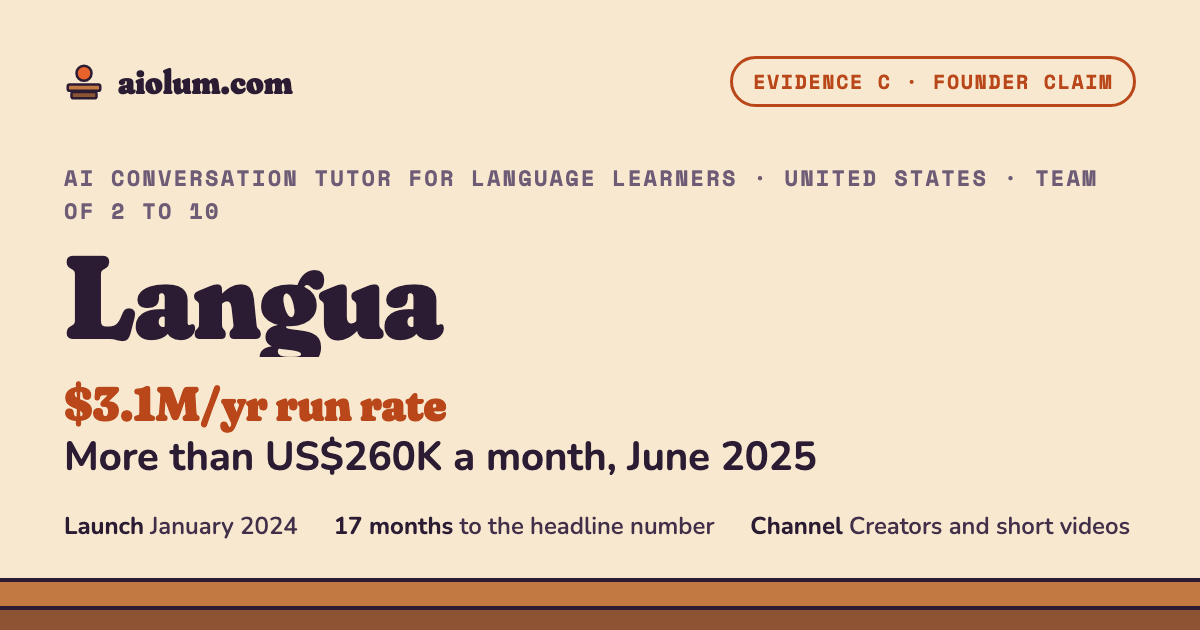
The company began as a tutoring marketplace in 2021, built by Alex Redfern, who had run a smaller marketplace called Lingoci since 2017, and Don Pottinger, a software engineer who kept his full-time job as an engineering manager at Google until 12 October 2025. When ChatGPT appeared, they used the marketplace's profits to build an AI product, and they launched Langua in January 2024. The newsletter gaps.com reported on 13 March 2025 that Pottinger had shared a figure of US$144,000 in monthly recurring revenue (MRR, the subscription income that repeats every month) 13 months after launch. Pottinger wrote on 18 June 2025 that the company was "north of US$260,000 MRR just on the SaaS side", which is Langua, and on 26 June 2025 that it had crossed US$3 million in annual recurring revenue. That is a run rate, the latest month multiplied by twelve, of about US$3.1 million a year, 17 months after launch.
Every revenue figure on this page is a founder statement, grade C: the figures come from two different sources (a newsletter in March 2025 and the co-founder's own blog in June 2025) and agree in direction, but no payment processor or buyer has confirmed them. The founders have not published the number of staff; the page explains below why the LinkedIn head count of 30 that a directory shows counts tutors who are contractors. The page also shows what happened to earlier companies that sold online tutoring.
The numbers, graded
Each row shows the evidence grade and the source numbers from the list at the end of this page. The grades are explained in How Aiolum verifies.
| Fact | Value | Grade | How we know | Sources |
|---|---|---|---|---|
| Monthly recurring revenue, June 2025 | more than US$260,000 (Langua only) | C | Co-founder Don Pottinger's blog, first posted on LinkedIn on 18 June 2025: "north of $260K MRR just on the SaaS side". The SaaS side is Langua; the marketplace is counted separately. His 8 June 2025 post says "$250K+ MRR". | [1, 5] |
| Run rate from the June 2025 figure | about US$3.12 million a year | calc | Calculated: US$260,000 times 12. The headline figure on this page. | [1] |
| Annual recurring revenue, 26 June 2025 | crossed US$3 million | C | Pottinger's blog, 26 June 2025, written as co-founder of LanguaTalk. US$3 million a year is US$250,000 a month, which agrees with the 18 June figure. | [4] |
| Monthly recurring revenue, March 2025 | US$144,000, 13 months after launch | C | Gaps.com income report for February 2025, published 13 March 2025: "Dom shared that Langua has grown to $144,000 in monthly recurring revenue" (the report misspells the co-founder's first name). Repeated in the March 2025 report. | [2, 17] |
| Growth from March to June 2025 | about 81% | calc | Calculated: from US$144,000 to US$260,000 in about three months. | [1, 2] |
| Monthly recurring revenue around March 2025, company level | US$141,000 | C | Pottinger's blog, 16 June 2025: "as LanguaTalk hit 141K MRR and investor interest heated up", three months earlier. Close to the US$144,000 Langua figure of the same period. | [7] |
| Langua compared with the marketplace | Langua earned more than the marketplace by late 2024 | C | Pottinger's blog on leaving Google, October 2025. | [3] |
| Gross volume of the tutoring marketplace | US$8.19 million in three years | C | Pottinger's blog, 18 June 2025. Gross volume is the total paid for lessons, most of which goes to the tutors; it is not the company's revenue. | [1] |
| Learners | more than 30,000 | C | Company's home page and organizations page, read in October 2026. App ratings: about 2,700 on the App Store and about 2,090 reviews on Google Play. | [11, 12, 13] |
| Team | 2 co-founders and a small staff of unpublished size | C | Pottinger worked full time at Google until 12 October 2025 and built Langua at night and on weekends. He wrote in June 2025 that they had "built out our engineering team" and had hired a junior engineer out of college. The company's updates page in May 2026 says "a small team like ours". The terms make tutors independent contractors, so the LinkedIn count of 30 in a directory includes tutors. | [3, 5, 6, 8, 14, 18] |
| Outside funding | none | C | Pottinger's blog: the marketplace's profits were the research fund for Langua; in 2025 the company reviewed funding options with an advisor because of investor interest, and he calls it profitable and growing. | [3, 7, 19] |
| Co-founder's earlier marketplace, Lingoci | about US$60,000 a month in February 2020, started with US$300 in January 2017 | C | Alex Redfern's interview with Starter Story, February 2020. He ran it alone with a virtual assistant and outsourced accounting. | [9] |
| Directory estimate of company revenue, 2024 | US$3.5 million a year, estimate | D | Latka's company page, marked as an estimate; it also records 30 employees from LinkedIn in October 2024, a count that includes tutors. | [14] |
| Time from launch to the June 2025 figure | 17 months | calc | Calculated: January 2024 to June 2025. The launch month is inferred: gaps.com counts 13 months before its February 2025 report, and a Wayback copy of 15 January 2024 shows the "Communicate with AI" feature that the 10 October 2023 copy lacks. | [2, 15] |
How to read this table: a grade C value is a founder statement in his own blog or quoted by a newsletter, or a company statement on its own site. A grade D value is an estimate by a directory, marked as such. A "calc" value was computed on this page from the rows above it. No value is grade A or B.
| Plan | Per month, billed yearly (US$) | Per month, billed monthly (US$) | Limit |
|---|---|---|---|
| Free | 0 | 0 | 3 minutes of calls a day, about 20 messages a week |
| Standard (Communicate) | 12.50 | 19.99 | 75 messages or 30 minutes of calls a day; US$149.99 a year |
| Unlimited | 16.67 | 29.99 | fair use of 350 messages a day; US$199.99 a year |
| Organizations | from 500 | custom plan per seat, from US$500 a month |
Both paid plans include all languages and all features. Standard (called Communicate on the App Store) is limited to 75 chat messages or 30 minutes of calls a day; Unlimited has a fair-use allowance of 350 messages a day in the terms. The App Store also lists 3-month plans: US$49.99 for Communicate and US$69.99 for Unlimited. A free account allows 3 minutes of calls a day and about 20 messages a week. A promotion code on the company's blog gives 25% off the annual Unlimited plan bought on the web. Plans for schools and companies start at US$500 a month in October 2026; the same page said US$200 a month in a March 2025 copy.
The timeline
From a US$300 tutoring website in 2017 to an AI tutor with a run rate above US$3 million a year, built by two people with day jobs and a tutoring marketplace. Each entry carries its grade.
- January 2017CAlex Redfern, then at a marketing agency in London, launches Lingoci, a language-tutoring website, with US$300. [9]
- February 2020CLingoci makes about US$60,000 a month, profitable, with one virtual assistant. Redfern says he is working with a software developer in the United States on a more scalable platform. [9]
- 2021CLanguaTalk launches as a tutoring marketplace, built by Redfern and Don Pottinger, who keeps his job as an engineering manager at Google. LanguaTalk Inc. is a remote company registered in the United States. [8, 10, 3]
- 2023CAfter ChatGPT, the founders decide to build an AI product with the marketplace's profits. The first features are AI transcripts of podcasts and videos with flashcards; the conversation feature comes later from Pottinger's late-night work. [3, 16]
- 10 October 2023CA Wayback copy of the Langua section shows podcasts and videos, but no AI conversation yet. [15]
- January 2024CLaunch. A Wayback copy of 15 January 2024 shows "Communicate with AI" among the features; gaps.com later counts 13 months from launch to February 2025. [15, 2]
- July 2024CFeedback reports after each conversation, and a move to what the updates page calls the smartest AI model available. [18]
- October 2024CTen more languages, including Russian, Greek, Turkish and Polish. [18]
- Late 2024CLangua earns more than the tutoring marketplace. [3]
- 27 December 2024CThe iPhone and Android apps go live. [18]
- 13 March 2025CGaps.com reports US$144,000 in monthly recurring revenue, 13 months after launch. [2]
- March 2025CAt about US$141,000 in monthly recurring revenue, investors show interest. The founders review funding options with an advisor and stay self-funded. [7]
- May to June 2025CGuided mode, custom conversations and a call mode with interruptions. The company hires a junior engineer out of college; Pottinger writes that the engineering team is now built out. [20, 6, 5]
- 18 June 2025CPottinger writes that the company is north of US$260,000 in monthly recurring revenue on the SaaS side, and that the marketplace has processed US$8.19 million in three years. [1]
- 26 June 2025CPottinger writes that the company has crossed US$3 million in annual recurring revenue. [4]
- July 2025CAn outage: servers down, users locked out, support tickets flooding in, in Pottinger's words. [21]
- 12 October 2025CPottinger's last day at Google after a voluntary separation. He works full time on Langua. [3]
- May to September 2026CThe company rebuilds parts of its cross-platform mobile app software, describing itself as a small team, then ships a call mode that hears the learner directly and accounts for organizations. [18, 12]
Why it worked
Four causes, in the order they mattered. Each one is a reusable lesson.
An audience before the product
The marketplace's learners became the beta testers of Langua from the first day, and the founders' first customers came from relationships built over years in language learning, by Pottinger's account. They did not need to find a market; they already sold to it.
The marketplace paid for the AI
Pottinger writes that the marketplace's profits were the research budget for Langua, so there was no investor and no deadline. When investors appeared in 2025, the company was already profitable and could say no.
Built around what the models allow
Instead of adding a chatbot to lessons, Langua is a conversation: cloned native voices in regional dialects, corrections with explanations, a learner who can switch to their own language when stuck. The founder says the conversation feature came late and by accident, and became the stickiest feature.
Teachers on YouTube as the sales force
The company says it grew through word of mouth from users and language teachers on YouTube. In June 2025 a Spanish-teaching YouTuber with 217,000 subscribers tested the AI language apps for three weeks and ranked Langua first, unpaid, because its Mexican and Spanish tutors used the right regional words.
A part-time co-founder with AI coding tools
Pottinger built and ran Langua at 5 a.m. and on weekends while managing a Google team. He writes that AI coding tools, Claude Code above all, let him build the deployment pipeline, debug the production database and ship features alone, and that a junior engineer with those tools became a top product contributor.
How it was built
These details come from the co-founder's blog posts and the company's own pages. They are grade C. [22, 18, 1, 11, 8, 19]
- A web app with a Postgres database; the co-founder debugs production by connecting an AI coding agent to the database. Mobile apps for iPhone and Android, live since December 2024, built with cross-platform software so that one small team maintains both.
- Voices cloned from native speakers for each dialect; a call mode that, since September 2026, hears the learner directly instead of waiting for a transcript. The AI model providers are not named; the updates page mentions AI provider errors and a move in July 2024 to a stronger model.
- Claude Code for the deployment pipeline, bug fixes, features and production debugging, after Copilot, ChatGPT and Cursor, by the co-founder's account. He also uses it for marketing content and data analysis.
- Subscriptions on the web and through the App Store and Google Play, with a 30-day money-back guarantee on web and Android purchases. The web price is shown in the visitor's currency.
- Growth through word of mouth, YouTube language teachers and an affiliate program; the privacy terms also mention Meta ads. Support by email through a Help Scout knowledge base, which the home page stresses is answered by people, not chatbots.
- The company is remote. Two well-known language teachers, Olly Richards and Lucy Simkins, support it, by the company's own about page.
Tools named in the sources
Each one opens its page in the Tools tab, with every story that uses it.
The dead that came before
Five companies in the Loot Drop database sold online tutoring with human teachers. The values below are from that database and are not independently verified.
Tutorspree
The promiseA marketplace to find the right tutor online.
Why it diedCustomer acquisition cost more than a student was worth, and the marketplace never reached the density of tutors and students it needed.
TutorCloud
The promiseOn-demand tutoring over video for any subject.
Why it diedCould not keep tutors or students on the platform, and bigger companies took the market.
SmarterCookie
The promiseAn on-demand marketplace that connects students with educators.
Why it diedLarger rivals and technical problems; users did not stay engaged.
VIPKid
The promiseOne-to-one online English lessons for Chinese children with North American teachers.
Why it diedChina's 2021 rules banned foreign tutors and for-profit school-age tutoring, ending the business model at once.
Juni Learning
The promisePremium one-to-one coding and math tutors for children.
Why it diedHuman tutors cost too much per lesson; churn after the pandemic and rising instructor wages ate the margin.
What changed
All five sold the time of human tutors. That has two costs that do not shrink: each lesson pays a teacher, and each student must be found again when the last one stops. Tutorspree, TutorCloud and SmarterCookie died on acquisition cost and thin margins; Juni on the price of instructors; VIPKid when a government closed its market. LanguaTalk's own marketplace has the same shape, and the founders say it was hard to run.
Langua changed the cost side. A conversation with an AI character costs model and voice fees, not a teacher's hour, so a US$20 to US$30 subscription can pay for unlimited practice, and the company's marketing says plainly that the model costs are the reason for the daily limits and the card on trial. The acquisition side changed too: the marketplace gave Langua its first users for free, and YouTube teachers sent the rest. What stays the same is that the founders still sell human lessons; they say the ideal method is both, so the marketplace keeps the learners who want a person.
Can one person copy it now?
The structure, yes; the head start, only with an audience.
Starting an AI conversation tutor in 2026 means competing with Langua itself, with Duolingo's video calls and with apps that raised venture money. What can be copied is the order of events: a small profitable business that already serves the customers, an AI product built with its profits and tested on its users, and a part-time technical founder who ships with AI coding tools until the revenue justifies leaving the job.
Where it is still open: Any skill that people practice with a human coach by the hour: public speaking, job interviews, sales calls, music, medical and legal exams; and any niche where a small human-service business already has the customers.
- 1Start or buy a small service business in the niche, so the AI product has customers and testers on day one.
- 2Pay for the AI product from that business's profit, not from investors, and charge from the first month.
- 3Build the feature that the models make newly possible, here spoken conversation in real dialects, not a chatbot bolted onto the old product.
- 4Find the teachers and creators who already review tools in the niche and make the product good enough that they recommend it unpaid.
- 5Keep the day job until the recurring revenue is proven; use AI coding tools to do the work of a larger team.
What to watch
The risks are the mirror image of the causes above.
Founder statements only
The US$144,000 figure was shared by the co-founder with a newsletter, and the US$260,000 and US$3 million figures are his own blog posts; no payment processor, filing or buyer has confirmed them, and "north of" is not an exact number. No figure later than June 2025 has been published; the October 2025 post says only that Langua earned more than the marketplace.
Which business the numbers cover
The June 2025 figure is explicitly the SaaS side, Langua. The March 2025 figures are described once as Langua (US$144,000) and once as LanguaTalk (US$141,000), so the marketplace's own revenue is not published and the company total is larger than the headline by an unknown amount.
The staff count is not published
The founders say "a small team" and describe an engineering team with at least one hire; one co-founder was a full-time Google employee until October 2025. A directory records 30 employees from LinkedIn, but the terms make every tutor an independent contractor, and LinkedIn counts tutors who list the company. Readers should treat the staff size as unverified.
Model and voice costs
The company says the AI it uses is not cheap to run, which is why trials need a card and the Standard plan has daily limits. A price increase from the model providers goes straight into the margin; the organization plan's starting price rose from US$200 to US$500 a month between March 2025 and October 2026.
Big competitors and outages
Duolingo, Babbel and venture-funded AI tutors sell to the same learners, and the models that make Langua possible are available to all of them. In July 2025 the service went down with users locked out, by the founder's account.
Investor interest
In 2025 the company reviewed funding options with an advisor. If it takes venture money and grows its staff, it will leave the small-team category that this site covers.
Sources
The grade next to each source is the best grade that the source can support. "Read in full" means that the text of the page was downloaded and the numbers were checked in it.
- C Don Pottinger's blog: The Unconventional Path to $100K MRR (originally posted on LinkedIn, 18 June 2025)Read in full. Co-founder's own post. Source for the US$260,000 MRR on the SaaS side, the US$8.19 million gross volume and the founder's history.
- C Gaps.com: Gaps Income Report, February 2025 (published 13 March 2025)Read the Langua section. Quotes the co-founder's figure of US$144,000 MRR 13 months after launch, and names both founders and the 2021 start.
- C Don Pottinger's blog: I Just Left Google, announcement post (October 2025)Read in full. Source for the marketplace profits as the research fund, Langua passing the marketplace in late 2024, and the 12 October 2025 last day at Google.
- C Don Pottinger's blog: The AI Revolution in Language Learning (26 June 2025)Read in full. Source for the US$3 million ARR statement and the product approach.
- C Don Pottinger's blog: Work-Life Balance is a Myth (8 June 2025)Read in full. Source for the US$250,000+ MRR, the weekend and 5 a.m. work, and the built-out engineering team.
- C Don Pottinger's blog: Family, Founders, and AI (4 June 2025)Read in full. Source for the hire of a junior engineer.
- C Don Pottinger's blog: The Million Dollar Lesson in Deal Structure (16 June 2025)Read in full. Source for the US$141,000 MRR, the investor interest, the review of funding options and the profitable status.
- C LanguaTalk support site: (About Us Page) What is LanguaTalk and who created it? (updated 21 May 2026; Wayback copies of June and December 2024)Read in full, live and in two Wayback copies. Source for the co-founders, the 2021 start, the 2024 launch, the remote company, LanguaTalk Inc. and the two teacher supporters.
- C Starter Story: How I Built A $60K/Month Language Tutoring Platform With No Coding Skills (16 February 2020)Read in full. Alex Redfern's interview about Lingoci: the US$300 start, the US$60,000 a month, the virtual assistant and the US developer. The page's own revenue box is a Starter Story figure and was not used.
- C Starter Story: Lingoci Update: How We Doubled Revenue And Grew Referrals By 20% (2021)Read in full. Redfern says he built and launched LanguaTalk with Don Pottinger.
- C LanguaTalk home page, read 23 October 2026Read in full. Source for the 30,000+ learners, the plans, the YouTube word of mouth, the trial and refund rules.
- C Langua: AI language learning on the App Store, read 23 October 2026Read the listing, the in-app purchase prices and the version history. Seller LanguaTalk Inc.
- C Langua on Google Play, read 23 October 2026Read the listing. Developer Languatalk Inc., Atlanta, Georgia; about 2,090 reviews.
- D Latka company page: Languatalk revenue 2024, estimateRead in full. A third-party estimate of US$3.5 million and LinkedIn head counts of 15 to 33; the head counts include tutors.
- C Wayback Machine copies of languatalk.com/langua, 10 October 2023 and 15 January 2024Read both copies. The October 2023 copy lists podcasts and videos; the January 2024 copy adds Communicate with AI. Used for the launch month.
- C Don Pottinger's blog: Stop Overthinking Your Startup Ideas (13 June 2025)Read in full. Source for the origin of LanguaTalk and the late arrival of the conversation feature.
- C Gaps.com: Gaps Income Report, March 2025 (published 17 April 2025)Read the Langua mention. Repeats the US$144,000 figure.
- C LanguaTalk support site: See the latest updates on Langua (July 2024 to October 2026)Read in full. Source for the feature dates, the mobile app launch on 27 December 2024, the small team statement of May 2026 and the September 2026 call mode.
- C Don Pottinger's blog: 50K Downloads, $300 Revenue: The Vanity Metrics Trap (15 June 2025)Read in full. Source for the profitable and growing statement and the YouTube creators.
- C Don Pottinger's blog: One Insight That Changed How We Build Langua (23 May 2025)Read in full. Source for guided mode, custom conversations and the coming call mode.
- C Don Pottinger's blog: Travel Chaos to Startup Wisdom (29 July 2025)Read in full. Source for the July 2025 outage.
- C Don Pottinger's blog: From 15 Tools to One: My Week with Claude CodeRead in full. Source for the deployment pipeline, the Postgres database and the AI coding tools.
- C LanguaTalk Terms and Privacy, read October 2026Read the sections on tutors, fair use and advertising. Tutors are independent contractors; the Unlimited plan has a 350-message fair-use allowance; Meta receives subscription events for ads.
- C Loot Drop database export, 1,749 failed startupsLocal export. AI-written summaries, not independently verified. Source for the failed predecessors.
- C Don Pottinger's blog: When a YouTuber Validates Your Product Vision (22 June 2025)Read in full. Source for the unpaid YouTube review by a teacher with 217,000 subscribers and the dialect detail; the post also dates the start of building to about 18 months earlier.