Litmas AI: Revenue, team and how it was built
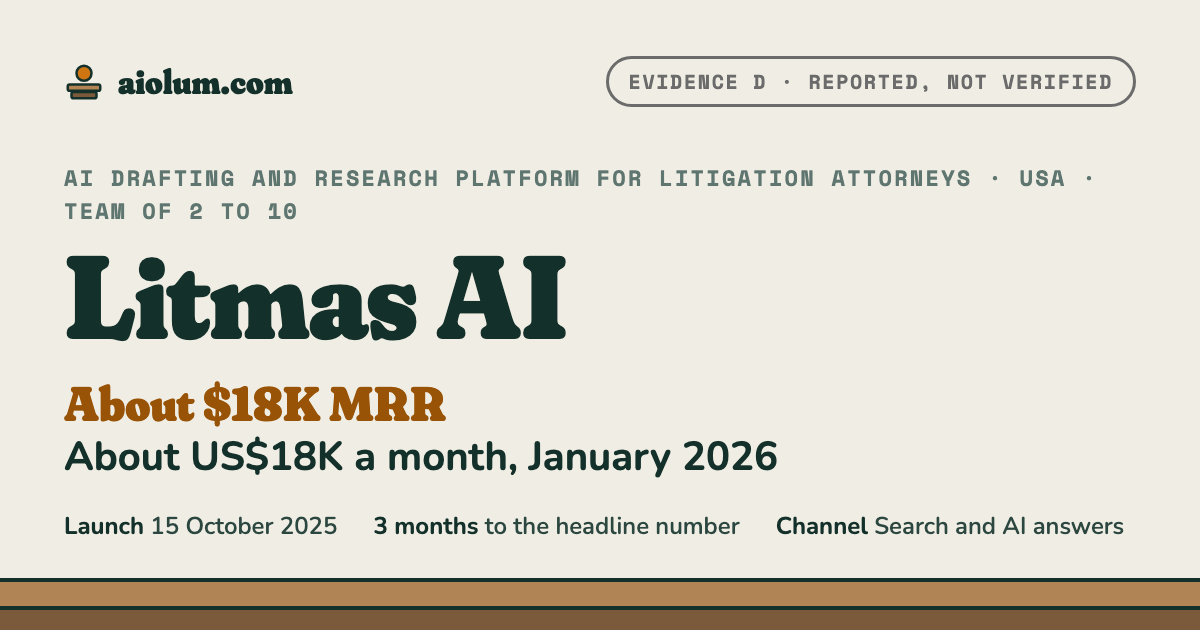
Litmas AI (AI drafting and research platform for litigation attorneys, USA): About US$18K a month, January 2026. Evidence grade D: reported, not verified. Team: 2 co-founders in 2025; 9 people on the team page in December 2025; 11 in November 2026. Launched 15 October 2025; still running.Added 5 November 2026 · updated 6 November 2026
- Outcome
- About US$18K a month, January 2026
- Evidence
- D reported, not verified
- Launch
- 15 October 2025
- Status
- Still running
- Team
- 2 co-founders in 2025; 9 people on the team page in December 2025; 11 in November 2026
- Outside funding
- Less than US$1M in outside funding (company statement, January 2026)
- Group
- Legal and law firms
- Main channel
- Search and AI answers
What is not verified
The headline figure, an MRR of about US$18,000 two months after launch, rests on one source: the company's own Startup Alley entry that LawNext published on 12 January 2026. LawNext printed the answers without checking them. The 45 firms and the funding of less than US$1 million come from the same entry. Later pages say more than 200 firms use the product but give no revenue. A reader could look for a payment-processor profile, a funding announcement with investor names, or a press interview with figures. The headline number is grade D: one claim or one estimate, with no second source. Aiolum shows it because the story is useful, and marks it so that it is not mistaken for a verified figure.
Litmas AI is litigation software. Litigation is the work of lawyers who take a dispute to court: they write a complaint, exchange evidence in discovery (the phase in which each side must hand over documents to the other), and file motions, written requests that ask the judge to decide a point. The product reads the documents of one case, maps each fact to its page, does case law research, and drafts these filings. Every citation carries a pincite, a reference to the exact page of the source, and the company says that a citation it cannot validate against real court opinions is removed from the draft.
The company's November 2026 press release says it was founded in 2025 by Jason Weber, a litigator who had run his own law firm, and Sriram Sekhar, a former Amazon product leader. LawNext listed the company's founding date as 14 July 2025 and its launch as 15 October 2025. In its Startup Alley entry, published by LawNext on 12 January 2026, the company stated that 45 law firms had signed contracts and that its MRR (monthly recurring revenue, the subscription income of one month) was approximately US$18,000 after two months, with less than US$1 million in outside funding. In November 2026 the company says that more than 200 firms use it.
The US$18,000 figure is the company's own statement on one date, grade D; no payment processor or reviewer has confirmed it. The team page listed 9 people in December 2025 and 11 in November 2026, so the company was a small team at the headline figure and has grown since. The page also shows legal technology startups that failed with a similar promise.
How much revenue does Litmas AI make?
Each row shows the evidence grade and the source numbers from the list at the end of this page. The grades are explained in How Aiolum verifies.
| Fact | Value | Grade | How we know | Sources |
|---|---|---|---|---|
| Monthly recurring revenue, about two months after launch | approximately US$18,000 | D | The company's own Startup Alley entry, published by LawNext on 12 January 2026: 'Litmas AI's MRR is approximately $18,000 after only two months of activity.' Not checked by LawNext. | [1] |
| Run rate from that figure | about US$216,000 a year | calc | Calculated: US$18,000 times 12. This is the headline value on this page. | [1] |
| Law firms under contract, January 2026 | 45 | D | Same entry. A mix of contingency-fee and hourly-billing firms. | [1] |
| Firms using it, November 2026 | more than 200 | C | Press release of 2 November 2026 and the home page ('Trusted by 200+ Firms'). No revenue figure is given with it. | [2, 6] |
| Founded | 14 July 2025, by two co-founders | C | Date from the LawNext entry. The press release of 2 November 2026 names Jason Weber and Sriram Sekhar as founders in 2025; Weber signs as 'Co-Founder & CEO'. | [1, 2, 7] |
| Launch | 15 October 2025 | D | The company's LawNext entry. | [1] |
| Team on the about page | 9 people in December 2025; 11 in November 2026 | C | Counted on the Internet Archive copy of 3 December 2025 (one of the 9 is a GTM advisor) and on the live page. The 11 include the two founders, a chief legal officer, product, sales, account and engineering staff and the advisor. | [3, 4] |
| Outside funding | less than US$1 million | D | The company's answer in the LawNext entry. No round, date or investor is named in any source read. | [1] |
| Location | Wilmington, Delaware (company); press release dated Miami | C | LawNext entry and press release. The team is described as 'globally distributed', and the careers page says remote-first. | [1, 2, 14] |
| Customers it targets | small and mid-sized firms | C | LawNext entry. The company also said it was in talks with several 'AM 100' (large) firms about pilots. | [1] |
| Prices | US$125 per case per month, or US$999 per attorney per month | C | Pricing page, 5 November 2026; the same prices appear in the January 2026 LawNext entry. | [5, 1] |
| Security | SOC 2 examination and a HIPAA compliance audit completed; data on US servers; case data not used to train models | C | Trust page and FAQ, company statements. The reports are available under a non-disclosure agreement. | [9, 10] |
| Underlying AI models | not named | C | No page read names the language models or providers behind the product. The comparison page lists ChatGPT, Claude, Gemini and Perplexity only as competitors. | [8, 10] |
| Time from launch to the headline figure | 3 months | calc | Calculated: 15 October 2025 to the LawNext publication on 12 January 2026 is 2.9 months; the entry itself says 'two months of activity'. | [1] |
How to read this table: grade D is a company statement with one date and no second source. Grade C is a statement that other dated pages of the company agree with. A "calc" value was computed on this page. No value is grade A or B.
| Plan | Per month, billed yearly (US$) | Per month, billed monthly (US$) | Limit |
|---|---|---|---|
| Per-Case | 125 per case | minimum US$125 a month; 5,000 pages per case | |
| Unlimited | 999 per attorney | whole docket; pre-suit work; free paralegal seat | |
| Enterprise | custom | for larger firms, from the company's LawNext entry |
The page does not show a yearly price. On the Per-Case plan a minimum platform fee of US$125 a month applies even when all cases are archived. Each case includes 5,000 pages; extra pages cost US$0.01 each, once. Only the Unlimited plan includes pre-suit work (intake, demand letters and complaints) and a free paralegal seat. The page says trials are set up for multi-attorney firms after a demo, and that subscriptions can be cancelled at any time.
When did Litmas AI launch, and how did it grow?
From a founding in July 2025 to more than 200 firms and an agentic version in November 2026. Each entry carries its grade.
- 14 July 2025CLitmas Inc. is founded, according to its LawNext entry. The press release names Jason Weber and Sriram Sekhar as the founders. [1, 2]
- 15 October 2025DLaunch. The company says it is live in all 50 US states. [1]
- 3 December 2025CThe about page lists 9 people: the two founders, a chief legal officer, sales and account staff, two full-stack engineers and an advisor. [4]
- 12 January 2026DLawNext publishes the company's Startup Alley entry: 45 law firms under contract and, the company stated, MRR of about US$18,000 after two months. [1]
- 5 March 2026CLitmas AI announces that voters chose it as one of 15 finalists for Startup Alley at ABA TECHSHOW 2026 in Chicago. [7]
- 2 November 2026CLaunch of the 'Agentic Associate', which unifies drafting, research and fact mapping. More than 200 firms use the product, the company says. [2]
- 5 November 2026CThe about page lists 11 people; the pricing page still shows US$125 per case and US$999 per attorney. [3, 5]
Why did Litmas AI work?
Four causes, in the order they mattered. Each one is a reusable lesson.
Domain expertise
The CEO ran a litigation practice and the team includes former litigators, so the product follows the order of a real case: pre-suit intake, complaint, discovery, motions, appeal. The company's comparison pages argue that Harvey is built for large firms and transactional work, and that general chat tools do not keep a whole case file.
Citation checking as the main promise
Invented case citations are the best-known failure of AI in law. Litmas AI says it validates every case, statute and pincite in two layers and removes a citation it cannot validate. Its marketing is built around this one claim.
Per-case pricing for small firms
The pricing page lists a Per-Case plan that a solo practitioner can start with, and an Unlimited plan per attorney. Contingency-fee firms, which earn a share of the result instead of hourly fees, gain directly from shorter drafting time.
Inbound marketing
The company stated in January 2026 that demand came mainly from inbound marketing. Its site has practice-area pages, comparison articles against Harvey, Lexis and ChatGPT, and a landing page made for ChatGPT ads.
How it was built
The sources say little about the technology. These points come from the company's own pages and are grade C. [3, 5, 9, 10, 14]
- A web application. Users upload Word, PowerPoint, Excel, text, HTML, PDF and image files, up to 500 MB per file; the pricing page counts 5,000 pages per case.
- Case law covers all 50 states and federal courts. Each citation is checked against verified US court opinions before it appears in a draft, and each fact links to its page in the record.
- The language models and their providers are not named in any page read.
- SOC 2 examination and HIPAA audit completed; data is stored on US servers with AES-256 encryption at rest and is not used to train models, the company says.
- The CTO had built earlier AI products before: an ad copy tool (2023), an invoice automation tool (2024) and a due-diligence tool (2025), according to his bio.
- A remote-first team; the careers page offers equity and access to the latest models and compute.
Tools named in the sources
Each one opens its page in the Tools tab, with every story that uses it.
Who tried this before Litmas AI, and why did they fail?
Four companies in our database of failed startups promised to make legal work faster with software or AI and failed. The values below are from that database and are not independently verified.
ROSS Intelligence
The promiseAI legal research that finds the relevant case law faster than the old databases.
Why it diedIt competed against the long-established research databases, and lawyers did not leave them.
Atrium
The promiseA law firm for startups that automates legal work to make it faster, cheaper and more predictable.
Why it diedThe automation could not handle real legal complexity, so it carried the costs of a large law firm without its quality.
jEugene
The promiseAutomatic error checking for contracts, sold to law firms as software.
Why it diedRivals with stronger AI moved faster, law firms adopted it slowly, and it ran out of money.
Glider
The promiseOne place to draft, negotiate and track contracts.
Why it diedLarger rivals such as DocuSign took the market, and its price was too high for small businesses.
The failed startups come from our database of 1,749 dead startups, retold here in our own words. Its entries are AI-assisted summaries of public sources, so these cards carry no evidence grade.
What changed
ROSS Intelligence and jEugene tried to automate legal research and document review before large language models existed, with expensive custom systems and slow sales to law firms. Atrium tried to replace the law firm itself and kept the costs of one. Litmas AI sells software to attorneys who keep the responsibility for the filing, and it builds on general language models that it does not have to train from the start.
The risk that killed the predecessors is still present in a new form. Harvey raised another US$550 million in September 2026, LawNext reported, and Anthropic, Google, OpenAI and Microsoft each launched a legal offering between May and October 2026. Litmas AI's answer is to stay narrow: litigation only, small and mid-sized firms, and citations that link to the record.
Can one person copy Litmas AI now?
Only with the professional background.
The product depends on the co-founder's years in litigation practice and on access to a full body of US case law for citation checks. A solo founder without legal training would find it hard to win the trust of attorneys, who carry professional responsibility for every filing. The method is general: pick one profession, follow its real workflow step by step, and sell a check of the AI's output as the main feature.
Where it is still open: Other narrow legal workflows (immigration, bankruptcy, appeals) and other professions with document-heavy, citation-bound work: insurance claims, tax, patent prosecution.
- 1Choose a profession whose work you know from the inside, where AI errors have known costs.
- 2Build around one workflow from start to end, not a general chat window.
- 3Make every output point to its source, so that the professional can verify it in seconds.
- 4Offer a small entry price per unit of work (here per case) next to a flat plan.
What could go wrong for Litmas AI?
The risks are the mirror image of the causes above.
What is not verified
The headline figure, an MRR of about US$18,000 two months after launch, rests on one source: the company's own Startup Alley entry that LawNext published on 12 January 2026. LawNext printed the answers without checking them. The 45 firms and the funding of less than US$1 million come from the same entry. Later pages say more than 200 firms use the product but give no revenue. A reader could look for a payment-processor profile, a funding announcement with investor names, or a press interview with figures.
Strong, well-funded competition
LawNext reported on 9 September 2026 that Harvey raised another US$550 million at a US$15.5 billion valuation, and that its co-founder wrote it had passed US$400 million in annual recurring revenue. In its LawNext entry, Litmas AI named Westlaw, Lexis, Spellbook and Clearbrief as competitors; its own comparison page also lists Harvey, Legora and Lexis+ Protégé. Clio, the practice-management company, now owns the caselaw provider Fastcase after its US$1 billion purchase of vLex, LawNext reported on 6 July 2026; access to caselaw data is itself a subject of lawsuits between legal AI companies.
Dependence on model providers
No source read names the language models behind Litmas AI. The model providers are now also its competitors: LawNext reported on 15 October 2026 that Microsoft launched Copilot for Legal, after Anthropic's Claude for Legal in May, Google's Gemini Enterprise for Legal in August and OpenAI's Astra for Law in September 2026. A price change or a legal product from the provider could affect both the cost and the demand.
Accuracy claims
The pricing page promises 'Zero fabricated case law' and the about page 'No hallucinations'. The about page also says: 'verifying it before you file remains your professional responsibility'. No independent test of the citation checking was found. Courts have sanctioned attorneys who filed AI-invented citations, so an error would fall on the customer.
The team grew past 10
Two co-founders started it in 2025. The about page listed 9 people in December 2025, near the headline figure, and 11 in November 2026, including a chief legal officer, sales and account managers, engineers and an advisor. The company took less than US$1 million in outside funding by January 2026, by its own statement.
Sources
The grade next to each source is the best grade that the source can support. "Read in full" means that the text of the page was downloaded and the numbers were checked in it.
- D LawNext (LawSites), 12 January 2026: Voting Is Now Open! Pick the 15 Finalists to Compete At Startup Alley at ABA TECHSHOW 2026 in MarchRead the section on Litmas AI. The text is the company's own application, printed unchanged. Source for the MRR, the 45 firms, the founding and launch dates, prices, funding and channel.
- C Litmas AI press release, 2 November 2026: Litmas AI Redefines Litigation Accuracy and Efficiency with Launch of Litmas AI Agentic AssociateRead in full. Source for the two founders and the 200+ firms.
- C Litmas AI about page, read 5 November 2026Read in full, including the team bios. Source for the 11-person team, the founders' backgrounds and the accuracy statements.
- C Internet Archive copy of the Litmas AI about page, 3 December 2025Read the team section. Source for the 9-person team near the headline date.
- C Litmas AI pricing page, read 5 November 2026Read in full. Source for the price table.
- C Litmas AI home page, read 5 November 2026Read in full. Source for 'Trusted by 200+ Firms' and the product description.
- C Litmas AI blog, 5 March 2026: Litmas AI Is an ABA TECHSHOW 2026 Startup Alley FinalistRead in full. Written by Jason Weber as co-founder and CEO.
- C Litmas AI comparison page, read 5 November 2026Read in full. Source for the competitors the company names.
- C Litmas AI trust page, read 5 November 2026Read in full. Source for the SOC 2 and HIPAA statements.
- C Litmas AI FAQ, read 5 November 2026Read the sections on data, training, file types and ChatGPT. Source for upload limits and the data-use statements.
- C LawNext, 9 September 2026: Harvey Raises Another $550M at a $15.5B ValuationRead in full. Source for Harvey's funding and its reported ARR.
- C LawNext, 15 October 2026: Microsoft Launches Copilot for Legal, Becoming the Fourth AI Giant in Five Months to Build Out a Legal VerticalRead the opening sections. Source for the legal products of Anthropic, Google, OpenAI and Microsoft.
- C Litmas AI landing page: Litigation AI Workflows (ChatGPT Ads), read 5 November 2026Read the title and opening. Shows a landing page made for ChatGPT ads.
- C Litmas AI careers page, read 5 November 2026Read in full. Source for remote-first work and equity.
- C LawNext, 6 July 2026: Fastcase And Alexi Head To Court This Week In High-Stakes Fight Over Legal AI, Caselaw Data And Clio's $1B vLex DealRead the opening sections. Source for Clio's ownership of vLex and Fastcase and the caselaw data dispute.
- C Database of failed startups, local exportLocal export. AI-written summaries, not independently verified. Source for the failed predecessors.
Run this company? Send corrections or a verified figure to aiolum@livyden.com