Optionality: Product, team and how it was built
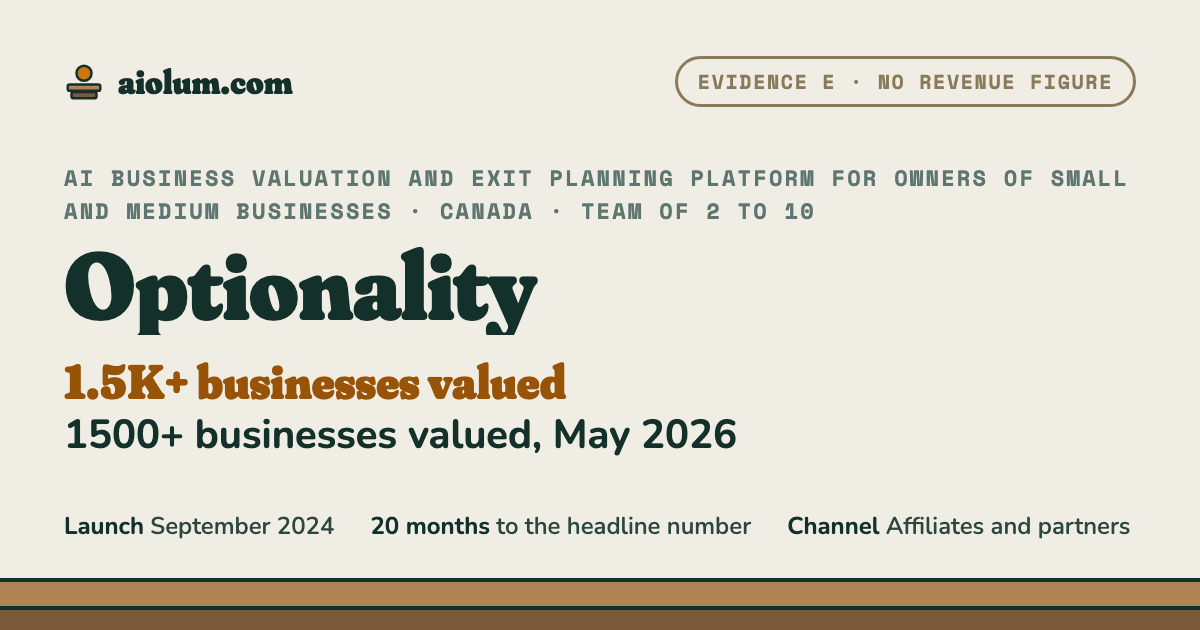
Optionality (AI business valuation and exit planning platform for owners of small and medium businesses, Canada): 1500+ businesses valued, May 2026. Evidence grade E: no revenue figure was checked. Team: Started by founder Simon Leroux; 6 staff in November 2025 and 7 staff plus 5 advisors on the About page in November 2026. Launched September 2024; still running.Added 5 November 2026 · updated 6 November 2026
- Outcome
- 1500+ businesses valued, May 2026
- Evidence
- E no revenue figure was checked
- Launch
- September 2024
- Status
- Still running
- Team
- Started by founder Simon Leroux; 6 staff in November 2025 and 7 staff plus 5 advisors on the About page in November 2026
- Outside funding
- Funded: backed by Inovia Capital and Luge Capital, by the company's own pages; amount not published
- Main channel
- Affiliates and partners
What is not verified
No revenue figure was found. The company's pages, its press post, archived copies of its site and the UpNext article give no revenue, customer count or funding amount. The 1,500+ businesses valued is a company figure retold by UpNext and likely includes free valuations. A reader could look for a funding announcement with an amount, an interview with figures, or a paying-customer count. This story is grade E: the business is real and its product, price and customers are described from public pages, but no revenue figure was checked. Aiolum shows it as an idea worth studying, not as proof that it makes money.
Optionality, a company in Montreal, sells an exit-planning platform: software that helps the owner of a private company prepare to sell it or pass it on, years before the sale. Its core is an automated business valuation, an estimate of what a buyer would pay for the company, computed from comparable transactions (sales of similar private companies) and from models that the company says were built with chartered business valuators, the Canadian accounting credential for valuation work. The platform adds a benchmark of 17 metrics, buyer lists, a financing estimate and a readiness score based on the CEPA (Certified Exit Planning Advisor) method.
Simon Leroux founded it after his own company sales. In 2024 the site took a waitlist and then offered a free trial of a generative AI "co-pilot" for M&A advisors; in 2026 it is sold mainly to business owners, with a free plan and paid plans from US$299 a month, by the company's pricing page. In May 2026 an UpNext article on the Google for Startups Accelerator Canada cohort reported 1,500+ businesses valued and 500+ entrepreneurs supported.
No revenue figure was found, so this is a grade E story. The company's pages say it is backed by Inovia Capital and Luge Capital and name 7 staff, so it is a small funded team.
How much revenue does Optionality make?
Each row shows the evidence grade and the source numbers from the list at the end of this page. The grades are explained in How Aiolum verifies.
| Fact | Value | Grade | How we know | Sources |
|---|---|---|---|---|
| Businesses valued, May 2026 | 1,500+ | C | UpNext, 28 May 2026, on the Google for Startups Accelerator Canada 2026 cohort: "1,500+ businesses valued, 500+ entrepreneurs supported". A company figure retold by the article; it likely counts free valuations. | [4] |
| Entrepreneurs supported, May 2026 | 500+ | C | Same UpNext article. | [4] |
| Founder | Simon Leroux | C | Company About page, archived November 2025: "Simon, our founder, built, sold, acquired, and divested multiple businesses - including an exit to private equity firm KKR." UpNext lists "Simon Leroux & Aymeric Freymond"; the company's current About page names Aymeric Freymond as Head of Marketing. | [3, 4, 7] |
| Team, November 2026 | 7 staff and 5 advisors | C | Current About page: 3 people under Leadership and 4 under Management, plus 5 advisors. The careers page says "We're a small team" and lists one open sales role. | [3, 10] |
| Team, November 2025 | 6 staff and 2 advisors | C | About page archived 19 November 2025, which lists Inovia Capital as "Investor". | [7] |
| Investors | Inovia Capital and Luge Capital | C | Company press post, 24 September 2026: "backed by investors including Inovia Capital and Luge Capital". The amount is not published. | [5] |
| First product online | waitlist in April 2024; free trial by September 2024 | C | Archived home pages of 24 April 2024 ("Join our waitlist") and 1 September 2024 ("1 Week Free Trial"). A February 2024 capture of the domain was a blank WordPress template. | [8, 9] |
| Data behind the valuations | 150,000+ transactions | C | Home page: "Powered by 150,000+ real transactions". Not checked. | [1] |
| Models | Cohere and Gemini, plus the company's own Option-1 model | C | Advisors page: "Built on Cohere, Gemini, and our proprietary Option-1™ model". In November 2025 the About page named "Gemini, OpenAI and Cohere". | [6, 7] |
| Partnership with M&A Club | 24 September 2026 | C | Company press post. The M&A Club describes itself as Canada's largest network of M&A professionals; members get preferential access to the platform. | [5] |
| Prices | free, US$299 a month, from US$499 a month | C | Pricing page, read 5 November 2026. | [2] |
| Time from the first free trial to the May 2026 figure | 20 months | calc | Calculated: September 2024 to May 2026. | [4, 9] |
How to read this table: a grade C value comes from the company's own pages, archived copies of them, or the UpNext article, which retells the company's statements. A "calc" value was computed on this page. No value is grade A or B, and no revenue figure exists.
| Plan | Per month, billed yearly (US$) | Per month, billed monthly (US$) | Limit |
|---|---|---|---|
| Essential | 0 | 0 | until 31 December; list price US$99 a month; preliminary valuation, readiness audit, transfer plan |
| Pro | 249.92 | 299 | US$2,999 a year; full valuation report, comparable transactions, buyer mapping, setup and support |
| Coach | 416.58 | from 499 | US$4,999 annual figure; adds quarterly human coaching and buyer introductions |
| Advisors | price not published; demo |
The page shows a monthly and an annual switch. Essential is shown as US$0 a month, crossed out from US$99, "Until December 31". Pro is US$299 a month or US$2,999 a year (about US$249.92 a month, calculated). Coach is "Starting at" US$499 a month, and the annual figure is US$4,999 with no period written next to it (about US$416.58 a month if it is per year, calculated). Coach adds quarterly coaching with an exit-planning expert and buyer introductions; the advisor version is sold after a demo, with no published price.
When did Optionality launch, and how did it grow?
From a waitlist page in April 2024 to 1,500+ valuations by May 2026, in about 20 months from the first free trial. Each entry carries its grade.
- April 2024CThe site takes a waitlist for AI valuations and benchmarks for business owners and says it is "Backed by Inovia Capital". [8]
- September 2024CThe site offers a one-week free trial of a generative AI co-pilot for M&A and financing advisors that writes pitchbooks, assessments and valuations. [9]
- November 2025CThe About page names the founder, 6 staff, 2 advisors and Inovia Capital as investor, and names Gemini, OpenAI and Cohere as model providers. [7]
- 28 May 2026CUpNext lists Optionality in the Google for Startups Accelerator Canada 2026 cohort with 1,500+ businesses valued. [4]
- 24 September 2026CPartnership with the M&A Club; the company names Inovia Capital and Luge Capital as investors. [5]
- November 2026CThe site sells mainly to owners: free Essential plan until 31 December, Pro at US$299 a month, Coach from US$499 a month. [1, 2]
Why did Optionality work?
Four causes, in the order they mattered. Each one is a reusable lesson.
Domain expertise of the founder
The founder had sold companies himself, one of them to KKR, by the company's pages. The product follows the steps that a sale really takes: value, benchmark, find buyers, check readiness, plan. The advisors named on the site include a valuation expert who is a Fellow of the CBV Institute and a CEPA-certified exit planner.
A free valuation as the entry point
The home page repeats "Free for Business Owners". An owner gets a first valuation without paying, and the paid plans sell the full report, buyer lists and coaching. This is how the count of 1,500+ businesses valued could grow faster than paying customers.
Reaching owners through advisors
The first product was for M&A advisors, and the advisor version is still sold. Advisors use the reports to start conversations with owners before a sale mandate exists, and the M&A Club partnership gives its members access. Advisors bring owners to the platform.
How it was built
The company's pages say little about its technology. These details come from its pages and archived copies, grade C. [1, 2, 3, 6, 7]
- Language models from Cohere and Google (Gemini), with a model of its own called Option-1; in November 2025 OpenAI was also named.
- A database of more than 150,000 private transactions and a company and private-equity database for buyer lists, by the home page.
- Valuation models developed with chartered business valuators; the readiness audit follows the CEPA method.
- Payments for the paid plans go through Stripe checkout links in the pricing page source.
- The team in November 2026 includes a CTO, a head of product and a PhD AI researcher.
Tools named in the sources
Each one opens its page in the Tools tab, with every story that uses it.
Who tried this before Optionality, and why did they fail?
Three companies in our database of failed startups sold financial software or services to small businesses or investors and failed. The values below are from that database and are not independently verified.
NetBooks
The promiseCloud accounting that made bookkeeping easy for small businesses.
Why it diedQuickBooks dominated the market; high customer acquisition costs and missing features left too few paying users.
Covela
The promiseSimple insurance for small businesses through technology and existing tools.
Why it diedIt depended on traditional insurers, fell behind faster rivals and ran out of money during the pandemic.
Cake Financial
The promiseTrack investments and compare their performance with peers.
Why it diedMint offered broader features, and the 2008 crash made investors avoid new consumer finance products.
The failed startups come from our database of 1,749 dead startups, retold here in our own words. Its entries are AI-assisted summaries of public sources, so these cards carry no evidence grade.
What changed
NetBooks and Covela sold financial tools to small businesses and spent too much to win each customer against incumbents. Cake Financial sold benchmarking that people liked but did not pay for. Optionality sells to the same owners, who buy a valuation rarely and often only when they decide to sell.
Two things differ. Language models can now write a readable valuation and exit plan from a company's statements in minutes, so a first valuation can be free and the paid plans come later. And the company reaches owners through advisors and the M&A Club, who already meet them, instead of paying for each owner directly.
Can one person copy Optionality now?
Not alone, and not without the credentials.
Owners trust a valuation when credentialed valuators and a large transaction database stand behind it, and this team has a founder with several company sales, credentialed advisors and venture investors. A solo founder could start in one industry or one region, with a free valuation built on public sale data, but would need a valuation professional to sign off the method.
Where it is still open: Other rare, high-stakes decisions of small business owners: succession inside a family, buying a competitor, refinancing, and selling property used by the business.
- 1Pick one industry or region where owners rarely know what their company is worth.
- 2Build a free first valuation from public or licensed transaction data, and show how it was computed.
- 3Work with a credentialed valuator on the method, and say so on the page.
- 4Sell to the advisors who meet owners: accountants, wealth advisors and brokers.
What could go wrong for Optionality?
The risks are the mirror image of the causes above.
What is not verified
No revenue figure was found. The company's pages, its press post, archived copies of its site and the UpNext article give no revenue, customer count or funding amount. The 1,500+ businesses valued is a company figure retold by UpNext and likely includes free valuations. A reader could look for a funding announcement with an amount, an interview with figures, or a paying-customer count.
Software with people around it
The valuations come from software: the home page says "Our AI delivers your valuation in minutes rather than days", and the Essential and Pro plans are self-serve software. UpNext describes the company as combining "AI and chartered business valuators". The Pro plan includes setup and a presentation of the reports, and the Coach plan adds quarterly coaching with an exit-planning expert and buyer introductions, so the higher plans include human service.
Claims on the pages
The home page and advisors page show a row of logos under "Backed by leading investors and partners" that mixes investors with banks, accounting firms, programs and a model provider; only Inovia Capital and Luge Capital are named as investors in text. "Featured in La Presse and Les Affaires" and the 150,000+ transactions were not checked, and the advisors page counters load by script and showed 0. The US$0 Essential price is a promotion until 31 December.
Competition and model providers
Intriq AI, another story on this site, also sells AI analysis to M&A and corporate finance advisors. Optionality depends on Cohere and Google Gemini models by its advisors page, and named OpenAI too in November 2025; it says its own Option-1 model and transaction data are what set its results apart.
Sources
The grade next to each source is the best grade that the source can support. "Read in full" means that the text of the page was downloaded and the numbers were checked in it.
- C Optionality home page, read 5 November 2026Read in full. Source for the product, the 150,000+ transactions claim, the CBV-developed models, the logo row and the plans.
- C Optionality pricing page, read 5 November 2026Read in full, including the structured data with the currency and the annual prices in the page source.
- C Optionality About page, read 5 November 2026Read in full. Source for the founder's background, the team and the advisors.
- C UpNext, 28 May 2026: Google for Startups Accelerator Canada 2026Read the section on Optionality. Source for the businesses valued and entrepreneurs supported.
- C Optionality news, 24 September 2026: Optionality and M&A Club Partner on Exit ReadinessRead in full. Source for the partnership, the founder's title and the named investors.
- C Optionality page for advisors, read 5 November 2026Read in full. Source for the advisor version and the named models; the counters load by script and could not be read.
- C Optionality About page, Internet Archive copy of 19 November 2025Read in full. Source for the founder statement, the 2025 team, the investor listing and the model providers.
- C Optionality home page, Internet Archive copy of 24 April 2024Read in full. Source for the waitlist and the early investor statement.
- C Optionality home page, Internet Archive copy of 1 September 2024Read in full. Source for the free trial of the advisor co-pilot.
- C Optionality careers page, read 5 November 2026Read in full. Source for the small-team statement and the open role.
- C Database of failed startups, local exportLocal export. AI-written summaries, not independently verified. Source for the failed predecessors.
Run this company? Send corrections or a verified figure to aiolum@livyden.com