Crit: Revenue, team and how it was built
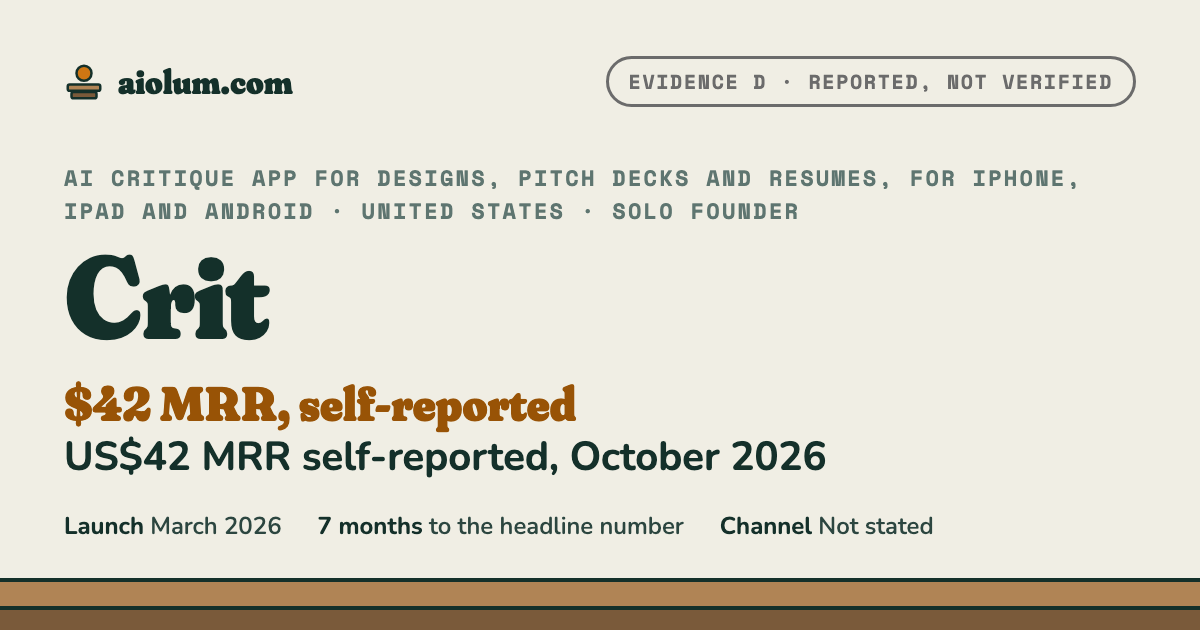
Crit (AI critique app for designs, pitch decks and resumes, for iPhone, iPad and Android, United States): US$42 MRR self-reported, October 2026. Evidence grade D: reported, not verified. Team: 1 maker listed: Vishal Mehta, through his IDYeah Studio LLC; headcount not published. Launched March 2026; still running.Added 6 November 2026
- Outcome
- US$42 MRR self-reported, October 2026
- Evidence
- D reported, not verified
- Launch
- March 2026
- Status
- Still running
- Team
- 1 maker listed: Vishal Mehta, through his IDYeah Studio LLC; headcount not published
- Outside funding
- None reported
- Main channel
- Not stated
What is not verified
The only money figure, US$42 MRR, comes from one source: the IndieMakerList profile, facts checked on 19 October 2026, which says the maker shares small revenue numbers in his X bio. X could not be read for this page. No payment-processor profile, store revenue report or interview was found. A reader could look for a verified revenue profile such as TrustMRR or a founder post with a dashboard screenshot. The headline number is grade D: one claim or one estimate, with no second source. Aiolum shows it because the story is useful, and marks it so that it is not mistaken for a verified figure.
Crit is an AI design critique app, a program that looks at a piece of visual work and writes the kind of review a senior designer would give: what works, what is unclear, and what to change first. It also reviews pitch decks and resumes. The app sends the uploaded file and the user's context to Anthropic's API, which is a paid service that runs Anthropic's Claude models for other companies, and shows the answer as scores, a diagnosis and three fixes. Reports stay on the user's device.
The seller is IDYeah Studio LLC, the design studio of Vishal Mehta in Cupertino, United States. Version 1.0 appeared in the App Store on 9 March 2026 as a pitch deck critique; resume critique followed in April and design critique in May, and version 2.0 in September added revision checks. IndieMakerList, a directory of independent makers, listed Crit at "$42 MRR (self-reported)" in a profile with facts checked on 19 October 2026. MRR means monthly recurring revenue, the subscription money that comes in each month.
That figure is the only money figure found, and the directory says it comes from the maker's own X bio. It is small: US$504 a year if it holds for twelve months, by this page's calculation. The story is here as an example of an early, one-person AI app from a domain expert, not as a large business.
How much revenue does Crit make?
Each row shows the evidence grade and the source numbers from the list at the end of this page. The grades are explained in How Aiolum verifies.
| Fact | Value | Grade | How we know | Sources |
|---|---|---|---|---|
| Monthly recurring revenue, October 2026 | US$42 (self-reported) | D | IndieMakerList profile of Vishal Mehta, facts checked 19 October 2026, read 6 November 2026: "$42 MRR". The directory says he shares small revenue numbers for each product in his X bio. The same figure is in the directory's open data file generated on 5 November 2026. No payment-processor or store figure was found. | [1, 8] |
| Run rate from that figure | US$504 a year | calc | Calculated: US$42 times 12, using the directory's self-reported figure. | [1] |
| First App Store version | 1.0, 9 March 2026 | C | App Store version history. The page shows "Mar 9" without a year, as Apple does for the current year; the listing's copyright line is 2026. | [5] |
| Seller and maker | IDYeah Studio LLC; Vishal Mehta | C | The App Store and Google Play name IDYeah Studio LLC as seller; the Google Play developer email is Vishal's address at idyeah.studio. IndieMakerList describes him as a Cupertino product designer with more than 25 years of UX experience. | [1, 5, 6] |
| AI model provider | Anthropic's API | C | Privacy page, last updated 2 October 2026: "Our service sends the content needed for the critique to Anthropic's API to generate feedback." | [4] |
| Other services named | Supabase, RevenueCat, Apple, Google, Resend | C | Privacy page: Supabase for optional Sign in with Apple, RevenueCat for subscription status, Resend for Android issue reports. | [4] |
| What it reviews | PNG or JPEG designs; PDF pitch decks up to 20 slides; PDF resumes up to 3 pages | C | Support page and Google Play listing. Google Play also gives file size limits of 5 MB and 7 MB. | [3, 6] |
| App Store ratings | 3 ratings, average 5.0 | C | App Store page read 6 November 2026. Two written reviews are shown, dated 29 March and 27 May. | [5] |
| Google Play downloads | more than 10 | C | Google Play listing shows "10+ Downloads", updated 12 October 2026, rated Everyone. | [6] |
| Price change | US$12.99 a month in March 2026; US$5.99 a month in November 2026 | C | The earlier price is in the App Store release note for version 1.4; the current price is on the company's site and support page. | [2, 3, 5] |
| Sister product | Crit by Keya, a web audit tool | D | IndieMakerList lists a separate product at crit.keya.studio that "reviews any website or product from eight expert perspectives", at a self-reported "$200 ARR". keya.studio shows "Eight-lens audit with clear findings". Not part of the headline. | [1, 7] |
| Outside funding | none reported | D | No source mentions investors or a funding round. | [1] |
| Time from launch to the October 2026 figure | 7 months | calc | Calculated: March 2026 to October 2026. | [1, 5] |
How to read this table: grade D is a figure from one source that nobody has checked, here a directory entry that quotes the maker. Grade C is what the company's own pages or app store listings say. A "calc" value (grade X) was computed on this page. No value is grade A or B.
| Plan | Per month, billed yearly (US$) | Per month, billed monthly (US$) | Limit |
|---|---|---|---|
| Free | 0 | 0 | 3 complete critiques in total, not per month; on Android the free critiques include the first fix only |
| Crit Pro, annual (iOS) | 3.33 | billed US$39.99 a year; new critiques, revision reviews, PDF export | |
| Crit Pro, monthly (iOS and Android) | 5.99 | same features; 7-day trial for eligible subscribers |
The site lists Crit Pro at US$5.99 a month on iOS and Android, or US$39.99 a year on iOS, which the site says saves 44% against twelve monthly payments. Pro is for individual use with daily fair-use limits; automated or bulk use is not supported. The monthly plan has a 7-day trial for eligible subscribers. Apple or Google Play collects the payment. An App Store release note of March 2026 shows an earlier price of US$12.99 a month after the trial.
When did Crit launch, and how did it grow?
From a pitch deck reviewer in March 2026 to a three-way critique app for designs, decks and resumes, in seven months. Each entry carries its grade.
- 9 March 2026CVersion 1.0 in the App Store. Early versions critique pitch decks. [5]
- March 2026CVersions 1.2 to 1.5 add a 7-day free trial and fix purchases for international users. The paywall shows US$12.99 a month after the trial. [5]
- 27 to 28 April 2026CVersions 1.6 and 1.7 add resume critique and a PDF download of each report. [5]
- 24 May 2026CVersion 1.9: "Crit now critiques design", with five design dimensions: visual hierarchy, clarity, brand consistency, accessibility and emotional tone. [5]
- 17 to 22 September 2026CVersion 2.0 adds revision checks against earlier fixes; version 2.1 adds the annual plan. [5]
- October 2026DIndieMakerList lists Crit at a self-reported US$42 MRR, from the maker's X bio. The Android app is updated on 12 October. [1, 6]
Why did Crit work?
Four causes, in the order they mattered. Each one is a reusable lesson.
Domain expertise turned into a fixed format
Every critique has the same parts: an overall score, five dimension scores, a diagnosis and exactly three fixes. The format reflects how a design lead reviews work, and it keeps the AI answer short enough to act on before a meeting.
Context before critique
The user says who the work is for and what it must achieve, and for a resume adds the target role and a job description. The same screen can get different feedback for a different goal, which is the main difference from a generic chat prompt.
Three markets from one engine
The app started with pitch decks, then added resumes and designs within three months. Each type is a separate page on the site, so one model call and one report format serve three groups of buyers.
A thin, low-cost stack
The model is rented from Anthropic, sign-in from Supabase and subscriptions from RevenueCat, and reports are stored on the device, so the maker runs little backend of his own.
How it was built
These details come from the company's privacy page, support page and store listings. They are grade C. [4, 3, 5]
- Native apps for iPhone and iPad (iOS 18.6 or later) and for Android.
- Critiques are generated through Anthropic's API; the backend keeps results in memory for ten minutes to support retries and does not store uploaded files durably.
- Supabase receives the account identifier for optional Sign in with Apple. The Android app has no sign-in.
- RevenueCat tracks subscriptions; Apple and Google Play take the payments.
- Resend delivers Android issue reports to the support inbox.
- Critique history is stored only on the device; an account does not sync history between devices.
Tools named in the sources
Each one opens its page in the Tools tab, with every story that uses it.
Who tried this before Crit, and why did they fail?
Four companies in our database of failed startups tried to give designers or job seekers feedback or design help as a product. The values below are from that database and are not independently verified.
Watchsend
The promiseRecord each tap and swipe of app users so that designers can see where an interface fails.
Why it diedLarger analytics companies offered the same, and video data cost too much to store.
The Grid
The promiseLet AI design a website, without a designer.
Why it diedThe AI of the time made weak designs, and simpler website builders gave better results.
Jobspice
The promiseA well-designed resume for job seekers without design skills.
Why it diedIt sold one narrow product while LinkedIn and free tools covered the same need.
Scoutzie
The promiseCustom design work from selected freelance designers.
Why it diedCheaper marketplaces such as Fiverr and Upwork took the buyers.
The failed startups come from our database of 1,749 dead startups, retold here in our own words. Its entries are AI-assisted summaries of public sources, so these cards carry no evidence grade.
What changed
Watchsend and The Grid each needed heavy technology of their own: video capture and storage, or a design system that did not yet work well. Jobspice and Scoutzie sold one narrow service that free tools or cheaper marketplaces could replace. All four raised money and still could not cover their costs.
Crit rents its model from Anthropic and pays per request, so it needs no AI team and no servers for training. A multimodal model, one that reads images and PDF layout as well as text, can now write a usable critique of a screen or a deck, which The Grid's generation of AI could not. The risk from the predecessors remains: the same model is available to anyone, including the design tools that designers already use.
Can one person copy Crit now?
Yes, the method is easy to copy. A paying audience is the hard part.
One expert, a fixed review format, a rented model and app-store billing are enough to ship this kind of app in weeks. The self-reported US$42 MRR after seven months shows that shipping is not the same as finding buyers.
Where it is still open: Expert critique in other fields where people want a second opinion before a meeting: grant proposals, sales emails, product requirement documents, architecture diagrams.
- 1Write down how you review work in your own field, as a fixed list of dimensions and a fixed number of fixes.
- 2Ask the user for the audience and the goal before the model sees the file.
- 3Give a small number of complete free reviews, then charge a subscription.
- 4Add a revision check, so a second upload compares the new work with the earlier fixes.
What could go wrong for Crit?
The risks are the mirror image of the causes above.
What is not verified
The only money figure, US$42 MRR, comes from one source: the IndieMakerList profile, facts checked on 19 October 2026, which says the maker shares small revenue numbers in his X bio. X could not be read for this page. No payment-processor profile, store revenue report or interview was found. A reader could look for a verified revenue profile such as TrustMRR or a founder post with a dashboard screenshot.
Very small so far
Three App Store ratings and more than 10 Google Play downloads in November 2026 show an early product. The monthly price fell from US$12.99 in March 2026 to US$5.99, as the release notes and the site show, which suggests the maker is still testing what buyers will pay.
Depends on one model provider
The privacy page names Anthropic's API as the service that writes every critique. A price change, an outage or a change of Anthropic's terms would reach Crit directly.
Competition
Other stories on this site generate interfaces (UX Pilot) or review resumes (Rezi, Sheets Resume); Crit sells the critique of finished work instead, and general chat apps that read images can give a similar review without a separate app.
One person, written as "we"
The support and privacy pages write "we" and "our team", and the support address is a studio address. The only person a source names is Vishal Mehta; no source gives a headcount, so the team is taken as one maker.
Reviews and AI limits
The App Store shows two written reviews, both very positive; their authors' relation to the maker is not known. The site itself says the AI "can miss context, make mistakes, or disagree with your intent" and that scores are not a certification.
Sources
The grade next to each source is the best grade that the source can support. "Read in full" means that the text of the page was downloaded and the numbers were checked in it.
- D IndieMakerList: Vishal Mehta (@idyeahstudio), Creator of Crit, Crit by KeyaRead in full on 6 November 2026. Directory profile, facts checked 19 October 2026, not claimed by the maker. Source for the self-reported US$42 MRR and the maker's background.
- C Crit home page: AI Design Critique Before the Client ReviewRead in full on 6 November 2026. Source for the product, the free critiques and the Pro prices.
- C Crit Support: Uploads, Subscriptions and PrivacyRead in full. Source for file limits, what a free critique includes and the subscription terms.
- C Crit privacy page, last updated 2 October 2026Read the sections on AI processing, service providers, subscriptions and children. Source for Anthropic's API, Supabase, RevenueCat and Resend.
- C App Store: Crit: AI Design Advisor, IDYeah Studio LLCRead in full on 6 November 2026. Source for the version history, ratings, age rating 4+ and in-app purchase prices.
- C Google Play: Crit, AI Design Advisor, IDYeah StudioRead in full on 6 November 2026. Source for the download count, update date and developer contact.
- C keya, a studio for thoughtful digital workRead in full. The maker's product studio page; source for the sister audit product only.
- D IndieMakerList open data, makers.json, generated 5 November 2026Downloaded by the pipeline's harvester on 6 November 2026; read the Vishal Mehta record. Same figure as the profile, same underlying source.
- C Database of failed startups, local exportLocal export. AI-written summaries, not independently verified. Source for the failed predecessors.
Run this company? Send corrections or a verified figure to aiolum@livyden.com