Lume: Revenue, sale and how it was built
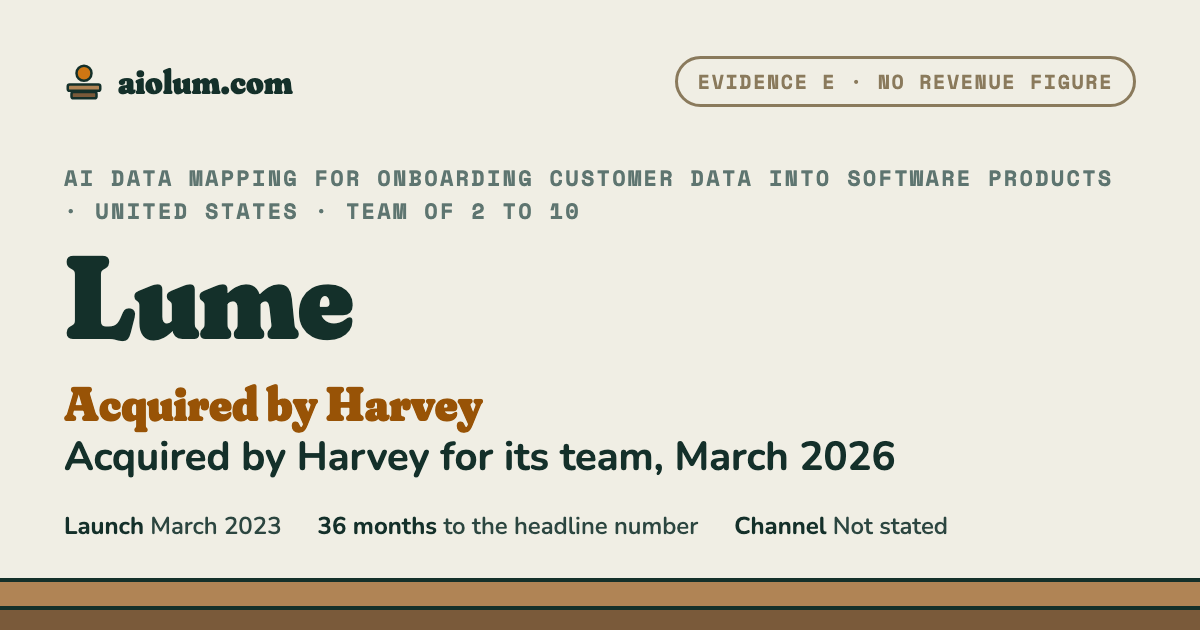
Lume (AI data mapping for onboarding customer data into software products, United States): Acquired by Harvey for its team, March 2026. Evidence grade E: no revenue figure was checked. Team: 3 co-founders from 2022; Y Combinator lists a team of 5 (undated, read November 2026); Harvey named 2 co-founders who joined it in March 2026. Launched March 2023; sold 36 months after launch.Added 8 November 2026
- Outcome
- Acquired by Harvey for its team, March 2026
- Evidence
- E no revenue figure was checked
- Launch
- March 2023
- Status
- Sold, 36 months after launch
- Team
- 3 co-founders from 2022; Y Combinator lists a team of 5 (undated, read November 2026); Harvey named 2 co-founders who joined it in March 2026
- Outside funding
- Y Combinator Winter 2023, then a US$4.2M seed round led by General Catalyst with Khosla Ventures, Floodgate and Soma Capital, as the company wrote on its blog on 12 November 2024
- Main channel
- Not stated
What is not verified
No revenue figure, sale price or count of paying customers was found. We read Harvey's announcement, Lume's Y Combinator page and both launch posts, and Internet Archive copies of its home, pricing, about, blog and case-study pages; no payment-processor profile or founder interview with figures was found. The case study does not say what Cardinal Gray paid, and its headline "13x" does not follow from its own "6 months to 5 weeks", which is about 5.2 times by calculation. The team size of 5 is Y Combinator's undated figure, and Harvey gives 2023 as the founding year where Y Combinator gives 2022. A reader could look for a statement by General Catalyst or a later interview with the founders. This story is grade E: the business is real and its product, price and customers are described from public pages, but no revenue figure was checked. Aiolum shows it as an idea worth studying, not as proof that it makes money.
Lume sold data mapping with AI. Data mapping is the work of deciding which field in one system goes to which field in another and how to convert it, for example a customer's "cust_nm" column into a product's "customer_name" with a changed date format. Each system's layout of tables and fields is its schema. Lume read a sample of the source data and the target schema, wrote the mapping logic, and let an engineer review it before it ran.
Nicolas Machado, Nebyou Zewde and Robert Ross started it in 2022 and went through Y Combinator in Winter 2023. In June 2024 they wrote that they had "onboarded several customers", and a 2025 case study names one, Cardinal Gray, a lending-software company. On 3 March 2026 Harvey announced that the Lume team was joining it, and Harvey's CTO called it the company's "second acquisition this year focused on talent", a talent acquisition: a purchase made mainly to hire the team.
No revenue figure and no sale price were published, so this story has grade E: the headline is the acquisition, which Harvey itself announced. By November 2026 the lume.ai domain showed a parking page.
How much did Lume make, and what was it sold for?
Each row shows the evidence grade and the source numbers from the list at the end of this page. The grades are explained in How Aiolum verifies.
| Fact | Value | Grade | How we know | Sources |
|---|---|---|---|---|
| Outcome, 3 March 2026 | Acquired by Harvey; price not disclosed | A | Harvey's own blog post, "The Lume AI Team Joins Harvey". Y Combinator's directory lists Lume as "Acquired". | [1, 2] |
| Kind of deal | a talent acquisition | A | Harvey's CTO, Siva Gurumurthy: "This is our second acquisition this year focused on talent". Co-founders Robert Ross and Nebyou Zewde joined Harvey's product and engineering teams. The post does not say whether Lume's product continued. | [1] |
| Founded | 2022 | C | Y Combinator's directory gives 2022, and a November 2022 copy of lume.ai is a waitlist page marked "Copyright © 2022 Lume AI". Harvey's post says "Founded in 2023". | [2, 4, 1] |
| Founders | Nicolas Machado, Nebyou Zewde and Robert Ross | C | Both Y Combinator launch posts and the seed-round post. Their Y Combinator profiles list Stanford computer science or AI. In July 2023 they shared a New York office with 4 other Y Combinator teams. | [2, 8, 5] |
| Team size | 5 | C | Y Combinator's directory, undated, read 8 November 2026. No source gives a larger team. | [2] |
| Funding | US$4.2 million seed, plus Y Combinator | C | Company blog, 12 November 2024: led by General Catalyst, with Khosla Ventures, Floodgate, Y Combinator and Soma Capital. Harvey's post names Y Combinator, Khosla Ventures and General Catalyst as backers. | [8, 1] |
| Customers, June 2024 | "several customers" | C | Founders' Y Combinator launch post of 26 June 2024. No count was published. | [3] |
| Named customer | Cardinal Gray, lending software | C | Company case study, archived 21 June 2025, with quotes from Cardinal Gray's CTO: a mapping project cut "from 6 months to 5 weeks", 563 mappings, 76% less maintenance time. The study does not say what Cardinal Gray paid. | [9] |
| Other customer results, November 2024 | about 1,500 live data pipelines for one financial startup | C | Seed-round post, customers not named: 95% mapping accuracy for a CRM and recruiting-software company, 75% faster mapping for a battery-analytics company. | [8] |
| Prices | Business and Enterprise plans, on request | C | Pricing page copy of 16 October 2025 and home page copy of 9 December 2025. No amount shown. | [10, 12] |
| AI provider | OpenAI | C | Sub-processor list, April 2024: "OpenAI : Artificial intelligence services", with Amazon Web Services and Weaviate. | [7] |
| Time from launch to the acquisition | 36 months | calc | Calculated: Launch YC post of March 2023 to Harvey's post of March 2026. | [2, 1] |
How to read this table: grade A is the buyer's own announcement. Grade C values are the company's own pages and posts, most read in Internet Archive copies because lume.ai is now a parking page. An "X" value was calculated on this page.
| Plan | Per month, billed yearly (US$) | Per month, billed monthly (US$) | Limit |
|---|---|---|---|
| Business | on request | on request | any customer database or ERP, AI schema discovery and mapping, dbt code generation, founders' phone number for support (December 2025) |
| Enterprise | on request | on request | adds SOC 2 Type 2 readiness, role-based access, private cloud or on-premise deployment, 24/7 support |
Both pages had a monthly and yearly switch marked "Save 20%" for yearly billing, but every plan led to "Talk to our team" or "Book a demo". The October 2025 page described AI agents for operations; the December 2025 page described customer integrations. The June 2024 launch post offered a free trial.
When did Lume launch, and how did it grow?
From a waitlist page in 2022 to a talent acquisition in 2026, with three changes of pitch on the way. Each entry carries its grade.
- November 2022Clume.ai is a one-page site that asks visitors to join the waitlist for a beta product. [4]
- 7 March 2023CIn the Y Combinator Winter 2023 batch, the founders launch a no-code tool to build and maintain custom data integrations, as a private beta. [2]
- 26 June 2024CSecond launch post: AI data mapping through an API and a web app, a free trial, and "several customers". [3, 6]
- 12 November 2024CThe company writes that it raised a US$4.2 million seed round led by General Catalyst. [8]
- June 2025CA case study with Cardinal Gray, a lending-software company, is on the site. [9]
- October to December 2025CThe site first presents AI agents for logistics, finance and HR, then returns to customer integrations with dbt code generation. Plans are on request. [10, 11, 12]
- 3 March 2026AHarvey announces that the Lume team joins it, its second talent-focused acquisition of the year. [1]
- 8 November 2026Clume.ai shows a domain parking page. [13]
Why did Lume work?
Four causes, in the order they mattered. Each one is a reusable lesson.
One repeated task
Business-software companies map each new customer's data by hand. Lume sold one step of that work, so the buyer was an engineering team with a clear cost: in the seed-round post the company wrote that its prospects spent about 5 weeks to map to a new system.
A sample, then review
The AI proposed the mapping from a sample of the source data and the target format. An engineer then reviewed and edited it, in plain language or in code, before it ran. The human check is what made the output acceptable for customer data.
Upkeep, not only setup
Lume watched for schema changes and adapted the mappers, and in late 2025 it generated dbt code that the customer kept in its own warehouse. That moved the product from a one-time job to an ongoing service.
How it was built
These details come from the company's own pages and launch posts. They are grade C. [2, 3, 6, 7, 12]
- Two products: an API to call the mappers from code, and a no-code web app to create, review and manage them.
- OpenAI for the AI, Amazon Web Services for hosting and storage, and Weaviate for vector search, as the April 2024 sub-processor list states.
- In 2023 it could connect to a customer's data warehouse and use its compute, so the data stayed in-house.
- Schema inference and notifications when a source or target format changed, with AI to adapt the mapper.
- In December 2025: schema discovery for Oracle, SAP, Salesforce, NetSuite and flat files, and dbt models as output.
- A SOC 2 report, a data processing addendum and OpenAI's data processing addendum were linked from the site by August 2024.
Tools named in the sources
Each one opens its page in the Tools tab, with every story that uses it.
Who tried this before Lume, and why did they fail?
Three companies in our database of failed startups promised to remove custom integration work between systems. The values below are from that database and are not independently verified.
Singly
The promiseOne API to collect and sync user data from many online services.
Why it diedIt depended on other platforms' APIs, which changed and limited access, and the cost of keeping many connections working outran what developers paid.
Solid
The promiseA unified API to connect enterprise systems without custom integration work.
Why it diedEnterprise integration was more complex than expected; long sales cycles and support costs were too high.
Pando
The promiseSupply-chain visibility with tracking and predictions across logistics networks.
Why it diedTwelve-month implementations and data integration work made it a services business.
The failed startups come from our database of 1,749 dead startups, retold here in our own words. Its entries are AI-assisted summaries of public sources, so these cards carry no evidence grade.
What changed
The three predecessors died on the same problem that Lume attacked: every customer's systems are different, so each integration was custom work by people. Singly and Solid tried to hide the differences behind one API; Pando absorbed them in long implementations.
Lume used large language models to propose each custom mapping from a sample, with a person approving it, so the custom part became faster instead of hidden. It still did not become a stand-alone business: after three years and several changes of pitch, the outcome was a talent acquisition, and the product's site is gone.
Can one person copy Lume now?
The product, yes. The outcome, not by plan.
A small team can build AI data mapping on a model provider's API, as Lume did. What cannot be planned is the exit: Harvey bought the team for its integration skills, not the product, and gave no price.
Where it is still open: Mapping data into products for one industry at a time, for example insurance, lending or manufacturing, where the target formats are fixed.
- 1Pick one task that every software company repeats for each new customer, and measure how long it takes them today.
- 2Let the AI propose the result from a sample, and give an engineer a fast way to review and edit it.
- 3Publish a case study with a named customer and real before-and-after numbers.
- 4Sell upkeep as well as setup, so the product is used after the first project.
What could go wrong for Lume?
The risks are the mirror image of the causes above.
What is not verified
No revenue figure, sale price or count of paying customers was found. We read Harvey's announcement, Lume's Y Combinator page and both launch posts, and Internet Archive copies of its home, pricing, about, blog and case-study pages; no payment-processor profile or founder interview with figures was found. The case study does not say what Cardinal Gray paid, and its headline "13x" does not follow from its own "6 months to 5 weeks", which is about 5.2 times by calculation. The team size of 5 is Y Combinator's undated figure, and Harvey gives 2023 as the founding year where Y Combinator gives 2022. A reader could look for a statement by General Catalyst or a later interview with the founders.
A sale of the team, not of the product
Harvey's CTO called it an acquisition "focused on talent", and the post names two co-founders who joined Harvey's product and engineering teams. It does not say what happened to Lume's customers. By 8 November 2026 the domain showed a parking page.
Dependence on a model provider
The April 2024 sub-processor list names OpenAI as the AI service, and the December 2025 home page shows OpenAI as the mapping step. A change in that provider's prices or terms would have reached Lume's costs directly.
Changing pitch and competition
The pitch moved from no-code integrations (2023) to AI data mapping (2024), AI agents for operations (October 2025) and back to customer integrations (December 2025). On this site, Distillery also sells AI-built data infrastructure, and ZeroEntropy and Jolt AI are other small funded teams that ended in a team acquisition.
Sources
The grade next to each source is the best grade that the source can support. "Read in full" means that the text of the page was downloaded and the numbers were checked in it.
- A Harvey blog, 3 March 2026: The Lume AI Team Joins HarveyRead in full. The buyer's own announcement. Source for the date, the talent-focused acquisition, the founding year it gives, the backers and the co-founders who joined.
- C Y Combinator company page: Lume (W23)Read in full on 8 November 2026, including the March 2023 launch post. Source for the status "Acquired", the founding year, the team size and the founders.
- C Launch YC, 26 June 2024: Lume, automate data mappings using AIRead in full. Founders' launch post. Source for the product description, the free trial and "several customers".
- C lume.ai home page, Internet Archive copy of 17 November 2022Read in full. A waitlist page with a 2022 copyright.
- C Lume blog, 27 July 2023: 3 Lessons From Our Y Combinator ExperienceRead in full, Internet Archive copy. Written by Nicolas Machado. Source for the batch and the New York office.
- C lume.ai home page, Internet Archive copy of 30 August 2024Read in full. Source for the API and the no-code platform and the SOC 2 and OpenAI DPA links.
- C Lume data processing sub-processor list, Internet Archive copy of 16 April 2024Read in full. Source for OpenAI, Amazon Web Services and Weaviate.
- C Lume blog, 12 November 2024: Lume raises $4.2M Seed Round led by General CatalystRead in full, Internet Archive copy. Written by Nicolas Machado. Source for the round, the investors and the unnamed customer results.
- C Lume case study: Cardinal Gray accelerated implementation timelines by 13xRead in full, Internet Archive copy of 21 June 2025. Source for the named customer and its figures.
- C Lume pricing page, Internet Archive copy of 16 October 2025Read in full. Business and Enterprise plans with no amounts.
- C Lume about page, Internet Archive copy of 16 October 2025Read in full. Source for the October 2025 pitch of AI agents for operations.
- C lume.ai home page, Internet Archive copy of 9 December 2025Read in full. Source for the customer-integration pitch, dbt code generation, the plans and OpenAI as the mapping step.
- C lume.ai, read 8 November 2026Read in full. A GoDaddy domain parking page.
- C Database of failed startups, local exportLocal export. AI-written summaries, not independently verified. Source for the failed predecessors.
Run this company? Send corrections or a verified figure to aiolum@livyden.com