Lyro Music: Revenue, team and how it was built
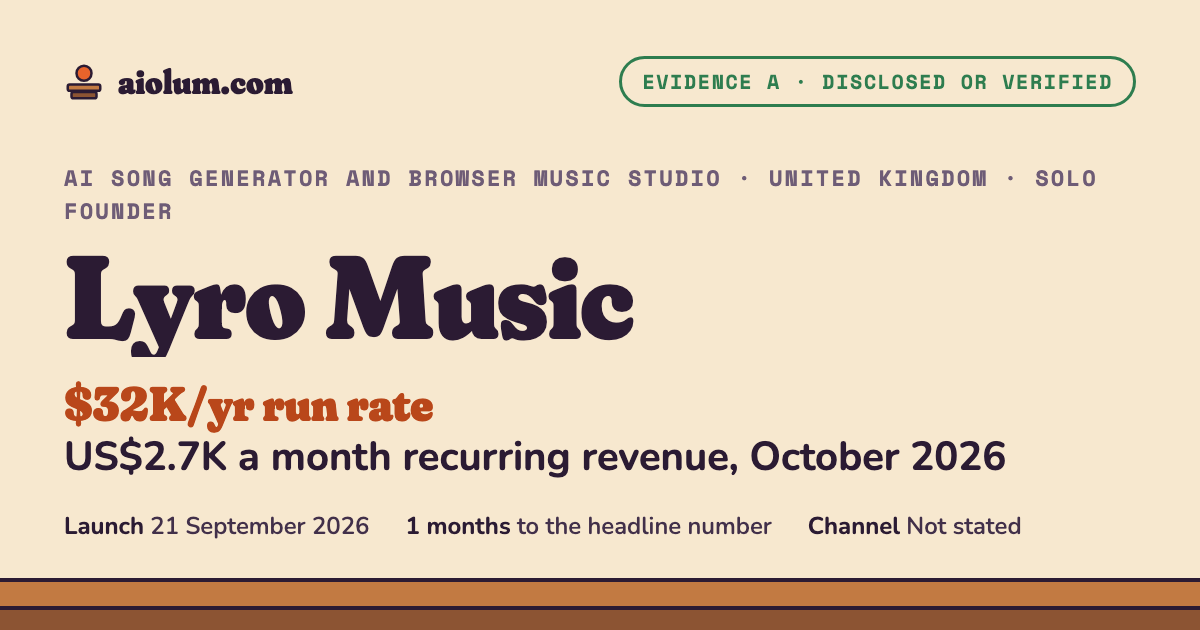
Lyro Music (AI song generator and browser music studio, United Kingdom): US$2.7K a month recurring revenue, October 2026. Evidence grade A: disclosed by a company or a filing, or verified by a payment processor. Team: 1 person on the company register (sole director, secretary and majority owner); no founder named in public. Launched 21 September 2026; still running, revenue growing.Added 25 October 2026
- Outcome
- US$2.7K a month recurring revenue, October 2026Revenue growing
- Evidence
- A disclosed by a company or a filing, or verified by a payment processor
- Launch
- 21 September 2026
- Status
- Still running
- Team
- 1 person on the company register (sole director, secretary and majority owner); no founder named in public
- Outside funding
- None found
- Group
- Voice and audio
- Main channel
- Not stated
Lyro Music is an AI song generator: a program in which a machine-learning model writes and sings a complete song, with instruments and vocals, from a text description. You can also start from your own audio. Lyro sings your lyrics over a beat you upload, or writes a beat around a vocal you recorded, and its studio separates a track into stems, the separate audio tracks for vocals, drums, bass and other parts. Its terms of service say that its two song models, Lyro High and Lyro Extra, are "models from Google" reached through fal.ai, a company that hosts AI models behind an API (an interface that lets one program call another over the internet), and that the tools for your own audio use the open-source ACE-Step model. Mixing and mastering run in the browser.
The business is RNIFY Limited, a private company registered in England and Wales on 29 September 2025. The Companies House register lists one person as its only director, its company secretary and the owner of 75% or more of the shares. That person lives in Turkey and is not named on the product's site, so this page does not name him. The founder-written TrustMRR profile gives 21 September 2026 as the founding date. On 25 October 2026 TrustMRR, which reads revenue directly from the company's Stripe account through an API key, showed US$2,686 in MRR (monthly recurring revenue, the monthly value of all active subscriptions), 154 active subscriptions, US$2,027 of revenue in the last 30 days and US$2,051 since the start. The profile also shows the business listed for sale since 14 October 2026 with an asking price of US$50,000.
The money figures are grade A: a payment processor's records, read by a third party. They cover only five weeks, and almost all of the revenue is first-month subscription payments, so no source yet shows how many customers renew. The page also shows four earlier companies that promised to let anyone make music without skill or without a studio, and what killed them.
How much revenue does Lyro Music make?
Each row shows the evidence grade and the source numbers from the list at the end of this page. The grades are explained in How Aiolum verifies.
| Fact | Value | Grade | How we know | Sources |
|---|---|---|---|---|
| Monthly recurring revenue, 25 October 2026 | US$2,686 | A | TrustMRR metric snapshot, from Stripe through an API key; revenue last synced 25 October 2026. | [1] |
| Active subscriptions, 25 October 2026 | 154 | A | TrustMRR metric snapshot, from Stripe. | [1] |
| Revenue in the last 30 days, to 25 October 2026 | US$2,027 | A | TrustMRR verified revenue, from Stripe. The profile shows this as +8,346.4% compared with the 30 days before. | [1] |
| Revenue since the start, to 25 October 2026 | US$2,051 | A | TrustMRR verified revenue: US$164 in September 2026 and US$1,887 in October 2026 to the 25th. | [1] |
| Largest day of revenue in the last 30 days | US$142, on 10 October 2026 | A | TrustMRR daily table, from Stripe. Every day from 26 September to 24 October has revenue between US$3 and US$142, so the total is many small subscription payments, not one or two large sales. | [1] |
| Run rate from the MRR | US$32,232 a year | calc | Calculated: US$2,686 times 12. This is the headline number on this page. | [1] |
| Average MRR per active subscription | about US$17.44 | calc | Calculated: US$2,686 divided by 154. It lies between the Starter price of US$14 and the Creator price of US$24. | [1, 3] |
| MRR about 30 days earlier | about US$54 | calc | Calculated from the profile's 30-day MRR growth of +4,874.1%: US$2,686 divided by 49.741. | [1] |
| Asking price for the business | US$50,000, listed for sale since 14 October 2026 | C | Seller's listing on TrustMRR. The profile shows a revenue multiple of 2.1x and 4 offers received. The seller wrote: "I want to make my first exit, nothing else." | [1] |
| Profit margin, last 30 days | 95.0% | C | Shown in the profile's metric snapshots, outside its Verification Sources section, so not verified. Every generation costs the company money at the model provider, which makes this margin hard to judge from outside. | [1, 3] |
| Visitors and Google search impressions, last 30 days | 647 visitors; 7,209 search impressions | C | TrustMRR snapshots. Google Search Console is connected; Google Analytics and DataFast are not, so the source of the visitor count is not stated. | [1] |
| Users | 1,075 (founder's estimate on TrustMRR); "2,000+ creators" (home page) | C | Two company statements that do not agree. Neither is verified. | [1, 2] |
| Company behind the product | RNIFY Limited, registered in England and Wales on 29 September 2025 | A | Companies House register; the site's about page and terms of service name the same company and number. Nature of business: business and domestic software development. | [9, 4, 5] |
| People on the company register | 1 person: sole director, company secretary and owner of 75% or more of the shares | A | Companies House officers and persons-with-significant-control pages, read 25 October 2026. The person lives in Turkey. No employees are named anywhere. | [10, 11] |
| Outside funding | none found | A | The register shows one person with 75% or more of the shares and voting rights; no source mentions investors. | [11] |
| AI models used | two Google music models through fal.ai, and the open-source ACE-Step model for work on your own audio | C | Terms of service, last updated 19 October 2026. The site sells the Google models under its own names, Lyro High and Lyro Extra. | [5] |
| Time from the founding date to the MRR figure | 1 month (34 days) | calc | Calculated: 21 September 2026, the founding date on the profile, to 25 October 2026. | [1] |
How to read this table: a grade A value was read by TrustMRR from the company's Stripe account through an API key, or is an entry in the UK company register. A grade C value is the company's own statement on its site or in the founder-written parts of the TrustMRR profile. A "calc" value was computed on this page from the rows above it.
| Plan | Per month, billed yearly (US$) | Per month, billed monthly (US$) | Limit |
|---|---|---|---|
| Starter | 14 | 80 credits, about 20 songs on Lyro High; own vocal or beat; commercial licence | |
| Creator | 24 | 300 credits, about 75 songs on Lyro High; stem splitter; 3 songs at once | |
| Teams and Ads | custom | custom | credits sized to volume, invoice billing |
| Top-up, 20 credits | 15 one-time | about 5 songs; subscribers only | |
| Top-up, 40 credits | 25 one-time | about 10 songs | |
| Top-up, 100 credits | 58 one-time | about 25 songs |
Both plans are billed monthly at one regular price; the pricing page lists no yearly price, although the terms describe a yearly offer shown once in the app after a purchase. A song on the default model Lyro High costs 4 credits, on Lyro Extra 5 credits. Plan credits carry over for one month. Top-up packs are one-time purchases for subscribers and never expire. There is no free plan or free trial. In the iPhone app, Apple sells the plans at its own, higher prices.
When did Lyro Music launch, and how did it grow?
From a company registration in September 2025 to a product with 154 paying subscriptions and a for-sale listing, in about five weeks of selling. Each entry carries its grade.
- 29 September 2025ARNIFY Limited is registered in England and Wales, with one person as director, secretary and majority owner. [9, 10, 11]
- 21 September 2026CFounding date on the TrustMRR profile. The same day, the company runs a small blind listening test (one rater, seven Turkish-language briefs, three models) to choose its default model. [1, 4, 8]
- 24 September 2026CLyro Extra, a second Google model with richer arrangements by its provider's account, is added next to the default Lyro High. [4]
- September 2026AUS$164 of verified revenue in the first month. [1]
- 14 October 2026CThe business is listed for sale on TrustMRR with an asking price of US$50,000. [1]
- 19 October 2026CThe terms of service are updated; they name fal.ai, Google and ACE-Step as the model sources and Stripe as the payment provider. [5]
- 25 October 2026ATrustMRR shows US$2,686 in MRR, 154 active subscriptions and US$2,027 of revenue in the last 30 days, from Stripe. [1]
Why did Lyro Music work?
Four causes, in the order they mattered. Each one is a reusable lesson.
Rented models, sold as one studio
Lyro does not train a music model. Its terms say that its two song models are Google models reached through fal.ai, and that the tools for your own audio use the open-source ACE-Step model. What it builds is the layer around them: a prompt writer, a credit price, a mixer and mastering tool in the browser, and one place to start from a description, lyrics, a vocal or a beat. When a better model appears, the about page says, it tests the model and changes the line-up.
No free plan, priced from the cost of each song
Every generation costs the company money at the model provider, so the pricing page says there is no free plan and no free trial. The Starter plan is US$14 a month for 80 credits and a song costs 4 or 5 credits. Failed generations refund their credits automatically. The TrustMRR profile shows that 154 people paid for a subscription in the first five weeks.
Your own vocal or beat on every plan
Many AI song tools start only from a text prompt. Lyro sells starting from a producer's own audio, on the cheapest plan: vocals over your beat, a beat around your vocal, and stem separation on the Creator plan. The home page says your vocal or beat is never altered.
Rules written into the product
The acceptable use policy bans cloning a real person's voice without documented consent and naming a real artist as a style target, and every download carries a tag that declares it AI-generated. The site's guides explain the platforms' rules on AI music. This lowers the risk that distributors or the model providers close the account.
How it was built
These details come from the company's own site, its terms of service and the founder-written parts of the TrustMRR profile. They are grade C, except the Stripe connection, which TrustMRR confirms. [5, 1, 4, 3, 12]
- Song generation: two Google music models through fal.ai, sold as Lyro High (4 credits a song) and Lyro Extra (5 credits a song).
- Work on the customer's own audio, such as a beat around a vocal or stem separation: the open-source ACE-Step model.
- Mixing, mastering and tempo and key detection run in the browser.
- Hosting on Cloudflare Workers, and billing with Stripe, by the founder's description on TrustMRR. Stripe is the payment provider that TrustMRR reads.
- A web app in 11 languages, and a Lyro app for iPhone in which Apple sells the plans.
- A creator programme gives TikTok, Instagram and YouTube creators credits and an invite link; no source says how many customers came from it.
Tools named in the sources
Each one opens its page in the Tools tab, with every story that uses it.
Who tried this before Lyro Music, and why did they fail?
Four companies in the Loot Drop database promised to let people make, remix or share music without skill, gear or a label, and failed. The values below are from that database and are not independently verified.
Jamglue
The promiseRemix music in the browser and become a bedroom producer without expensive gear.
Why it diedAudio processing in a browser was too hard for the time, licensing user remixes was costly, and SoundCloud took the users.
Magic Instruments
The promiseA digital guitar with buttons and lights, so you can play songs without knowing a chord.
Why it diedHigh hardware costs, and cheaper music apps taught people to play without a special instrument.
Mixwit
The promiseMake and share digital mixtapes.
Why it diedRights holders sent cease-and-desist letters, licences could not be agreed, and Spotify arrived.
Mint Songs
The promiseMusicians sell their songs as NFTs and earn outside the music industry.
Why it diedThe NFT market fell in 2022, and few artists or fans wanted songs as speculative assets.
The failed startups come from Loot Drop, a free database of dead startups, retold here in our own words. Loot Drop describes its entries as AI-assisted summaries of public sources, so these cards carry no evidence grade.
What changed
Jamglue and Magic Instruments both tried to remove the skill needed to make music, and both hit a technical wall: browser audio was too weak in 2008, and a special guitar cost too much to build. Mixwit and Jamglue also hit the rights wall, because their products were built on other people's recordings. Mint Songs bet on a payment model that buyers left.
Lyro avoids the technical wall because the hard part, a model that sings and produces a full song, is now rented from Google through fal.ai, and the browser can mix and master. It is built to avoid the rights wall: the output is new audio, the acceptable use policy bans other people's voices and artist names as styles, and every file is labelled as AI-made. It charges a subscription from the first song. What it has not shown yet, after five weeks, is whether customers keep paying.
Can one person copy Lyro Music now?
Yes, and the barrier to copying is low.
Lyro is a product layer over models that anyone can rent through fal.ai. A single person built a paid studio with clear prices, rules and a mixer, and TrustMRR shows that 154 subscriptions followed within five weeks. The same low barrier means that competitors can do the same, and the model provider sets both the quality and the cost of each song.
Where it is still open: Other model types sold by API through hosts like fal.ai: sound effects, podcast intros, voice-overs with licensed voices, and jingles for small businesses.
- 1Pick a model category that a hosting service such as fal.ai offers by API, and test the models blind for your main use case.
- 2Price in credits that match the model cost of each output, and refund failed generations automatically.
- 3Sell starting points that a text prompt alone does not cover, such as the customer's own vocal or beat.
- 4Write the rules on consent, artist names and AI labels into the product before a distributor or provider asks.
What could go wrong for Lyro Music?
The risks are the mirror image of the causes above.
Five weeks of data
TrustMRR shows US$164 of revenue in September 2026 and US$1,887 in October to the 25th. Most of the 154 subscriptions are in their first month, so no source yet shows how many renew, and the MRR of US$2,686 is a snapshot, not a trend. The terms of service also mention a lower first-month price for some new accounts.
Listed for sale one month after launch
The business has been for sale on TrustMRR since 14 October 2026 at US$50,000. The seller wrote that the goal is a first exit. A buyer would take over a product whose models, quality and cost depend on Google and fal.ai.
Owner not named in public
The site, terms and register name the company, RNIFY Limited, and the register lists one person as director and majority owner, who lives in Turkey. No source names a founder in public, so the team size rests on the register: one officer and no named staff.
Numbers that do not agree
The home page says "2,000+ creators"; the founder's estimate on TrustMRR is 1,075 users. TrustMRR shows 647 visitors in 30 days next to 154 active subscriptions, which would be an unusually high share of paying visitors; the visitor count does not come from a connected analytics source. The 95.0% profit margin is not verified, although each song costs the company money at the model provider.
Rented models and unsettled law
Google's and fal.ai's usage policies are part of Lyro's terms, and the terms say a change in a provider's policy may change what Lyro allows. The about page says the law on AI music is not yet settled, and the home page says that some distributors do not accept AI music.
Sources
The grade next to each source is the best grade that the source can support. "Read in full" means that the text of the page was downloaded and the numbers were checked in it.
- A TrustMRR markdown profile: Lyro, revenue synced 25 October 2026Read the markdown profile in full on 25 October 2026, twice (the second read returned the same cached snapshot). The revenue, MRR, subscription and daily figures are in its Verification Sources and revenue sections, read from Stripe through an API key. The description, founding date, user estimate, profit margin, visitor count, tech stack and seller message are founder-written or unexplained and are treated as grade C.
- C Lyro Music home pageRead in full on 25 October 2026. Source for the product description, the company name, the user claim and the statement that Lyro has no voice cloning.
- C Lyro pricing: plans, credits and what a song costsRead in full. Source for the plans, the credit costs, the top-up packs and the iPhone app pricing.
- C About Lyro Music and RNIFY Limited, the company behind itRead in full. Source for the company, the two models, the listening test and the date Lyro Extra was added.
- C Lyro Music terms of service, last updated 19 October 2026Read the sections on who the company is, payment, the iPhone app, acceptable use and model providers. Source for fal.ai, the Google models, ACE-Step and Stripe.
- C Lyro Music acceptable use policyRead in full. Source for the ban on cloning real voices without documented consent and on naming real artists as style targets.
- C Lyro Music guide: how to make music like an artist without naming themRead in full. Source for how the product handles artist names in prompts.
- C Lyro Music llms.txt, the site's summary for AI assistantsRead the summary at the top. Source for the company number and the model credit costs.
- A Companies House: RNIFY LIMITED (16749515), company overviewRead in full on 25 October 2026. Source for the incorporation date, status, company type and nature of business. The site has no robots.txt.
- A Companies House: RNIFY LIMITED, officersRead in full. One person holds both officer roles. The name is not used on this page because the person is not a public face of the business.
- A Companies House: RNIFY LIMITED, persons with significant controlRead in full. One person with 75% or more of the shares and voting rights.
- C Lyro Music creator programme pageRead in full. Source for the creator programme with credits and invite links.
- C Loot Drop database export, 1,749 failed startupsLocal export. AI-written summaries, not independently verified. Source for the failed predecessors.