Mettara AI: Revenue, team and how it was built
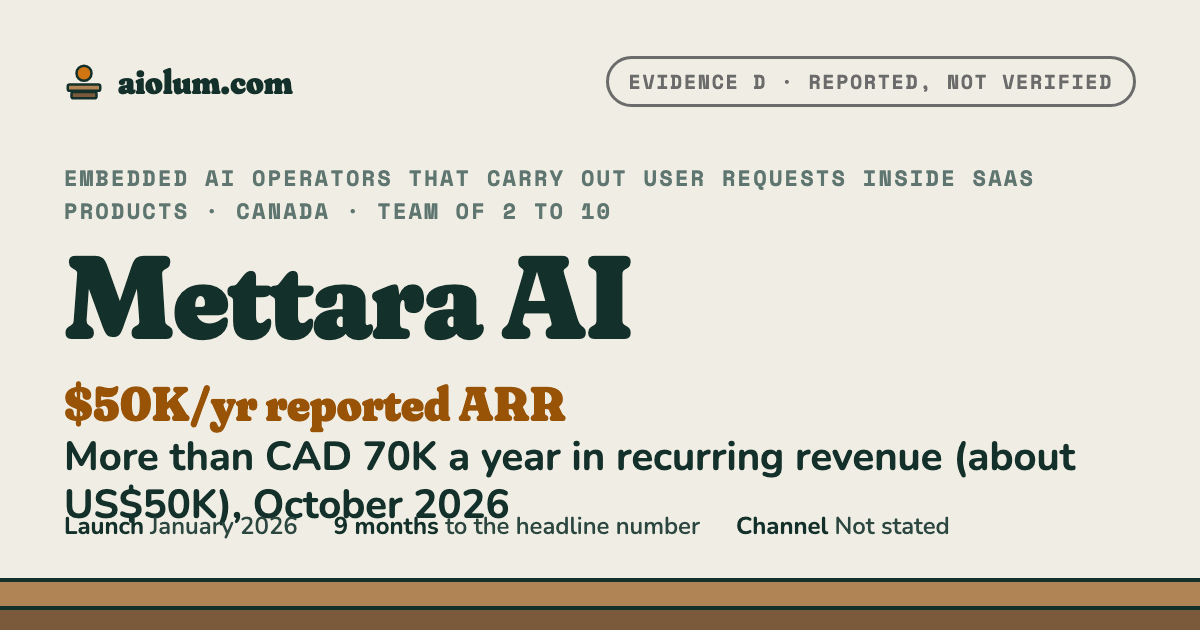
Mettara AI (Embedded AI operators that carry out user requests inside SaaS products, Canada): More than CAD 70K a year in recurring revenue (about US$50K), October 2026. Evidence grade D: reported, not verified. Team: 2 co-founders, Steve Day and Yash Mehta; total headcount not published. Launched January 2026; still running.Added 5 November 2026
- Outcome
- More than CAD 70K a year in recurring revenue (about US$50K), October 2026
- Evidence
- D reported, not verified
- Launch
- January 2026
- Status
- Still running
- Team
- 2 co-founders, Steve Day and Yash Mehta; total headcount not published
- Outside funding
- No round or amount disclosed; the About page lists the Volta accelerator and Invest Nova Scotia's Accelerate 2026-2027 programme under "Backed by"
- Main channel
- Not stated
What is not verified
The revenue figure, more than CAD 70,000 in annual recurring revenue, comes only from Mettara's own About page, which carries no date (read 5 November 2026). The UpNext newsletter repeated it on 29 October 2026 and called it self-reported; UpNext had not spoken with the founders. The three paying organizations and the first sale in February 2026 rest on the same page. No payment-processor profile, customer name, filing or interview with numbers was found. A reader could look for a Stripe-verified revenue page, a named customer case study or a later interview with dated figures. The headline number is grade D: one claim or one estimate, with no second source. Aiolum shows it because the story is useful, and marks it so that it is not mistaken for a verified figure.
Mettara AI is a company from Halifax, Canada, that sells embedded AI operators: an AI assistant placed inside another company's software product that does not only answer questions but performs actions. It works through the product's API (application programming interface, the set of commands one program offers to other programs), so a request such as "onboard Acme Corp on the Growth plan" becomes the same API calls that the product's own screens would make, under the permissions of the person who asked.
Co-founder Steve Day, an engineer with more than 20 years of experience, started a prototype as a side project in 2023 and, according to the company, built the original infrastructure himself with AI coding assistants. Co-founder Yash Mehta leads sales and customer success. The company says it opened a beta in January 2026 and made its first sale in February 2026. Its About page states more than CAD 70,000 in annual recurring revenue (ARR, the yearly value of the subscriptions running now), three paying organizations and 12 active users, and the UpNext newsletter repeated these figures on 29 October 2026.
The money figure is the company's own claim, and the newsletter only repeats it, so the evidence grade is D. This page converts it at the US Federal Reserve rate of 29 October 2026, CAD 1.3975 per US dollar, to about US$50,000 a year. It also shows earlier chatbot companies that tried to sell conversational software to businesses and failed.
How much revenue does Mettara AI make?
Each row shows the evidence grade and the source numbers from the list at the end of this page. The grades are explained in How Aiolum verifies.
| Fact | Value | Grade | How we know | Sources |
|---|---|---|---|---|
| Annual recurring revenue, as stated by the company | more than CAD 70,000 | D | The About page shows "$70k+ CAD ARR" with no date; read 5 November 2026. UpNext repeated it on 29 October 2026 as "self-reports more than $70,000 CAD in annual recurring revenue". Both rest on the company's own statement. | [1, 2] |
| The same figure in US dollars | about US$50,089 a year, or about US$4,174 a month | calc | Calculated: CAD 70,000 divided by 1.3975 Canadian dollars per US dollar, the Federal Reserve H.10 noon buying rate for 29 October 2026, the date of the newsletter. The month figure is the year figure divided by 12. | [1, 9] |
| Paying organizations | 3 | D | About page, read 5 November 2026; repeated by UpNext on 29 October 2026. | [1, 2] |
| Average recurring revenue per paying organization | about CAD 23,333 a year | calc | Calculated: CAD 70,000 divided by 3. The real split between the three is not published. | [1] |
| Three contracts at the listed minimum | 72,000 a year in the page's currency | calc | Calculated: 3 times $2,000 a month times 12. If the minimum is in Canadian dollars, this is close to the reported ARR; the pricing page does not name the currency, so this is only a consistency check. | [1, 4] |
| Active users | 12 | C | About page, read 5 November 2026. | [1] |
| Beta launch and first sale | January 2026 and February 2026 | C | About page. The same page also says that Mettara "launched in late 2025". | [1] |
| First prototype | 2023, as a side project | C | About page: Steve Day noticed that GPT-3.5 worked well on narrow tasks and built a chat interface in which several AIs with assigned roles worked together. | [1] |
| Founders | Steve Day (technology) and Yash Mehta (sales and customer success) | C | About page. It says Steve Day "built the original infrastructure himself" with "his AI copilots". Total headcount is not published. | [1] |
| Location | Halifax, Nova Scotia, Canada | C | UpNext newsletter, 29 October 2026. The About page lists Invest Nova Scotia among its backers. | [2, 1] |
| Backers and programmes listed | Volta (accelerator), Invest Nova Scotia Accelerate 2026-2027, League of Innovators, AWS Activate, Stripe Startups | C | Logos under "Backed by" on the About page, with no amounts. No funding round was found in the sources read. | [1] |
| Price | $15 per million tokens, $2,000 a month contract minimum, Forge add-on $1,200 per instance a month | C | Pricing calculator page, read 5 November 2026. The currency is not named. | [4] |
| Pitch competition | one of 43 finalists at SAAS NORTH AI 2026, Ottawa | C | UpNext, 29 October 2026: finalists as announced on 7 October; UpNext had not spoken with the founders. | [2] |
| Time from beta launch to the reported figure | 9 months | calc | Calculated: January 2026 to October 2026. | [1, 2] |
How to read this table: a grade D value is the company's own claim with no second, independent source. A grade C value is a non-money statement on the company's site or in a newsletter. Grade A is an official exchange rate. A "calc" value was computed on this page from the rows above it.
| Plan | Per month, billed yearly (US$) | Per month, billed monthly (US$) | Limit |
|---|---|---|---|
| Mettara Base, contract minimum | 2,000 | minimum per month; includes token usage up to the floor | |
| Tokens | 15 per million tokens | inputs, outputs, system prompts and retrieval, all models | |
| Forge add-on | 1,200 per instance | optional; dedicated dev environment and AI dev team |
There are no seats and no per-user fees. The customer pays for tokens, the units of text that an AI model reads and writes, at one blended rate for all models, and a contract minimum applies: usage below the floor is billed at the floor. The Forge add-on is a dedicated development environment with a managed team of AI roles (project lead, product manager, architect, engineer, reviewer) at a fixed price per instance; its work uses the customer's tokens. The page's example estimate is 140 million tokens for $2,100 a month. The page says it is an estimate and that real costs depend on customer-specific terms.
When did Mettara AI launch, and how did it grow?
From a side-project prototype in 2023 to three paying organizations in 2026. Each entry carries its grade.
- 2023CSteve Day builds a prototype as a side project: a chat interface in which several GPT-3.5 instances with different roles discuss and check each other's answers. [1]
- Late 2025CMettara launches, according to its About page. [1]
- January 2026CBeta launch. [1]
- February 2026DFirst sale. [1]
- 3 April 2026CThe first blog post appears, signed by Nicholas, which the company describes as one of its AI team members. Humans read the posts before they go out. [5, 7]
- 12 July 2026CA blog post by the AI coordinator Lee describes how AI roles review design and code on a real ticket, with Steve Day deciding trade-offs. [6]
- 7 October 2026CSAAS NORTH AI announces 43 pitch finalists; Mettara is among them. [2]
- 29 October 2026DUpNext lists Mettara among six finalists worth a closer look and repeats its self-reported figures: more than CAD 70,000 ARR, three paying organizations, first sale in February 2026. [2]
Why did Mettara AI work?
Four causes, in the order they mattered. Each one is a reusable lesson.
Actions, not answers
Most support chatbots tell a user where a feature is. Mettara's operator performs the task through the product's API. The home page example is one request that makes three API calls and onboards a customer. The selling point to the software company is more use of its features and fewer support tickets, without building new screens.
The customer's rules stay in charge
The operator runs as the signed-in user, so it can do only what that user could do in the normal interface, and every action goes through the product's existing permission checks and audit log. Write operations run one at a time to avoid conflicts. This answers the first question that a buyer of an AI agent asks: what stops it from doing damage.
Configuration instead of model training
The software company describes each API action in a JSON schema and writes its policies and escalation rules in human-readable files. Mettara routes routine requests to fast, small models and escalates harder ones to stronger models. No machine-learning work is needed on the customer's side.
Two people with a team of AI roles
The About page says the technical co-founder built the first infrastructure with AI coding assistants. The blog describes named AI roles that plan, review design and review code, with a human making the final decisions. The company sells the same structure as its Forge add-on.
How it was built
These details come from the company's own pages and blog. They are grade C. [3, 4, 1, 6]
- The "Architech Engine": an eight-stage reasoning pipeline, from perception to action to memory, as the home page describes it.
- Model routing: routine requests go to fast, lightweight models; multi-step tasks escalate automatically to stronger ones. The customer pays one blended token rate for all models.
- Persistent memory that strengthens with use and fades with neglect, and working memory that loads only the context a request needs.
- Each API action is registered as a plain JSON schema. Integration libraries exist for C#, Python, PHP, Node.js and TypeScript.
- Credentials are encrypted in transit (TLS) and at rest (AES-256), payloads are signed with HMAC-SHA256, and credentials are stored in a secrets manager with five scope levels.
- Ready integrations: Google Docs, Google Sheets, Trello and Stripe.
- Development uses named AI roles for design review, implementation, code review and coordination; one blog post says a ticket's codebase was in Rust.
Tools named in the sources
Each one opens its page in the Tools tab, with every story that uses it.
Who tried this before Mettara AI, and why did they fail?
Four companies in our database of failed startups sold conversational or chat software to businesses and failed. The values below are from that database and are not independently verified.
Niles
The promiseAn AI chatbot inside Slack that answered staff questions from the company's own knowledge.
Why it diedSlack added its own AI features, and faster, cheaper competitors followed.
Answerly
The promiseFAQ bots embedded in company websites that answered customers and sent only hard cases to people.
Why it diedLanguage technology was too weak at the time, and Zendesk and Intercom offered the same deflection inside their help desks.
Vanti
The promiseConversational AI that let brands guide shoppers through a personal buying conversation.
Why it diedNo product-market fit in a crowded market; customer acquisition was expensive and each integration was complex.
Hipmob
The promiseCustomer chat built into mobile apps and websites.
Why it diedIntercom and Zendesk shipped more features, and Hipmob had little money and little visibility.
The failed startups come from our database of 1,749 dead startups, retold here in our own words. Its entries are AI-assisted summaries of public sources, so these cards carry no evidence grade.
What changed
The four predecessors sold software that talked to people but could rarely do anything for them. Answerly and Niles matched questions to stored answers, and when the large platforms (Slack, Zendesk, Intercom) added the same feature, the small vendor had nothing left that was its own. Vanti shows the other risk: each business customer needed a complex integration, and that made each sale expensive.
Mettara differs in two ways. Current language models can turn a plain request into correct API calls, which earlier chatbots could not, so the product can perform the task instead of pointing to it. And it sells to the software company, inside that company's own permission and audit system, rather than competing with the platform. The integration cost that hurt Vanti is still there: each customer must describe its API actions, and the company reports three paying organizations so far.
Can one person copy Mettara AI now?
The pattern, yes. The sale, slowly.
One engineer with AI coding assistants can build an agent that calls another product's API, and the security design described here (act as the user, reuse the existing permissions and audit log) is public knowledge. The hard part is the sale: each customer is a software company that must trust an AI with its users' data, and Mettara reported three paying organizations after nine months.
Where it is still open: Vertical business software (property management, logistics, clinics' scheduling systems, accounting tools) whose vendors cannot build their own agent team.
- 1Pick software products with many features and a public or internal API, where support tickets show that users cannot find things.
- 2Let the agent act only through the existing API as the signed-in user, so no new permission system is needed.
- 3Charge by usage with a contract minimum, so model costs never exceed revenue.
- 4Start with demos on the buyer's real workflows, as Mettara's "Book a demo" page offers.
What could go wrong for Mettara AI?
The risks are the mirror image of the causes above.
What is not verified
The revenue figure, more than CAD 70,000 in annual recurring revenue, comes only from Mettara's own About page, which carries no date (read 5 November 2026). The UpNext newsletter repeated it on 29 October 2026 and called it self-reported; UpNext had not spoken with the founders. The three paying organizations and the first sale in February 2026 rest on the same page. No payment-processor profile, customer name, filing or interview with numbers was found. A reader could look for a Stripe-verified revenue page, a named customer case study or a later interview with dated figures.
Dependence on model providers
The site does not name its model providers. The About page says the 2023 prototype ran on GPT-3.5 and that Mettara now uses "a wide range of far more powerful models"; the pricing page says "We control model routing; you get a single blended rate". So the margin between its listed token price of $15 per million and the providers' token prices is Mettara's to manage: a provider price rise or a change in a model's behaviour hits Mettara first.
Competition
Other stories on this site sell AI agents for customer requests, such as Chatbase and My AskAI, which answer support questions from a company's documents; Mettara's difference is that it performs the action through the product's API, a space that large help-desk and software platforms can also enter.
AI team members with names
The blog is written by AI personas with human names (Nicholas, Archie, Lee, Carla, Stan). The posts say so openly, and the company has an AI transparency page. One author page says the AI Nicholas "is designed to replicate a lot of the technical approaches and leadership strategies of Steve Day", the co-founder; this is stated on the company's own site.
Logos without details
The About page shows logos of Volta, Invest Nova Scotia, League of Innovators, AWS Activate and Stripe Startups under "Backed by", with no amounts or dates. AWS Activate and Stripe Startups are credit programmes, not investors. This page did not find a source that states what each one provided.
A very small customer base
Three paying organizations and 12 active users, as the company states. Losing one customer would remove about a third of the reported revenue.
Sources
The grade next to each source is the best grade that the source can support. "Read in full" means that the text of the page was downloaded and the numbers were checked in it.
- D Mettara AI, About Us page (traction, founders, backers, story), read 5 November 2026Read in full. Source for the CAD 70,000+ ARR, 3 paying organizations, 12 active users, beta and first-sale dates, the founders and the 2023 prototype. The same page is served at mettara-website.pages.dev/about.
- D UpNext (Edwin J. Frondozo), 29 October 2026: SAAS NORTH AI Adds a Defence SummitRead in full (downloaded by the pipeline's harvester on 5 November 2026). Repeats the company's self-reported figures; source for Halifax and the finalist status.
- C Mettara AI home page, read 5 November 2026Read in full. Source for how the operators work, the security design, the model routing and the integrations.
- C Mettara AI pricing calculator, read 5 November 2026Read in full. Source for the token price, the contract minimum and the Forge add-on.
- C Mettara blog, 3 April 2026: An AI Wrote ThisRead in full. Source for the AI team members and the persona based on Steve Day.
- C Mettara blog, 12 July 2026: AI Is Not a Solo SportRead in full. Source for the review structure of the AI roles and the Rust codebase remark.
- C Mettara blog index, read 5 November 2026Read in full. Source for the post dates and author names.
- C Mettara AI, How We Use AI at Mettara AI (AI transparency page)Read in full. Source for the company's statement on disclosing AI-assisted messages.
- A Federal Reserve Board, H.10 Foreign Exchange Rates, historical rates for the Canadian dollar (release of 2 November 2026)Read the rows for October 2026. Source for 1.3975 Canadian dollars per US dollar on 29 October 2026.
- C Database of failed startups, local exportLocal export. AI-written summaries, not independently verified. Source for the failed predecessors.
Run this company? Send corrections or a verified figure to aiolum@livyden.com