Munito AI: Product, team and how it was built
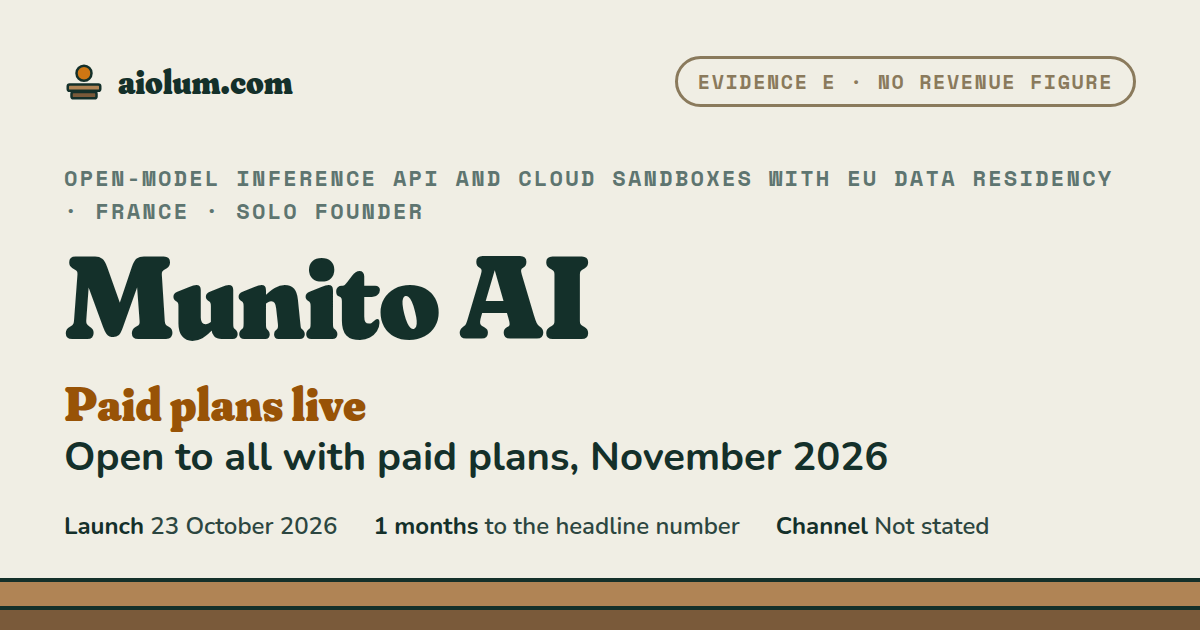
Munito AI (Open-model inference API and cloud sandboxes with EU data residency, France): Open to all with paid plans, November 2026. Evidence grade E: no revenue figure was checked. Team: 1 founder, listed as team size 1 on the Y Combinator page (Fall 2026). Launched 23 October 2026; still running.Added
- Outcome
- Open to all with paid plans, November 2026
- Evidence
- E no revenue figure was checked
- Launch
- 23 October 2026
- Status
- Still running
- Team
- 1 founder, listed as team size 1 on the Y Combinator page (Fall 2026)
- Outside funding
- Y Combinator, Fall 2026 batch; the amount is not published
- Main channel
- Not stated
What is not verified
No revenue figure was found. A payment-processor profile, a founder interview with figures, a filing and press coverage were looked for and not found. The paid plans and the prepaid-credit checkout are on the company's own pages and in its terms. No independent source confirms that a customer has paid. The founder's earlier roles at Mistral AI and Airbnb come from his own text on the Y Combinator page. The French company directory lists Munito AI France as created on 8 October 2026. The sandbox count of 32,752 and the start time of 772 milliseconds are the company's own measurements. A reader could look for a customer case study. This story is grade E: the business is real and its product, price and customers are described from public pages, but no revenue figure was checked. Aiolum shows it as an idea worth studying, not as proof that it makes money.
Munito AI is an inference provider for open models in Europe. Inference means running a trained model to answer a request; open-weight models have published parameters, such as DeepSeek, GLM and Qwen. The company sells one API for them and says that requests sent to its EU host run in EU member states. It also sells sandboxes, isolated cloud computers for AI agents.
Alexey Eryshev founded it in 2026. The Y Combinator page lists him as the only active founder, with team size 1, in the Fall 2026 batch, in Paris. He wrote there that he led inference at Mistral AI and spent five years at Airbnb. The company's legal notice names him as President of Munito AI France, a French company with share capital.
No revenue figure was found, so this story is grade E. The company's pages show a free tier, prepaid credits bought by card and sandbox plans billed each month. No independent source confirms that a customer has paid. The inference API opened to everyone on 23 October 2026, and a European gateway listed its models on 16 November 2026.
Why did Munito AI work?
Four causes, in the order they mattered. Each one is a reusable lesson.
The founder says he ran inference at a model lab first
On the Y Combinator page the founder wrote: “At Mistral, we built everything in-house, because no independent European provider could handle our scale”. He says that in Europe inference is a side product. Cloud providers sell it next to their virtual machines, and model labs sell it for their own models. No independent source confirms his earlier roles.
It makes the EU region the default and proves it in each answer
A request to the EU host runs in EU member states, the company's blog says, and the response names the region in a header. The company also says that it keeps no prompts or outputs by default. A buyer who must answer to a regulator gets a technical proof, not a promise.
It rents its GPUs, so launching needs no hardware
The company's launch post says: "We own no GPUs, and that is the point." It rents capacity across clouds and GPU markets and runs the model servers itself. The founder says that it rents GPUs across many vetted data centers and clouds. A region becomes a choice, not a building to finance.
How it was built
These details come from the company's own pages and documentation (grade C) and from the legal notice. [5, 12, 6, 7, 15]
- One API answers in two formats on one key: the OpenAI format and the Anthropic Messages format. A customer changes the base address and keeps the SDK, the company says.
- Three hosts exist: EU, US and global. The EU host runs requests in EU member states, and the response header munito-region names the region.
- The models are open-weight models of other makers. They include DeepSeek, GLM from Z.ai, Qwen, Gemma 4 for speech to text, Kolibri 1 from Aleph Alpha and an OCR model from LightOn.
- The company rents capacity across clouds and GPU markets, places the replicas and runs the model servers with a router of its own.
- Sandboxes start in about a second and bill per second. A command line tool, @munitoai/cli, starts them and runs coding agents in them.
- The legal notice says that Microsoft Azure hosts the websites in its France Central region.
Tools named in the sources
Each one opens its page in the Tools tab, with every story that uses it.
Who tried this before Munito AI, and why did they fail?
Four companies in our database of failed startups sold cloud infrastructure or a developer platform and ended. The values below are from that database and are not independently verified.
Surge Cloud
The promiseA Polish cloud provider offering a regional alternative to the large clouds, with GDPR compliance and lower prices.
Why it diedIt underestimated how much capital a cloud needs and how hard it is to move customers away from the large providers.
QingCloud
The promiseA Chinese cloud provider that sold itself as a domestic alternative to AWS and Alibaba Cloud.
Why it diedIt competed on price and scale against providers with deeper pockets, and its unit economics did not work, the record says.
Parse
The promiseA backend platform that let a mobile developer ship an app without building servers.
Why it diedFacebook bought it in 2013 and shut it down in 2017. The record calls the unit economics of its freemium model fatal.
DotCloud
The promiseA platform that let a developer deploy an application without managing servers.
Why it diedIt pivoted to Docker, the container technology that it had created, and the original platform was overshadowed.
The failed startups come from our database of 1,749 dead startups, retold here in our own words. Its entries are AI-assisted summaries of public sources, so these cards carry no evidence grade.
What changed
Each of the four sold the running of other people's software on infrastructure that someone had to pay for. Surge Cloud and QingCloud tried to beat large clouds on price or on location. The records say that capital and scale decided it, and the smaller company lost. Parse and DotCloud sold a simpler way to deploy, and a larger company absorbed or outgrew the idea.
Munito AI differs in two ways that its own pages show. It owns no GPUs, so its first cost is not a building. It also sells compliance with a rule that buyers must follow: where data is processed. Whether its margins hold against large clouds that also host open models is not shown by any source found.
Can one person copy Munito AI now?
The niche, partly. The start is hard for a newcomer.
The founder says he ran inference at a model lab before he started. One person without that background would have to learn it first. The structure carries over: rent the capacity, make a legal rule the default, and publish every price.
Where it is still open: Other buyers with a rule about where data may go: public bodies, banks and health services in other regions.
- 1Pick a rule that buyers cannot ignore, here where data is processed, and make it the default setting.
- 2Rent capacity, as the company does, instead of buying hardware.
- 3Copy an interface that buyers already use, so that they change an address and not their code.
- 4Publish every price and offer a free tier, so that a buyer can start without a sales call.
How much revenue does Munito AI make?
Each row shows the evidence grade and the source numbers from the list at the end of this page. The grades are explained in How Aiolum verifies.
| Fact | Value | Grade | How we know | Sources |
|---|---|---|---|---|
| Public launch of inference | 23 October 2026 | C | The company's blog post of that date says that Munito AI is open to everyone and that the private beta is over. | [5] |
| Earliest trace of the website | 14 September 2026 | B | The Internet Archive index lists its first capture of munito.ai on that date. It lists later captures on 26 October, 8 November and 22 November 2026. | [18] |
| Start of the company | 2026 | C | The Y Combinator page says "Founded: 2026". The French company directory lists Munito AI France, a SAS, as created on 8 October 2026, with Alexey Eryshev as President. No earlier name, product or company was found on the pages read. | [3, 15, 17, 20] |
| Founder | Alexey Eryshev | B | The Y Combinator page lists him as Founder/CEO and the only active founder. The legal notice names him as President of Munito AI France. | [3, 15] |
| Team | 1 person | C | The Y Combinator page says "Team Size: 1" and lists "Jobs 0". No team page of the company was found. | [3] |
| Funding | Backed by Y Combinator, Fall 2026 | C | The home page says "Backed by Y Combinator" and the Y Combinator page lists the Fall 2026 batch. No amount is published. | [2, 3] |
| Prices of sandbox plans, November 2026 | US$15, US$95, US$495 and US$1,995 a month | C | Munito AI's pricing page lists Starter, Pro, Scale and Fleet. Its documentation gives the same prices and says that Starter and Pro are chosen on the Billing page. | [1, 13] |
| Payment terms | prepaid credits from US$1 to US$10,000, paid by card, no refunds | C | Terms of 17 November 2026: "Paid offers are for business use only." The changelog dates the paid tiers and prepaid credits to 15 October 2026. | [16, 14] |
| Sandboxes started in one run | 32,752 at once | C | The company's blog post of 28 October 2026 says that one run started that many through the public API, from Paris. It is the company's own demonstration. | [6] |
| Listed on a European gateway | 11 models on 3 routes at Opper AI | B | Opper AI's provider page lists Munito AI as a Paris-based provider backed by Y Combinator. The company's post of 16 November 2026 announces the partnership. | [9, 8] |
| Time from launch to the gateway listing | 1 month | calc | Calculated: 23 October 2026 to 16 November 2026, which is 24 days. | [5, 8] |
| Status of security certificates | ISO 27001 and SOC 2 in progress | C | The home page and the security-research page both say that the two certificates are in progress, not obtained. | [2, 10] |
How to read this table: grade B is an independent party. Grade C is a statement by the company or the founder. Grade X was calculated on this page. No row gives revenue, because no source states it.
| Plan | Per month, billed yearly (US$) | Per month, billed monthly (US$) | Limit |
|---|---|---|---|
| Inference, free tier | 0 | On spare capacity, with daily limits on each model; needs a verified phone number | |
| Inference, pay as you go | per token | Prepaid credits paid by card; GLM-5.3-Flash on the EU host in the standard tier lists US$0.15 input and US$0.50 output per million tokens | |
| Sandboxes, trial | 0 for 7 days | 2 sandboxes at once; US$0.90 of sandbox time; needs a card | |
| Sandboxes, Starter | 15 | 50 sandboxes at once | |
| Sandboxes, Pro | 95 | 200 sandboxes at once | |
| Sandboxes, Scale | 495 | 1,000 sandboxes at once; through support during the preview | |
| Sandboxes, Fleet | 1995 | 2,000 sandboxes at once; through support during the preview | |
| Committed spend and Enterprise | custom | Order form, monthly invoice, dedicated endpoints, your own cloud or servers |
Sandbox plans are monthly and the whole plan price comes back as credits for that month. Inference is billed per million tokens from prepaid credits, with a free tier. The company's terms say that paid offers are for business use only. Scale and Fleet are sold through support during the preview.
When did Munito AI launch, and how did it grow?
From the first trace of the website in September 2026 to a listing on a European gateway in November 2026, in about two months. Each entry carries its grade.
- 14 September 2026BThe Internet Archive makes its first capture of munito.ai. The Y Combinator page gives 2026 as the founding year. [18, 3]
- 7 to 15 October 2026CThe changelog lists a higher free tier "for the launch" on 7 October, and paid tiers with prepaid credits on 15 October. On 14 October it names Munito AI France as operator and seller and publishes the legal notice. [14]
- 23 October 2026CThe company announces that inference is open to everyone and that the private beta is over. [5]
- 28 October 2026CSandboxes open as a public preview. One demonstration run starts 32,752 sandboxes at once. [6]
- 10 November 2026CCloud agents open as a public preview. One command hands a coding task to an agent that runs in its own sandbox. [7]
- 16 November 2026BFive Munito AI models become available through the Opper AI gateway, at half price there until 12 December 2026. [8, 9]
What could go wrong for Munito AI?
The risks are the mirror image of the causes above.
What is not verified
No revenue figure was found. A payment-processor profile, a founder interview with figures, a filing and press coverage were looked for and not found. The paid plans and the prepaid-credit checkout are on the company's own pages and in its terms. No independent source confirms that a customer has paid. The founder's earlier roles at Mistral AI and Airbnb come from his own text on the Y Combinator page. The French company directory lists Munito AI France as created on 8 October 2026. The sandbox count of 32,752 and the start time of 772 milliseconds are the company's own measurements. A reader could look for a customer case study.
Home page trust signals
The home page shows the badges "Zero data retention", "DPA included", "No model training", "ISO 27001 In progress" and "SOC 2 In progress", and the line "Backed by Y Combinator". The Y Combinator page confirms the last one. The other badges are the company's own statements, and the two certificates are not yet obtained. No customer logo wall, counter of users or testimonial was found on the home page or the pricing page. The company's pages "Prices compared" and "Nebius vs Munito AI" were not read.
Security research offering
The company offers two models "with the refusal direction removed", GLM-5.3-Flash and DeepSeek-V4.1-Flash-1017, "abliterated", on request. Its security-research page says: "A guarded model refuses the analysis of malware, phishing and exploit text." It says that a dedicated endpoint "is agreed in a contract, not clicked" and that it serves "authorised defensive and research work". It adds: "We do not serve a request to build or operate an attack." The documentation says that access goes to one organization at a time, "after a check of the organization and of its use". The same page says that the company runs "no human review and no content moderation" over what customers send. The security-research page lists both models as "On request"; the model documentation also lists the DeepSeek build with posted prices.
Models of other makers
The company serves open-weight models of DeepSeek, Z.ai, Alibaba's Qwen, Google, Aleph Alpha, LightOn and Perplexity. The licence terms of these models were not read here. The free tier runs "on spare capacity", with daily limits. The founder wrote that the company is "building a self-improving inference stack"; no source shows what that stack does yet.
Sources
The grade next to each source is the best grade that the source can support. "Read in full" means that the text of the page was downloaded and the numbers were checked in it.
- C Munito AI pricing pageRead in full on 23 November 2026. Source for the free tier, pay-as-you-go inference, the sandbox plans and their prices.
- C Munito AI home pageRead in full on 23 November 2026. Source for the product description, the badges, the integrations list and the line "Backed by Y Combinator".
- B Y Combinator company page: Munito AIRead in full on 23 November 2026. Source for the founder, the founding year, the team size, the batch, the location and the founder's launch post.
- C Munito AI blog indexRead in full on 23 November 2026. Source for the dates of the four posts.
- C Munito AI blog, 23 October 2026: Munito AI is live: open-model inference, run in EuropeRead in full on 23 November 2026. The company's launch post. Source for the opening to everyone, the two API formats, the regions and the rented capacity.
- C Munito AI blog, 28 October 2026: Sandboxes: a cloud computer for every agentRead in full on 23 November 2026. Source for the sandbox launch and the run of 32,752 sandboxes.
- C Munito AI blog, 10 November 2026: Cloud agents: a coding agent on a machine of its ownRead in full on 23 November 2026. Source for the cloud agents launch and the start time of 772 milliseconds.
- C Munito AI blog, 16 November 2026: Munito AI partners with Opper AIRead in full on 23 November 2026. Source for the partnership, the five models, the three tiers and the half-price offer.
- B Opper AI provider page: Munito AIRead the opening and the model table on 23 November 2026. An independent gateway's page. Source for the 11 models on 3 routes.
- C Munito AI security research pageRead in full on 23 November 2026. Source for the two models with the refusal direction removed, the contract gate and the stated limits.
- C Munito AI documentation: DeepSeek-V4.1-Flash-1017 AbliteratedRead in full on 23 November 2026. Source for the access check, the preview status and the prices of that model.
- C Munito AI documentation: ModelsRead the model list and the price tables on 23 November 2026. Source for the models served and their prices from 21 November 2026.
- C Munito AI documentation: Sandboxes pricing and limitsRead in full on 23 November 2026. Source for the plans, the trial and the sandbox sizes.
- C Munito AI documentation: ChangelogRead in full on 23 November 2026. Source for the dated changes from 7 October 2026, including the paid tiers.
- C Munito AI legal notice, last updated 13 October 2026Read in full on 23 November 2026. Source for the operating company, its form and the publication director. The address and the telephone number on the page are not repeated here.
- C Munito AI terms of service, last updated 17 November 2026Read in full on 23 November 2026. Source for the payment terms and the rule on unlawful content.
- C Munito AI privacy policy, last updated 31 October 2026Read the opening on 23 November 2026. Source for the operating company. It names no earlier company or product.
- B Internet Archive capture index for munito.aiRead on 23 November 2026. A list of five captures of the home page. The earliest is 14 September 2026; the others are of 26 October (two), 8 November and 22 November 2026. The captured pages themselves were not read.
- C Database of failed startups, local exportRecord pages read on the website on 23 November 2026. AI-written summaries, not independently verified. Source for the failed predecessors.
- B French company directory (Annuaire des entreprises): Munito AI FranceRead on 23 November 2026. The public register data of the French state. Source for the creation date of 8 October 2026, the legal form SAS and the President. The address is not repeated here.
Run this company? Send corrections or a verified figure to aiolum@livyden.com