Trellis: Revenue, team and how it was built
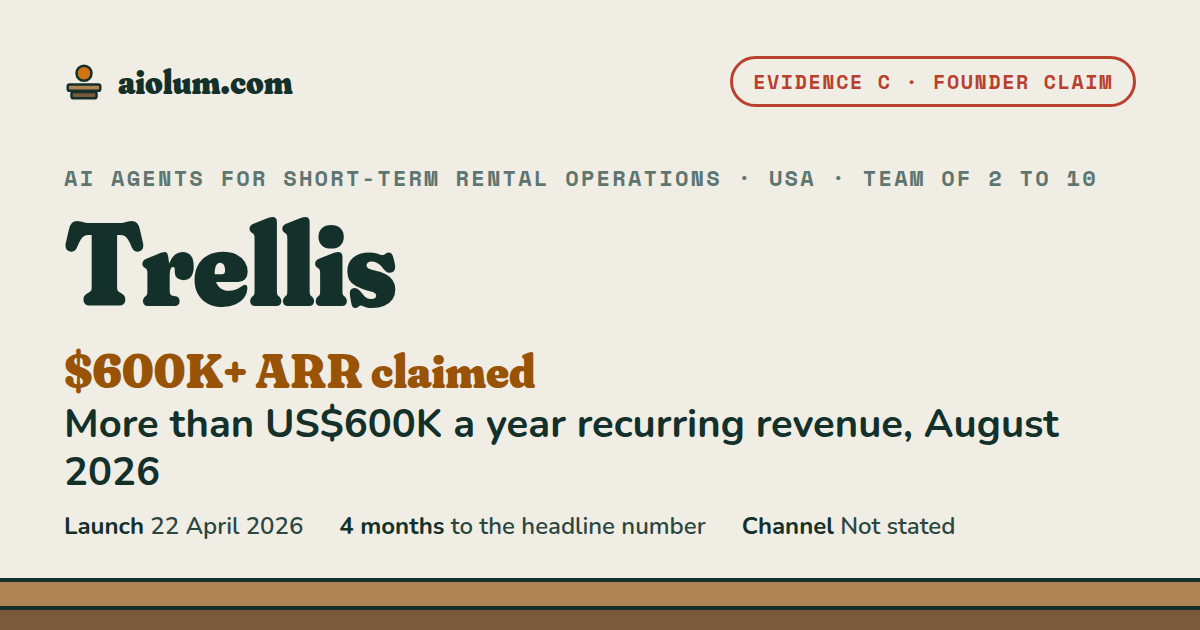
Trellis (AI agents for short-term rental operations, USA): More than US$600K a year recurring revenue, August 2026. Evidence grade C: the founder's own figures, not verified by anyone else. Team: 2 founders; the Y Combinator page listed 6 people in May 2026 and 5 in November 2026. Launched 22 April 2026; still running, revenue growing.Added
- Outcome
- More than US$600K a year recurring revenue, August 2026Revenue growing
- Evidence
- C the founder's own figures, not verified by anyone else
- Launch
- 22 April 2026
- Status
- Still running
- Team
- 2 founders; the Y Combinator page listed 6 people in May 2026 and 5 in November 2026
- Outside funding
- Y Combinator (Spring 2026) and Entrepreneurs First; amount not published
- Main channel
- Not stated
Trellis sells software to companies that manage short-term rentals. Its product is a set of AI agents: programs that use a large language model to read a message and decide what to do. They then act in other software. A guest writes that a shower is broken. The agent finds the booking, collects photos, creates a task, asks a technician to come and tells the guest and the home owner. The company says an agent drafts and hands off by default, and the operator chooses which channels run on autopilot.
Trellis Tech, Inc. was founded in February 2026 by Lodovico Benvenuti and Jan Sahagun, according to the company's own facts page. It joined the Y Combinator Spring 2026 batch and posted its launch there on 22 April 2026. The Y Combinator company page says the company grew to US$500,000 in ARR across 35 customers. ARR is annual recurring revenue: the monthly subscription revenue multiplied by twelve. On 24 August 2026 the company's facts page said ARR was more than US$600,000 across more than 45 property management companies. The price starts at US$749.99 a month and no plan can be bought without a demo call.
Every revenue and customer number on this page is a statement by the company, grade C. No payment processor, journalist or customer has confirmed it. The US$500,000 sentence on the Y Combinator page carries no date. Internet Archive copies show that it was not on that page on 21 May 2026 and was there on 8 August 2026. The Y Combinator page lists a team of 5; the company's own pages name only the two founders.
Why did Trellis work?
Four causes, in the order they mattered. Each one is a reusable lesson.
The first founder ran a 150-apartment rental business before this
The company blog post under his byline says Xenia runs 150 apartments in Milan with four employees. It says he built task, dispatch and chatbot systems for it. The Y Combinator launch post says he built AI customer service agents for short-term rentals at Conduit. The launch post says the second founder led early sales at several AI tools for property managers. Both sets of claims are the founders' own.
One flat price covers every product
The pricing page shows one plan from US$749.99 a month with no feature tiers. The price scales with the number of properties. The page says that under about 20 units the per-listing math usually wins, so it does not target single-unit hosts.
Agents draft first and earn autopilot one channel at a time
The pricing page says agents draft and escalate by default. The operator chooses which channels run on autopilot, and sensitive properties stay on suggestions only.
The agents work across messages, cleaners and maintenance together
The Y Combinator post states the problem as work spread across five to ten tools. The agent keeps the guest, property and task in one context and follows each issue until it is resolved. Customer stories on the company's customers page report fewer open maintenance tickets and faster replies. These are the company's figures.
How it was built
These details come from the company's own pages and the Y Combinator post. They are grade C, apart from the page source, which is public code. [13, 4, 5, 6]
- Language models from Anthropic, Google and OpenAI. The company's data processing addendum lists these three as the providers of large language model inference.
- Products named on the site: an AI inbox for every guest channel and an operations layer. Also workflows that the operator writes once, and a mobile app for field staff on iOS and Android.
- Connections to property management systems and booking channels. The company says it works with more than 200 tools and is a certified partner of Guesty and Hostaway.
- The company website is a Next.js application. Its page source loads files from /_next/static.
- Sales start with a demo call and white-glove onboarding. The onboarding team connects the property management system and tunes the agents with the customer.
Tools named in the sources
Each one opens its page in the Tools tab, with every story that uses it.
Who tried this before Trellis, and why did they fail?
Four companies in our database of failed startups sold lodging or home cleaning that needed people on site, and failed. The values below are from that database and are not independently verified.
Stayzilla
The promiseDigital distribution for small property owners in India, with no upfront cost.
Why it diedThe record says broken unit economics and strategic missteps during the 2015 to 2016 funding winter.
Homejoy
The promiseBook a house cleaner with a few clicks, at prices below traditional services.
Why it diedThe record says broken unit economics made the legal exposure fatal.
Zen Rooms
The promiseStandardize budget hotels in Southeast Asia with technology and operational playbooks.
Why it diedThe record says broken unit economics and premature scaling, then a pivot that destroyed the traction.
Zeus Living
The promiseFurnished apartments managed through proprietary software for stays of 30 days or more.
Why it diedThe record says unsustainable unit economics, too much capital and a market timing problem.
The failed startups come from our database of 1,749 dead startups, retold here in our own words. Its entries are AI-assisted summaries of public sources, so these cards carry no evidence grade.
What changed
All four predecessors sold a marketplace or a managed service. Each new property needed a person on site, such as a field sales visit, a cleaner or a furnished unit. The the failed-startup database records describe this in their sections on scale. Trellis sells software on a monthly plan to the company that already manages the properties.
The second difference is the price unit. Trellis charges the manager, not the guest or the owner, and the price grows with the number of properties. Whether the agents replace enough work to justify US$749.99 a month or more is not shown by any independent source.
Can one person copy Trellis now?
Partly. The software is copyable only by someone who has run rentals.
The founder's earlier business is what the company points to first. A person without a rental portfolio or sales contacts would have to find those another way. The structure is available to a person who knows one operation well. It has one flat price, agents that draft before they act, and a demo call for each customer.
Where it is still open: Other trades with many small operators and messy coordination: cleaning companies, maintenance contractors, hotel groups and small property owners' associations.
- 1Run or manage the operation yourself first, and write down each task and who does it.
- 2Build agents that draft and hand off, and turn on autopilot one channel at a time.
- 3Sell one flat plan that grows with the number of properties, and charge onboarding separately.
- 4Show named customer stories with before and after numbers, and date every counter.
How much revenue does Trellis make?
Each row shows the evidence grade and the source numbers from the list at the end of this page. The grades are explained in How Aiolum verifies.
| Fact | Value | Grade | How we know | Sources |
|---|---|---|---|---|
| Annual recurring revenue, August 2026 | more than US$600,000 | C | The company's facts page, last updated 24 August 2026: "Annual recurring revenue $600K+". No payment processor or press piece confirms it. | [1] |
| Annual recurring revenue on the Y Combinator page, no date given | US$500,000 across 35 customers and 3,000 listings | C | The Y Combinator company page says: "In two months, we've grown to $500k ARR across 35 customers and 3000 listings". The sentence has no date. It is missing from the Internet Archive copy of 21 May 2026 and present in the copy of 8 August 2026. | [2, 15, 16] |
| Customers and listings, 24 August 2026 | more than 45 companies and more than 4,000 listings | C | The company's facts page and its pricing page, both with the date 24 August 2026. | [1, 5] |
| Customers and listings on the pages read on 12 November 2026 | more than 60 companies and more than 7,000 listings | C | The home page, the about page and the customers page show these counters with no date. They are larger than the figures of August 2026. | [4, 6, 7] |
| Recurring revenue per customer, August 2026 | about US$1,111 a month | calc | Calculated: US$600,000 divided by 45 companies, divided by 12. The list price starts at US$749.99 a month. The undated Y Combinator sentence gives about US$1,190 a month (US$500,000 divided by 35, divided by 12). | [1, 2, 5] |
| Price | from US$749.99 a month, plus a one-time onboarding fee | C | The company's pricing page. One plan with every product included. The onboarding fee is quoted on a call. | [5] |
| Company start | February 2026 | C | The company's page data gives "foundingDate" 2026-02 and the facts page says "Founded February 2026". The legal name is Trellis Tech, Inc., a Delaware corporation. | [1, 4, 6] |
| Earlier use of the domain trellistech.com | for sale on a domain market in September 2024 | C | An Internet Archive copy of 12 September 2024 shows "The domain name TrellisTech.com is for sale". No product ran on that address then. | [9] |
| Team | 2 founders named; 5 people on the Y Combinator page in November 2026 | C | The Y Combinator page lists "Team Size: 5". Its Internet Archive copy of 21 May 2026 lists "Team Size: 6". The company's about page names the two founders only. | [2, 4, 15] |
| Funding | Y Combinator (Spring 2026) and Entrepreneurs First; amount not found | C | The about page says "Backed by Y Combinator Entrepreneurs First". No source gives an amount. | [2, 4] |
| Earlier business of the first founder | Xenia, a short-term rental business in Milan; first listing in August 2021, first client property in early 2022 | C | The company blog post under his byline says it manages 150 apartments with four employees and made 3 million euros in 2025. Xenia rents apartments and is a different business from Trellis Tech, Inc. The same post says he built its software systems by early 2024. | [8] |
| Earlier employer of the first founder | Conduit, called Host AI before, a Y Combinator Winter 2024 company | C | The same blog post says he joined Conduit as an employee. Conduit's own Y Combinator page lists two other founders. | [8, 11, 12] |
How to read this table. A grade C value is a statement by the company or its founders, on a page that was downloaded. A "calc" value was computed on this page from rows above it. No value is grade A or B.
| Plan | Per month, billed yearly (US$) | Per month, billed monthly (US$) | Limit |
|---|---|---|---|
| One plan, every product included | from 749.99 | scales with property count; onboarding fee extra |
The page shows one plan with every product included, from US$749.99 a month. The price scales with the number of properties. Onboarding is a separate one-time fee, quoted on a call. The page says there is no self-serve signup and that the plan is for companies with 20 to 2,000 or more units.
When did Trellis launch, and how did it grow?
From a rental business in Milan in 2021 to a Y Combinator launch in April 2026. By August 2026 the company claims US$600,000 in recurring revenue. Each entry carries its grade.
- August 2021CThe first founder lists an apartment in Milan on Airbnb. The company blog post under his byline says the rental income was higher than his rent. The post calls this the sublet that started everything. [8]
- 2024CHe asks Host AI, later called Conduit, for work. According to the same post he joins it as an employee in San Francisco after five months. [8]
- September 2024CThe domain trellistech.com is for sale on a domain market, as an Internet Archive copy of 12 September 2024 shows. [9]
- Late 2025CThe blog post says that Conduit shifted focus and that he returned to Milan. [8]
- February 2026CTrellis Tech, Inc. is founded by two people, according to the company's own facts page. [1, 4]
- 22 April 2026CLaunch post on Y Combinator. The home page of that day, as an Internet Archive copy shows, carries the button "Get started for free". [3, 10]
- 8 August 2026CAn Internet Archive copy of the Y Combinator page carries the sentence on US$500,000 in ARR, as the company states it. The copy of 21 May 2026 does not carry it. [15, 16]
- 24 August 2026CThe company's facts page gives ARR above US$600,000, more than 45 customers and more than 4,000 listings. [1]
What could go wrong for Trellis?
The risks are the mirror image of the causes above.
Self-reported figures
No outside source confirms the ARR. Both figures are the company's own statements, and the US$500,000 sentence has no date. Internet Archive copies place its first appearance between 21 May and 8 August 2026. The counters on the site rose over time. The Y Combinator page says 35 customers and 3,000 listings. The facts page of 24 August 2026 says more than 45 and 4,000. The pages read on 12 November 2026 say more than 60 and 7,000. A reader could ask for a payment processor profile.
Counters, badges and a logo wall
The pages show counters: 60+ companies, 7,000+ listings, 200+ tools, and 84.5% of guest interactions automated as of 24 August 2026. They also show a badge "Guesty + Hostaway certified partner" and a logo wall of 14 company names. No source in this story confirms the badge or says which logos are paying customers. Two logos are named Xenia, the same name as the first founder's own rental business. The figure 84.5% also appears in a sample dashboard on the home page, already in the Internet Archive copy of 22 April 2026.
Testimonials
The pricing page shows two quotations by first name only: "Ale · Heart Milan Apartments" and "Luke · Grand Welcome Gulf Coast". The about page shows a quotation signed by a named chief executive of Haven Vacation Rentals. No other source was found for these quotations, and a search for the same words under other names was not possible.
Earlier business and earlier pages
The first founder's rental business Xenia dates from 2021, and he worked at Conduit before. Trellis Tech was founded in February 2026, according to its own facts page. The launch post says Trellis now runs the rental operations with 1 person, while the blog post of January 2026 says four employees. The launch post gives that business about US$2M in revenue, and the blog post gives 3 million euros for 2025. The 22 April 2026 home page offered "Get started for free"; the pricing page now says there is no self-serve signup.
Sources
The grade next to each source is the best grade that the source can support. "Read in full" means that the text of the page was downloaded and the numbers were checked in it.
- C Trellis: company facts (Trellis AI information page), last updated 24 August 2026Read in full on 12 November 2026. Company statement. Source for the ARR above US$600,000, the customer and listing counts, the start in February 2026 and the plan price.
- C Y Combinator company page: Trellis, Agents that run short-term rental operations end-to-endRead in full on 12 November 2026. Source for the US$500,000 ARR sentence, the team size of 5 and the batch. The sentence has no date.
- C Y Combinator launch post: Trellis, Autonomous Agents for Short Term RentalsRead in full on 12 November 2026 (the data file of the post). It is dated 22 April 2026 and does not contain the ARR sentence. Source for the problem statement and for the founders' stated backgrounds.
- C Trellis: About, Built by operators, for operatorsRead in full on 12 November 2026. Source for the founders' names, the legal name, the backer line, the testimonial and the counters.
- C Trellis: PricingRead in full on 12 November 2026. Source for the price from US$749.99 a month, the onboarding fee, the 24 August 2026 counters and the two first-name testimonials.
- C Trellis: home pageRead in full on 12 November 2026. Source for the counters, the badge and the page source.
- C Trellis: CustomersRead in full on 12 November 2026. Source for the customer stories and the logo wall.
- C Trellis blog: The Story of Xenia, 19 January 2026, updated 23 August 2026Read in full on 12 November 2026. Company blog post under the first founder's byline. Source for his earlier rental business and his time at Host AI and Conduit.
- C Internet Archive copy of trellistech.com, 12 September 2024Read in full. Shows the domain for sale on a domain market. Source for the earlier state of the domain.
- C Internet Archive copy of www.trellistech.com, 22 April 2026Read in full. Source for the home page on the launch day, with the button Get started for free.
- C Y Combinator company page: Conduit, AI Agents for HospitalityRead in full on 12 November 2026. Shows the batch Winter 2024 and two founders who are not the Trellis founders.
- C Trellis blog index, read 12 November 2026Read the list of posts. One post says that HostAI is now Conduit.
- C Trellis: Data Processing AddendumRead the section on AI sub-processors. Source for the three language model providers.
- C Database of failed startups, local exportRecord pages read on the website on 12 November 2026. AI-written summaries, not independently verified. Source for the failed predecessors.
- C Internet Archive copy of the Y Combinator company page for Trellis, 21 May 2026Read in full. The page has no ARR sentence on that day and lists a team size of 6.
- C Internet Archive copy of the Y Combinator company page for Trellis, 8 August 2026Read in full. The page carries the US$500,000 ARR sentence on that day and lists a team size of 5.
Run this company? Send corrections or a verified figure to aiolum@livyden.com