PaiBox: Revenue, team and how it was built
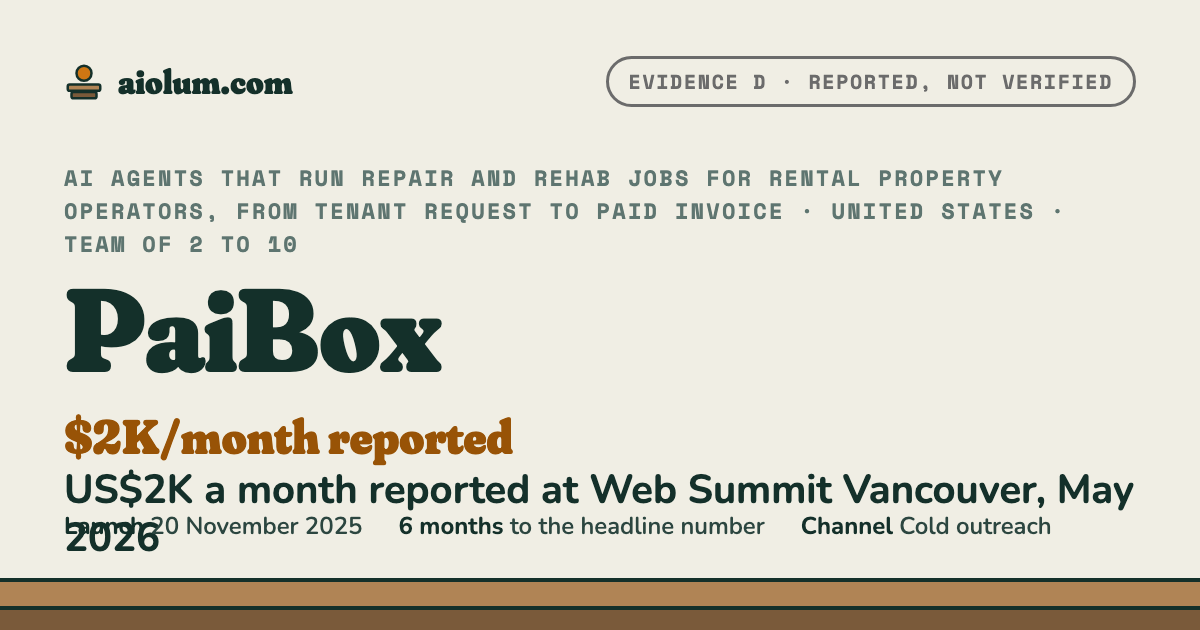
PaiBox (AI agents that run repair and rehab jobs for rental property operators, from tenant request to paid invoice, United States): US$2K a month reported at Web Summit Vancouver, May 2026. Evidence grade D: reported, not verified. Team: Founder and CEO Sherry Li plus three named team members and two advisors on the About page, November 2026; spun out of the founder's rental fund in 2025. Launched 20 November 2025; still running.Added 5 November 2026
- Outcome
- US$2K a month reported at Web Summit Vancouver, May 2026
- Evidence
- D reported, not verified
- Launch
- 20 November 2025
- Status
- Still running
- Team
- Founder and CEO Sherry Li plus three named team members and two advisors on the About page, November 2026; spun out of the founder's rental fund in 2025
- Outside funding
- None found in the sources
- Main channel
- Cold outreach
What is not verified
The headline figure of US$2,000 a month rests on one statement: UpNext's recap of the Web Summit Vancouver 2026 pitch startups, published 15 May 2026, which repeats the company's pitch. The same recap reports 5,000+ units onboarding and a 90%+ demo-to-pilot rate. No payment-processor profile, filing, investor statement or second interview was found, and the company's own press releases of December 2025 and October 2026 give no revenue. A reader could look for a later interview with a dated figure or a funding announcement. The headline number is grade D: one claim or one estimate, with no second source. Aiolum shows it because the story is useful, and marks it so that it is not mistaken for a verified figure.
PaiBox is a set of AI agents, programs that use a large language model to decide and carry out the next step of a task, for residential property maintenance. Its own pages describe it as ontology-first: an ontology here is a structured map of every state, approval and exception a repair job can have, written by people before any AI is added. Fixed rules handle the steps that the map covers, the AI agents handle steps that need judgment (reading a tenant's message, comparing three quotes written in three formats), and the system stops and asks the operator when a job falls outside the map.
Sherry Li, the founder and CEO, built the first internal tools in 2019 for the repairs in her own rental fund, according to the company's press release of December 2025. The company says the tool got an AI layer in 2024 and was spun out as a standalone company in 2025. The iPhone app's version 1.0 is dated 20 November 2025, the public launch release came on 11 December 2025, and version 2.0 left closed beta in October 2026. At Web Summit Vancouver in May 2026, the startup recap on UpNext reported that PaiBox was "onboarding 5,000+ units, generating $2K/month in revenue from paid customers".
That revenue figure is one statement from the founder's pitch, repeated by one publication, so this page grades it D. The company is small: the About page names the founder, three team members and two advisors. The page also shows earlier companies that tried to fix property maintenance and home-service coordination with software and marketplaces.
How much revenue does PaiBox make?
Each row shows the evidence grade and the source numbers from the list at the end of this page. The grades are explained in How Aiolum verifies.
| Fact | Value | Grade | How we know | Sources |
|---|---|---|---|---|
| Revenue per month, May 2026 | US$2,000 from paid customers | D | UpNext's recap of the Web Summit Vancouver 2026 pitch startups, published 15 May 2026: 'generating $2K/month in revenue from paid customers'. The figure comes from the company's pitch and no second source repeats it. | [1] |
| Run rate from the May 2026 figure | about US$24,000 a year | calc | Calculated: US$2,000 times 12. | [1] |
| Units onboarding, May 2026 | more than 5,000 | D | Same UpNext recap: 'onboarding 5,000+ units'. Onboarding means not yet live. The recap also reports a 'demo-to-pilot conversion rate' above 90%. | [1] |
| Origin | internal tool of the founder's rental fund, first prototypes in 2019 | C | Press release, 11 December 2025: prototypes in 2019, an internal system refined from 2019 to 2023, an AI agent layer from 2024. The home page says the product was built 'inside our own portfolio of 500 rental homes'. | [3, 4] |
| Standalone company | spun out in 2025 | C | Press release, 28 October 2026: 'PaiBox was spun out as a standalone company in 2025'. The legal entity in the terms of use is C-Star PaiBox Solutions Inc., New York. | [2, 7] |
| First App Store version | 1.0, 20 November 2025 | C | App Store version history. Developer: C-Star PaiBox Solutions Inc. | [6] |
| Public launch | 11 December 2025, on iOS and Android | C | Press release of that date, with pilots in Georgia and North Carolina. | [3] |
| PaiBox 2.0 out of closed beta | 28 October 2026 | C | Press release: generally available to residential property operators nationwide. | [2] |
| Team, November 2026 | founder and CEO, three named team members, two advisors | C | About page: product and go-to-market, head of finance, chief engineer, and two advisors. It says the company is based in New York with 'a diverse global team'. | [5] |
| Results reported for pilot customers | 4 times the work orders per team; 15 days to 5 from work order to invoice | C | Company claims on the home page and in the October 2026 press release. These are customer outcomes, not PaiBox revenue. | [2, 4] |
| App Store ratings, November 2026 | 2 ratings, 5.0 | C | App Store page, read 5 November 2026. Age rating 18+. | [6] |
| Outside funding | none found | C | No source read names an investor or a round. | [1, 2, 3] |
| Time from App Store launch to the May 2026 figure | 6 months | calc | Calculated: 20 November 2025 to 15 May 2026. | [1, 6] |
How to read this table: a grade D value rests on one statement that no second source repeats. A grade C value is the company's own statement on its site, app listing or press release. A "calc" value was computed on this page. No value is grade A or B.
| Plan | Per month, billed yearly (US$) | Per month, billed monthly (US$) | Limit |
|---|---|---|---|
| Platform fee, operators | not published | not published | flat fee each month |
| Fee per completed job, operators | not published | not published | charged when a job is closed out |
| PaiBox app (iPhone, iPad) | 0 | 0 | free download |
| PaiBox Pro, vendors | 0 | 0 | free to sign up and submit quotes |
The home page says: "No per-door fees", a "Flat monthly platform fee" for system and infrastructure, and a "Fee per completed job", charged only when a job is closed out. No amounts are published; operators book a demo. The terms of use refer enterprise customers to their individual sales contracts. The App Store app is free to download, and the vendor sign-up page says joining and quoting is free for vendors.
When did PaiBox launch, and how did it grow?
From an internal repair tool in a rental fund to a product sold to other operators, in about seven years. Each entry carries its grade.
- 2019CSherry Li and her team build the first internal prototypes to run repairs across the rental homes they own and manage. [3]
- 2019 to 2023CThe team refines the internal system and maps how repair and rehab jobs move: statuses, approvals, handoffs and failures. [2, 3]
- 2024CAn AI agent layer is added on top of the internal system. [3]
- 2025CPaiBox is spun out of the rental fund as a standalone company. [2]
- 20 November 2025CVersion 1.0 of the PaiBox app appears on the App Store. [6]
- 11 December 2025CPublic launch on iOS and Android, after pilots with operators in Georgia and North Carolina. [3]
- 15 May 2026DAt Web Summit Vancouver, UpNext reports US$2,000 a month from paid customers and more than 5,000 units onboarding. [1]
- 17 October 2026CApp version 2.0.0, with guided AI diagnosis of maintenance requests. [6]
- 28 October 2026CPaiBox 2.0 leaves closed beta and becomes generally available to operators across the United States. [2]
Why did PaiBox work?
Four causes, in the order they mattered. Each one is a reusable lesson.
Map first, AI second
The October 2026 press release argues that an agent that gets 97% of single steps right finishes a 20-step job correctly only about half the time (0.97 to the 20th power is 0.54). PaiBox's answer is the ontology built from years of its own repairs: fixed rules for the steps the map covers, AI only for the steps that need judgment, and a check at every handoff.
Built by the customer
The company says it built the tool inside the founder's own portfolio of about 500 rental homes. The first user was the operator who owned the problem, so the workflow was tested on real jobs before any sale.
Paid per finished job
The home page says operators pay a flat platform fee and a fee per completed job, not a fee per rental unit. That ties the bill to the work the agents finish.
Both sides in one app
Tenants, property managers and vendors use the same system. Vendors join for free, and the App Store notes say pros contacted through Thumbtack can quote PaiBox jobs directly. More vendors mean more jobs that can be filled.
How it was built
These details come from the company's site, its press releases and its App Store version history. They are grade C. [2, 4, 6, 8]
- An ontology of repair and rehab work: every job status, approval threshold, handoff and failure, written down before the AI layer was added.
- Several specialized AI agents (the app's March 2026 notes say 'multiple AI agents for smarter repair diagnosis and vendor matching'), with fixed rules for the steps that need no judgment. The assistant is called Avina.
- Operator controls: approval rules, spending limits, one-click approval, and a log of every agent action in a screen called Mission Control.
- Mobile apps for iPhone, iPad and Android, plus a vendor portal. Chat messages can be translated with AI, and price messages are hidden from tenants.
- Integration with the operator's property management system, where each job is closed out.
- No source names the large language model provider or the technology stack.
Tools named in the sources
Each one opens its page in the Tools tab, with every story that uses it.
Who tried this before PaiBox, and why did they fail?
Four companies in our database of failed startups tried to fix property operations or home-service coordination with software or a marketplace. The values below are from that database and are not independently verified.
Enzo
The promiseAn operating system for property management: maintenance coordination, vendor management and workflows for real estate operators.
Why it diedProperty managers resisted changing their workflow, and the sales and onboarding cost per customer was too high for the revenue.
Castle
The promiseOn-demand property management with software for tenant messages, maintenance requests and rent.
Why it diedHigh customer acquisition cost and the work of managing local service providers at scale, against Buildium and AppFolio.
Zaarly
The promiseA local marketplace where people posted home-service tasks and local pros bid on them.
Why it diedVetting providers city by city was manual and expensive, and TaskRabbit and Thumbtack were larger.
Opez
The promiseOn-demand booking of cleaning, landscaping and handyman work from local providers.
Why it diedIt could not balance both sides of the marketplace, and service quality varied.
The failed startups come from our database of 1,749 dead startups, retold here in our own words. Its entries are AI-assisted summaries of public sources, so these cards carry no evidence grade.
What changed
The four predecessors failed on the cost of coordination: people had to vet vendors, chase quotes and fix scheduling by hand, and each new customer or city added more of that work. Enzo sold the same promise as PaiBox, an operating system for maintenance, and its record says property managers would not change how they worked.
PaiBox's claim is that large language models can now do the messy middle steps (reading a tenant's photos, comparing quotes, following a group chat) that earlier software left to people, and that it works next to the operator's existing property management system instead of replacing it. It also sources vendors from the operator's own list first and from networks such as Thumbtack second, instead of building a new marketplace city by city. Whether that changes the economics is not yet shown: the only revenue figure is the founder's pitch statement, reported in May 2026.
Can one person copy PaiBox now?
Only with the domain. The method, yes.
The product rests on years of repair data from the founder's own rental homes, which a newcomer does not have. The method can be copied in any field with long multi-party jobs: map the workflow by hand first, let fixed rules run the known steps, and use AI agents only for the steps that need judgment.
Where it is still open: Commercial facility maintenance, insurance claim repairs, home warranty jobs, short-term rental turnovers, and construction punch lists.
- 1Pick a workflow you run yourself, with many parties and many steps, where jobs get lost.
- 2Write down every state, approval and failure before adding any AI.
- 3Let AI handle reading messages, comparing documents and following up; let rules handle the rest; stop and ask a person outside the map.
- 4Charge per finished job, so the customer pays for results.
What could go wrong for PaiBox?
The risks are the mirror image of the causes above.
What is not verified
The headline figure of US$2,000 a month rests on one statement: UpNext's recap of the Web Summit Vancouver 2026 pitch startups, published 15 May 2026, which repeats the company's pitch. The same recap reports 5,000+ units onboarding and a 90%+ demo-to-pilot rate. No payment-processor profile, filing, investor statement or second interview was found, and the company's own press releases of December 2025 and October 2026 give no revenue. A reader could look for a later interview with a dated figure or a funding announcement.
Pilot results and testimonial are the company's own
The 4x capacity, 15-to-5 days and 35% shorter rehab cycle figures on the home page are company claims about pilot customers, without a named study. The one testimonial is attributed to the head of operations at Canyon Residential; the sources do not say whether that operator is linked to the founder's own rental fund.
Origin before 2022
The internal tool dates from 2019, according to the company. It was not sold to others; the AI layer came in 2024, the company was spun out in 2025 and the app launched in November 2025. Its funding, if any, came from the founder's own business: no outside investor is named.
AI messages to vendors and tenants
The home page says the AI handles 'unanswered messages, vendor no-shows, scope changes and price negotiations', and the October 2026 release says the agents handle 'the vendor calls'. The sources do not say whether vendors and tenants are told they are talking to an AI.
Competition and dependence on providers
On this site, ProhostAI sells an AI property manager for short-term rental hosts, a near neighbour for a different kind of landlord. No source names the language model provider PaiBox uses, so its costs and quality depend on a vendor that is not disclosed; vendor sourcing beyond the operator's own list also depends on networks such as Thumbtack, which the App Store notes name.
Country
The lead came from Web Summit Vancouver in Canada, but the company's terms of use, About page and press releases place it in New York.
Sources
The grade next to each source is the best grade that the source can support. "Read in full" means that the text of the page was downloaded and the numbers were checked in it.
- D UpNext, 15 May 2026: Web Summit Vancouver 2026: Enterprise AI Deployment RecapRead the section on PaiBox. A recap of the pitch startups; the traction figures come from the company. Source for the revenue figure, the units onboarding and the conversion rate.
- C PR Newswire release, 28 October 2026: PaiBox 2.0 Launches Nationwide, Putting Property Repairs and Rehabs on Autopilot (read on Webull's news page; original at prnewswire.com/news-releases/paibox-2-0-launches-nationwide-putting-property-repairs-and-rehabs-on-autopilot-302921995.html)Read in full on Webull's copy; PR Newswire's robots.txt allows Claude agents. Company statement. Source for the spin-out year, the ontology argument, pilot results and general availability.
- C PR Newswire release, 11 December 2025: PaiBox Unveils an Agentic AI Operating System for Real Estate Operations (read on Webull's news page; original at prnewswire.com/news-releases/paibox-unveils-an-agentic-ai-operating-system-for-real-estate-operations-302639427.html)Read in full on Webull's copy. Company statement. Source for the 2019 origin, the 2024 AI layer, the pilots and the public launch.
- C PaiBox home pageRead in full, 5 November 2026. Source for the product, the fee structure, the 500-home origin and the pilot claims.
- C PaiBox About Us pageRead in full. Source for the team roles and the New York base.
- C PaiBox on the App StoreRead the description, ratings and version history. Source for the 1.0 date, the developer name, the AI features and the Thumbtack note.
- C PaiBox User License Agreement (terms of use), last updated 15 October 2026Read the sections on the parties, AI, enterprise subscribers and the copyright agent. Source for the legal entity and address.
- C PaiBox For Vendors page: Join PaiBox ProRead in full. Source for free vendor sign-up and quoting.
- C Database of failed startups, local exportLocal export. AI-written summaries, not independently verified. Source for the failed predecessors.
Run this company? Send corrections or a verified figure to aiolum@livyden.com