Pattrn: Revenue, team and how it was built
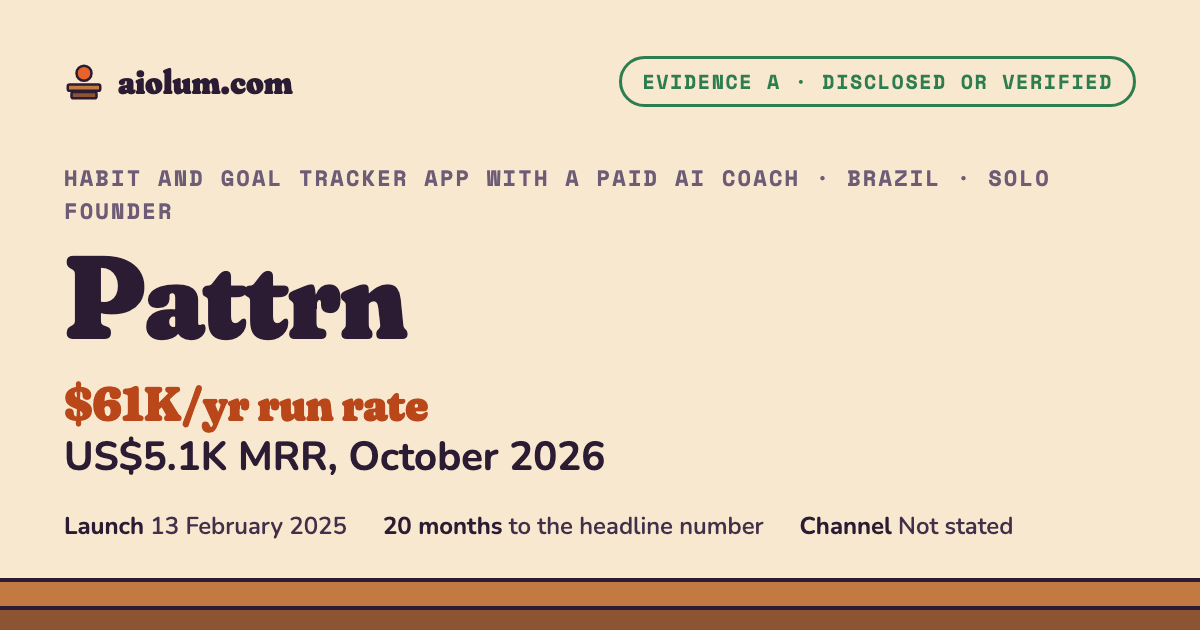
Pattrn (Habit and goal tracker app with a paid AI coach, Brazil): US$5.1K MRR, October 2026. Evidence grade A: disclosed by a company or a filing, or verified by a payment processor. Team: 1 named founder; no source gives a headcount, and the App Store seller is a Brazilian company in his name. Launched 13 February 2025; still running, revenue flat.Added 25 October 2026
- Outcome
- US$5.1K MRR, October 2026Revenue flat
- Evidence
- A disclosed by a company or a filing, or verified by a payment processor
- Launch
- 13 February 2025
- Status
- Still running
- Team
- 1 named founder; no source gives a headcount, and the App Store seller is a Brazilian company in his name
- Outside funding
- None reported
- Main channel
- Not stated
Pattrn is a habit tracker, an app in which a person records every day whether they did a planned action, such as reading 10 pages, and sees streaks and charts of that record. Pattrn links these habits to goals with a deadline and computes whether each goal is on track. Its paid plan adds an AI agent, here a chat assistant built on a language model that can read the user's habit and goal data and change it: it writes goal plans, splits goals into milestones (smaller goals on the way), and suggests a later deadline or a smaller habit when the user falls behind. The tracker itself works without AI, so this page calls the business AI-leveraged: the AI is the part that people pay for, and the site's mission page says that only AI makes advice for each person possible.
Pedro Schott, who calls himself the founder of Pattrn on its help page, released version 1.0 on 23 January 2025 and the worldwide release on 13 February 2025. On 1 October 2026, whatsthe.app, a marketplace and leaderboard for app businesses, read the app's subscription data from RevenueCat, a service that records the subscriptions that an app sells through Apple. It showed monthly recurring revenue (MRR, the subscription income of one month, with a yearly plan counted as one twelfth of its price) of US$5,077, US$9,627 of revenue in the last 28 days, and 1,509 active subscriptions. The same listing offers the app for sale at US$110,000.
The revenue figures are grade A, because whatsthe.app read them from RevenueCat and not from a screenshot. They are a single reading on a single date: no source gives an earlier figure, so the growth path is not known. No source gives the team size or says how customers find the app. The page also shows four earlier habit and self-improvement companies that failed, one of which paid human coaches for the job that Pattrn gives to a model.
How much revenue does Pattrn make?
Each row shows the evidence grade and the source numbers from the list at the end of this page. The grades are explained in How Aiolum verifies.
| Fact | Value | Grade | How we know | Sources |
|---|---|---|---|---|
| Monthly recurring revenue, 1 October 2026 | US$5,077 | A | whatsthe.app: "All data is verified through RevenueCat. Last updated: Oct 1, 2026". The page data gives 5,077.49 and the credential type "revenuecat-verified". The leaderboard data of the same site shows the same value. | [1, 2] |
| Revenue in the last 28 days, to 1 October 2026 | US$9,627 | A | Same reading. The page data gives 9,626.95. | [1, 2] |
| Run rate from the MRR | US$60,930 a year | calc | Calculated: 5,077.49 times 12 equals 60,929.88. whatsthe.app shows the same ARR. | [1] |
| Revenue compared with MRR | 1.9 times | calc | Calculated: 9,626.95 divided by 5,077.49 equals 1.90. Revenue counts the full price of a yearly or lifetime purchase when it is paid; MRR counts a yearly plan as one twelfth a month. So sales of yearly plans make revenue larger than MRR. | [1] |
| Active subscriptions, 1 October 2026 | 1,509, plus 11 active trials | A | whatsthe.app reading. Paid subscriber share 99.3%. | [1] |
| MRR per active subscription | about US$3.36 a month | calc | Calculated: 5,077.49 divided by 1,509 equals 3.365. whatsthe.app shows an ARPPU of US$3.36. | [1] |
| Customers, 28 days to 1 October 2026 | 10,449 active customers, 6,361 new customers | A | whatsthe.app reading. Calculated: 1,509 divided by 10,449 is 14.4% of active customers with a subscription, the same as the page's "Subscription Penetration". | [1] |
| Change over 28 days | MRR minus 1.5%, subscribers minus 0.5% | A | whatsthe.app reading. This page marks the trend as flat. | [1] |
| Asking price | US$110,000 | C | The whatsthe.app listing says the app is for sale, with 136 buyer views and 0 inquiries. Calculated: 1.81 times the ARR of US$60,930. The page also shows a "Claim this app" banner, and its data marks the listing as imported by the site. | [1] |
| Founder | Pedro Schott | C | The help page starts: "I'm Pedro, the founder of Pattrn." The App Store names him as developer, and whatsthe.app names him as founder with the X account @pedroschott0. | [7, 3, 1] |
| Seller on the App Store | a limited company (LTDA) in the founder's name | B | The company name ends in "TECNOLOGIA DA INFORMACAO LTDA", the Portuguese form of a Brazilian limited company. This page infers the country from it; no source states where the founder lives. | [3] |
| Team | not stated | C | Only the founder is named. Developer replies on the App Store are signed "Pattrn team", and changelog entries are signed either "The Pattrn Team" or "Pedro". | [3, 5] |
| Outside funding | none reported | C | No downloaded source mentions an investor. The whatsthe.app listing leaves its financing field empty. | [1] |
| First version | 23 January 2025 | C | Changelog: "Pattrn 1.0 ... The first version of Pattrn". whatsthe.app gives a worldwide release date of 13 February 2025, the date of version 1.01, and says business operations started in February 2025. | [5, 1] |
| Free plan and paid Pro plan | since 26 February 2025 | C | Changelog of version 1.3: the free plan tracks unlimited habits and up to two goals; Pro adds unlimited goals, AI features and milestones. | [5] |
| Releases | 83 iOS versions from 23 January 2025 to 20 October 2026 | C | Counted in the changelog. Calculated: 635 days divided by 83 is one release every 7.7 days. | [5] |
| AI models named by the company | OpenAI o3-mini, GPT-4.1 and o4-mini | C | Changelog: o3-mini in March 2025, GPT-4.1 for Pro users in April 2025, o4-mini in June 2025, and "Updated the AI model used by Pattrn" in April 2026 without a name. | [5] |
| App Store ratings, October 2026 | 4.8 from about 2,100 ratings in all countries | B | Apple's US page shows 4.8 from 1K ratings. whatsthe.app counts 2,124 ratings in 16 countries, 940 of them in the US. The app's own description says "Rated 4.9/5 by users". | [3, 1] |
| Users claimed on the home page | 25,000+ | C | Company statement, not verified. whatsthe.app counted 10,449 active customers on 1 October 2026. | [4, 1] |
| Time from the worldwide release to the headline figure | 20 months | calc | Calculated: February 2025 to October 2026. | [1] |
How to read this table: a grade A value was read by whatsthe.app from the app's RevenueCat account. A grade B value is a record that Apple shows on the App Store. A grade C value was written by the founder or the seller, on the app's own site or on the sale listing. A "calc" value was computed on this page from the rows above it.
| Plan | Per month, billed yearly (US$) | Per month, billed monthly (US$) | Limit |
|---|---|---|---|
| Free | 0 | 0 | unlimited habits, up to two goals |
| Pro, lowest yearly price | 1.67 | US$19.99 a year | |
| Pro, other yearly prices | 2.50 to 3.33 | US$29.99, US$34.99 or US$39.99 a year | |
| Pro, monthly | 4.99 or 7.99 | two monthly prices | |
| Pro, weekly | 21.62 | US$4.99 a week | |
| Lifetime | 44.99 one-time | one payment |
Apple lists nine in-app purchases for the same app: four yearly prices, two monthly prices, a weekly price and a lifetime price. No source says which users see which price. Per-month values for yearly plans are the yearly price divided by 12; the weekly value is US$4.99 times 52 divided by 12. The free plan's limits are from the changelog entry of 26 February 2025.
When did Pattrn launch, and how did it grow?
From version 1.0 in January 2025 to US$5,077 of monthly recurring revenue in October 2026, with 83 releases in between. Each entry carries its grade.
- 23 January 2025CVersion 1.0 of the iPhone app: track habits, set goals. [5]
- 13 February 2025CWorldwide release on the App Store, according to whatsthe.app. [1]
- 26 February 2025CA free plan and Pattrn Pro. Pro holds the AI features and milestones. [5]
- March 2025CThe home page calls Pattrn a "Habit Tracker & Goal Setting AI App". Version 1.5 splits the AI analysis into several specialized prompts and uses OpenAI's o3-mini model. [8, 5]
- April to June 2025CGPT-4.1 for Pro users, then o4-mini. iCloud sync arrives in April; in May the company stops offering it to new users after internal tests found possible data loss. [5]
- 14 May 2025CThe AI assistant becomes the Pattrn Agent, which learns from the user's past goals and habits. [5]
- July 2025CPortuguese and Spanish. Pattrn 2.0 on 24 July: a rebuilt design, a global leaderboard, friend competitions, a referral link that gives free Pro, and a Discord server. [5]
- 22 September 2025CAI agent chat that can plan and change anything in the app, community events and a lessons library, all for Pro. [5]
- January to February 2026CApple Health logging for Pro, and specialized agents for fitness and study. [5]
- 10 July 2026CPattrn 3.0: a daily journal, habits to stop, XP and levels. [5]
- 11 August 2026CThe app's listing is created on whatsthe.app. [2]
- 1 October 2026Awhatsthe.app reads US$5,077 of MRR, US$9,627 in 28 days and 1,509 active subscriptions from RevenueCat. The app is listed for sale at US$110,000. [1, 2]
- 20 October 2026CVersion 3.0.8: Pattrn Cloud accounts, a Mac app, and a way for Pro users to connect assistants such as Claude and ChatGPT to their habits and goals. [5, 3]
Why did Pattrn work?
Four causes, in the order they mattered. Each one is a reusable lesson.
A free tracker, a paid coach
Since February 2025 the habit tracker is free, with a limit of two goals. The paid plan sells what a human coach would do: a plan for a goal, milestones, a weekly look at the data, and a suggestion when the user slips. App Store reviewers praise both the free tracker and the AI.
Persistence: a release every 7.7 days
The changelog lists 83 iOS versions in 635 days, and new AI models arrived three times in the first six months. Most releases are small fixes; the large ones, 1.5, 1.6, 2.0 and 3.0, came every two to twelve months.
Yearly plans
whatsthe.app read US$9,627 of revenue in 28 days against US$5,077 of MRR. The difference comes from purchases paid in advance, such as yearly and lifetime plans. Cash comes in early, and each yearly buyer must renew a year later.
One founder, many small apps
The same App Store developer account publishes three other apps: a health dashboard, a calorie tracker and an AI to-do list. Pattrn is the one with public revenue.
How it was built
These details come from the company's changelog, its help page and the App Store. They are grade C, except the App Store records (grade B). [5, 7, 3, 1]
- An iPhone app first, with beta support for iPad, macOS and visionOS from March 2025 and a Mac app in October 2026. An Android version is marked as coming soon.
- OpenAI models for the AI features: o3-mini in March 2025, GPT-4.1 in April 2025, o4-mini in June 2025. The analysis is split into several specialized prompts, and the agent keeps context about the user's past goals and habits.
- Subscriptions are sold as App Store in-app purchases and recorded in RevenueCat, which whatsthe.app reads.
- Sync moved from iCloud, which the company stopped offering to new users in May 2025 because of possible data loss, to its own account system, Pattrn Cloud, in October 2026.
- Apple Health logging from January 2026, Apple Shortcuts actions, home and lock screen widgets, and a way to connect outside AI assistants.
- Community features to keep users: a global leaderboard, friend competitions, a referral link that gives free Pro, a feature suggestion board and a Discord server.
Tools named in the sources
Each one opens its page in the Tools tab, with every story that uses it.
Who tried this before Pattrn, and why did they fail?
Four companies in the Loot Drop database tried to sell better habits or personal coaching before language models could give advice to each user. The values below are from that database and are not independently verified.
Habit Labs
The promiseHealth Month, a web app in which users set personal goals and tracked them in a social game.
Why it diedIt charged for habit building while competitors offered free game-like apps.
Habitual
The promiseA habit tracker based on the book Atomic Habits, with personal feedback to keep routines going.
Why it diedThe database says the product was good but had no marketing plan in a crowded category of productivity apps.
Likebetter
The promiseSelf-improvement as a game of choices that would teach users about themselves.
Why it diedIt had no money and no clear group of users, and lost attention to Facebook.
Arivale
The promiseGenetic and blood tests plus a human wellness coach, for US$3,500 upfront and US$99 a month.
Why it diedEach coach could serve only 50 to 100 clients. The database says it spent about US$4,700 a year per customer and collected about US$1,200.
The failed startups come from Loot Drop, a free database of dead startups, retold here in our own words. Loot Drop describes its entries as AI-assisted summaries of public sources, so these cards carry no evidence grade.
What changed
The two habit trackers in this list show the two usual ways to fail: Habit Labs charged for something that free apps also did, and Habitual built a good tracker that nobody heard of. Arivale shows the other end: personal coaching that worked but needed one paid coach for every 50 to 100 clients, and lost money on each customer.
Pattrn keeps the tracker free and charges for the coaching part, which a language model does for every user at once. The founder does not hire coaches, and Apple and RevenueCat handle billing. That is how one named founder can sell a coach-like service for a few dollars a month: whatsthe.app read an MRR of about US$3.36 per active subscription. Whether Pattrn has solved Habitual's problem, finding users, the sources do not say.
Can one person copy Pattrn now?
The structure, yes. The category is crowded.
The App Store shows many similar apps next to Pattrn, such as other discipline and habit trackers, and any of them can add an AI coach with the same models. What can be copied is the structure: a free tool that people use every day, and a paid AI layer that does a job people used to pay a person for.
Where it is still open: The same free-tracker and paid-coach structure for narrower groups: students before exams, people in physical therapy, shift workers, or one sport. The narrower the group, the more specific the AI advice can be.
- 1Pick a daily activity that already has a tracker category, and make the free tracker good on its own.
- 2Put the AI in the paid plan, and make it act on the user's own data: plans, milestones, changes when the user slips.
- 3Ship small releases often and keep a public changelog.
- 4Sell yearly plans next to monthly ones, and use a subscription service such as RevenueCat so the revenue can be verified when you want to sell.
What could go wrong for Pattrn?
The risks are the mirror image of the causes above.
One reading, one date
All revenue figures come from one whatsthe.app reading of 1 October 2026. No source gives an earlier figure, so this page cannot show how fast the app grew. MRR fell 1.5% in the 28 days before the reading.
For sale
The listing asks US$110,000, about 1.8 times the yearly run rate, and showed 136 buyer views and 0 inquiries. A new owner could change the product or the prices. The page also asks the owner to claim the app, and its data marks the listing as imported by the site, so the founder has not confirmed the listing on that page.
Team and country not stated
Only Pedro Schott is named. Replies on the App Store are signed "Pattrn team". The country on this page comes from the company form of the App Store seller, not from a statement.
Unknown customer channel
whatsthe.app counted 6,361 new customers in 28 days, but no source says where they came from. The App Store privacy section says the app may use identifiers for third-party advertising, but no source says that the company buys ads.
Model costs and copies
Every Pro user's AI answers cost the company money, and no source gives that cost. The average MRR per subscription is about US$3.36. Other habit trackers can add the same models, so the AI part alone is not a lasting difference.
Sources
The grade next to each source is the best grade that the source can support. "Read in full" means that the text of the page was downloaded and the numbers were checked in it.
- A whatsthe.app listing of Pattrn, data of 1 October 2026Read in full on 25 October 2026, including the page data. Metrics "verified through RevenueCat", last updated 1 October 2026. Source for the MRR, revenue, subscriptions, customers, asking price, release date and ratings by country.
- A whatsthe.app leaderboardRead on 25 October 2026 in the lead search, including the embedded listing data. Confirms the same MRR and revenue, the founder's name, the "revenuecat-verified" credential and the listing date of 11 August 2026.
- B App Store: Pattrn - Discipline TrackerRead in full on 25 October 2026. Source for the developer and seller, the in-app purchase prices, the ratings, the description, the reviews and the version history.
- C Pattrn home pageRead in full on 25 October 2026. Source for the product description, the AI coach and the 25,000+ users claim.
- C Pattrn Updates: iOS changelog and release notesRead in full on 25 October 2026. Source for the release dates, the free and Pro plans, the AI models and the features by date.
- C Pattrn mission pageRead in full. Source for the company's reason to use AI: advice fitted to each person.
- C Pattrn help page: Getting Started with PattrnRead in full. Written by the founder. Source for the founder's name and for what Pro and the AI agent do.
- C Pattrn home page, Wayback Machine copy of 13 March 2025Read in full. Shows that the app was sold as an AI app one month after its release.
- C Loot Drop database export, 1,749 failed startupsLocal export. AI-written summaries, not independently verified. Source for the failed predecessors.