PlaylistAI: Revenue, team and how it was built
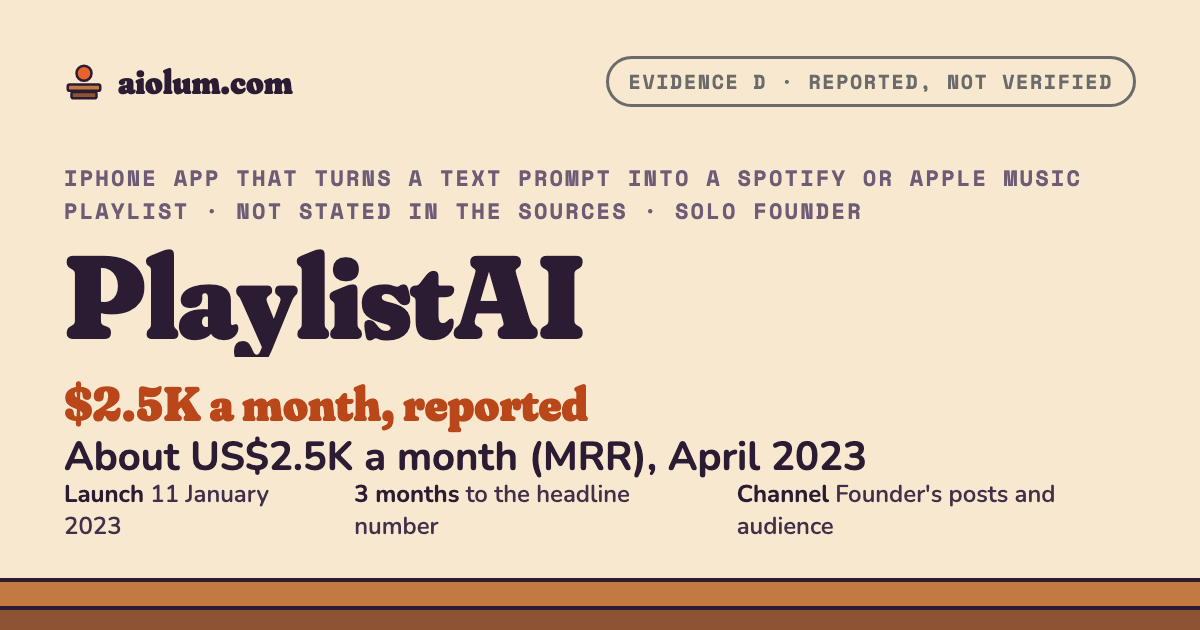
PlaylistAI (iPhone app that turns a text prompt into a Spotify or Apple Music playlist, Not stated in the sources): About US$2.5K a month (MRR), April 2023. Evidence grade D: reported, not verified. Team: 1 person: Brett Bauman, an iOS developer, who said he ran the app on the side. Launched 11 January 2023; still running.Added 26 October 2026
- Outcome
- About US$2.5K a month (MRR), April 2023
- Evidence
- D reported, not verified
- Launch
- 11 January 2023
- Status
- Still running
- Team
- 1 person: Brett Bauman, an iOS developer, who said he ran the app on the side
- Outside funding
- None reported; the App Store seller is Brett Bauman as an individual
- Group
- Voice and audio
- Main channel
- Founder's posts and audience
What is not verified
The headline figure of about US$2,500 a month in recurring revenue rests on one Hacker News comment that the founder, Brett Bauman (user bbauman), posted on 14 April 2023, together with his statement that the first US$2,000 came in two weeks. No payment processor, buyer or journalist has confirmed it, we found no TrustMRR profile among the 11,412 slugs that site lists, and no later figure exists. A reader could look for a RevenueCat or TrustMRR profile of the app, or for a later interview in which the founder gives dated numbers. The headline number is grade D: one claim or one estimate, with no second source. Aiolum shows it because the story is useful, and marks it so that it is not mistaken for a verified figure.
PlaylistAI is an iPhone app that makes music playlists, ordered lists of songs that a music service plays one after another. The user writes a prompt, a short request in normal words such as "chill coding music, electronic", and a language model, an AI program trained on large amounts of text that can answer such requests, chooses the songs. The app then matches the result against the catalog of the user's music service and saves the playlist there, through each service's API, the documented interface that lets one program act on another company's system. The music stays on Spotify, Apple Music, Deezer or Amazon Music; PlaylistAI only writes the list.
The App Store seller and developer is Brett Bauman, who introduced himself on Hacker News as an iOS developer. The same App Store listing (id1631703551) first sold LineupSupply, an app from August 2022 that read artist names from a festival poster with Apple's Vision framework and made a Spotify playlist. On 11 January 2023 he relaunched it as PlaylistAI with AI prompts, and MusicRadar reported the same day that he had used OpenAI's technology. On 14 April 2023 he wrote in a Hacker News comment that the app was "at ~$2500 MRR", that is about US$2,500 of monthly recurring revenue (subscription revenue that repeats every month), and that it took two weeks to get the first US$2,000.
That comment is the only revenue figure we found, so the headline is grade D: reported by the founder once, not verified. No payment-processor profile and no later figure exist in the sources. The app is still on sale in October 2026, with 775 ratings on the App Store, and the company site was updated in October 2026, but the latest App Store version is from 6 October 2024.
How much revenue does PlaylistAI make?
Each row shows the evidence grade and the source numbers from the list at the end of this page. The grades are explained in How Aiolum verifies.
| Fact | Value | Grade | How we know | Sources |
|---|---|---|---|---|
| Monthly recurring revenue, April 2023 | about US$2,500 | D | One Hacker News comment by the founder (bbauman), 14 April 2023: "I run an iOS app on the side thats at ~$2500 MRR". No second source. | [1] |
| Time to the first US$2,000 in revenue | 2 weeks after the January 2023 launch | D | Same comment: "I launched in January and it took 2 weeks to get the first $2k in revenue." | [1] |
| Run rate from the April 2023 figure | about US$30,000 a year | calc | Calculated: US$2,500 times 12. It is only as good as the one comment it comes from. | [1] |
| Time from the AI relaunch to the figure | 3 months | calc | Calculated: 11 January 2023 to 14 April 2023. | [1, 3] |
| Where users came from | "Twitter mostly", then press coverage | C | Founder's Hacker News reply, 14 April 2023: the app "was also picked up by FastCompany, TechCrunch, some others, which has helped people continue to find it". | [2] |
| AI provider | OpenAI | B | MusicRadar, 11 January 2023: "developer Brett Bauman has repurposed OpenAI's technology". In a reply on the App Store page dated 14 November 2023 the developer blamed ChatGPT outages for slow playlists. The exact model is not stated by the founder. | [11, 6] |
| Seller and developer on the App Store | Brett Bauman | B | App Store page, read 26 October 2026. The 2023 company site said: "Previously known as LineupSupply. Made by Brett Bauman". | [6, 9] |
| Ratings on the App Store, October 2026 | 775 ratings, average 4.3 of 5 | B | App Store page, United States store. Age rating 13+. | [6] |
| Users | more than 100,000 people | C | The company site, March 2024 and October 2026. Not a count of paying users. | [7, 10] |
| Latest App Store version | 2.34, 6 October 2024 | B | Version history on the App Store page. The company site itself had pages published and updated in September and October 2026. | [6, 8] |
| Music services supported | Spotify, Apple Music, Deezer (December 2023), Amazon Music (February 2024) | B | App Store version notes 2.26 and 2.27. | [6] |
| Outside funding | none reported | C | The founder called it a side project, and the seller is a person, not a company. No source mentions investors. | [1, 6] |
How to read this table: a grade D value rests on one statement by the founder with one date. A grade B value is on Apple's App Store page or in a journalist's article. A grade C value was written by the founder or on the company's own site. A "calc" value was computed on this page from the rows above it.
| Plan | Per month, billed yearly (US$) | Per month, billed monthly (US$) | Limit |
|---|---|---|---|
| Free | 0 | 0 | free download; the company site says Pro unlocks unlimited playlists |
| Pro, yearly | 2.50 | US$29.99 a year with a 7-day free trial | |
| Other "Unlock all features" purchases | US$3.99 to US$69.99 on the App Store page, period not shown |
The company site says that PlaylistAI Pro costs US$29.99 a year with a 7-day free trial and is billed through the App Store; the per-month figure is calculated. The App Store page lists ten in-app purchases, all named "Unlock all features", at US$3.99, US$4.99, US$14.99, US$29.99, US$39.99, US$49.99 and US$69.99, without saying which period each one covers. A customer review on the App Store page, written in 2023 or 2024, mentions US$2.99 a month. In August 2022 the older LineupSupply app had a one-time purchase of US$1.99.
When did PlaylistAI launch, and how did it grow?
From a festival-poster app in August 2022 to an AI playlist app that the founder said earned about US$2,500 a month in April 2023. Each entry carries its grade.
- 29 August 2022CBrett Bauman posts LineupSupply on Hacker News: an iOS app that reads artist names from a festival poster and makes a Spotify playlist. Free, with a one-time US$1.99 purchase for extra features. [4]
- 6 September 2022CTechCrunch writes about LineupSupply, according to the dated link in the press list on the app's 2023 home page. [9]
- 11 January 2023BThe same App Store listing is relaunched as PlaylistAI, with AI prompts, image reading and song recognition in videos, posted on Hacker News and Twitter. MusicRadar reports that it uses OpenAI's technology. [3, 11]
- January 2023DThe founder later said it took two weeks from the launch to get the first US$2,000 in revenue. [1]
- 14 April 2023DIn a Hacker News thread about side projects, the founder writes that the app is at about US$2,500 MRR, and that most users came from Twitter and press coverage. [1, 2]
- August 2023CHe launches Songburst, a separate app that generates music from text, and version 2.13 of PlaylistAI links his "new AI music generation app" from its settings screen. [5, 6]
- 24 October 2023BPlaylistAI 2.0: a redesign around playlist suggestions for the time and day. [6]
- 14 November 2023BIn a reply to a customer review, the developer says ChatGPT outages are slowing PlaylistAI. [6]
- December 2023 to February 2024BDeezer and Amazon Music are added. Version 2.29 on 28 February 2024 brings a "New AI model", not named. [6]
- March 2024CThe company site offers an "Install for ChatGPT" button and says over 100,000 people use the app. [10]
- 6 October 2024BVersion 2.34, the latest version on the App Store page in October 2026. [6]
- October 2026CThe app is still on sale. The company site says Pro costs US$29.99 a year and publishes new pages about playlist generation. [7, 8]
Why did PlaylistAI work?
Four causes, in the order they mattered. Each one is a reusable lesson.
Timing
PlaylistAI appeared on 11 January 2023, when ChatGPT was new and journalists wrote about almost any product that applied OpenAI's models to a familiar task. MusicRadar published its article on the launch day, and the 2023 home page lists articles in Fast Company, TechCrunch, edm.com, Lifehacker and Musically. The founder said in April 2023 that this coverage kept bringing users.
An existing app and an existing App Store listing
The app was not new. LineupSupply had been on the App Store since 2022 with the same listing, the Spotify connection and the poster reading. The AI prompt was a new feature on an app that already worked, so the relaunch needed only the model call and a new name.
No music rights
The app never plays or stores music. It writes playlists into the user's own Spotify or Apple Music account through their APIs, so it needs no music license, which was the cost that ended several earlier playlist companies.
Paid inside the App Store
Pro is an in-app purchase billed by Apple, so the founder needs no payment system of his own. The founder said in April 2023 that the first US$2,000 came within two weeks of the launch.
How it was built
These details come from the founder's Hacker News posts, the App Store page and the company site. Most are grade C or B. No source describes the code in detail. [4, 3, 11, 6, 7, 8, 10]
- An iOS and iPadOS app by a single iOS developer. The company site says there is no Android app and that the website does not build playlists.
- The 2022 version used Apple's Vision framework to read text in a poster image and the Spotify API to create the playlist.
- Prompts go to a language model, and the result is matched against the music service's catalog. MusicRadar reported OpenAI's technology in January 2023; the developer named ChatGPT outages in November 2023; version 2.29 in February 2024 brought a new, unnamed model.
- Videos: the app recognizes the songs in a TikTok or Instagram Reel and saves them as a playlist.
- Payments: App Store in-app purchases, and the site FAQ also mentions subscriptions bought on the web.
- A PlaylistAI plugin inside ChatGPT serves desktop users, according to the company site.
Tools named in the sources
Each one opens its page in the Tools tab, with every story that uses it.
Who tried this before PlaylistAI, and why did they fail?
Four companies in the Loot Drop database promised playlists chosen for a mood, an activity or a person's taste. The values below are from that database and are not independently verified.
Songza
The promisePlaylists chosen by human curators for a mood, a time of day or an activity.
Why it diedLarger services automated the same curation. Google bought the company and later closed the service.
Stereomood
The promisePlaylists that matched the listener's mood instead of a genre.
Why it diedIt could not pay for music licenses while Spotify held the catalog and the users.
Soundwave
The promiseDiscover music by seeing what friends played across several services.
Why it diedSpotify copied the social features with far more money.
Post.fm
The promiseBuild and share your own radio station and playlists.
Why it diedSpotify's catalog and SoundCloud's community left it without users or money.
The failed startups come from Loot Drop, a free database of dead startups, retold here in our own words. Loot Drop describes its entries as AI-assisted summaries of public sources, so these cards carry no evidence grade.
What changed
Each of the four tried to be the place where people listened, so each needed music licenses, a catalog or a social network of its own, and each lost to Spotify. PlaylistAI does not compete as a place to listen. It writes a list into the account that the user already pays for, so it needs no license and no catalog, and its cost per playlist is a call to a language model.
The second change is the language model. Songza paid human curators to write playlists for moods and activities; in 2023 an OpenAI model could produce a list for any sentence a user typed, and one iOS developer could add that to an existing app. The weakness is the same as before: the music services own the listeners, and Spotify now offers its own prompt-based playlists to Premium subscribers, as the PlaylistAI site itself explains.
Can one person copy PlaylistAI now?
The pattern, yes. The 2023 press moment, no.
In January 2023 an AI feature in a consumer app was news by itself; that is no longer true. What still works is the pattern: take an app that already does one job on top of a big platform, add a language model where users type what they want, and charge through the App Store.
Where it is still open: Other platforms with good APIs and weak built-in search: podcast apps, photo libraries, fitness trackers, reading lists. The risk is the same in each: the platform can add the feature itself.
- 1Start from a small utility that works on top of a platform with a public API, such as Spotify, Apple Music or a calendar.
- 2Add a prompt box where a language model turns a sentence into the platform's own objects (songs, events, tasks).
- 3Keep the product free to try and sell one upgrade through in-app purchases.
- 4Post the launch with a short demo video and send it to the writers who cover that platform.
What could go wrong for PlaylistAI?
The risks are the mirror image of the causes above.
What is not verified
The headline figure of about US$2,500 a month in recurring revenue rests on one Hacker News comment that the founder, Brett Bauman (user bbauman), posted on 14 April 2023, together with his statement that the first US$2,000 came in two weeks. No payment processor, buyer or journalist has confirmed it, we found no TrustMRR profile among the 11,412 slugs that site lists, and no later figure exists. A reader could look for a RevenueCat or TrustMRR profile of the app, or for a later interview in which the founder gives dated numbers.
Built on music services it does not control
Every playlist is written through the Spotify, Apple Music, Deezer or Amazon Music interfaces. In 2022 the founder noted that Apple Music lacked an API for making playlists public. The company site now explains that Spotify offers its own Prompted Playlists to Premium subscribers, the same feature built into the platform.
Depends on OpenAI
MusicRadar reported in January 2023 that the app runs on OpenAI's technology, and in November 2023 the developer blamed ChatGPT outages for slow playlists. A 2025 customer review on the App Store page says ChatGPT itself makes better playlists. The model provider is both the supplier and a competitor.
Weaker evidence than other phone apps on this site
RoastGPT, another one-person AI phone app on this site (group ai-model-tools), has US$66,002 of revenue in 11 months read by TrustMRR from its payment data, grade A, while PlaylistAI has one founder comment from 2023, grade D.
Fewer updates, more side projects
The latest App Store version is from 6 October 2024, although the site was updated in 2026. The founder called PlaylistAI a side project and has since posted other apps on Hacker News: Songburst in August 2023, an app for Linear in October 2023 and TeeTimer for golf tee times in February 2024.
Sources
The grade next to each source is the best grade that the source can support. "Read in full" means that the text of the page was downloaded and the numbers were checked in it.
- D Hacker News comment by bbauman, 14 April 2023 (item 35572542), read through the Algolia APIRead in full. The only source for the US$2,500 MRR and the two weeks to US$2,000.
- C Hacker News comments by bbauman, 2016 to 2023, Algolia search APIRead in full (8 comments). Source for where users came from (comment 35572670, 14 April 2023) and the Apple Music API limit (comment 32642334, 29 August 2022).
- C Show HN: PlaylistAI, Create Spotify and Apple Music Playlists with AI, 11 January 2023 (item 34338825)Read in full through the Algolia API. Founder's launch post.
- C Show HN: I made an app to create Spotify playlists from music festival posters, 29 August 2022 (item 32639833)Read in full through the Algolia API. Founder's post about LineupSupply on the same App Store listing; source for the Vision framework, the Spotify API and the US$1.99 purchase.
- C Hacker News stories by bbauman, Algolia search APIRead in full (8 stories). Source for the founder's later apps: Songburst, the Linear app and TeeTimer.
- B App Store: AI Playlist Maker: PlaylistAI, by Brett BaumanRead in full on 26 October 2026: description, seller, ratings, age rating, in-app purchases, version history and the developer's replies to reviews.
- C PlaylistAI home page and FAQRead in full on 26 October 2026. Source for the Pro price, the user count, the music services and the press list.
- C PlaylistAI: Playlist Generator page, published 27 September 2026, updated 19 October 2026Read in full. Source for how the language model is used and for the ChatGPT plugin.
- C PlaylistAI home page, Wayback Machine copy of 9 February 2023Read in full. Source for the 2023 press list and "Previously known as LineupSupply. Made by Brett Bauman". The Fast Company, TechCrunch and Musically articles it links were not opened, because those sites' robots.txt files disallow ClaudeBot.
- C PlaylistAI home page, Wayback Machine copy of 1 March 2024Read in full. Source for the ChatGPT install button and the 100,000 users in 2024.
- B MusicRadar, 11 January 2023: This new app uses the AI technology behind ChatGPT to make you any kind of playlist you wantRead in full. A journalist's test of the app on launch day; source for OpenAI and the free tier with Pro.
- C Loot Drop database export, 1,749 failed startupsLocal export. AI-written summaries, not independently verified. Source for the failed predecessors.