Rosebud
What is not verified
The headline rests on one source: the company's own blog post of 4 June 2025, which says "7,500+ paying customers". No payment processor, investor or journalist has confirmed the count, and the revenue range on this page was computed from it at the company's list prices, so the real figure depends on the plan mix, discounts and app-store fees. The only money figure stated by a third party, Screens Design's estimate of about US$100,000 a month for the iPhone app, was read on 23 October 2026, carries no date or method, and covers the App Store only. The US$2.7 million revenue estimate for 2024 that appears under the name Rosebud on GetLatka belongs to Rosebud AI, a game-development company, and was not used. A reader could look for a TrustMRR or Stripe-verified profile (none existed in October 2026), a founder interview with dated revenue, or a later funding announcement that states revenue. The headline number is grade D: one claim or one estimate, with no second source. Aiolum shows it because the story is useful, and marks it so that it is not mistaken for a verified figure.
Rosebud is an interactive journal: a journaling app in which a large language model, a text-generating AI model of the kind behind ChatGPT, answers each entry with a reflection, questions and guidance. Its distinguishing feature is long-term memory, a store of earlier entries that the model reads before it answers, so that a difficult day can be linked to something written weeks before. Users type or speak; the app transcribes voice, tags entries, tracks goals and writes a weekly report. The founders say it is not therapy and not a replacement for professional care; its help pages tell users in a crisis to contact a professional.
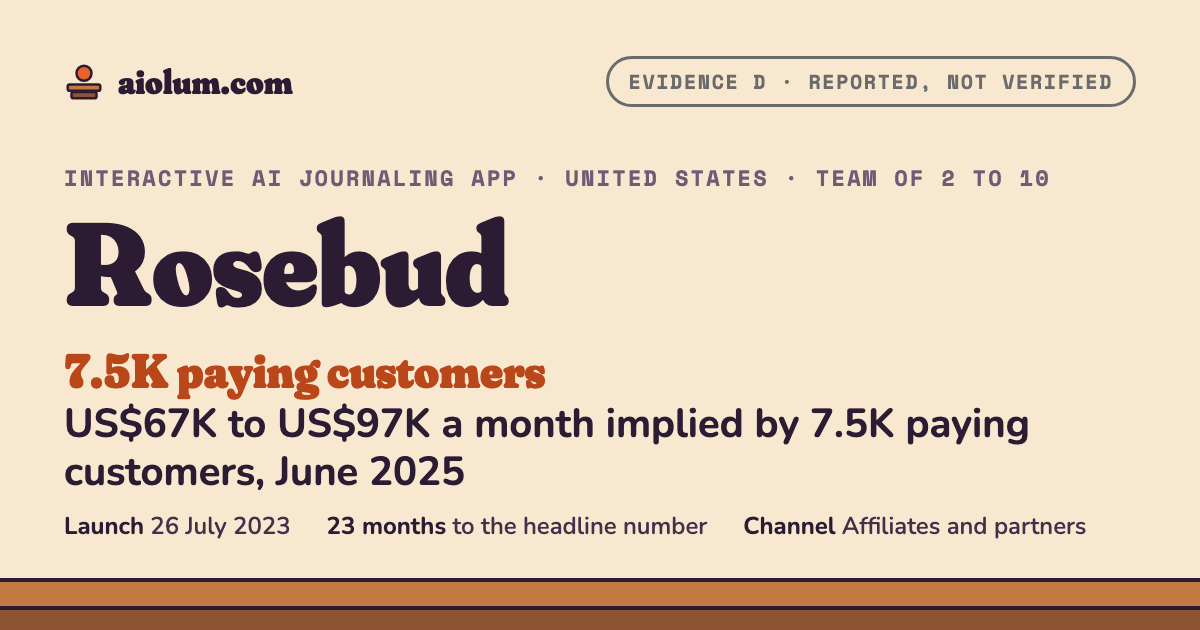
Chrys Bader, a co-founder of the social app Secret, and Sean Dadashi started Rosebud in 2023 in Santa Monica, California, and released it as a free web app on 26 July 2023 with a US$4.99 a month premium plan, according to the company's own launch post. Native iPhone and Android apps followed on 6 August 2024. A reporter for the Santa Monica Daily Press wrote in August 2024 that the team was four people and that the premium plan cost US$12.99 a month or US$107.99 a year. On 4 June 2025 the company announced a US$6 million seed round led by Bessemer Venture Partners and said it had more than 7,500 paying customers and 500 million words journaled; TechCrunch reported the same day that the team was still four people. At the company's own prices, 7,500 subscriptions imply US$67,000 to US$97,000 a month, a figure computed on this page, not stated by anyone.
The headline figure rests on one company statement, so the page is marked "Reported, not verified". A third-party estimate read in October 2026, by the app-analytics site Screens Design, puts the iPhone app's revenue at about US$100,000 a month; it agrees in size with the implied figure but is itself an estimate. A US$2.7 million revenue estimate for 2024 that circulates under the name Rosebud belongs to a different company, Rosebud AI, a game-development startup, and is not used here. The company's help page said in October 2026 that the team had grown to 12, so Rosebud is now larger than the small team that reached the June 2025 figure.
The numbers, graded
Each row shows the evidence grade and the source numbers from the list at the end of this page. The grades are explained in How Aiolum verifies.
| Fact | Value | Grade | How we know | Sources |
|---|---|---|---|---|
| Paying customers, June 2025 | more than 7,500 | D | Company blog post of 4 June 2025 announcing the seed round. One statement, one date; no second source gives a customer count. | [1] |
| Subscription revenue implied by that count | about US$67,000 to US$97,000 a month | calc | Calculated: 7,500 customers times the yearly plan's US$8.99 a month (low) or the monthly plan's US$12.99 (high). The headline figure on this page is this range, and outcomeUsd is the low end times 12, US$809,100 a year. Real revenue depends on the mix of plans, discounts and app-store fees, which no source gives. | [1, 2, 3] |
| Third-party revenue estimate, iPhone app | about US$100,000 a month | D | Screens Design app page, read 23 October 2026, which shows "Revenue $100k" and "Installs <5k" per month and gives no method. An estimate for the App Store only; web and Android sales are not included. By this date the team was 12 people. | [4] |
| Price of the premium plan | US$12.99 a month or US$107.99 a year | B | TechCrunch, June 2025, reported US$12.99 a month. The Santa Monica Daily Press reported both prices in August 2024, and the home page and App Store list show the same prices in October 2026. | [2, 3, 5, 14] |
| Price at launch, July 2023 | free web app; premium US$4.99 a month | C | Company launch post of 26 July 2023. | [8] |
| Words journaled | 7 million (September 2023), 32 million (March 2024), 100 million (August 2024), 500 million (June 2025) | C | Company home page in Wayback Machine copies, a founder quote to the Santa Monica Daily Press, and the company's seed announcement. Consistent growth across four dates. | [15, 3, 1] |
| Users claimed | 50,000+ (March 2025), 150,000+ (October 2026) | C | Company home page, Wayback Machine copy of March 2025 and the live page in October 2026. A user count, not a paying-customer count. | [15, 14] |
| App store ratings, October 2026 | App Store 4.9 from 3,400 ratings; Google Play 4.2 from 2,850 reviews and 100,000+ downloads | C | The two store listings. The App Store rates the app 18+ and lists the seller as Just Imagine, Inc. | [5, 6] |
| Team size | 4 people in August 2024 and June 2025; 12 by October 2026 | B | The Santa Monica Daily Press reporter in August 2024; TechCrunch in June 2025 ("its team of four"); the company's help center roadmap page in October 2026 ("a small team of 12 based in LA"), undated. | [3, 2, 10] |
| Outside funding | US$6 million seed, June 2025, plus two earlier rounds of undisclosed size | B | TechCrunch and the company's post name Bessemer Venture Partners as lead, with 776, Initialized Capital, Fuel Capital, Avenir and Tim Ferriss. Bader told the Santa Monica Daily Press in August 2024 of "two rounds of relatively modest investment"; the help center lists Seven Seven Six, Initialized, Fuel and Weekend as backers. | [2, 1, 3, 9] |
| Mental-health survey claim | 75% of users surveyed report meaningful improvement within 30 days | D | Company statement in its seed announcement. The home page says 1,300 users were surveyed after 7 days. Self-reported by users to the company; no independent study. | [1, 14] |
| Free plan | retired on 30 September 2026 | C | Company help center. The reason given is the running cost of the new memory system. | [11] |
| The US$2.7 million estimate for 2024 | belongs to Rosebud AI, a different company | C | GetLatka's page for rosebud.ai, a game-development company founded in 2019 with a different chief executive, estimates US$2.7 million for December 2024. It is not the journaling app and is not used on this page. | [17] |
| Time from launch to the June 2025 figure | 23 months | calc | Calculated: 26 July 2023 to June 2025. | [8, 1] |
How to read this table: a grade D value comes from one source with one date, either the company's own announcement or a directory estimate that says it is an estimate. A grade C value is a company or founder statement that agrees across dates or a reviewer's observation. A grade B value was reported by a journalist. A "calc" value was computed on this page from the rows above it. No value is grade A.
| Plan | Per month, billed yearly (US$) | Per month, billed monthly (US$) | Limit |
|---|---|---|---|
| Free | 0 | 0 | retired 30 September 2026 |
| Bloom | 8.99 | 12.99 | weekly AI usage budget; long-term memory, voice |
| Thrive 2x | 16.67 | 24.99 | App Store list; larger usage budget |
| Thrive 5x | 41.67 | 59.99 | App Store list; largest usage budget |
The free plan was retired on 30 September 2026, according to the company's help center, which says the new memory system costs too much to run for free. Bloom is shown on the home page as US$8.99 a month billed yearly (US$107.99 a year, with a struck-out list price of US$155.99) or US$12.99 a month. The App Store list adds Rosebud Thrive 2x at US$24.99 a month or US$199.99 a year and Rosebud Thrive 5x at US$59.99 a month or US$499.99 a year; the list does not explain the multiplier, and the help center says that plans differ in their weekly AI usage budget. Yearly prices were divided by 12 on this page. Subscriptions bought in the iPhone app are billed by Apple; the web app has its own billing and accepts referral and discount codes.
The timeline
From a prototype built in under a week to a venture-funded app with 7,500 paying customers in 23 months, then a team of 12. Each entry carries its grade.
- 2020 to 2022CBader starts journaling after a retreat during the pandemic and wonders what an AI could notice in his entries over time. [3]
- Early 2023CHe and his colleagues build a prototype in under a week and test it with people. [3]
- 26 July 2023CLaunch as a free web app that can be added to a phone's home screen, with a US$4.99 a month premium plan, on Product Hunt the same day. The launch post says the app is powered by OpenAI. [8, 7]
- September 2023CThe home page claims over 7 million words journaled and 807 reviews. [15]
- March 2024COver 32 million words journaled and 2,625 reviews. The tagline is now "the #1 AI-powered journal for mental health and personal growth". [15]
- 6 August 2024BNative iPhone and Android apps, a year after the web launch, with a second Product Hunt launch. A local reporter counts a team of four in a small office on Main Street, Santa Monica. Bader says 100 million words and 5,000 ratings, and that two modest funding rounds have been raised. [3, 7, 10]
- 27 November 2024CBader appears on The Undefeated Underdogs podcast on building a consumer app in mental health. No transcript is published. [18]
- March 2025CThe home page claims 50,000+ users and shows the Bloom plan at US$12.99 a month or US$8.99 a month billed yearly. [15]
- 4 June 2025DUS$6 million seed round led by Bessemer Venture Partners. The company says more than 7,500 paying customers and 500 million words journaled; TechCrunch reports a team of four. At the company's prices the customer count implies US$67,000 to US$97,000 a month, computed on this page. [1, 2]
- 30 September 2026CThe free plan is retired; the company says its new memory system costs too much to run for free. [11]
- October 2026DThe help center says the team is 12 people in Los Angeles, and the home page has shown a hiring link since at least March 2026. The home page claims 150,000+ users. Screens Design estimates the iPhone app's revenue at about US$100,000 a month. [10, 15, 14, 4]
Why it worked
Four causes, in the order they mattered. Each one is a reusable lesson.
Memory is the product
A chat model forgets each conversation. Rosebud stores entries and reads them back before answering, so the reply can say "last week you mentioned this". TechCrunch reported in June 2025 that part of the new money would go into what the company calls its proprietary memory technology. The help center's comparison page sells it directly: ChatGPT, short-term memory; Rosebud, long-term memory, at US$12.99 a month against US$20.
Between sessions, not instead of them
The app is sold as a companion between therapy and coaching sessions, co-designed with practitioners, and its own help page says it cannot diagnose, treat or handle a crisis. Bader told the Santa Monica Daily Press in August 2024 that a significant number of therapists recommend it to clients to use between sessions. A practitioner program and an affiliate program turn those recommendations into a channel.
Web first, phones later
The first year was a web app that users added to the home screen, and the help center's 2024 goal was a native app with the most requested features. Native apps came on 6 August 2024, with billing through Apple on iPhone and the company's own billing on the web.
Price by AI budget
Every plan has a weekly budget of AI usage, and the meter runs faster on the more capable model. Higher plans in the App Store list (Thrive 2x, Thrive 5x) sell a larger budget. When the memory system became more expensive to run, the company retired the free plan on 30 September 2026 rather than cut the feature.
How it was built
These details come from the company's own pages, its Product Hunt entries and press reports. They are grade C unless marked. [8, 7, 10, 16, 9, 1]
- A prototype in under a week, then a web app that could be installed on a phone's home screen, launched 26 July 2023; native iPhone and Android apps on 6 August 2024.
- The launch post of July 2023 says the app is powered by OpenAI. By the time of its Product Hunt "built with" entry the company wrote that Claude 3.5 Sonnet had raised the quality of its responses and that users preferred it to GPT.
- A long-term memory store, auto-tagging, weekly reports, voice transcription and text-to-speech, all counted against a weekly usage meter that the user can see in settings.
- Entries are encrypted in transit and at rest and, the company says, never used to train AI models; the therapy page calls the practices HIPAA-aligned.
- Billing by Apple inside the iPhone app and by the company on the web, where referral and discount codes work. A help center on Notaku, a Discord community for early testers, an affiliate program and a practitioner program.
- Two founders and two others until mid-2025, funded by two small rounds and then a US$6 million seed round that the company said in June 2025 would pay for engineers, product people and marketing.
Tools named in the sources
Each one opens its page in the Tools tab, with every story that uses it.
The dead that came before
Four companies in the Loot Drop database sold self-reflection, mental-health support or journaling to consumers before AI models could answer back. The values below are from that database and are not independently verified.
OhLife
The promiseA journal you keep by replying to a daily email.
Why it diedToo simple to hold users once richer journaling apps and social networks arrived; email prompts lost to push notifications.
In Your Corner
The promiseAffordable online therapy with licensed therapists by video.
Why it diedEach session needed a human therapist, so costs did not fall with scale, and better-funded rivals with insurer deals took the market.
Mindstrong
The promisePredict mental-health relapses from how you type and scroll on your phone.
Why it diedCould not prove its clinical claims to regulators and payers, pivoted several times, and ran out of a business model.
Likebetter
The promiseSelf-improvement through game-like choices and community insight.
Why it diedNo way to charge and no reason to return; early social networks absorbed the audience.
What changed
OhLife and Likebetter could only record or ask; they had nothing to say back, and users left. In Your Corner had something to say back, a therapist, at a human's cost per hour. Mindstrong tried to make the phone itself the clinician and ran into the evidence that a medical claim needs. Rosebud sits between these: a model that answers every entry, sold as self-reflection with a memory, without a clinical claim to defend.
What changed is the cost and the quality of an answer. A large language model reads a year of entries and replies in seconds, which makes a journal worth returning to, and each reply costs the company model usage, which is why the plans are priced by AI budget and why the company retired the free plan in September 2026. What has not changed is the predecessors' problem of staying different: the model makers can add memory to their own chat apps, and Rosebud's answer is a memory built for reflection, practitioner recommendations and a price that the company's comparison page sets below ChatGPT's.
Can one person copy it now?
The structure, yes. The scale, not alone.
A journaling app with a model that remembers is a weekend prototype, and the first year of Rosebud was a web app with a US$4.99 plan, as the company's launch post says. Getting to the 7,500 paying customers that the company reported in June 2025 took native apps, therapist relationships, two small rounds and then a venture seed round, and the team was four people at that point and twelve a year later.
Where it is still open: Any reflective practice that a model can answer and remember: coaching check-ins, language learning diaries, recovery and habit programs, and journals for one condition or life stage, each with its own practitioners to partner with.
- 1Launch as a web app that installs to the home screen, so the product can change daily without store review, and move to native apps once users ask for them.
- 2Make memory the feature: store entries, retrieve the relevant ones before each reply, and show the user what was remembered.
- 3Position beside professionals, not against them: write the limitations page first, make the app a companion between sessions, and give practitioners a program to recommend it.
- 4Price by AI budget per week, with higher plans selling a larger budget, so that heavy users pay for the model calls they cause.
What to watch
The risks are the mirror image of the causes above.
What is not verified
The headline rests on one source: the company's own blog post of 4 June 2025, which says "7,500+ paying customers". No payment processor, investor or journalist has confirmed the count, and the revenue range on this page was computed from it at the company's list prices, so the real figure depends on the plan mix, discounts and app-store fees. The only money figure stated by a third party, Screens Design's estimate of about US$100,000 a month for the iPhone app, was read on 23 October 2026, carries no date or method, and covers the App Store only. The US$2.7 million revenue estimate for 2024 that appears under the name Rosebud on GetLatka belongs to Rosebud AI, a game-development company, and was not used. A reader could look for a TrustMRR or Stripe-verified profile (none existed in October 2026), a founder interview with dated revenue, or a later funding announcement that states revenue.
The team grew past the site's limit
Four people reached the June 2025 figure. By October 2026 the company's help center said 12, and the home page showed a hiring link from March 2026. The seed round of US$6 million, reported by TechCrunch in June 2025, makes Rosebud a venture-funded company; the story is on this site for the period when it was four people.
The model makers can add memory
Rosebud's own comparison page is built around one difference from ChatGPT: long-term memory against short-term memory. Nothing stops the model makers from closing that gap in their own apps. Every predecessor on this page that depended on a feature lost it to a larger platform. Rosebud's answers are a memory tuned for reflection, practitioner relationships and privacy terms.
Mental-health claims
The company says 75% of surveyed users reported meaningful improvement in their mental health within 30 days. That is a self-reported survey of its own users, not a study. The app's pages say it is therapist-recommended and HIPAA-aligned, while its limitations page says it cannot diagnose, treat or handle a crisis. Reviewers on the home page compare it with their therapists; the company does not.
Usage costs rise with the product
The free plan ended on 30 September 2026 because the memory system costs more to run. Plans are sold by AI budget, so the company's margin depends on model prices that it does not control.
Sources
The grade next to each source is the best grade that the source can support. "Read in full" means that the text of the page was downloaded and the numbers were checked in it.
- D Rosebud blog, 4 June 2025: Rosebud Raises $6M to Expand the World's Leading AI JournalRead in full. The company's own announcement. Source for the 7,500 paying customers, the 500 million words, the survey claim and the investor list.
- B TechCrunch, 4 June 2025, by Aisha Malik: Rosebud lands $6M to scale its interactive AI journaling appRead in full from a Wayback Machine copy, because techcrunch.com's robots.txt disallows this agent's crawler. Source for the team of four, the US$12.99 price, the round and the founders' quotes.
- B Santa Monica Daily Press, 15 August 2024, by Scott Snowden: Santa Monica startup Rosebud offers mental health via an AI-based learning appRead in full. A local reporter's visit. Source for the team of four, the prices, the 100 million words, the two earlier rounds and the therapist channel.
- D Screens Design app page: Rosebud: AI Journal & Diary, onboarding, paywall and UX flowRead in full on 23 October 2026. A third-party estimate of App Store revenue and installs, with no date or method given.
- C App Store listing: Rosebud: AI Journal & Diary, by Just ImagineRead in full on 23 October 2026. Source for the in-app purchase prices, the ratings, the 18+ rating and the seller name.
- C Google Play listing: Rosebud: AI Journal & Diary, by Just Imagine, Inc.Read the header. Source for the download band, the rating and the review count.
- C Product Hunt: Rosebud product page, its two launches and its "built with" pageRead the product page, the launch list and the built-with page. Source for the launch dates of 26 July 2023 and 6 August 2024 and the company's note on Claude 3.5 Sonnet.
- C Rosebud blog, 26 July 2023, by Chrys Bader: Meet Rosebud: Your AI Personal Growth CoachRead in full. The launch post. Source for the free web app, the US$4.99 plan and "Powered by OpenAI".
- C Rosebud help center: About usRead in full. Names the founders, Santa Monica, and the early backers Seven Seven Six, Initialized, Fuel and Weekend.
- C Rosebud help center: Roadmap (live page, October 2026, and the Wayback Machine copy of 19 May 2025)Read both versions. The live page says "a small team of 12 based in LA"; the May 2025 copy says the native app launched on 6 August 2024.
- C Rosebud help center: Changes to the Free PlanRead in full. The free plan ends 30 September 2026 because the memory system costs more to run.
- C Rosebud help center: Rosebud's LimitationsRead in full. The company's own statement of what the app cannot do: diagnose, treat, or handle a crisis.
- C Rosebud help center: ChatGPT vs. RosebudRead in full. The company's price and memory comparison with ChatGPT.
- C Rosebud home page, read 23 October 2026Read in full, including the pricing section in the page's script. Source for the Bloom prices, the 150,000+ users claim and the 1,300-user survey note.
- C Rosebud home page in the Wayback Machine: copies of September 2023, March 2024, March 2025 and March 2026Read all four copies. Source for the words-journaled counts, the review counts, the 50,000+ users claim and the prices over time.
- C Rosebud for Therapy & Coaching pageRead in full. Source for the between-sessions positioning, the HIPAA-aligned claim and the store review counts.
- C GetLatka: Rosebud AI revenue 2024, estimate (rosebud.ai, a game-development company)Read in full. Shows that the US$2.7 million estimate belongs to a different company, founded in 2019 with a different chief executive.
- C The Undefeated Underdogs podcast, 27 November 2024: Chrys Bader, a masterclass on the art of building viral consumer appsRead the episode page and chapter list. No transcript is published, so no figures were taken from it.
- C Loot Drop database export, 1,749 failed startupsLocal export. AI-written summaries, not independently verified. Source for the failed predecessors.