Specsight: Product, team and how it was built
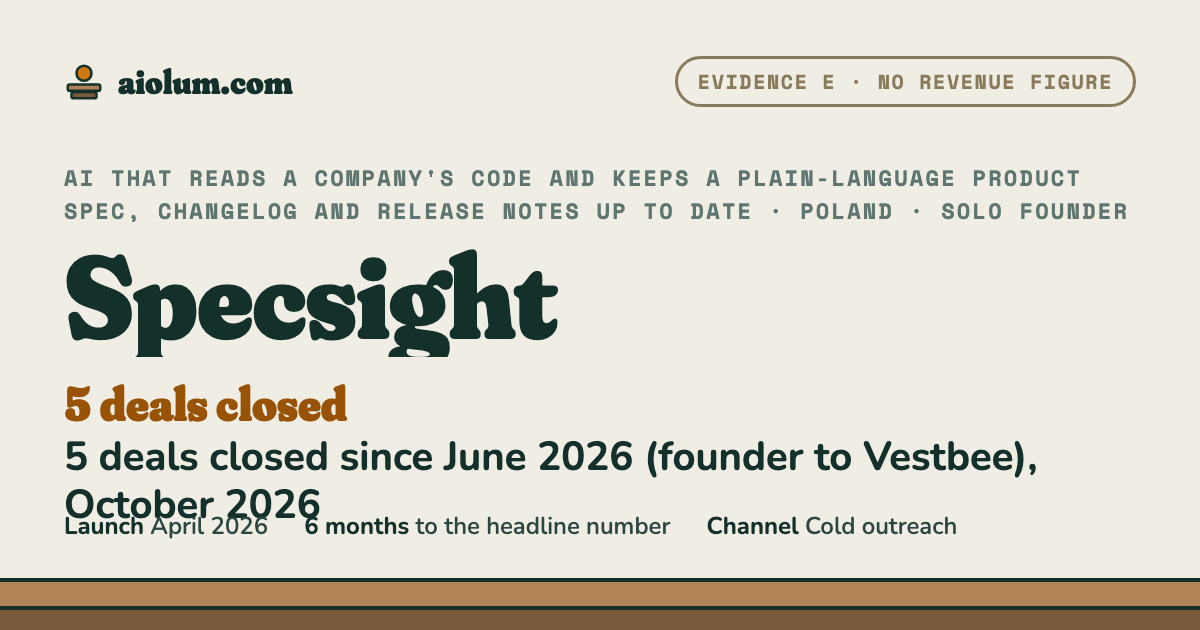
Specsight (AI that reads a company's code and keeps a plain-language product spec, changelog and release notes up to date, Poland): 5 deals closed since June 2026 (founder to Vestbee), October 2026. Evidence grade E: no revenue figure was checked. Team: 1 founder, no employees (Vestbee interview, 29 October 2026); she plans to hire a product engineer and a commercial lead. Launched April 2026; still running.Added 5 November 2026 · updated 6 November 2026
- Outcome
- 5 deals closed since June 2026 (founder to Vestbee), October 2026
- Evidence
- E no revenue figure was checked
- Launch
- April 2026
- Status
- Still running
- Team
- 1 founder, no employees (Vestbee interview, 29 October 2026); she plans to hire a product engineer and a commercial lead
- Outside funding
- None raised in the sources read; the founder told Vestbee in October 2026 that she is seeking a €850,000 pre-seed round
- Main channel
- Cold outreach
What is not verified
No revenue figure was found. The headline is the founder's count of five deals closed since June 2026, given to Vestbee (article of 29 October 2026) and repeated on a MilestoneWins page written by the founder herself (1 November 2026); no source says how many customers pay today, and some early customers cancelled. The Slush 100 place appears only on the founder's own page. No payment-processor profile, company register entry or customer statement was found. A reader could look for a TrustMRR or Stripe-verified profile or a pre-seed announcement. This story is grade E: the business is real and its product, price and customers are described from public pages, but no revenue figure was checked. Aiolum shows it as an idea worth studying, not as proof that it makes money.
Specsight calls itself a product observability platform. Observability usually means tools that show what servers and software are doing (uptime, errors, clicks); here it means a view of how the product itself behaves and what changed in the last release. The service clones a customer's repository into a temporary environment, has an AI model read it, and writes each behaviour as a scenario, one rule in Context/Action/Outcome form, similar to the Given/When/Then format of behaviour-driven development (BDD), a testing practice in which behaviour is written as plain sentences. Its FAQ says the code analysis is done by Claude from Anthropic and the code is deleted after each job.
Ola Piętka built it alone in Poland. She told Vestbee, a Central European investment platform, that the first MVP (minimum viable product, the first version that can be used) was ready in April 2026 and sales began in June, and that she has since closed five deals and started two pilots, while some early customers cancelled. She runs the company with AI agents instead of employees.
No revenue figure was found. The five deals are the founder's count, reported in one interview and repeated on a page she wrote herself. This is a grade E story: the business and the product are real and live, and its money results are not known.
How much revenue does Specsight make?
Each row shows the evidence grade and the source numbers from the list at the end of this page. The grades are explained in How Aiolum verifies.
| Fact | Value | Grade | How we know | Sources |
|---|---|---|---|---|
| Product, November 2026 | spec, product map, changelog, release notes and product answers, read from the code | C | Home page and llms-full.txt, read 5 November 2026. Works with GitHub (a read-only GitHub App) and GitLab (an access token). | [3, 5] |
| MVP ready | April 2026 | C | Founder to Vestbee: "The first MVP was ready in April 2026; sales began in June." | [1] |
| First line of code | March 2026 | C | Founder's own story page: "first line of code in March, paying customers within four months". Only this page gives the month. | [2] |
| Deals since June 2026 | 5 closed, plus 2 new pilots | C | Founder to Vestbee, 29 October 2026: "Since June, Piętka has closed five deals and started two new pilots, although some early customers have cancelled." Number of current paying customers not stated. | [1, 2] |
| Self-service sign-ups | some customers subscribed through the website without a call | C | Founder to Vestbee: they found Specsight on LinkedIn and connected a repository themselves, which she says takes about two minutes. | [1] |
| Price | €150 a month per organisation, about US$167 | C | Pricing page, read 5 November 2026; the founder gave the same price to Vestbee. Converted at US$1.1163 per euro (H.10, 30 October 2026). | [4, 1, 8] |
| Target customers | B2B software companies with 20 to 200 employees in Europe and the US | C | Founder to Vestbee, especially teams that ship often with AI. | [1] |
| Team | 1 founder, no employees | C | Vestbee: "Piętka runs Specsight without employees, relying instead on AI agents to handle much of the work." | [1] |
| Funding | seeking €850,000 pre-seed | C | Founder to Vestbee, October 2026, from European and US investors, to hire a product engineer and a commercial lead. No closed round found. | [1] |
| AI model for code analysis | Claude, through the Anthropic API | C | FAQ: "Code analysis is performed by Claude (Anthropic)". Code is cloned to a temporary environment and deleted in the same job. | [6, 1] |
| Time from MVP to the October 2026 figure | 6 months | calc | Calculated: April 2026 to October 2026. | [1] |
How to read this table: a grade C value comes from the founder (her interview with Vestbee or her own story page) or from the company's own pages. A "calc" value was computed on this page. No value is grade A or B, and no revenue figure exists.
| Plan | Per month, billed yearly (US$) | Per month, billed monthly (US$) | Limit |
|---|---|---|---|
| Standard | 167 (€150) | 3 projects, 50 members, 200 syncs a month, 10,000 source files or 150 MB per project, 50 questions a day | |
| Custom | price on a call | limits set per company |
One plan, Standard, at €150 a month per organisation, not per seat, by the pricing page. A 7-day free trial is given by application and needs a card; a first payment made without a trial has a 14-day money-back guarantee. The FAQ says an older plan in which customers brought their own AI key (BYOK) is no longer offered. Larger teams get a Custom plan after a call.
When did Specsight launch, and how did it grow?
From the first line of code in March 2026 to paying customers and a pre-seed search, in about seven months. Each entry carries its grade.
- March 2026CThe founder writes the first line of code, by her own story page. [2]
- April 2026CThe first MVP is ready. [1]
- June 2026CSales begin, through hundreds of LinkedIn messages a week, events and product demos. [1]
- October 2026CFive deals closed and two pilots started; some early customers cancelled because they did not want another dashboard, so product answers move into AI assistants such as Claude. She seeks €850,000 in pre-seed funding, she told Vestbee. [1]
- 5 November 2026CLive site with one Standard plan at €150 a month, GitHub and GitLab connections, an MCP server and a public roadmap with Slack alerts and screenshots in scoping. [3, 4, 7]
Why did Specsight work?
Four causes, in the order they mattered. Each one is a reusable lesson.
Read the code, not the tickets
The founder argues that code is a more accurate record of what was built than tickets or documents, which may describe plans. Each merge triggers a sync that rewrites only the scenarios whose code changed, so the spec follows the product without anyone writing it.
Sell to the people outside engineering
The buyer is the support, sales and product staff who would otherwise ask an engineer what shipped. The site names that cost: "A deal stuck on 'let me check with the team'".
Deliver where users already work
Customers who cancelled told her they did not want one more dashboard. The answer was an MCP server, so Claude, ChatGPT, Cursor and other assistants can read a customer's spec and draft release notes; email updates are planned.
One person with AI agents
She told Vestbee that agents research and qualify leads and prepare outreach messages, meeting briefs and follow-ups, and that she takes over once a prospect replies.
How it was built
These details come from the company's pages and the founder's interview. They are grade C, except the web framework, which is visible in the page source. [6, 5, 1, 3]
- Code analysis by Claude through the Anthropic API; the founder also uses ChatGPT and sometimes Gemini for her own work across development, marketing, sales and operations.
- A Supabase Postgres database with row-level security per organisation; access tokens are stored encrypted in Supabase Vault.
- Repositories are cloned with a short-lived GitHub App token or a GitLab token, analysed and deleted in the same job; only the extracted spec is kept.
- An MCP (Model Context Protocol) server, the open standard for connecting AI assistants to outside tools, with OAuth sign-in or a read-only API key.
- Billing through the Stripe customer portal; the site is a Next.js app by its page source.
- She is working toward SOC 2 or ISO certification for enterprise customers, she told Vestbee.
Who tried this before Specsight, and why did they fail?
Three companies in our database of failed startups tried to make code or company knowledge easy to understand and failed. The values below are from that database and are not independently verified.
CodeSee
The promiseVisual maps of a codebase that updated automatically as the code changed.
Why it diedEngineering leaders could not measure the time saved, free users did not convert, and AI assistants began to answer code questions directly.
Niles
The promiseAn AI chatbot in Slack that answered questions from a company's knowledge.
Why it diedSlack added its own AI search, competitors expanded, and the product was not used enough to stand alone.
Omniref
The promiseA 'Wikipedia for Code' where developers documented and annotated source code.
Why it diedIt depended on volunteers writing the content and could not compete with GitHub and Stack Overflow.
The failed startups come from our database of 1,749 dead startups, retold here in our own words. Its entries are AI-assisted summaries of public sources, so these cards carry no evidence grade.
What changed
Omniref needed people to write the documentation, and CodeSee drew diagrams for engineers, who could not show their managers a return. Specsight has the model write the documentation and sells it to the staff outside engineering, who feel the cost of not knowing what shipped.
Large language models after 2023 can read a whole production codebase and describe its behaviour in plain sentences, which the earlier tools could not do. Niles shows the risk that remains: a platform owner (here GitHub, GitLab or the AI assistants themselves) can add the same feature.
Can one person copy Specsight now?
Yes, for an engineer who can sell.
The product is an AI model over a repository plus a careful data model of scenarios and changes, built by one person in a few months by her own account. The harder part, by her account, was finding buyers: she had never sold before and used hundreds of LinkedIn messages a week, events and demos.
Where it is still open: Other questions whose answers are in the code: which permissions each user role has, which data a product stores for privacy reviews, or what a coding agent changed in a pull request.
- 1Pick a group of people inside software companies who keep asking engineers the same kind of question.
- 2Connect read-only to the repository, generate the answer from the code, and delete the code after each job.
- 3Update only what changed on each merge, so the cost per customer stays low.
- 4Deliver the answers in the tools the buyers already use (AI assistants, email, Slack) instead of a new dashboard.
What could go wrong for Specsight?
The risks are the mirror image of the causes above.
What is not verified
No revenue figure was found. The headline is the founder's count of five deals closed since June 2026, given to Vestbee (article of 29 October 2026) and repeated on a MilestoneWins page written by the founder herself (1 November 2026); no source says how many customers pay today, and some early customers cancelled. The Slush 100 place appears only on the founder's own page. No payment-processor profile, company register entry or customer statement was found. A reader could look for a TrustMRR or Stripe-verified profile or a pre-seed announcement.
Sales methods and testimonials
The founder told Vestbee that she sent hundreds of LinkedIn messages each week and that AI agents prepare outreach messages and follow-ups, while she handles replies herself; the sources do not say whether the messages are sent by hand or by a tool. The home page shows three quotes under "Trusted by teams building with AI", attributed to a role and a company or "Freelancer" but not to named people; they were not checked.
Competition and model providers
Ferndesk, already on this site, uses AI to keep a help center's articles up to date, which is close to Specsight's release notes for customers. Code analysis runs on Claude from Anthropic (FAQ), and the plan price includes the AI cost, so Anthropic's prices and terms affect the margin; the founder told Vestbee she relies on read-only access and deletion of analysed code for security. GitHub or another developer platform could build a similar feature, which Vestbee called an open question.
Sources
The grade next to each source is the best grade that the source can support. "Read in full" means that the text of the page was downloaded and the numbers were checked in it.
- C Vestbee, 29 October 2026: Building a startup solo in the age of AI — the story of Specsight (Lisa Palchynska)Read in full. An interview by Vestbee's editor; the figures are the founder's statements. Source for the launch, the deals, the team, the price and the pre-seed search.
- C MilestoneWins, 1 November 2026: Solo in Poland, With a Team of AI Agents: Ola Piętka's Bet on Product Observability (by Ola Piętka)Read in full. A page under the founder's byline that retells the Vestbee interview. Source for the first line of code in March 2026 and the Slush 100 mention.
- C Specsight home page, read 5 November 2026Read in full. Source for the product features, the testimonials and the page framework.
- C Specsight pricing page, read 5 November 2026Read in full. Source for the plans, limits, trial, refund and Stripe portal.
- C Specsight llms-full.txt, read 5 November 2026Read the About, Pricing, FAQ and MCP sections. Source for the founder's name, the scenario format and Supabase Vault.
- C Specsight FAQ, read 5 November 2026Read the sections on security, data, AI and billing. Source for Claude as the model, Supabase and the older BYOK plan.
- C Specsight vision and roadmap page, read 5 November 2026Read the roadmap board. Source for the shipped and planned features.
- B US Federal Reserve, H.10 Foreign Exchange Rates, release of 2 November 2026Read the euro row. Rate of 30 October 2026, US$1.1163 per euro, used for the price conversion only.
- C Database of failed startups, local exportLocal export. AI-written summaries, not independently verified. Source for the failed predecessors.
Run this company? Send corrections or a verified figure to aiolum@livyden.com