Spur: Product, team and how it was built
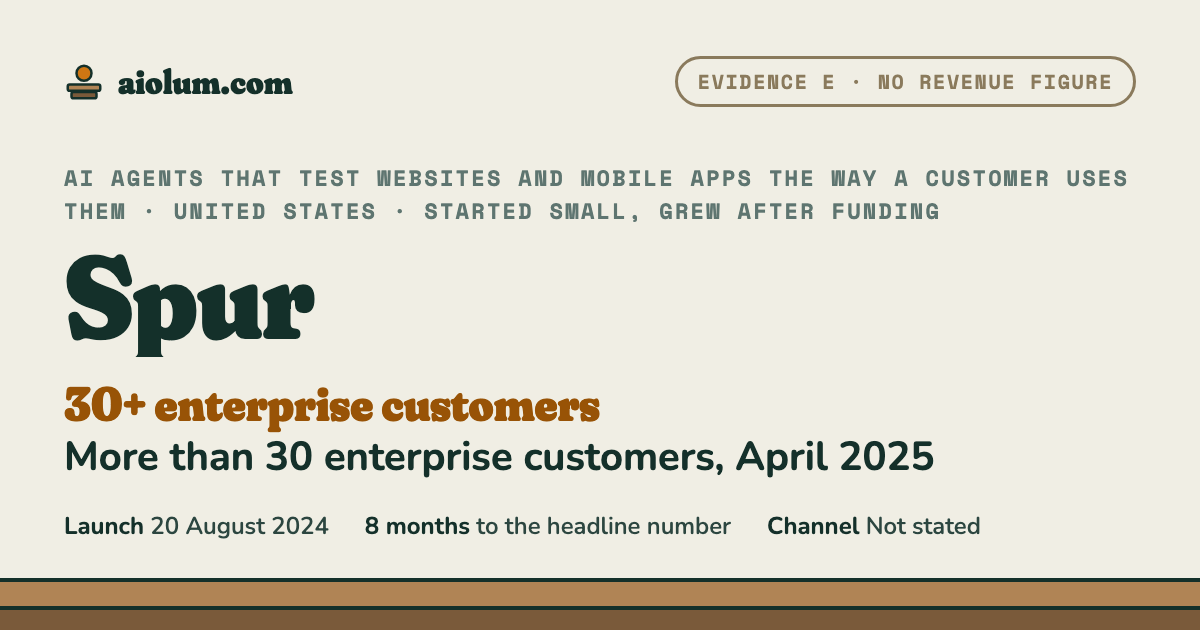
Spur (AI agents that test websites and mobile apps the way a customer uses them, United States): More than 30 enterprise customers, April 2025. Evidence grade E: no revenue figure was checked. Team: 2 co-founders at launch in August 2024; 15 people on its Y Combinator page, read November 2026. Launched 20 August 2024; still running.Added 8 November 2026
- Outcome
- More than 30 enterprise customers, April 2025
- Evidence
- E no revenue figure was checked
- Launch
- 20 August 2024
- Status
- Still running
- Team
- 2 co-founders at launch in August 2024; 15 people on its Y Combinator page, read November 2026
- Outside funding
- Y Combinator Summer 2024 (US$500,000, as the CEO described the standard deal) and US$4.5M from First Round, Pear VC, Neo, Conviction and others, as Pulse 2.0 reported in April 2025
- Main channel
- Not stated
What is not verified
No revenue figure was found. The headline, more than 30 enterprise customers in April 2025, rests on the company's announcement as Pulse 2.0 reported it and does not say what those customers paid. No payment-processor profile, company filing or interview with revenue was found. The Business Insider article on the round is listed on the Y Combinator page but blocks ClaudeBot and was not read. A reader could look for a revenue figure in a later funding announcement or a founder interview. This story is grade E: the business is real and its product, price and customers are described from public pages, but no revenue figure was checked. Aiolum shows it as an idea worth studying, not as proof that it makes money.
Spur sells end-to-end testing, checks that run a whole user flow in the real product (sign up, search, pay) instead of testing one function of the code. Its AI agents, programs that use a language model to decide their next step, read a test written in plain English, use the website or app as a customer would, and report what broke. The founders wrote in 2024 that their tests are not bound to CSS selectors, the fixed names of page elements that ordinary test scripts depend on and that break when a page is redesigned.
Sneha Sivakumar and Anushka Nijhawan met as first-year students at Yale and built the first version of the tool in their senior year, by Yale's engineering school. They joined Y Combinator's Summer 2024 batch and launched in August 2024. Pulse 2.0 reported on 18 April 2025 that the company had raised US$4.5 million from investors including First Round, Pear VC, Neo and Conviction, and that it had more than 30 enterprise customers less than a year after launch.
This is a grade E story: no revenue figure was found. It is on the site under the rule for teams that started small and grew: two founders at launch, 15 people on its Y Combinator page in November 2026.
How much revenue does Spur make?
Each row shows the evidence grade and the source numbers from the list at the end of this page. The grades are explained in How Aiolum verifies.
| Fact | Value | Grade | How we know | Sources |
|---|---|---|---|---|
| Enterprise customers, April 2025 | more than 30 | C | Pulse 2.0, 18 April 2025, on the funding announcement: "in less than a year already have more than 30 enterprise customers using the technology", naming LivingSpaces.com, Norse Atlantic Airways and Wander.com. It does not say how much they pay. | [4] |
| Founding team | 2 co-founders: Sneha Sivakumar (CEO) and Anushka Nijhawan (CTO) | C | Launch post of 20 August 2024: "Anushka and I met our freshman year at Yale." Yale's engineering school, 22 August 2024: "Nijhawan and Sivakumar ... have founded Spur". | [2, 3] |
| Team today | 15 people | C | Y Combinator company page, read 8 November 2026 (team size field). The page also lists open jobs for founding engineers and a founding designer. | [1] |
| Founded | 2024, New York | C | Y Combinator page: founded 2024, New York City. Yale's article says the company "started as a project in a course" and that the founders worked on an earlier user-experience research app in the fall semester of 2023. | [1, 3] |
| Y Combinator | Summer 2024 batch, US$500,000 | C | Batch from the Y Combinator page. The amount is the CEO's description of the standard deal in Yale's article: "they give you $500,000 and they take about 7.5 % of the company". | [1, 3] |
| Funding round, April 2025 | US$4.5 million | C | Pulse 2.0, 18 April 2025: raised "from investors including First Round, Pear VC, Neo, Conviction, Liquid2Ventures, and Predictive Venture Partners", plus angel investors. The Y Combinator page lists a Business Insider article of 17 April 2025 with the same amount; that site blocks ClaudeBot and was not read. | [4, 1] |
| Prices | not published; sold through a demo | C | Home page and comparison page, read 8 November 2026. /pricing returns a 404 error page. | [5, 7] |
| Customers named on the home page | Docusign, Abercrombie & Fitch, Bombas, Vuori, Living Spaces, Wondr Health, OneSafe | C | Home page, read 8 November 2026, under "Customers with real applications", each with a case study. The September 2026 launch post also names HelloFresh, Nextdoor, Bilt and Alo Yoga. | [5, 8] |
| DocuSign case study | green in nine days; 26 defects caught in three months; 80+ tests | C | Spur's case study, undated: Spur "is now the primary validation layer" for DocuSign's self-serve signup, plan changes and checkout, and replaced four automation stacks. The numbers are the company's. | [6] |
| Native mobile testing | launched 23 September 2026 for iOS and Android | C | Launch post on Y Combinator: "We started with web testing, and today we're launching native app testing across iOS and Android." | [8] |
| Time from launch to the April 2025 customer count | 8 months | calc | Calculated: August 2024 to April 2025. | [2, 4] |
How to read this table: a grade C value comes from the company's own pages and launch posts, its Y Combinator profile, or a press write-up that repeats the company's announcement. A "calc" value was computed on this page. No value is grade A or B, and no revenue figure exists.
| Plan | Per month, billed yearly (US$) | Per month, billed monthly (US$) | Limit |
|---|---|---|---|
| Annual plan | custom | custom | priced by test-run volume, not per seat; quote after a demo |
Spur's comparison page against Mabl says only that "Spur's pricing is built so you run what you need, when you need it", with no figure. At launch in August 2024 the founders offered free setup of tests for a customer's core flows with a launch code, also without a price. The customers named on the home page are large online retailers and software companies.
When did Spur launch, and how did it grow?
From a Yale course project to a 15-person company that tests websites and phone apps for large retailers, in about three years. Each entry carries its grade.
- Fall 2023CThe two founders, Yale computer-science students, build a user-experience research app in a software engineering course, then apply to Y Combinator at the end of the semester. [3]
- Spring 2024CIn their senior year they build a no-code testing tool powered by AI web agents, with a US$500 student grant from Yale's Tsai CITY innovation center, by Yale's article. Both graduate in May with computer-science degrees. [3]
- 20 August 2024CLaunch post on Y Combinator, "Spur - Your AI QA Engineer": tests written in natural language and run by multimodal agents. The founders offer free setup of core-flow tests at sign-up. [2]
- 18 April 2025CPulse 2.0 reports a US$4.5 million round from First Round, Pear VC, Neo, Conviction and others, and more than 30 enterprise customers. [4]
- 23 September 2026CSpur launches native iOS and Android app testing and names HelloFresh, Nextdoor, DocuSign, Bilt, Alo Yoga and Abercrombie as users. [8]
- November 2026CThe Y Combinator page lists a team of 15. The home page shows case studies for DocuSign, Abercrombie & Fitch, Bombas and Vuori. [1, 5]
Why did Spur work?
Four causes, in the order they mattered. Each one is a reusable lesson.
Tests that state the goal, not the clicks
A Spur test says what the user should be able to do, for example finish a checkout with a promo code, and the agent works out the clicks. The founders' argument is that the same test then keeps working across iOS, Android and page redesigns, because the user's goal has not changed.
Spur runs the test machines
The customer does not maintain browsers or phones. The home page describes isolated browser sessions started on demand, traffic that leaves from the country being tested, and Spur-owned racks of iPhones, iPads and Android devices. Tests run on each pull request, each release, on a schedule or by an API call.
Large retailers and venture money
Spur sells to large online shops and software companies through demos and detailed case studies, and it raised a funding round eight months after launch, as Pulse 2.0 reported. It was built by a funded team that grew to 15 people, not by one person.
How it was built
These details come from the company's launch posts and pages. They are grade C. [2, 5, 6, 8]
- The 2024 launch post says Spur uses "multimodal agents", models that read the screen as an image as well as text, and that its tests are not bound to CSS selectors.
- Every run keeps console and network logs, video, screenshots and the page structure (DOM). At DocuSign, defects go straight to Jira.
- Browsers run as concurrent, isolated sessions; native app tests run on phones in Spur's own device labs, by the home page.
- The Model Context Protocol (MCP), a standard that lets AI coding agents call outside tools, is "a first-class interface to Spur", so a coding agent can ask Spur to check a change, by the September 2026 launch post.
- The home page states SOC 2 Type II compliance. No source read names the AI model provider.
Tools named in the sources
Each one opens its page in the Tools tab, with every story that uses it.
Who tried this before Spur, and why did they fail?
Two companies in our database of failed startups promised to take manual quality checking off people's hands and failed. The values below are from that database and are not independently verified.
Testmunk
The promiseAutomated mobile app testing on real devices, to replace manual test work.
Why it diedBetter-funded competitors and constant operating-system updates that kept breaking the tests.
Movley
The promiseQuality control for manufacturers through human inspectors, reported in real time.
Why it diedIts human inspectors cost more than AI-based checking, and it did not change in time.
The failed startups come from our database of 1,749 dead startups, retold here in our own words. Its entries are AI-assisted summaries of public sources, so these cards carry no evidence grade.
What changed
Testmunk sold automated tests on real phones and, like Spur, went through Y Combinator. Its tests broke with each operating-system update and its device farm was expensive. Spur runs its own phone racks too, so that cost is the same; its claim is that a test written as a goal survives interface changes that broke script-based tests. The sources read do not measure how often that holds.
Movley shows the other side: a quality service built on people lost to cheaper automated checking. Spur sells that automation to online shops, whose merchandising teams checked product launches by hand, by its Bombas story. The open question is price competition, because many funded companies now sell AI testing agents.
Can one person copy Spur now?
Not as it was done.
Spur was built by two founders with research experience in web agents, Y Combinator money, a later funding round and a team of 15, and it sells to large companies, with a stated security certification and its own device labs. One person could build a narrow testing agent for one kind of shop or one kind of flow, but not this company's breadth.
Where it is still open: Narrow testing agents for one platform or one kind of flow (shop launches, translations, accessibility), where a general testing agent is weaker or too expensive for small teams.
- 1Pick one check that teams do by hand on every launch, such as product pages and checkout in online shops.
- 2Let customers write the test as a goal in plain English and let an agent work out the clicks.
- 3Report evidence with every run: screenshots, logs and a short video.
- 4Publish customer case studies with numbers, as Spur does for each named customer.
What could go wrong for Spur?
The risks are the mirror image of the causes above.
What is not verified
No revenue figure was found. The headline, more than 30 enterprise customers in April 2025, rests on the company's announcement as Pulse 2.0 reported it and does not say what those customers paid. No payment-processor profile, company filing or interview with revenue was found. The Business Insider article on the round is listed on the Y Combinator page but blocks ClaudeBot and was not read. A reader could look for a revenue figure in a later funding announcement or a founder interview.
A funded team, not a solo business
Two founders launched it in August 2024. It joined Y Combinator, raised US$4.5 million by Pulse 2.0's report of April 2025, and the Y Combinator page lists 15 people in November 2026.
Competition
Spur publishes a comparison page against Mabl, another testing tool, and its DocuSign story describes Playwright tests paused and UiPath kept only for maintenance. On this site, QA.tech is a grade E story about a Swedish company that also sells AI agents that test web and mobile apps like a real user.
Dependence on model providers
The product runs on AI models (the 2024 launch post says "multimodal agents"), but no source read names the provider. Model prices and quality changes affect the cost and reliability of each test run in a way the sources do not quantify.
Company-stated claims
The SOC 2 Type II compliance on the home page and the results in the case studies (for example 26 defects caught at DocuSign) are the company's own statements; no auditor's report or customer statement outside Spur's site was read. The home page's logo strip, "Companies that work with Spur", also shows logos of Sephora, Koala, Boss and True Religion with no case study, quote or other source read; Bilt and Nextdoor are named only in the founders' September 2026 launch post.
Sources
The grade next to each source is the best grade that the source can support. "Read in full" means that the text of the page was downloaded and the numbers were checked in it.
- C Y Combinator: Spur company pageRead in full, 8 November 2026. Source for the founding year, the team size of 15, the Summer 2024 batch, the founders' roles, the news list and the job openings.
- C Y Combinator Launch, 20 August 2024: Spur - Your AI QA EngineerRead in full. The founders' launch post. Source for the founding team, the natural-language tests, the multimodal agents and the launch offer.
- C Yale School of Engineering & Applied Science, 22 August 2024: With launch of tech company Spur, recent grads discuss the hectic, exciting startup lifeRead in full. Interview with both founders. Source for the course project, the earlier app, the graduation and the Y Combinator deal.
- C Pulse 2.0, 18 April 2025: Spur: $4.5 Million Raised To Advance Quality Analysis AI Agent Technology, by Amit ChowdhryRead in full. A write-up of the company's funding announcement. Source for the round, the investors and the 30 enterprise customers.
- C Spur home pageRead in full, 8 November 2026. Source for the product, the test infrastructure, the named customers and the SOC 2 statement.
- C Spur case study: Docusign made its revenue path safe to ship with one validation layerRead in full, 8 November 2026. The company's case study. Source for the DocuSign results and the Jira reporting.
- C Spur blog: Why E-Commerce Teams Are Switching from Mabl to SpurRead the comparison section, 8 November 2026. Source for the pricing statement and the competitor.
- C Y Combinator Launch, 23 September 2026: Spur - testing infrastructure for your mobile appsRead in full. The founders' second launch post. Source for native mobile testing, the MCP interface and the named users.
- C Database of failed startups, local exportLocal export. AI-written summaries, not independently verified. Source for the failed predecessors.
Run this company? Send corrections or a verified figure to aiolum@livyden.com