Traceten: Revenue, team and how it was built
Traceten (AI traffic analytics and AI search visibility tracking, Not stated in the sources): US$199 a month MRR (self-reported), October 2026. Evidence grade D: reported, not verified. Team: 1 named founder, Jay Patel; the company writes of "the team"; headcount not published. Launched July 2026; still running.Added 6 November 2026
- Outcome
- US$199 a month MRR (self-reported), October 2026
- Evidence
- D reported, not verified
- Launch
- July 2026
- Status
- Still running
- Team
- 1 named founder, Jay Patel; the company writes of "the team"; headcount not published
- Outside funding
- None reported; the company joined the Neon, ClickHouse Cloud and Claude for Startups programs in October 2026
- Group
- SEO and AI search
- Main channel
- Not stated
What is not verified
The only revenue figure, US$199 MRR in October 2026, rests on one source: IndieMakerList reported on 19 October 2026 that the founder's X bio listed it, and the directory marks it self-reported. The X bio could not be read for this page. US$199 a month is the price of one Pro plan or about four Growth plans; no source says how many customers pay. A reader could look for a TrustMRR or Stripe-verified profile (none was found at trustmrr.com/startup/traceten) or a dated founder update. The headline number is grade D: one claim or one estimate, with no second source. Aiolum shows it because the story is useful, and marks it so that it is not mistaken for a verified figure.
Traceten is AI traffic analytics: analytics that sorts a site's visitors by the AI assistant that sent them. It reads the referrer (the address of the page a visitor came from), UTM tags (labels added to a link to name its source) and the user agent, and gives each classification a confidence score from 0.0 to 1.0. It then joins visits to orders for revenue attribution, which means crediting a sale to the visit that started it. Its AI visibility feature (in beta) runs a customer's prompts through Perplexity's API, Google AI Overviews and, as a paid add-on, the Anthropic and OpenAI APIs with web search, and records whether the answers mention the brand and cite its pages.
The founder is Jay Patel, whom the IndieMakerList directory describes as a former JPMorgan engineer. The company blog starts on 27 July 2026, and the changelog counts 25 entries since 14 August 2026. IndieMakerList reported on 19 October 2026 that his X bio listed Traceten at US$199 MRR (monthly recurring revenue) as of October 2026. The pricing page has a free plan and paid plans at US$49 and US$199 a month.
The revenue figure rests on one self-reported number in the founder's X bio, quoted by a directory, so it is grade D. No payment-processor profile was found. The page also shows earlier analytics companies that tried to sell a dashboard in a market where the largest platforms give their own measurement away.
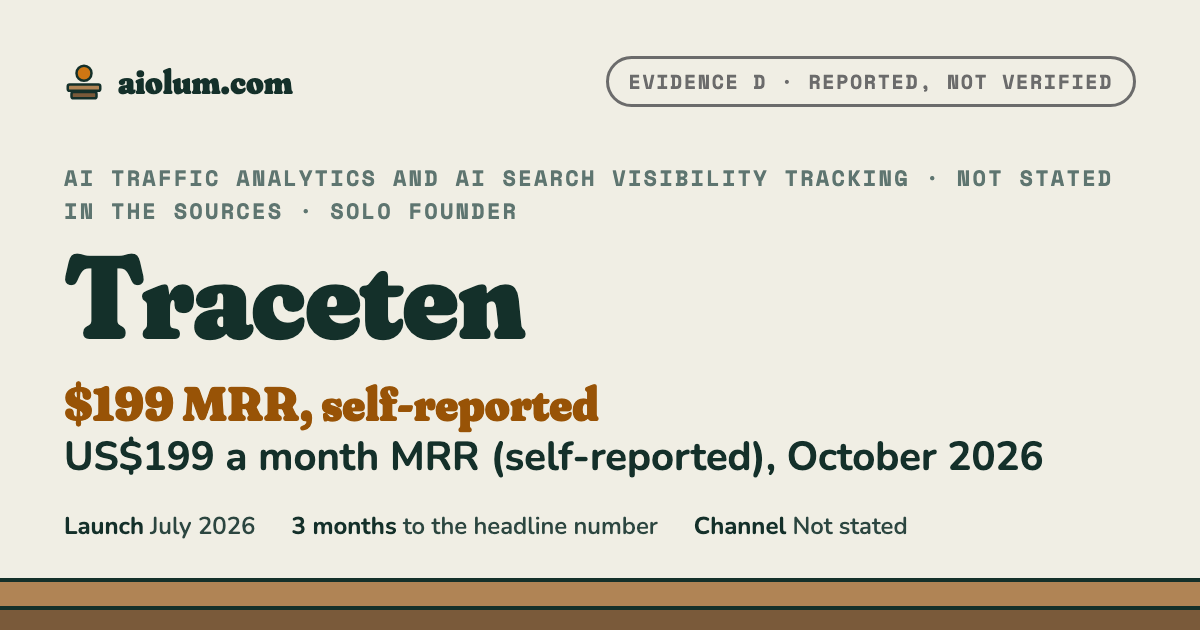
How much revenue does Traceten make?
Each row shows the evidence grade and the source numbers from the list at the end of this page. The grades are explained in How Aiolum verifies.
| Fact | Value | Grade | How we know | Sources |
|---|---|---|---|---|
| Monthly recurring revenue, October 2026 | US$199 | D | IndieMakerList, facts checked 19 October 2026: "Jay Patel's X bio listed Traceten at $199 MRR as of October 2026". The directory marks it self-reported. The X bio itself could not be read. | [1] |
| Yearly run rate from that figure | US$2,388 | calc | Calculated: US$199 times 12. | [1] |
| Founder | Jay Patel | C | Signs the About page as "Founder, Traceten" and writes the blog posts. IndieMakerList calls him a computer science graduate and former JPMorgan engineer (not verified elsewhere). | [4, 5, 1] |
| First blog post | 27 July 2026 | C | The oldest date on the blog index. The changelog counts 25 entries since 14 August 2026, the first being AI crawler tracking. | [8, 4] |
| Plans | Starter US$0, Growth US$49, Pro US$199 a month | C | Pricing page and About page. Prices billed monthly. | [3, 4] |
| AI assistants named | 25 or more | C | ChatGPT, Claude, Perplexity, Gemini, Copilot, Grok and others, named from the referrer, UTM tags and user agent. | [3] |
| AI visibility engines | Perplexity Sonar API, Google AI Overviews through DataForSEO, Anthropic API and OpenAI API with web search | C | Company documentation. Gemini is left out because its grounding API requires showing Google's Search Suggestions and permits Google to retain prompts. | [7] |
| Status, November 2026 | Public, open for sign-up; AI visibility in beta | C | About page: "Public, and open for sign-up." | [4] |
| AI crawler hits on its own site, 5 to 29 September 2026 | 4,805 hits from 11 companies; 14 AI-referred visits | C | Company blog, measured with its own product. OpenAI sent 2,186 of the hits. | [6] |
| Startup programs | Neon Startup Program, ClickHouse Cloud Startup Program, Claude for Startups | C | Company blog, 14 October 2026. Neon is its Postgres database and ClickHouse its analytics store. | [5] |
| Outside funding | none reported | C | No source names an investor or a round. | [1, 5] |
| Time from first blog post to the revenue figure | 3 months | calc | Calculated: July 2026 to October 2026. | [8, 1] |
How to read this table: a grade D value was reported by one source and not checked. A grade C value comes from the company's own pages. A "calc" value was computed on this page. No value is grade A or B.
| Plan | Per month, billed yearly (US$) | Per month, billed monthly (US$) | Limit |
|---|---|---|---|
| Starter | 0 | 60,000 events, 100,000 AI crawl hits, 1 AI visibility prompt a month | |
| Growth | 49 | 600,000 events, 650,000 AI crawl hits, 5 AI visibility prompts a month | |
| Pro | 199 | 3,000,000 events, 1,500,000 AI crawl hits, 20 AI visibility prompts a month |
Prices are in US dollars and billed monthly; the page shows no yearly price. Overage is off by default; on Growth it is US$0.000085 per event and US$0.00004 per AI crawl hit. AI visibility add-ons: extra prompts at US$1.00 a month each, weekly scans at US$10 (Growth) or US$45 (Pro) a month, and Claude plus ChatGPT through each vendor's API at US$15 (Growth) or US$89 (Pro) a month.
When did Traceten launch, and how did it grow?
From the first blog post to a self-reported US$199 a month, in about three months. Each entry carries its grade.
- 27 July 2026CFirst post on the company blog. Posts follow almost every day in August. [8]
- 14 August 2026CAI crawler tracking ships, with checks against the crawlers' published IP ranges and reverse DNS, and a public crawler directory. [4]
- 2 to 6 September 2026CA command-line tool and an MCP server with sign-in ship, then the AI visibility beta. [4]
- 14 September 2026CRevenue net of refunds: a refund comes off the source that earned the sale, on the day it was issued. [4]
- 30 September 2026CThe company publishes 25 days of crawler data from its own site: 4,805 AI crawler hits and 14 visits sent by AI assistants. [6]
- 14 October 2026CJoins the Neon, ClickHouse Cloud and Claude for Startups programs. [5]
- October 2026DIndieMakerList reports that the founder's X bio lists US$199 MRR. [1]
Why did Traceten work?
Four causes, in the order they mattered. Each one is a reusable lesson.
A new traffic source to measure
AI assistants now send visitors, and general analytics tools file many of those visits under direct or referral traffic. Traceten names the assistant and keeps the method and a confidence score for each classification, so a customer can check any number.
Revenue, not only visits
The product connects to Stripe, Shopify, Paddle, Lemon Squeezy, Polar and Dodo Payments and puts each order on the AI visit that started it, with refunds taken off on the day they happen. A count of AI visits becomes a figure in money that a customer can compare with other channels.
Content as marketing
The blog has posts on almost every day since late July 2026, comparison pages against Google Analytics, PostHog, Mixpanel, Plausible, Profound, Peec AI and Otterly.AI, a free AI robots.txt checker and a public crawler directory. No source says how many customers came from these pages.
How it was built
These details come from the company's own blog and documentation. They are grade C. [5, 6, 3, 7]
- Neon (hosted Postgres) holds accounts, sites and API keys; ClickHouse is the analytics store that every classified visit lands in.
- Claude is part of the internal engineering stack, in the company's words.
- A small script tag on the customer's site collects visits; crawler hits are counted on the server by a middleware package, @traceten/ai-crawl, because crawlers do not run scripts.
- Visitor IP addresses are hashed on arrival with HMAC-SHA-256 under a key derived per site, and events are kept for 730 days.
- AI visibility calls Perplexity's Sonar API, the Anthropic API and the OpenAI API with web search, and gets Google AI Overviews from DataForSEO, which runs the prompt as a Google search.
- An API, an MCP server, a command-line tool, SDKs and webhooks give developers and AI assistants access to the same data.
Tools named in the sources
Each one opens its page in the Tools tab, with every story that uses it.
Who tried this before Traceten, and why did they fail?
Three companies in our database of failed startups sold marketing or e-commerce analytics and failed. The values below are from that database and are not independently verified.
SumAll
The promiseOne dashboard of marketing and sales data for small businesses.
Why it diedIt could not stand apart from Google Analytics and Tableau, and free tools such as Google Data Studio took its customers.
Intent Media
The promisePredictive analytics that told online retailers which shoppers would buy.
Why it diedGoogle and Facebook built better targeting on their own data, and integration with many e-commerce platforms was costly.
Reach.ly
The promiseReal-time analytics of customer behaviour for e-commerce shops.
Why it diedIt moved into unrelated work, such as Twitter mining for hotels, and lost focus on its core product.
The failed startups come from our database of 1,749 dead startups, retold here in our own words. Its entries are AI-assisted summaries of public sources, so these cards carry no evidence grade.
What changed
All three sold analytics that larger platforms later gave away or did better with their own data. Traceten faces the same risk: Google Analytics, PostHog and similar tools can add an AI-assistant channel, and the AI companies can add their own reports for site owners.
What differs is cost and scope. One founder can run the product on hosted Postgres and ClickHouse, with startup-program credits, so a small revenue can keep it alive. It also ties AI visits to money from payment systems, and checks crawlers against their published addresses, which a general analytics tool does not do by default.
Can one person copy Traceten now?
Yes, with a narrow focus.
The parts are standard: a tracking script, a column store, integrations with payment systems and calls to model APIs. The work is in classification rules for each assistant and in honest methods, which the company documents in public. The market already has many AI visibility trackers, so a copy needs a narrower customer or a different measurement.
Where it is still open: Narrow versions: AI traffic analytics for one platform such as Shopify or WordPress, or for one industry such as travel or software documentation.
- 1Pick one new traffic source that general analytics tools report badly.
- 2Classify each visit with a stated method and a confidence score, and leave unknown visits unnamed.
- 3Connect to the payment systems that the target customers already use, so the report shows money.
- 4Publish the method and your own data on your own site, as Traceten did with its crawler study.
What could go wrong for Traceten?
The risks are the mirror image of the causes above.
What is not verified
The only revenue figure, US$199 MRR in October 2026, rests on one source: IndieMakerList reported on 19 October 2026 that the founder's X bio listed it, and the directory marks it self-reported. The X bio could not be read for this page. US$199 a month is the price of one Pro plan or about four Growth plans; no source says how many customers pay. A reader could look for a TrustMRR or Stripe-verified profile (none was found at trustmrr.com/startup/traceten) or a dated founder update.
Very young and very small
The blog starts in late July 2026, so the figure is from about three months after launch. It is far below the stories on this site that have years of revenue.
Where the AI is
The core classification uses referrers, UTM tags and user agents, not a model. The AI features are AI visibility (beta), which sends prompts to model APIs, and an MCP server that lets AI assistants query the analytics. Google AI Overviews are collected by DataForSEO, which in the company's words runs the prompt as a search on google.com and returns the rendered results, a form of scraping of public result pages.
Competition
Traceten's own comparison pages name Profound, Peec AI, Otterly.AI, Google Analytics, PostHog and DataFast; on this site, Otterly.AI, Rank Prompt and Promptmonitor sell AI visibility tracking with much larger reported figures.
Dependence on model providers
AI visibility depends on Perplexity's Sonar API, the Anthropic and OpenAI APIs, and DataForSEO for Google. The documentation says the Claude and ChatGPT numbers come from the APIs and can differ from what people see in the consumer apps, and that Gemini is left out because of its API terms. A change in any provider's terms or prices changes the product.
One founder, "the team"
Only Jay Patel is named. The blog speaks of "the team", and the company's GitHub organization has no public members, so the headcount is not known. The home page shows the logos of three startup programs; the company's 14 October 2026 post says what each program is and that the company runs on those tools.
Sources
The grade next to each source is the best grade that the source can support. "Read in full" means that the text of the page was downloaded and the numbers were checked in it.
- D IndieMakerList: Jay Patel (@jayypatel18), Creator of Traceten, facts checked 19 October 2026Read in full. A directory that quotes the founder's X bio for the US$199 MRR and marks it self-reported. Source for the founder background.
- C Traceten home page, read 6 November 2026Read in full. Source for the product description, how it works and the startup-program logos.
- C Traceten pricing page, read 6 November 2026Read in full. Source for the plans, limits, add-ons, data retention and IP hashing.
- C Traceten About page, read 6 November 2026Read in full. Source for the status, the changelog dates and the founder's signature.
- C Traceten blog, 14 October 2026: Traceten Joins the Neon, ClickHouse and Claude Startup ProgramsRead in full. Source for the startup programs and the infrastructure.
- C Traceten blog: AI crawlers on traceten.com, the first 25 daysRead the summary and method sections. Source for the crawler counts and the middleware package.
- C Traceten docs: AI visibility enginesRead in full. Source for the model APIs, DataForSEO and the reason Gemini is left out.
- C Traceten blog index, read 6 November 2026Read the list of post dates. Source for the first post date, 27 July 2026.
- C Traceten organization on GitHub, read 6 November 2026Read in full. No public repositories and no public members.
- C Database of failed startups, local exportLocal export. AI-written summaries, not independently verified. Source for the failed predecessors.
Run this company? Send corrections or a verified figure to aiolum@livyden.com