Advanced GSC MCP: Revenue, team and how it was built
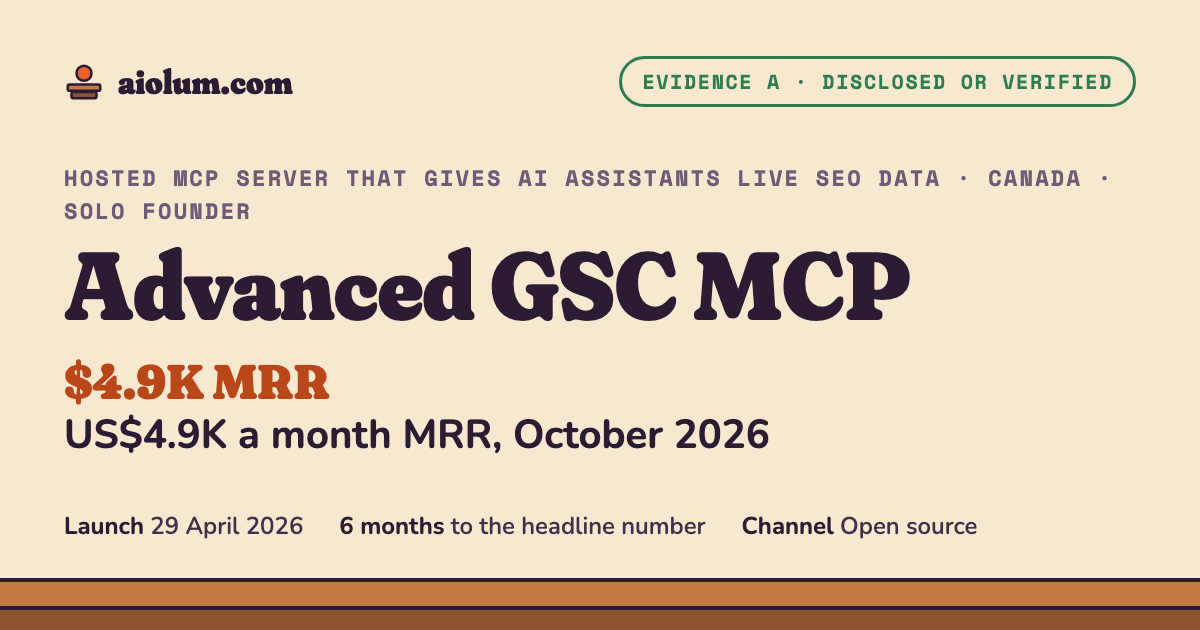
Advanced GSC MCP (Hosted MCP server that gives AI assistants live SEO data, Canada): US$4.9K a month MRR, October 2026. Evidence grade A: disclosed by a company or a filing, or verified by a payment processor. Team: 1 named founder; no source names any other staff. Launched 29 April 2026; still running, revenue growing.Added 25 October 2026
- Outcome
- US$4.9K a month MRR, October 2026Revenue growing
- Evidence
- A disclosed by a company or a filing, or verified by a payment processor
- Launch
- 29 April 2026
- Status
- Still running
- Team
- 1 named founder; no source names any other staff
- Outside funding
- None reported (TrustMRR listed Bootstrapped on 12 October 2026)
- Group
- SEO and AI search
- Main channel
- Open source
Advanced GSC MCP is a hosted MCP server for search specialists. MCP, the Model Context Protocol, is an open standard from Anthropic that lets an AI assistant call outside tools and read live data; an MCP server is the program that offers those tools. This one connects the assistant to Google Search Console (GSC), Google's free report of how a website appears in Google search: clicks, impressions, average position and indexing status. On the Pro plan it also connects GA4, Google Analytics 4, which counts visits on the site.
Amin Foroutan, an SEO consultant who builds his own tools, published a free GSC MCP server on GitHub in March 2025. Users asked for an easier way in, because the free version needs Python and a Google Cloud setup on the user's own computer. The hosted version started taking payments in late April 2026 and is sold in groups of 100 seats. On 25 October 2026 its Stripe account, read by TrustMRR, showed US$4,891 in monthly recurring revenue (MRR, the subscription revenue that repeats each month) from 149 active subscriptions. Revenue was US$1,041 in May 2026 and US$4,310 in August 2026.
The money numbers on this page are grade A: TrustMRR reads them from the payment processor through an API key. The team size and the funding status are founder statements. The page also shows four failed startups that sold dashboards, marketing analysis or easy data connections before AI assistants could do the analysis themselves.
How much revenue does Advanced GSC MCP make?
Each row shows the evidence grade and the source numbers from the list at the end of this page. The grades are explained in How Aiolum verifies.
| Fact | Value | Grade | How we know | Sources |
|---|---|---|---|---|
| Monthly recurring revenue, 25 October 2026 | US$4,891 | A | TrustMRR metric snapshot, revenue last synced from Stripe on 25 October 2026. TrustMRR states that its last-30-day MRR growth was 14.6%. | [1] |
| Run rate | US$58,692 a year | calc | Calculated: 4,891 multiplied by 12. | [1] |
| Active subscriptions, 25 October 2026 | 149 | A | TrustMRR metric snapshot from Stripe. | [1] |
| Average MRR per subscription | about US$32.83 | calc | Calculated: 4,891 divided by 149. This is close to the Pro price, US$40 a month, minus founding and quarterly discounts. | [1, 2] |
| Monthly recurring revenue, 12 October 2026 | US$4,712 from 144 subscriptions | A | A copy of the same TrustMRR profile, synced on 12 October 2026. From 12 to 25 October, MRR rose 3.8% (calculated). | [1] |
| Revenue, May 2026 | US$1,041 | A | TrustMRR monthly timeline from Stripe. April 2026 shows US$0.60, which looks like a test payment. | [1] |
| Revenue, June 2026 | US$1,364 | A | [1] | |
| Revenue, July 2026 | US$2,010 | A | [1] | |
| Revenue, August 2026 | US$4,310 | A | 2.14 times the July figure (calculated). Quarterly plans are paid in advance, so a month can include three months of payment from some customers. | [1] |
| Revenue, September 2026 | US$4,252 | A | 1.3% below August (calculated). | [1] |
| Revenue, 1 to 25 October 2026 | US$3,872 | A | Month not finished when read; the last day is partial. | [1] |
| Revenue, all time to 25 October 2026 | US$16,850 | A | TrustMRR total. The monthly rows above add up to US$16,849.60 (calculated). | [1] |
| Website visitors, last 30 days to 25 October 2026 | 4,101 | B | From the connected Google Analytics account, through TrustMRR. TrustMRR computes US$1.15 of revenue per visitor. | [1] |
| Seats sold in rounds | first round of 100 sold out; 36 of 100 left in round two | C | Company pricing page, 25 October 2026. That implies 164 seats taken in both rounds (calculated), against 149 active subscriptions at TrustMRR; the difference can be cancellations, but no source explains it. | [2, 4] |
| Team | 1 named founder | C | The pages are written in the first person by Amin Foroutan, support tickets go to the developer directly, and the terms say the service is owned by Amin Foroutan. No source gives a headcount. | [2, 4] |
| Outside funding | none reported | C | The TrustMRR profile copy of 12 October 2026 lists Funding: Bootstrapped, which is founder-entered profile text. The 25 October version no longer has the line. | [1] |
| Stars on the free open-source server, October 2026 | 2,028 | B | GitHub counter for AminForou/mcp-gsc. The company's About page still says over 800 stars, and a March 2026 article said more than 600. | [7, 6, 8] |
| Users of the founder's free Chrome extension | 10,000 in the store; 17,000+ on the company site | B | Chrome Web Store listing of Advanced GSC Visualizer, version 3.5.2, rating 4.5 from 70 ratings. The higher figure is the company's own claim (grade C). | [9, 11] |
| Time from the first payment to the headline figure | 6 months | calc | Calculated: 29 April 2026, the founding date on TrustMRR, to 25 October 2026 is 179 days. | [1] |
How to read this table: a grade A value comes from the company's Stripe account, read by TrustMRR through an API key. A grade B value is public data from a third party (GitHub, the Chrome Web Store, a connected Google Analytics account). A grade C value is a statement by the founder or on the company's own pages. A "calc" value was computed on this page from the rows above it.
| Plan | Per month, billed yearly (US$) | Per month, billed monthly (US$) | Limit |
|---|---|---|---|
| Free | 0 | 0 | 1 property, 3 Search Console tools, last 30 days of data |
| Starter | 12.75 | 15 | 3 properties, 200 search result lookups and 100 keyword lookups a month |
| Pro | 34 | 40 | 10 GSC and 10 GA4 properties, 500 search result lookups a month |
| Max | 89.25 | 105 | Unlimited properties (about 100 under fair use), crawl tools, 250 backlink lookups a month |
| Custom | custom | custom | Connections to a content management system such as WordPress or Webflow |
Prices exclude tax. Quarterly billing is 15% cheaper than monthly billing. The first 100 subscribers, the founding round, keep lower prices for as long as they stay subscribed: US$12, US$35 and US$100 a month, or US$29, US$84 and US$240 a quarter, as the Markdown version of the same page still lists. The customer's AI assistant is billed separately by its own provider. Starter and Pro can start with a 5-day free trial that needs a card; Max is billed at once.
When did Advanced GSC MCP launch, and how did it grow?
From a free open-source tool in March 2025 to a paid hosted service with US$4,891 of monthly recurring revenue in October 2026. Each entry carries its grade.
- March 2025CAmin Foroutan builds a free Google Search Console MCP server in Python and publishes it on GitHub under the MIT license, a few months after Anthropic introduced MCP. [8, 6]
- 2025CThe open-source server gets users who ask for an easier setup; the founder says this is why he built a hosted version. He also keeps his free Chrome extension for Search Console and his SEO consulting. [6, 10]
- 26 March 2026CHis article on the company blog explains GSC MCP and says the free server has more than 600 GitHub stars. [8]
- 29 April 2026AFounding date of the hosted product on TrustMRR. The Stripe account shows its first, very small payment in April. [1]
- May 2026AFirst full month of sales: US$1,041 of revenue. [1]
- July to August 2026ARevenue grows from US$2,010 to US$4,310 a month. [1]
- September 2026ARevenue US$4,252. The free open-source server gets releases 0.4.0 and 0.4.1 with fixes from outside contributors. [1, 7]
- 12 October 2026ATrustMRR shows US$4,712 of MRR and 144 active subscriptions. [1]
- 18 October 2026CNew terms of service: the product is in Early Access, sold in cohorts of up to 100 subscribers, and each subscriber keeps the price of the cohort while subscribed. [4]
- 25 October 2026ATrustMRR shows US$4,891 of MRR from 149 subscriptions. The pricing page says the founding round sold out and 36 of 100 round-two seats are left, at higher prices. [1, 2]
Why did Advanced GSC MCP work?
Four causes, in the order they mattered. Each one is a reusable lesson.
A free version first
The open-source server on GitHub does the core job for free, and its README links to the hosted version. The founder's About page says the paid product exists because users of the free one asked for an easier way in. The free code works as a demonstration and as a list of interested users.
Selling the setup, not the data
Google gives Search Console and GA4 data away through its official APIs. What the free route costs is time: Python, a Google Cloud project and an OAuth credentials file, and it works only in desktop apps. The hosted version replaces that with a Google sign-in and one line of configuration, and it also works in the web versions of Claude and ChatGPT.
Data the free version does not have
The paid plans add search result snapshots, keyword volumes and backlink data bought from DataForSEO, a licensed data provider, plus Core Web Vitals from Google's Chrome UX Report and page audits. Without these plans, a customer would need a separate SEO data tool for the same data.
An audience that already trusts the founder
The founder's free Chrome extension for Search Console has at least 10,000 users in the Chrome Web Store, and the extension site quotes posts about it by other search specialists. The extension site, the founder's own site and his news site Daily SEO Brief all link to the paid server.
Small rounds with price locks
Seats are sold in rounds of 100. Each round costs more than the one before, and a subscriber keeps the round's price while the subscription stays active. This gives early buyers a reason to subscribe now and a reason not to cancel.
How it was built
These details come from the company's terms, privacy policy, page source and the open-source repository. They are grade B and C. [4, 5, 7, 2, 1]
- The free version is a Python MCP server built on the official MCP Python SDK. Users run it on their own computer with a Google Cloud OAuth setup or a service account.
- The hosted version runs on rented cloud servers, and the privacy policy says it is operated from the United States. TrustMRR lists Next.js for the website, and the page source loads images from the Sanity content system.
- Search Console and GA4 data come from Google's official APIs. The privacy policy says the use of Google data follows the Google API Services User Data Policy, including its Limited Use rules, and that the server does not store the data permanently.
- Search results, keyword data and backlinks come from DataForSEO. Only the keyword, the location or the domain that the customer asks about is sent there.
- Payments, trials, retries of failed cards and plan changes run on Stripe. The in-app support assistant and the chat widget on the marketing pages use the OpenAI API.
- The marketing pages measure visits with Google Analytics, Microsoft Clarity and DataFast.
Tools named in the sources
Each one opens its page in the Tools tab, with every story that uses it.
Who tried this before Advanced GSC MCP, and why did they fail?
Four companies in the Loot Drop database sold marketing dashboards, automated marketing advice or easier connections between software tools before AI assistants could read the data and explain it. The values below are from that database and are not independently verified.
SumAll
The promiseOne dashboard for a small business's marketing and sales data, without a data scientist.
Why it diedLarge analytics companies and free tools offered the same charts. An undifferentiated dashboard could not justify its price.
Metigy
The promiseMachine learning that analyzes a small business's social media and recommends what to do, in place of a marketing team.
Why it diedThe recommendations were generic and small businesses wanted someone to do the work for them. It spent US$14 million on advice that customers did not use.
Xkit
The promiseA platform that makes connecting and managing third-party APIs easy for software teams.
Why it diedZapier and do-it-yourself cloud tools covered the same need, and Xkit could not keep up with its own integration work and costs.
DataNitro
The promiseRun Python scripts inside Excel for data analysis without leaving the spreadsheet.
Why it diedExcel added its own Python support and stronger competitors appeared, so the add-on lost its reason to exist.
The failed startups come from Loot Drop, a free database of dead startups, retold here in our own words. Loot Drop describes its entries as AI-assisted summaries of public sources, so these cards carry no evidence grade.
What changed
SumAll and Metigy both tried to turn marketing data into decisions for people who are not analysts. SumAll stopped at charts, which free tools also drew. Metigy tried to write the advice itself with its own machine learning, and its customers found the advice generic. Both needed large teams and venture money, and both closed.
Advanced GSC MCP does neither job itself. The customer's own AI assistant, which the customer already pays for, does the analysis, and the server only delivers the data and a few calculations to it. That is why one person can build and support it. The weak point is the one that ended Xkit and DataNitro: a connector is easy to copy, and the platforms it sits between, Google and the AI assistant makers, can add the same connection themselves.
Can one person copy Advanced GSC MCP now?
Yes, if you already have the audience.
Writing an MCP server for a public API is a small project, and the founder's own article calls his server one of the earliest GSC MCP implementations, so others exist. What is hard to copy is the founder's position: a free open-source server with about 2,000 stars and a free Chrome extension with at least 10,000 users in the same niche, built over several years.
Where it is still open: The same pattern is open for other data that professionals read every day through an official API: ad accounts, app store analytics, accounting systems, e-commerce stores. Each needs a founder who already knows the users and the questions they ask.
- 1Pick a data source that a professional group checks every day and that has an official API, such as Search Console for search specialists.
- 2Publish a free, self-installed MCP server first, and watch which setup steps users complain about.
- 3Sell the hosted version that removes those steps, and add paid data from a licensed provider that the free version does not have.
- 4Sell in small rounds with a locked price, and answer support requests yourself while the rounds are small.
What could go wrong for Advanced GSC MCP?
The risks are the mirror image of the causes above.
Google or the AI companies can add the same connection
Search Console and GA4 data are free from Google. If Google or Anthropic ships an official Search Console connector, the basic plan loses its reason to exist, and the paid data from DataForSEO becomes the main thing that customers pay for.
Revenue flat for two months
Revenue was US$4,310 in August and US$4,252 in September 2026, while MRR kept rising. Quarterly plans are paid in advance, so monthly revenue and MRR do not move together. The figures cover only six months.
Early Access status
The terms say the product is in Early Access, with expected bugs and outages, and that these do not qualify for a refund. Customers in later rounds pay more than founding members, which can make later rounds sell more slowly.
Numbers that do not agree
The company site says 17,000+ extension users; the Chrome Web Store shows 10,000. The About page says over 800 GitHub stars; GitHub shows 2,028. The pricing page implies 164 seats sold; TrustMRR counts 149 active subscriptions. TrustMRR lists the country as Canada, while the privacy policy says the service is operated from the United States.
Dependence on outside providers
The product depends on Google's API terms and quotas, on DataForSEO for search and backlink data, and on the MCP support of each AI assistant. A change in any of them changes what the product can sell.
Sources
The grade next to each source is the best grade that the source can support. "Read in full" means that the text of the page was downloaded and the numbers were checked in it.
- A TrustMRR, Advanced GSC MCP profile (Stripe-verified metrics, synced 25 October 2026)Read the markdown profile on 25 October 2026, and a copy of the same profile saved on 12 October 2026. Revenue, MRR and subscriptions come from Stripe through an API key; the description, country, founding date and funding line are founder-entered (grade C).
- C Advanced GSC MCP home and pricing pageRead in full on 25 October 2026, including the plan prices in the page source. Source for the plans, the seat rounds and the purpose check.
- C Advanced GSC MCP, Markdown version of the home page for AI agentsRead in full. Source for the plan contents, the founding-round prices and the FAQ answers.
- C Advanced GSC MCP Server, Terms of Service, updated 18 October 2026Read in full. Source for the owner's name, the official Google APIs, Early Access, the cohorts, the price locks, trials and refunds.
- C Advanced GSC MCP Server, Privacy PolicyRead in full. Source for Stripe, OpenAI, DataForSEO, the analytics tools, the Google API Services User Data Policy statement and the United States operation.
- C About Advanced GSCRead in full. Founder's account of the open-source server and why he built the hosted version.
- B GitHub, AminForou/mcp-gsc: Google Search Console MCP Server for SEOsRead the repository page and README on 25 October 2026. Source for the star count, the MIT license, the release notes and the link to the hosted version.
- C Advanced GSC blog, 26 March 2026, Amin Foroutan: Google Search Console MCP: What It Is and How to Use ItRead in full. Source for the March 2025 start of the open-source server and the setup that the free version needs.
- B Chrome Web Store, Advanced GSC VisualizerRead the listing page. Source for the user count, rating, version and update date of the founder's free extension.
- C Amin Foroutan, personal websiteRead the home page. Source for the founder's SEO consulting and his other tools, checked for the purpose rules.
- C Advanced GSC Visualizer home pageRead in full. The founder's free Chrome extension; source for its own user claim and its link to the paid server.
- C Daily SEO BriefRead the home page. The founder's AI-curated SEO news site; it carries a banner for the paid server.
- C Loot Drop database export, 1,749 failed startupsLocal export. AI-written summaries, not independently verified. Source for the failed predecessors.