TripDesk: Revenue, team and how it was built
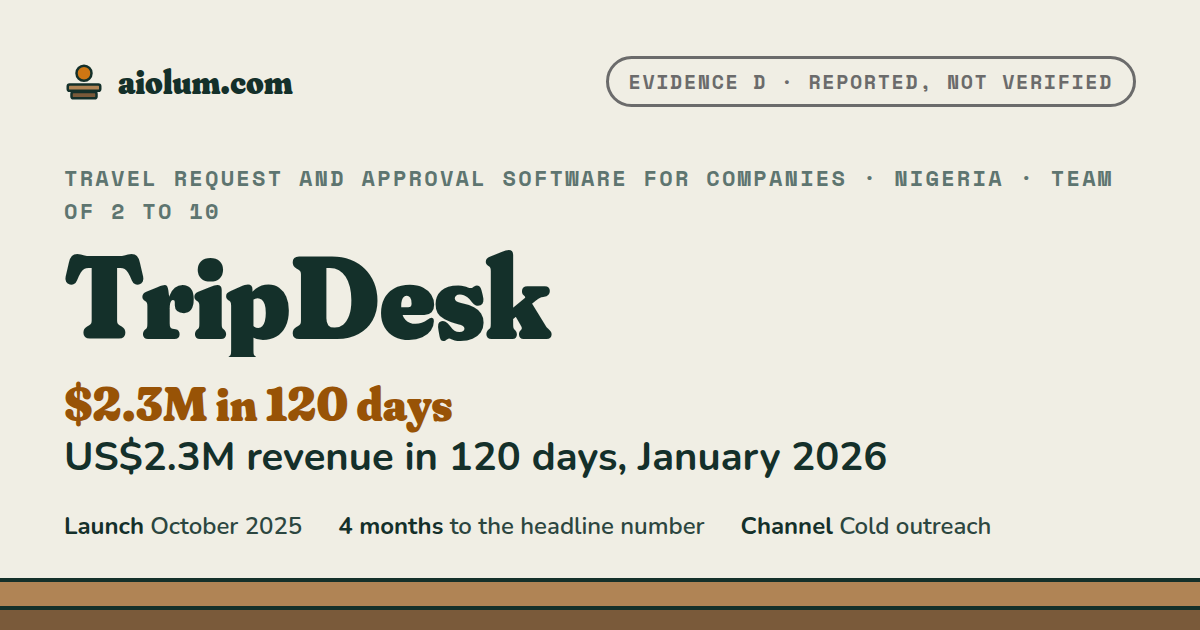
TripDesk (Travel request and approval software for companies, Nigeria): US$2.3M revenue in 120 days, January 2026. Evidence grade D: reported, not verified. Team: 10 people listed on the About page in November 2026, 4 of them co-founders; team size at the January 2026 figure not stated. Launched October 2025; still running.Added
- Outcome
- US$2.3M revenue in 120 days, January 2026
- Evidence
- D reported, not verified
- Launch
- October 2025
- Status
- Still running
- Team
- 10 people listed on the About page in November 2026, 4 of them co-founders; team size at the January 2026 figure not stated
- Outside funding
- Seed round of debt and equity, amount and investors not stated
- Main channel
- Cold outreach
What is not verified
The US$2.3 million revenue figure rests on press reports that retell one origin, the company or its founder. No piece gives the figure in a named person's own words, and Condia reported it first, on 30 January 2026. No piece says whether revenue means fees or the full value of bookings. No filing, payment-processor record or buyer confirms it. A reader could look for company accounts, an audit or an interview that defines revenue. The headline number is grade D: one claim or one estimate, with no second source. Aiolum shows it because the story is useful, and marks it so that it is not mistaken for a verified figure.
TripDesk is a travel approval platform. An employee asks for a trip, and a manager or finance controller approves it. The company's own pages say that AI checks each request against the company's travel rules and points out key details to the approver. The founder is Mark Essien, who also founded the hotel-booking site Hotels.ng, according to Disrupt Africa and Condia.
Disrupt Africa reported on 3 February 2026 that TripDesk crossed US$2.3 million in revenue within 120 days of its public debut. The same piece reported that it was profitable by its second month and had closed a seed round that mixed debt and equity. Condia, Techpoint and BusinessDay reported the same figure between 30 January and 11 February 2026.
The figure comes from one origin, the company or its founder, and no filing, payment record or buyer confirms it. None of the four pieces explains whether revenue means fees or the full value of the bookings. The company's site shows a demo request and no price.
Why did TripDesk work?
Four causes, in the order they mattered. Each one is a reusable lesson.
Hotels.ng corporate customers asked for an approval system
Techpoint reported that Hotels.ng ran a VIP unit for large companies for years. Those companies needed approvals by line managers, controllers and finance teams, not only rooms. In Techpoint's account, TripDesk was built for that gap. Techpoint also reported that it took about a year to build.
A few large contracts carried the reported revenue
BusinessDay reported that TripDesk had fewer than 30 customers in its first four months. It wrote that these were enterprise clients with large travel budgets. Techpoint reported, citing Essien, that a single customer means a significant jump in revenue. Techpoint also wrote that losing one client can have a material effect.
Direct sales and Hotels.ng ties found the first customers
BusinessDay wrote that most early users came through direct sales and existing networks, with no heavy marketing spend. Techpoint wrote that Hotels.ng acts as a funnel for these clients. Neither names a customer or a channel with numbers.
How it was built
These details come from press reports and from the company's own pages. Nothing here is confirmed by the company's technical staff. [3, 5, 6, 7]
- Techpoint quoted this about the software: "There's nothing technically crazy about it. It is a simple piece of software."
- Techpoint wrote that it took about a year to build. It quoted Essien: "I had to carry the old investors along."
- Techpoint credits HNG, the Hotels.ng Internship, with the pool of developers from which the team was assembled. Social links in the page source of the company's site point to pages named hngtech and hng-internship.
- The pages are built with Next.js, a JavaScript web framework, and load Google's analytics tag. Both appear in the page source of the home page.
- The AI role: the company's pages say that AI checks requests against company rules and suggests similar hotels. Techpoint wrote that it acts as a decision assistant, not a content generator.
- In February 2025 a Hotels.ng representative booked the hotel after approval, according to the archived home page.
Tools named in the sources
Each one opens its page in the Tools tab, with every story that uses it.
Who tried this before TripDesk, and why did they fail?
Three companies in our database of failed startups sold travel or lodging with technology and shut down. The values below were read on 11 November 2026 and are not independently verified.
Utrip
The promiseAI-made travel itineraries, with a paid version for hotels, agencies and tourism boards.
Why it diedThe record says its customers had small budgets and the AI systems cost a lot to run.
HotelsAroundYou
The promiseLast-minute and short-stay hotel bookings in India, paid by commission.
Why it diedThe record says it faced Oyo Rooms and MakeMyTrip, which had more brand recognition and money, and could not raise more funding.
Frontdesk
The promiseFurnished apartment hotels for business travelers, with keyless entry and mobile check-in.
Why it diedThe record says the unit economics were poor, the company expanded too fast, and the economy turned against it.
The failed startups come from our database of 1,749 dead startups, retold here in our own words. Its entries are AI-assisted summaries of public sources, so these cards carry no evidence grade.
What changed
The three predecessors served travelers or lodging in markets with many rivals and thin margins. Press describes TripDesk as selling to the finance and procurement teams of large companies. A contract there is large, and the number of buyers is small.
Techpoint wrote that the pool of possible clients is small. It reported that Essien expects little churn. It also wrote that a competitor would need a funnel like Hotels.ng. These are claims, not measured results.
Can one person copy TripDesk now?
Possible, but it needs an existing customer base.
The reported route is to sell software to the large customers of an earlier business. Techpoint credits the Hotels.ng VIP unit as the source of both the need and the first buyers. A founder without such a base would need another way to reach large companies.
Where it is still open: Other manual back-office processes of large companies in Africa, such as approvals of expenses, purchases and leave, where a founder already serves such customers.
- 1List the manual process that your best customers ask you to do for them, such as approvals and invoices.
- 2Build the software for that process with their rules, and sell it to those customers first.
- 3Sell to a few large buyers, since Techpoint reported 20 to 30 customers for the US$2.3 million figure.
- 4Say what revenue means in your accounts, because the press pieces on TripDesk do not.
How much revenue does TripDesk make?
Each row shows the evidence grade and the source numbers from the list at the end of this page. The grades are explained in How Aiolum verifies.
| Fact | Value | Grade | How we know | Sources |
|---|---|---|---|---|
| Revenue within 120 days of public launch | US$2.3 million | D | Disrupt Africa reported this on 3 February 2026 as the company's result. Condia reported the same figure first, on 30 January 2026, then Techpoint and BusinessDay. No piece gives the number in a named person's own words. BusinessDay attributes the explanation of the figure to Essien. | [1, 2, 3, 4] |
| What revenue means | not stated | D | Techpoint reported that the company earns subscription fees and service charges on bookings. No piece says whether the US$2.3 million counts fees or the total value of bookings. The terms of service say TripDesk "acts simply as a mediator between you (the customer) and the service provider". The terms also say customers can pay into TripDesk's bank accounts. | [3, 8] |
| Profit | profitable by the second month; about 30% of revenue was profit | D | Disrupt Africa reported the second month. Techpoint wrote that about 30% of the revenue is profit, without naming who stated it. | [1, 3] |
| Customers | fewer than 30, up to 4,000 employees each | D | BusinessDay reported fewer than 30 customers in the first four months. Techpoint reported 20 to 30 customers, the largest with up to 4,000 employees. Neither names one. | [3, 4] |
| Company start | 2024 | C | The About page says: "Founded in 2024, Tripdesk was created with a clear goal". The earliest Internet Archive capture of the domain is 31 August 2024. | [5, 7] |
| Older company of the same founder | Hotels.ng, launched in 2012 or 2013 | D | Condia dates Hotels.ng to 2013. Techpoint wrote on 10 February 2026 that the launch was 14 years earlier, which gives 2012. Techpoint wrote that TripDesk emerged from the needs of Hotels.ng's VIP customers. | [2, 3] |
| Public launch | about October 2025 | calc | Calculated: 120 days before the first report, the Condia article of 30 January 2026, is 2 October 2025. This is the latest possible month, since the figure was reached before the report. The press does not give a launch date. | [1, 2] |
| Time from launch to the revenue figure | 4 months | calc | Calculated: 120 days is about 4 months. Condia and BusinessDay also write four months. | [1, 2, 4] |
| Team on the About page, November 2026 | 10 people, 4 of them co-founders | C | The page lists four co-founders and six other people by role. It carries no date and no headcount for January 2026. The roles listed are management, finance, legal, content and four account executives, and no engineer is listed. BusinessDay wrote that the company has a lean team. | [5, 4] |
| Funding | seed round of debt and equity | D | Disrupt Africa reported a seed round with a strategic debt-equity mix. Amount and investors are not stated. Condia reported that existing Hotels.ng investors were given a deal. BusinessDay wrote that Essien "has not announced plans to raise external funding". | [1, 2, 4] |
| How it charges | monthly subscription fees and service charges on bookings | D | Techpoint reported this. The company's own pages show no price, only a demo request form. | [3, 6] |
| Price on the website | none; demo request only | C | The home page offers "Request a Demo today" and lists no plan or amount. | [6] |
How to read this table. Grade D means a figure that was reported and not verified. Grade C is a statement on the company's own pages. A grade X value was computed on this page.
| Plan | Per month, billed yearly (US$) | Per month, billed monthly (US$) | Limit |
|---|
The home page, the pricing path and the About page were read on 11 November 2026 and show no plan or amount. Techpoint reported that the company charges monthly subscription fees and service charges on bookings, without amounts.
When did TripDesk launch, and how did it grow?
From a hotel-booking company of 2012 or 2013 to a business-travel platform that press covered in early 2026. Each entry carries its grade.
- 2012 or 2013DMark Essien launches Hotels.ng, a hotel-booking site for Nigeria. Condia dates it to 2013. Techpoint's count of 14 years gives 2012. [2, 3]
- 2024CThe About page of TripDesk says it was founded in 2024. The Internet Archive first captured the domain on 31 August 2024. [5, 7]
- 28 February 2025CAn Internet Archive copy of the home page offers a demo and says that a Hotels.ng representative books the hotel. [7]
- About October 2025calcPublic launch, by calculation: 120 days before the first press report of the revenue figure. [1, 2]
- 30 January to 11 February 2026DCondia, Disrupt Africa, Techpoint and BusinessDay report US$2.3 million in revenue, profit from the second month and a seed round. [2, 1, 3, 4]
- 11 November 2026CThe home page still offers a demo request without a price. The About page lists 10 people. [5, 6]
What could go wrong for TripDesk?
The risks are the mirror image of the causes above.
What is not verified
The US$2.3 million revenue figure rests on press reports that retell one origin, the company or its founder. No piece gives the figure in a named person's own words, and Condia reported it first, on 30 January 2026. No piece says whether revenue means fees or the full value of bookings. No filing, payment-processor record or buyer confirms it. A reader could look for company accounts, an audit or an interview that defines revenue.
Customers are not named, and no price is shown
No independent source confirms that these customers pay. The home page shows "Trusted by Leading Companies" above eight empty placeholder boxes, because the logos load by script, so no company is named. Press reports say there are fewer than 30 customers. The site offers a demo request only.
The older company of the same founder
Hotels.ng, launched in 2012 or 2013, belongs to the same founder. Condia wrote that Hotels.ng investors "have been given a deal they are happy with". The About page says TripDesk was founded in 2024. Techpoint describes a Hotels.ng VIP unit as the origin of the need and Hotels.ng as a funnel for clients. It is not verified whether that unit counts as an earlier version of the product. No source says how much of the reported revenue comes from earlier Hotels.ng customers.
The product pages show testimonials with first names only
The pages for enterprises, small businesses and startups each show six short quotations, 18 in total. Each carries a first name and a job title, with no company and no surname. Press reports describe fewer than 30 customers, all large companies. No source confirms who these people are.
AI is one part of the product, and people did the booking
The archived home page of 28 February 2025 does not mention AI. It says that "A Hotels.ng representative books the hotel". Techpoint wrote in February 2026 that the AI "works quietly in the background". The home page of November 2026 says AI checks rules and suggests hotels. No source says who books the hotels today. The About page lists four account executives and no engineer.
The terms page describes a wider business
The terms of service say TripDesk provides tools, products and services of all types, such as hotels, designs, flights, cars and clothing. They also offer payment in cash or by ATM card. The home page and the About page describe only business travel approval.
Sources
The grade next to each source is the best grade that the source can support. "Read in full" means that the text of the page was downloaded and the numbers were checked in it.
- D Disrupt Africa, 3 February 2026: African corporate travel AI startup TripDesk hits $2.3m revenue 4 months after launchRead in full. Source for the revenue figure, the second-month profit and the seed round. It quotes Essien on other points.
- D Condia, 30 January 2026: Mark Essien's new company, TripDesk has crossed $2.3m in revenue barely 4 months post-launchRead in full. Source for the date of Hotels.ng, the seed round and the deal for Hotels.ng investors.
- D Techpoint Africa, 10 February 2026: How Mark Essien's 4-month old product made $2.3 million with less than 30 customersRead in full. Interview-based feature. Source for the origin in the Hotels.ng VIP unit, the customer count and how it charges.
- D BusinessDay, 11 February 2026: How Mark Essien's new startup hit $2.3m revenue in four months with fewer than 30 customersRead in full. Source for fewer than 30 customers, the lean team and the early customer channels.
- C TripDesk About page, read 11 November 2026Read in full. Source for the start year 2024, the team list and the description of the product.
- C TripDesk home page, read 11 November 2026Read in full, including the page source. Shows the demo request, no price and the placeholder boxes of the logo wall.
- C Internet Archive copy of the TripDesk home page, 28 February 2025Read in full. Shows that the product offered a demo in 2025 and that Hotels.ng staff did the booking. The capture list shows 31 August 2024 as the first.
- C TripDesk terms of service, read 11 November 2026Read in full. Source for the scope of services and the payment methods the terms describe.
- C TripDesk product pages for enterprises, small businesses and startups, read 11 November 2026Read in full, with the pages /products/for-smbs and /products/for-startups. Source for the first-name testimonials named in the notes.
- C Database of failed startups, local exportRecord pages read on the website on 11 November 2026. AI-written summaries, not independently verified. Source for the predecessors.
Run this company? Send corrections or a verified figure to aiolum@livyden.com