Vaultaire: Revenue, team and how it was built
Vaultaire (Encrypted photo and file vault for iPhone, United States): US$41K in a single month, October 2026. Evidence grade D: reported, not verified. Team: 1 founder: "No team, no investors, no advisory board". Launched March 2026; still running, revenue growing.Added 26 October 2026
- Outcome
- US$41K in a single month, October 2026Revenue growing
- Evidence
- D reported, not verified
- Launch
- March 2026
- Status
- Still running
- Team
- 1 founder: "No team, no investors, no advisory board"
- Outside funding
- None for Vaultaire (the founder's earlier company PEX was venture funded)
- Group
- Photos and portraits
- Main channel
- Search and AI answers
What is not verified
The headline figure, US$41,000 in a single month, rests on one source: Rasty Turek's interview with Starter Story, published 18 October 2026. The same is true of the US$66 first month and the US$2,000 to US$3,000 a day. The AI Money Brief issue of 19 October 2026 only repeats that interview and labels the numbers "Self-reported". He showed an App Store Analytics screen on the video, but no payment processor or buyer has confirmed the numbers, the month of the US$41,000 is not named, and his daily figure implies more than that month. A reader could look for a TrustMRR or RevenueCat profile, an App Store Connect report, or a second dated interview, such as the Indie Hackers interview of 8 October 2026 that reportedly gave US$40,000 a month; it could not be read here, because Indie Hackers blocks AI crawlers. The headline number is grade D: one claim or one estimate, with no second source. Aiolum shows it because the story is useful, and marks it so that it is not mistaken for a verified figure.
Vaultaire is a photo vault app: an app that stores private photos and files apart from the phone's normal photo library. Most such apps only hide the files behind a PIN screen; Vaultaire encrypts them on the device with AES-256-GCM, a standard method of encryption that also detects if the encrypted data was changed. The key comes from a pattern that the user draws, through PBKDF2, a function that turns a short secret into a long key slowly, so that guessing many patterns takes a long time. The app is free for up to 3 vaults with 100 photos and 10 videos; the App Store page lists Vaultaire Pro at US$1.99 a week, US$5.99 a month, US$19.99 a year or US$39.99 once.
Rasty Turek built it alone. He grew up in Slovakia, worked for a security company that Google acquired and then at Google, sold an entertainment company to Amazon, and in 2025 sold PEX, a venture-funded copyright company. He told the Starter Story video channel in an interview published on 18 October 2026 that it is his first iOS app, "mostly thanks to the coding agents", that it took about three weeks, and that he has not written "a single line either of code or the text on the web". The App Store version history starts in March 2026. In the same interview he said the app made US$66 in its first month, then US$41,000 in a single month about six months later, and that it was averaging US$2,000 to US$3,000 a day, with more than 60,000 downloads.
This page gives the story the grade D, reported, not verified: every revenue figure is a founder statement in one interview on one date. During that interview he showed his App Store Analytics screen to the hosts, and the host said "You're doing over 40,000 a month", but no payment processor, buyer or second dated interview has confirmed the figures, and an earlier interview with Indie Hackers could not be read for this page. The story belongs to the collection "Built with AI": the product is ordinary privacy software, and AI is the tool that let one person with no iOS experience build and market it. The page also shows earlier privacy products that failed because free products from large companies were good enough for most users.
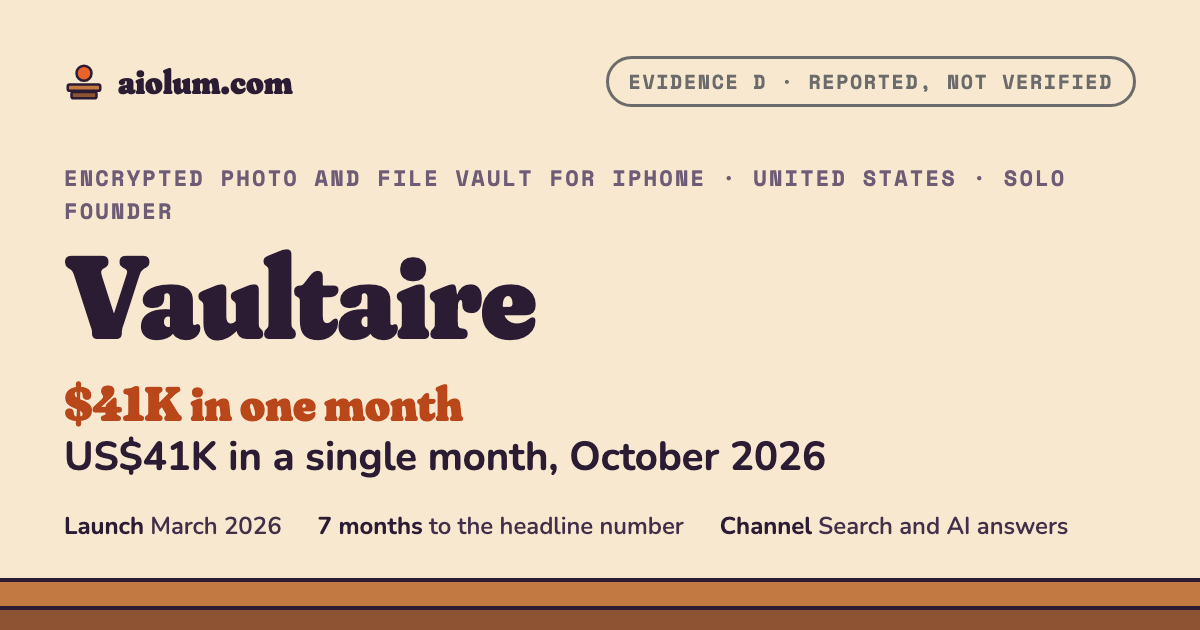
How much revenue does Vaultaire make?
Each row shows the evidence grade and the source numbers from the list at the end of this page. The grades are explained in How Aiolum verifies.
| Fact | Value | Grade | How we know | Sources |
|---|---|---|---|---|
| Revenue in a single month, reported October 2026 | US$41,000 | D | Starter Story interview, 18 October 2026. The host says the app made US$41,000 in a single month six months after its first month, and "You're doing over 40,000 a month" after the founder showed his App Store Analytics screen. The month is not named, and no source says whether the figure is before or after Apple's commission. | [1, 2] |
| Run rate from that month | US$492,000 a year | calc | Calculated: US$41,000 times 12. A single month is not a stable rate, and most of the money is one-time lifetime purchases. | [1] |
| Daily revenue, October 2026 | about US$2,000 to US$3,000 a day | D | Founder in the same interview: "It's currently averaging around 2 000 to 3 000 a day"; on the dashboard: "daily revenue is like hovering around 2 000 these days". AI Money Brief quotes the lower US$41,000 figure and says the daily figure "would be higher". | [1, 2] |
| Monthly revenue implied by the daily figure | US$60,000 to US$90,000 | calc | Calculated: US$2,000 and US$3,000 times 30 days. This is higher than the US$41,000 month, so the two founder statements agree only if revenue rose after that month. The headline uses the lower figure. | [1] |
| Revenue in the first month | US$66 | D | Founder: "The first month it made 66 got a couple of downloads". | [1, 2] |
| Downloads, October 2026 | just over 60,000 | C | Founder: "I just passed 60 000 overall downloads". | [1, 2] |
| Share of lifetime purchases | about 60% of purchases, more than 80% of revenue | C | Founder: "majority of my purchases are for lifetime I will say a good 60 at this point They also account for majority of the revenue north of 80 I think". | [1, 2] |
| Conversion to paid users | lowest on day 1, highest around day 60 | C | Founder in the interview. He read a download-to-paid rate of 5.47% on day one from his dashboard; the transcript writes it as "5 47". | [1] |
| Build time and the role of AI | about three weeks, all code written by coding agents | C | Founder: "It's my first iOS app mostly thanks to the coding agents It took roughly three weeks" and "I literally haven't written a single line either of code or the text on the web Everything is done by one of the coding agents". AI Money Brief names the agents as Codex and Claude. | [1, 2] |
| First version in the App Store history | 1.0.2, 13 March 2026 | C | Version history on the App Store page, read 26 October 2026. The host says the founder started in March. | [3, 1] |
| Web conversion | about 10% of web visitors, and the web is most of the traffic | C | Founder: "I have around 10 conversion from the web and the web is the majority of traffic at this point". | [1, 2] |
| Content output | one guide a day | C | Founder: "essentially publishing one a day and that's it". He said Google needs about three to four days to register a new guide. | [1, 2] |
| Team | 1 person | C | About page: "No team, no investors, no advisory board." The app is published by Wraxle LLC. | [4, 3] |
| Outside funding for Vaultaire | none | C | About page. The founder said his previous company, PEX, was venture funded and was sold in 2025. | [4, 1] |
| App Store rating, 26 October 2026 | 4.7 out of 5 from 52 ratings; age rating 4+ | C | US App Store page. Category Photo and Video. | [3] |
| Time from launch to the October 2026 figure | 7 months | calc | Calculated: March 2026 to October 2026. | [1, 3] |
How to read this table: a grade D value is a founder statement that appears in one source only, the Starter Story interview of 18 October 2026, which the AI Money Brief newsletter repeats, and that no payment processor, buyer or second interview confirms. A grade C value is another founder statement in that interview or a fact read on the App Store page or the company's site. A "calc" value was computed on this page from the rows above it. No value is grade A or B.
| Plan | Per month, billed yearly (US$) | Per month, billed monthly (US$) | Limit |
|---|---|---|---|
| Free | 0 | 0 | up to 3 vaults, 100 photos and 10 videos in total |
| Vaultaire Pro Weekly | 1.99 a week | Pro features | |
| Vaultaire Pro Monthly | 5.99 | Pro features | |
| Vaultaire Pro Annual | 1.67 | US$19.99 a year | |
| Vaultaire Pro Lifetime | 39.99 one-time | Pro features, no renewal | |
| Vaultaire Pro Family Annual | 4.17 | US$49.99 a year, Apple family group | |
| Vaultaire Pro Family Lifetime | 99.99 one-time | Apple family group |
All payments go through Apple's in-app purchase. The founder said in October 2026 that the lifetime plan is about 60% of purchases and, he thought, more than 80% of revenue. The yearly plans are shown as a monthly figure, calculated here as the yearly price divided by 12. The App Store also lists an "Annual Offer" at US$19.99. Family plans cover an Apple family group.
When did Vaultaire launch, and how did it grow?
From a personal tool for wallet keys to US$41,000 in a month, in about seven months. Each entry carries its grade.
- Before 2025CTurek, who grew up in a village of 700 people in Slovakia, moves to Boston to work for a security company that Google acquires, then works on the Gmail team, and later sells an entertainment company to Amazon. [1]
- 2025CHe sells PEX, a venture-funded company for copyright in music and entertainment. [1, 2]
- March 2026CHe builds Vaultaire, his first iOS app, in about three weeks with coding agents, to store wallet keys and pictures of documents. Version 1.0.2 is in the App Store on 13 March. He sets a price only the day before release, to limit support requests. [1, 3]
- First monthCThe app makes US$66 from a few downloads. [1]
- April to May 2026CUpdates add Spanish, French, German, Portuguese and Japanese, then seven more languages. The site and the app later read in 31 languages. [3]
- 2026CHe builds a daily loop: a command-line tool he wrote, Gum, pulls Google Keyword Planner and search data each morning, and a coding agent writes one guide for a search where the site appears but gets no clicks. [1, 2]
- About six months after launchCUS$41,000 in a single month, the founder showed and the host said. [1]
- 18 October 2026CStarter Story interview: US$2,000 to US$3,000 a day, more than 60,000 downloads, about 60% of purchases on the lifetime plan. [1]
- 23 October 2026CVersion 1.1.2 in the App Store, with backup and restore fixes. [3]
Why did Vaultaire work?
Four causes, in the order they mattered. Each one is a reusable lesson.
Coding agents replaced the iOS experience he did not have
The founder's background is B2B and enterprise software. He said the app was his first for iOS, possible "mostly thanks to the coding agents", and that agents wrote every line of the code and of the website text. That is why one person could ship a native Swift app in about three weeks.
Web search instead of App Store search
He said the vault apps that lead the App Store are 15 years old or older and that he had no chance to pass them there, but that they ignore the web. His site lists the features and adds guides for long, specific searches such as how to store photos on an iPhone. He said about 10% of web visitors convert and that the web is most of his traffic.
A daily keyword loop run by an agent
Each morning his tool Gum reads Google Keyword Planner and search data and finds searches where the site is shown but not clicked. An agent writes one guide for such a search and links it from pages that already have traffic. He said he keeps it to one guide a day so that the content stays useful rather than mass-produced.
Trust first, payment later
The free tier is usable. He said conversion is lowest on the first day and highest around day 60, the opposite of apps that must convert at once. Most buyers choose the US$39.99 lifetime plan, which he said gives more than 80% of revenue.
How it was built
These details come from the founder's interview with Starter Story, the AI Money Brief account of it, the App Store page and the company's own pages. They are grade C. [1, 2, 4, 5, 3]
- A native iPhone and iPad app in Swift with UIKit, built in about three weeks with the coding agents Codex and Claude, which, the founder said, wrote all of the code and all of the website copy.
- Encryption on the device: AES-256-GCM for the files under a random master key, PBKDF2 to turn the drawn pattern into a vault key, the iOS Keychain, and a nine-word recovery phrase per vault.
- No company server for the vaults: backup and sync go to the user's own iCloud account through Apple's CloudKit, encrypted before they leave the phone.
- Payments through Apple's in-app purchase, with weekly, monthly, yearly and lifetime plans.
- Marketing by a daily loop: Gum, the founder's own open-source command-line tool, reads Google Keyword Planner and search data; a coding agent writes and links one guide a day.
- Analytics and crash reports are on by default and can be switched off in Settings, the company's pages say. Starter Story lists Cloudflare in the stack; its use is not described.
Tools named in the sources
Each one opens its page in the Tools tab, with every story that uses it.
Who tried this before Vaultaire, and why did they fail?
Four companies in the Loot Drop database sold privacy as the main reason to choose them, and failed when free products from large companies were good enough for most people. The values below are from that database and are not independently verified.
Skiff
The promiseEnd-to-end encrypted email, documents and file storage, as a private alternative to Google Workspace.
Why it diedFree incumbents with network effects; privacy was not enough of a difference for most users.
Tenta
The promiseA private web browser with a built-in VPN.
Why it diedChrome, Firefox and Safari added privacy features for free.
Graphite Docs
The promiseA private alternative to Google Docs built on a blockchain.
Why it diedUsers chose free and fast over secure and expensive.
Neeva
The promiseAn ad-free search engine for US$5 a month, without tracking.
Why it diedToo few people paid for private search, and AI chat changed search.
The failed startups come from Loot Drop, a free database of dead startups, retold here in our own words. Loot Drop describes its entries as AI-assisted summaries of public sources, so these cards carry no evidence grade.
What changed
Each of the four asked people to replace a free product that they used every day, with privacy as the reason, and needed a large team and venture money to build that replacement. Most users did not switch. Vaultaire does not ask anyone to leave the iPhone, Google Photos or iCloud: it adds one small place for the few files a person most wants to protect, and it uses Apple's own iCloud for backup.
The cost is different too. The founder said coding agents wrote the app and the site, and the app has no servers, so the business has almost no fixed costs and one person can run it. Its customers come from web searches, which the older vault apps do not compete for, according to the founder. The risk that killed the predecessors is still there in another form: Apple can improve the hidden album in iOS, and Google can change how it ranks the guides.
Can one person copy Vaultaire now?
Yes, for a builder who can judge security code.
Nothing in the product is new: photo vaults are an old App Store category. What is copyable is the method: let coding agents build a small, single-purpose utility in weeks, then let an agent write one useful guide a day for searches that the large competitors ignore. The part that is not easy to copy is the founder's security background, which a privacy app needs, because a user who loses a pattern or a file to a bug cannot get it back.
Where it is still open: Other old App Store utility categories whose leaders do little on the web: scanners, file managers, password and document lockers, simple trackers.
- 1Pick a category that people already search for and already pay for, with old leaders.
- 2Build a native app with coding agents, and review the parts where a bug loses user data.
- 3Make a plain site with the features, then add guides for long, specific searches.
- 4Each day, find searches where the site is shown but not clicked, and publish one guide for one of them.
- 5Offer a lifetime price next to the subscription, and let the free tier earn trust before asking for money.
What could go wrong for Vaultaire?
The risks are the mirror image of the causes above.
What is not verified
The headline figure, US$41,000 in a single month, rests on one source: Rasty Turek's interview with Starter Story, published 18 October 2026. The same is true of the US$66 first month and the US$2,000 to US$3,000 a day. The AI Money Brief issue of 19 October 2026 only repeats that interview and labels the numbers "Self-reported". He showed an App Store Analytics screen on the video, but no payment processor or buyer has confirmed the numbers, the month of the US$41,000 is not named, and his daily figure implies more than that month. A reader could look for a TrustMRR or RevenueCat profile, an App Store Connect report, or a second dated interview, such as the Indie Hackers interview of 8 October 2026 that reportedly gave US$40,000 a month; it could not be read here, because Indie Hackers blocks AI crawlers.
Lifetime revenue does not recur
He said lifetime purchases are more than 80% of revenue. Each month's money must therefore come from new buyers. AI Money Brief wrote: "When the traffic stops, so does the revenue."
Traffic depends on Google and on agent-written pages
The founder said coding agents write all the text on the site and publish one guide a day, and that the web is most of his traffic. He said he limits the number of guides so they are not mass-produced, but a change in Google's ranking could cut the main channel. The site also has comparison pages against ten competing vault apps.
A privacy promise with stated limits
No source has audited the encryption. The company's own pages say that analytics, crash diagnostics and Apple Ads attribution are "enabled by default" and can be turned off, that crash reports can include file names, and that an examiner with the app's files "can still estimate how many vaults you have". A forgotten pattern and phrase cannot be recovered. The founder told of a call from an FBI agent whom he could not help.
Country not stated
The seller is Wraxle LLC. The founder grew up in Slovakia and moved to Boston for work; no source says where he or the company is based now. The country on this page comes from those two facts.
Sources
The grade next to each source is the best grade that the source can support. "Read in full" means that the text of the page was downloaded and the numbers were checked in it.
- C Starter Story, 18 October 2026: This app is making $2,000 PER DAY (video interview with Rasty Turek, with transcript)Read in full: the page and the full transcript. Source for the revenue figures, the downloads, the lifetime share, the role of coding agents, the background and the marketing loop.
- C AI Money Brief, 19 October 2026: His first iPhone app makes ~$41K a monthRead the section on Vaultaire. A newsletter account of the Starter Story interview; source for the names of the coding agents, the stack table and the label "Self-reported".
- C App Store: Vaultaire: Photo Vault, by Wraxle LLC (US storefront)Read in full on 26 October 2026. Source for the prices, the rating, the age rating, the seller and the version history.
- C Vaultaire: About VaultaireRead in full. Source for the one-person team, the absence of investors, the encryption design and the analytics statement.
- C Vaultaire home pageRead in full. Source for the features, the free tier and the limits of the privacy promise.
- C Vaultaire Terms of UseRead in full. Source for the lawful-use clause and the subscription terms.
- C Loot Drop database export, 1,749 failed startupsLocal export. AI-written summaries, not independently verified. Source for the failed predecessors.