Acephalt: Product, team and how it was built
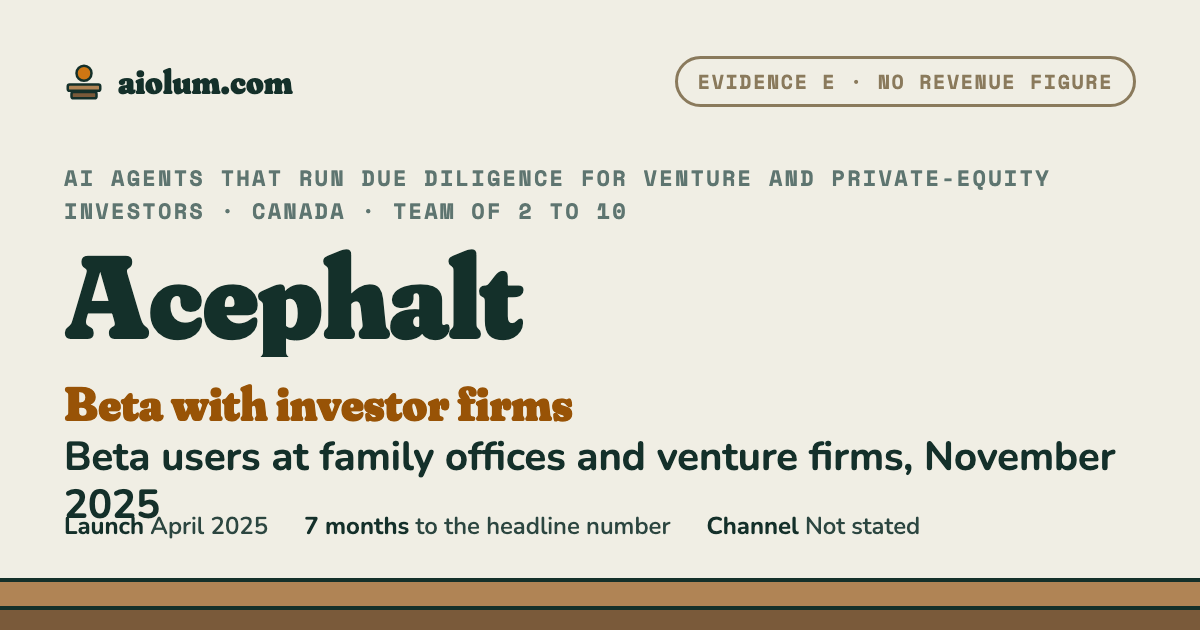
Acephalt (AI agents that run due diligence for venture and private-equity investors, Canada): Beta users at family offices and venture firms, November 2025. Evidence grade E: no revenue figure was checked. Team: Founded by Winnicent Zuo; a CFO writes on the company blog in 2026; headcount not published. Launched April 2025; still running.Added 5 November 2026 · updated 6 November 2026
- Outcome
- Beta users at family offices and venture firms, November 2025
- Evidence
- E no revenue figure was checked
- Launch
- April 2025
- Status
- Still running
- Team
- Founded by Winnicent Zuo; a CFO writes on the company blog in 2026; headcount not published
- Outside funding
- None found in the sources
- Main channel
- Not stated
What is not verified
No revenue figure was found. The only traction statements are the UpNext profile of 7 November 2025 (beta users and design partners, no names or count, and more than 1,000 hours saved by the users' own report) and the company's own unnamed case study. No price list, payment-processor profile, funding announcement or company filing was found. The launch month on this page is the date of the terms of use, not a published launch date. A reader could look for a named customer, a funding announcement or a founder interview with figures. This story is grade E: the business is real and its product, price and customers are described from public pages, but no revenue figure was checked. Aiolum shows it as an idea worth studying, not as proof that it makes money.
Acephalt is an AI platform for due diligence, the checking that an investor does on a company before investing: reading its contracts, financial statements and market claims. Investors receive these files in a data room, a shared folder that the company opens to possible investors. Acephalt runs several AI agents, programs that call a language model in steps and use tools without a person typing each prompt, in parallel over the data room, and it drafts an IC memo, the written case that a deal team sends to its investment committee.
Winnicent Zuo founded it; the company is Acephalt Inc. at 250 Wellington Street West in Toronto. UpNext, a founder-media site, wrote on 7 November 2025 that the platform "has already attracted design partners and beta users across North American family offices and venture firms" and that early adopters report "saving over 1,000 hours" of diligence time. The company's own blog describes one investor turning a 370-file data room into a full IC memo in under 24 hours.
No revenue figure, price list, customer name or funding round was found. This page is a grade E story: the business is real and live, and what it has achieved in money is not known.
How much revenue does Acephalt make?
Each row shows the evidence grade and the source numbers from the list at the end of this page. The grades are explained in How Aiolum verifies.
| Fact | Value | Grade | How we know | Sources |
|---|---|---|---|---|
| Company | Acephalt Inc., 250 Wellington Street West, Toronto, Ontario, Canada | C | Terms of use and the security and privacy page. The terms are governed by the laws of Ontario and of Canada. | [7, 8] |
| Founder | Winnicent Zuo | C | UpNext profile, 7 November 2025: he studied mathematics and computer science and later earned a master's degree in financial engineering. | [1] |
| Earliest dated company page | terms of use last updated 3 April 2025 | C | No launch date is published. The Internet Archive's earliest copy of the home page found is from 19 January 2026. The launch month on this page is the date of the terms. | [7, 9] |
| Users, November 2025 | design partners and beta users at North American family offices and venture firms | C | UpNext profile, 7 November 2025. No firm is named and no count is given. | [1] |
| Time saved, November 2025 | "over 1,000 hours" of due diligence time | C | UpNext profile: "Early adopters report saving over 1,000 hours of due diligence time." Not a money figure, and not checked. | [1] |
| Case study | a 370-file data room to a full IC memo and model review in under 24 hours | C | Company blog. One investor, not named. Another company post dates the case study to 6 December 2025. | [4, 5] |
| Team | founder plus a CFO, Nicolas Frendo, who signs a company post; headcount not published | C | Company blog post "Introduction to Acephalt", written by the CFO. No source gives the number of people. | [3, 1] |
| Prices | not published | C | Home page read 5 November 2026: Get Started and Talk to us only. | [2] |
| Partner model for spreadsheets, 2026 | Tetra, a spreadsheet agent from DealGlass, embedded by API | C | Company benchmark post: "Acephalt is partnering with DealGlass to embed Tetra as the spreadsheet agent for VC and family office due diligence, via bespoke API." | [6] |
| Outside funding | none found | C | No funding round is named in any downloaded source. | [1, 2, 3] |
| Time from the terms date to the beta-user report | 7 months | calc | Calculated: April 2025 to November 2025. | [7, 1] |
How to read this table: a grade C value comes from the company's own pages or from a founder profile written from his statements. A "calc" value was computed on this page. No value is grade A or B, and no revenue figure exists.
| Plan | Per month, billed yearly (US$) | Per month, billed monthly (US$) | Limit |
|---|---|---|---|
| Get Started or Talk to us | no list price | sign-up in the web app or a booked call; terms not published |
The home page offers "Get Started", which leads to the web app at app.acephalt.com, and "Talk to us", which books a call. No plan names, prices or limits appear on any page that was read, and the site has no pricing page.
When did Acephalt launch, and how did it grow?
From terms of use dated April 2025 to a benchmark study of AI agents in 2026. Each entry carries its grade.
- 3 April 2025CDate of the terms of use of Acephalt Inc., Toronto. The earliest dated page of the company that was found. [7]
- 2025CZuo gives an UpNext PopUp interview at Elevate Festival 2025. [1]
- 7 November 2025CUpNext publishes a founder profile: design partners and beta users at North American family offices and venture firms, and more than 1,000 hours of diligence time saved, by the users' own report. [1]
- December 2025CThe company publishes a case study: one investor turns a 370-file data room into an IC memo in under 24 hours. [4, 5]
- 12 March 2026CSecurity and privacy overview of Acephalt Inc. last updated. [8]
- 2026CThe company tests three AI agents on a cap-table model and announces a partnership with DealGlass to embed its Tetra spreadsheet agent. [6]
Why did Acephalt work?
Four causes, in the order they mattered. Each one is a reusable lesson.
One agent per kind of work
Diligence mixes financial, legal and market analysis. The founder told UpNext that most AI tools treat these as one task, so Acephalt gives each part to a specialised agent and then joins the results into one report.
A source for every figure
An investor has to defend each number in front of an investment committee. Acephalt links every claim and figure in the memo back to the file in the data room, which a plain chat answer does not do.
The firm's own scorecard
A firm sets its investment criteria once, and the software scores each new deal against them and lists the open questions for the team. This makes the output fit the firm, not a general template.
How it was built
These details come from the company's own pages and the page source of its site. They are grade C. [2, 6, 7]
- A web app at app.acephalt.com; the marketing site is a Next.js site.
- Parallel agents read the data room, build or check the financial model and draft the memo, with exports to Excel, Word and PDF.
- Connectors bring in data rooms, call transcripts, inboxes and CRM records; the home page says 20 or more connectors are available on request.
- For spreadsheet work it embeds Tetra, an agent from DealGlass, through an API. Which language models run the other agents is not published.
- The terms say that AI outputs, including memos, risk flags and confidence scores, remain subject to verification by the user.
Who tried this before Acephalt, and why did they fail?
Three companies in our database of failed startups sold data and analysis to investors and failed. The values below are from that database and are not independently verified.
Mattermark
The promisePrivate-company data and growth signals for venture investors.
Why it diedIt could not set itself apart from CB Insights and PitchBook, and the cost of collecting data grew faster than revenue.
Monitor110
The promiseEarly warning signals for hedge funds from blogs, news and social media.
Why it diedProcessing the data cost more than clients paid, and the market was not ready for it.
Pit.AI
The promiseAI-driven insights to manage investment portfolios.
Why it diedIt could not show better results than traditional asset managers, and regulation asked for transparency that its models did not give.
The failed startups come from our database of 1,749 dead startups, retold here in our own words. Its entries are AI-assisted summaries of public sources, so these cards carry no evidence grade.
What changed
The three predecessors sold data or signals and had to pay to collect and process that data themselves. Acephalt does not sell data: the investor brings the data room, and the software does the reading and checking that analysts did by hand.
Language models that can read hundreds of documents and write a structured memo became available only after 2022, so one founder can now build what needed a data team before. The open question is the same one that ended Mattermark: whether a small company can stay different from large data vendors and from general AI tools that add the same features.
Can one person copy Acephalt now?
Hard for one person; the pattern is clear.
Selling software to investment firms needs knowledge of how diligence works, trust with careful buyers, and security reviews. The pattern can be copied in other fields where a professional reads a pile of documents and must cite each claim.
Where it is still open: Audit, lending, insurance underwriting and legal review, where small teams read data rooms of their own. The founder told UpNext he is looking at internal auditing.
- 1Pick a document-heavy decision that a small team makes again and again.
- 2Split the reading into specialised agents, one per kind of analysis.
- 3Link every output figure to its source file, so the buyer can defend it.
- 4Start with design partners who bring real files, before setting prices.
What could go wrong for Acephalt?
The risks are the mirror image of the causes above.
What is not verified
No revenue figure was found. The only traction statements are the UpNext profile of 7 November 2025 (beta users and design partners, no names or count, and more than 1,000 hours saved by the users' own report) and the company's own unnamed case study. No price list, payment-processor profile, funding announcement or company filing was found. The launch month on this page is the date of the terms of use, not a published launch date. A reader could look for a named customer, a funding announcement or a founder interview with figures.
Competition and model providers
Henry AI, already on this site, also sells AI-built underwriting work to finance professionals, and the company itself compares its product with general tools such as Claude and ChatGPT, which can read the same files. The company's 2026 benchmark tested Opus 4.7 and GPT-5.5 against its partner DealGlass's Tetra agent, which it embeds by API; which model providers run the rest of the product is not published, so its dependence on them cannot be judged.
Sample data and a produced profile
The home page shows a demonstration dashboard whose rows name well-known companies such as Databricks, Figma and Notion with check sizes and partner initials; the page does not say that these are customers or real deals. The UpNext profile is a "Flashpoint POV" feature, which the page says is produced by Flashpoint Global, a thought-leadership studio that works with founders.
People mapping
The home page offers to "Map the executives, decision makers, shareholders, and stakeholders behind every company" and to "Enrich every profile". It is presented as research on companies under review; the pages read do not say which data sources it uses for people.
Sources
The grade next to each source is the best grade that the source can support. "Read in full" means that the text of the page was downloaded and the numbers were checked in it.
- C UpNext, 7 November 2025: The Future of Due Diligence (Flashpoint POV founder profile of Winnicent Zuo)Read in full, from the copy downloaded by the pipeline on 6 November 2026. A profile written from the founder's statements. Source for the founder, the beta users and the 1,000 hours.
- C Acephalt home page, read 5 November 2026Read in full. Source for the product, the connectors, the demonstration dashboard and the absence of prices.
- C Acephalt blog: Introduction to Acephalt, written by Nicolas Frendo, CFORead in full. Source for the CFO and the company's own description.
- C Acephalt blog: A Real Deal: 370 Files To A Full IC Memo In Under 24 HoursRead in full. The company's case study of one unnamed investor.
- C Acephalt blog: Why Acephalt Outperforms Claude and ChatGPT in Data Room Due DiligenceRead in full. Source for the comparison with general AI tools and the date of the case study.
- C Acephalt x DealGlass: Benchmarking Agents for Cap Table ModellingRead the sections on the method and the partnership. Source for the models tested and the Tetra integration.
- C Acephalt terms of use, last updated 3 April 2025Read in full. Source for the company name, address, governing law and the earliest company date.
- C Acephalt security and privacy overview, last updated 12 March 2026Read in full. Confirms Acephalt Inc. and its Toronto address.
- C Internet Archive Wayback Machine availability record for acephalt.comRead in full. The closest copy to 1 January 2023 is from 19 January 2026, so no earlier copy was found.
- C Database of failed startups, local exportLocal export. AI-written summaries, not independently verified. Source for the failed predecessors.
Run this company? Send corrections or a verified figure to aiolum@livyden.com