Poetic: Revenue, team and how it was built
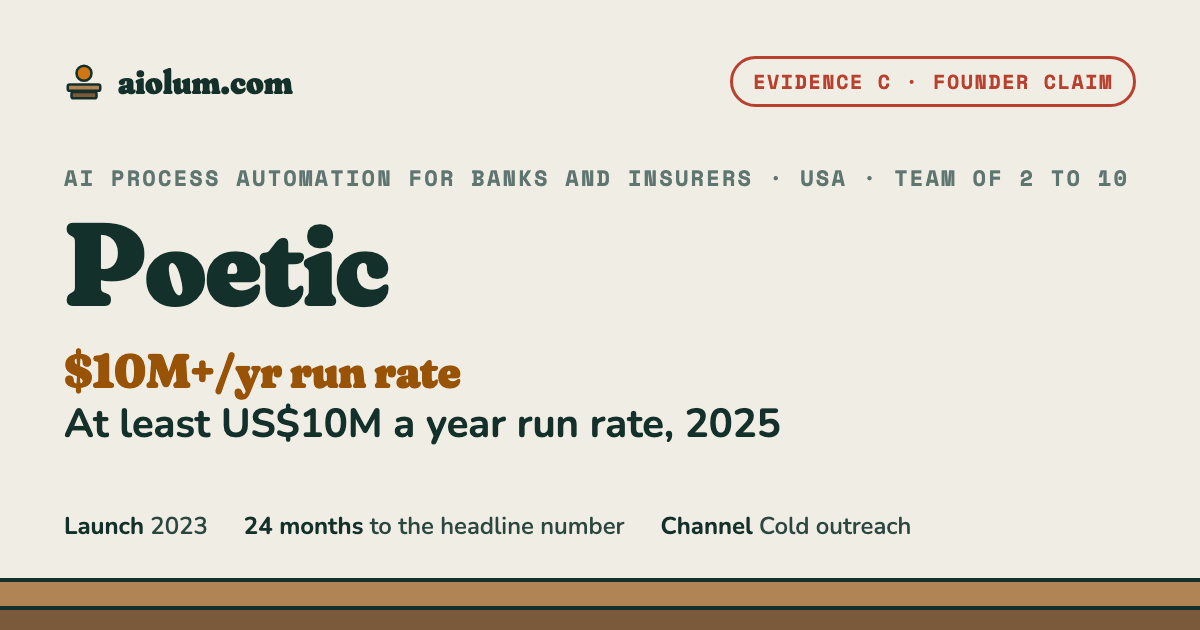
Poetic (AI process automation for banks and insurers, USA): At least US$10M a year run rate, 2025. Evidence grade C: the founder's own figures, not verified by anyone else. Team: 1 founder in 2023; 4 people at the 2025 run rate; later headcount not published, hiring after the June 2026 round. Launched 2023; still running.Added 5 November 2026 · updated 6 November 2026
- Outcome
- At least US$10M a year run rate, 2025
- Evidence
- C the founder's own figures, not verified by anyone else
- Launch
- 2023
- Status
- Still running
- Team
- 1 founder in 2023; 4 people at the 2025 run rate; later headcount not published, hiring after the June 2026 round
- Outside funding
- Seed led by Kleiner Perkins (amount not published); US$50M Series A at a US$500M valuation, June 2026
- Main channel
- Cold outreach
Poetic, called Forge until 2026, sells enterprise process automation: software that does multi-step office work in large companies that people did by hand, for example checking whether a disputed card payment was fraud. Its idea is to "learn like AI but run like code". A language model reads the company's procedures and expert feedback, and the result is stored as deterministic program steps, which means the same input always gives the same output, instead of a model that reasons freely on every case.
Markie Wagner founded it alone in 2023, according to Silicon Republic. She had worked on machine learning at Stanford, Google and Waymo, and ran an AI consultancy called Delphi. On 10 June 2026 the company said in a press release that it had reached an "eight-figure run rate in 2025 with just four employees". A run rate is the current revenue of a month or quarter extended to a full year. Eight figures means US$10 million to US$99.9 million a year, so this page uses US$10 million, the lowest value that the words allow. Its lead investor, Kleiner Perkins, wrote the same day that Poetic was profitable in 2025 with four people.
The same release announced a US$50 million Series A, the first large venture round after the seed round, at a US$500 million valuation, according to the company. The money is to grow a team of engineers who work on site at customers. This page grades the revenue C: the company and its investor state it, but only as a range, and no payment processor or filing confirms it. The customers named by the company are SoFi, AIG and Chime.
How much revenue does Poetic make?
Each row shows the evidence grade and the source numbers from the list at the end of this page. The grades are explained in How Aiolum verifies.
| Fact | Value | Grade | How we know | Sources |
|---|---|---|---|---|
| Run rate in 2025 | at least US$10 million a year | C | The press release says "an eight-figure run rate in 2025". Eight figures is a range from US$10,000,000 to US$99,999,999; this page uses the lower bound. No month in 2025 is given. Kleiner Perkins, the lead investor, repeats it. | [1, 2] |
| People at that run rate | 4 | C | Press release: "with just four employees". Kleiner Perkins: "with just four people". | [1, 2] |
| Profitable | yes, in 2025 | C | Stated by Kleiner Perkins only: "became profitable in 2025". No profit figure is given. | [2] |
| Run rate per person | at least US$2.5 million a year | calc | Calculated: 10,000,000 divided by 4 equals 2,500,000. | [1] |
| Founded | 2023, as Forge | B | Silicon Republic, citing Bloomberg. The Lean AI Leaderboard also lists 2023. No month is published. | [4, 8] |
| Founders | Markie Wagner alone | B | Silicon Republic: founded "by Markie Wagner". The press release calls her "CEO and Founder". No source names a co-founder. | [1, 4] |
| Series A, 10 June 2026 | US$50 million | C | Led by Kleiner Perkins, with Founders Fund, First Harmonic and OpenAI. The company's home page also lists Genius Ventures. One directory dates the round 8 July 2026; this page uses the press release date. | [1, 5, 9] |
| Valuation at the Series A | US$500 million | C | Stated by the company. | [1] |
| Valuation divided by run rate | at most 50 times | calc | Calculated: 500,000,000 divided by 10,000,000 equals 50. Because US$10 million is the lowest possible run rate, 50 is the highest possible multiple. | [1] |
| Seed round | led by Kleiner Perkins, amount not published | C | The investor writes that she backed the company "at the seed stage when Markie was still finishing her last consulting engagement". | [2, 3] |
| Named customers | SoFi, AIG, Chime | C | The home page shows quotes from SoFi, AIG and Chime. The press release names SoFi and AIG. | [1, 5] |
| Fraud investigations at SoFi | 99%+ quality in five weeks | C | Company statement in the press release. The home page shows "99% Quality for auto-decisioning fraud". | [1, 5] |
| Disputes handled | more than 500,000 | C | Home page, in the Chime quote: "More than 500,000 disputes have been handled using Poetic-supported workflows". | [5] |
| Pilot to production conversion | 100% | C | Founder statement in the press release. No count of pilots is given. | [1] |
| Open roles, November 2026 | 7 | C | Careers page: forward deployed engineer, forward deployed strategist, platform engineer, talent, recruiting coordinator, recruiting operations lead, enterprise sales. The total headcount is not published. | [6] |
| Time from founding to the 2025 run rate | about 24 months | calc | Calculated: from 2023 to 2025 is 2 years, 24 months. Neither date has a month, so the real value can be from about 13 to 35 months. | [1, 4] |
How to read this table: a grade B value comes from a journalist's report. A grade C value is a statement by the company, its founder or its investor. A grade D value comes from a directory that copies other sources. A grade X value was computed on this page from the rows above it.
| Plan | Per month, billed yearly (US$) | Per month, billed monthly (US$) | Limit |
|---|---|---|---|
| Enterprise contract | custom | custom | No public price; sold after a pilot at the customer |
The home page and the product page offer only a "Work With Us" contact. Enterprise software of this kind is sold by contract after a pilot, so the price depends on the processes and the volume. No source states a contract size.
When did Poetic launch, and how did it grow?
From a one-person start in 2023 to a US$500 million valuation in June 2026. Each entry carries its grade.
- Before 2023BMarkie Wagner works on machine learning at Stanford and Waymo and runs Delphi, an AI consultancy. She sees AI projects that work in tests fail in real company processes. [3, 4]
- 2023BShe founds the company as Forge. Kleiner Perkins invests at the seed stage while she is finishing her last consulting project. [2, 4]
- 2025CThe company reaches a run rate of at least US$10 million a year with four people, and it is profitable, according to the company and its lead investor. [1, 2]
- 10 June 2026CForge is renamed Poetic and leaves stealth with a US$50 million Series A at a US$500 million valuation, led by Kleiner Perkins with Founders Fund, First Harmonic and OpenAI. [1, 4]
- June 2026CTech Funding News repeats the run rate and the headcount and reports that the money goes to the forward-deployed engineering team and to new industries such as healthcare and government processes. [3]
- November 2026CThe careers page lists seven open roles in San Francisco and New York, most of them for engineers and recruiters. [6]
Why did Poetic work?
Four causes, in the order they mattered. Each one is a reusable lesson.
A narrow, costly problem
Fraud investigations, disputes and know-your-customer checks run thousands of times a day at a large bank, take a person hours each, and must follow written rules that regulators check. A tool that does them correctly saves a lot of staff time, so a few customers can pay a large amount. The company says it saved Fortune 500 customers "double-digit millions".
Code at run time, AI at build time
Most AI agents call a language model at every step, which costs tokens and can give different answers to the same case. Poetic uses the model to turn procedures, videos and expert corrections into a workflow in its own programming language, then runs that workflow as fixed steps with few or no model calls. The company calls this "near-tokenless execution".
Engineers at the customer
Poetic sells with forward deployed engineers: engineers who work inside the customer's systems. This lets four people serve a few large customers, but it limits how fast the company can add customers. The Series A money is for more of these engineers.
Proof at well-known customers
The founder and the investor point to results at SoFi and AIG and to a claimed 100% rate of pilots that became production contracts. In regulated industries a reference customer matters more than marketing, because each new buyer asks what other banks already use.
How it was built
Poetic has published no technical write-up. These points come from the press release, the investor's post and the product page, all grade C. [1, 2, 5, 7]
- A purpose-built programming language: operators describe a workflow in natural language, and the system turns it into deterministic steps.
- Input is the customer's own material: standard operating procedures (SOPs) as PDF files, training session videos and screenshots of the internal tools.
- The product page shows "GPT 5.5 Medium", an OpenAI model, as the model that reads these materials and writes the first draft. OpenAI is also an investor.
- Expert feedback loop: an investigator comments on a result (for example, widen a time window from 8 to 16 hours), and the workflow is updated until it reaches production quality.
- Self-repair: when a screen in the customer's system changes, for example a tab is renamed, the automation finds the new element and continues.
- Security claims on the home page: data stays in the customer's environment, zero data retention including for AI, audit logs, and SOC 2 Type II and PCI DSS certification.
Tools named in the sources
Each one opens its page in the Tools tab, with every story that uses it.
Who tried this before Poetic, and why did they fail?
Three companies in our database of failed startups promised to automate the back-office work of large regulated companies. The values below are from that database and are not independently verified.
Olive AI
The promiseAn "AI workforce" of software bots that would handle prior authorizations, claims and billing for hospitals.
Why it diedThe bots were brittle and broke whenever a hospital changed its software or forms, and each customer needed custom integration work by many engineers, so costs grew with every sale.
Opkit
The promiseAutomated health insurance verification and claims processing for healthcare providers.
Why it diedIntegration with each provider's existing systems was hard, contracts stayed short, and large vendors such as Epic offered bundled services.
Solid
The promiseOne API layer to connect enterprise systems and automate workflows between them.
Why it diedIt tried to support more than 100 enterprise systems at once; every connector needed upkeep, sales cycles were long and support costs too high.
The failed startups come from our database of 1,749 dead startups, retold here in our own words. Its entries are AI-assisted summaries of public sources, so these cards carry no evidence grade.
What changed
Olive AI is the closest earlier attempt: it sold hospitals bots that would do administrative work and raised US$852 million, according to the database. Its bots were robotic process automation (RPA), scripts that click through screens in a fixed order. They broke whenever a form or screen changed, and each customer needed many engineers to build and repair them.
Poetic claims two changes. A language model now writes the first version of the workflow from the procedures and videos that a company already has, so less engineering work is needed for each customer. And when a screen changes, the system finds the new element and continues instead of failing. The fixed-step execution keeps the predictability that regulated work needs. Whether this keeps costs low as the company grows is not yet shown by any public figure after 2025.
Can one person copy Poetic now?
Not by one person today.
Poetic sells to the largest banks and insurers. That needs a founder with years of applied machine learning work, reference customers, security certifications such as SOC 2 and PCI DSS, and engineers who work inside the customer's systems. It now has venture funding and investors that include OpenAI, and it competes with RPA vendors and with large AI companies that sell agents to the same buyers.
Where it is still open: Smaller regulated companies, such as regional banks, credit unions and small insurers, run the same dispute and compliance procedures with fewer staff, and the large vendors sell to them less. A narrow product for one procedure in one country is a possible start for a small team.
- 1Pick one procedure that a regulated company runs thousands of times a day by hand and that has written rules.
- 2Learn the procedure from the customer's own documents and from the experts who do it, not from a general model.
- 3Use the model to build the workflow, then run it as fixed, logged steps that an auditor can check.
- 4Sell to one large customer first and use the result as the reference for the next.
What could go wrong for Poetic?
The risks are the mirror image of the causes above.
The run rate is a range
The only revenue statement is "an eight-figure run rate in 2025", made by the company in its press release of 10 June 2026 and repeated by its lead investor Kleiner Perkins the same day. Eight figures can mean anything from US$10 million to US$99.9 million; no month, no exact figure, no payment-processor profile and no filing exists. A reader could look for a later round announcement or an interview with an exact number.
A customer quote that differs between pages
In the press release, SoFi's chief executive is quoted: "we've seen 100% process adherence, even in our most complex compliance investigations." The same quote on the company's home page in November 2026 reads: "we've seen consistent adherence to our high standards, even in our most complex processes." The two versions of the quote say different things, and the page notes the difference without judging it.
Company performance claims
The figures 99%+ quality, 100% pilot-to-production conversion and "double-digit millions in savings" are the company's own statements. No customer or auditor has published the measurement method.
Team after the round
The team was four people in 2025. The company is hiring for seven roles, and the Kleiner Perkins partner said in the press release that the team includes leaders from Palantir, UiPath, Ramp, Scale and Retool, but no source gives the headcount after June 2026. If it is now above 10, this is a story of a team that grew after funding.
Decisions about customers' money
Poetic's work includes fraud and dispute decisions that affect bank customers' access to their accounts. The Chime quote on the home page says that "agents remain responsible for all dispute decisions"; at SoFi, the quote speaks of "auto-decisioning". How each customer divides decisions between people and software is not public.
Sources
The grade next to each source is the best grade that the source can support. "Read in full" means that the text of the page was downloaded and the numbers were checked in it.
- C PR Newswire, 10 June 2026, company press release: Poetic Raises $50M Series A to Automate the World's Most Complex Enterprise Processes with Reliable AIRead in full. Primary source for the run rate, the headcount, the round, the valuation and the customer results.
- C Kleiner Perkins, 10 June 2026, post by partner Leigh Marie Braswell: Poetic: Turning Enterprise Procedures into Evolving SoftwareRead in full. The lead investor's statement. Source for profitability in 2025, the seed round and the founder's background.
- C Tech Funding News, 12 June 2026: She left Google and Waymo because she kept watching AI fail in production. Now Kleiner Perkins and OpenAI just backed her $500M fixRead in full. Repeats the company's figures; source for the founder's background and the planned use of the money.
- B Silicon Republic, 10 June 2026: OpenAI backs automation start-up Poetic in $50m roundRead in full. Journalist report citing Bloomberg. Source for the founding year, the former name Forge and the founder.
- C Poetic home page, read 5 November 2026Read in full. Source for the customer quotes, the dispute count, the investors and the security claims.
- C Poetic careers page, read 5 November 2026Read in full. Source for the open roles.
- C Poetic product page, read 5 November 2026Read in full. Source for how the product works and the model shown.
- D Lean AI Leaderboard, published Google Sheet (CSV export), downloaded 5 November 2026Read the Poetic row. It lists US$10,000,000 annual revenue, 4 employees, founded 2023, with the press release as its source. Not an independent figure.
- D Funded Startups Daily, company page for PoeticRead in full. A directory. Used for the company's web address and to note that it dates the round 8 July 2026.
- C Database of failed startups, local exportLocal export. AI-written summaries, not independently verified. Source for the failed predecessors.
Run this company? Send corrections or a verified figure to aiolum@livyden.com