Almanac: Product, team and how it was built
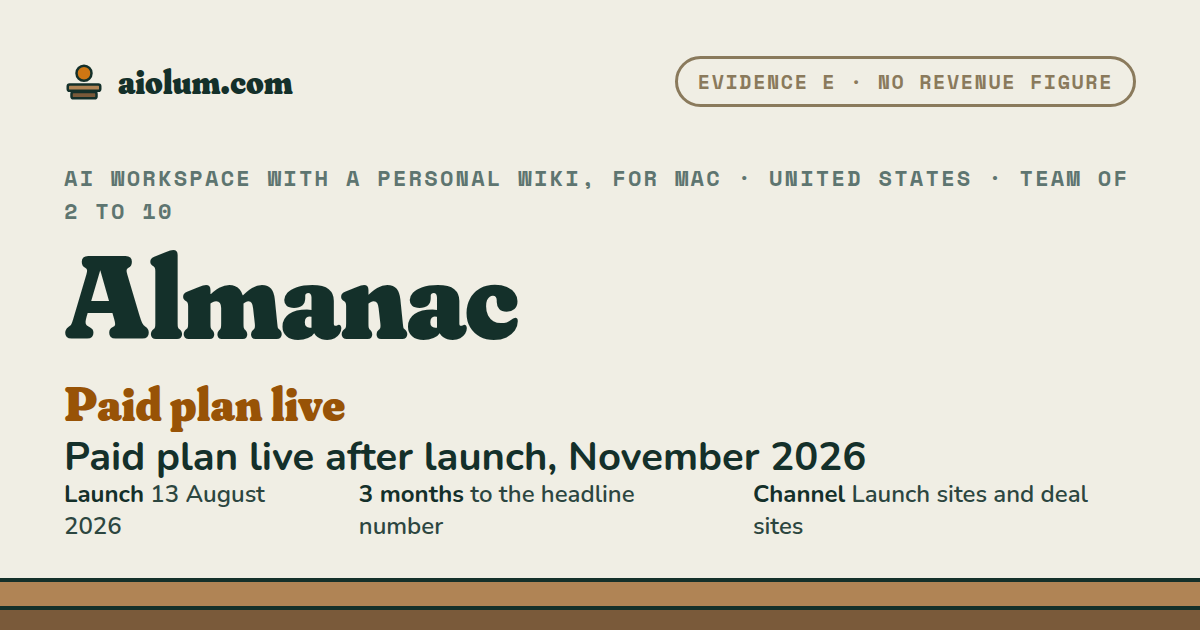
Almanac (AI workspace with a personal wiki, for Mac, United States): Paid plan live after launch, November 2026. Evidence grade E: no revenue figure was checked. Team: 3 founders; team size 3 on the Y Combinator directory page, read 12 November 2026. Launched 13 August 2026; still running.Added
- Outcome
- Paid plan live after launch, November 2026
- Evidence
- E no revenue figure was checked
- Launch
- 13 August 2026
- Status
- Still running
- Team
- 3 founders; team size 3 on the Y Combinator directory page, read 12 November 2026
- Outside funding
- Backed by Y Combinator, Summer 2026 batch; amount not found
- Main channel
- Launch sites and deal sites
What is not verified
No revenue figure was found, so the story is grade E. The home page, pricing page, terms, privacy page, subprocessor page, the Y Combinator page and the Launch HN post were read, and none gives revenue. A reader could look for a payment-processor profile or a press interview. No source states that a customer has paid. The founders say they have customers and name none, and the funding amount and the date of incorporation were not found. This story is grade E: the business is real and its product, price and customers are described from public pages, but no revenue figure was checked. Aiolum shows it as an idea worth studying, not as proof that it makes money.
Almanac is a Mac app that gives a person an AI agent, a program that takes steps on the user's behalf. The agent works from a wiki, a set of linked pages. Almanac builds the pages from connected accounts such as Gmail, Calendar and PostHog. The founders say it keeps a personal wiki and a company wiki.
The company is Reverie Project, Inc., doing business as Almanac, in San Francisco. Three founders started it: Rohan Sharma, Kushagra Chitkara and Divit Sheth. The Y Combinator directory lists 2025 as the founding year, the Summer 2026 batch and a team of 3. The founders posted a Launch HN on 31 August 2026.
No revenue figure was found, so the story is grade E. The pricing page lists one plan, Pro, at US$20 a month after a 7-day trial that needs a card. No source states that a customer has paid.
Why did Almanac work?
Four causes, in the order they mattered. Each one is a reusable lesson.
The founders built it after setting up an agent for themselves
The Launch HN post says the three founders set up Hermes for their own company, built connectors by hand and struggled with its memory. It adds that other founders in their batch had the same problem. No source shows how many users came this way.
It keeps context in a wiki that the agent reads first
The home page and the Y Combinator page say the agent works from a wiki that updates from the user's accounts. The founders write that most assistants treat memory as an afterthought. They give no benchmark, and a founder's reply on Hacker News says the team has no formal benchmarks.
The price changed from a demo quote to one US$20 plan
A copy of 13 May 2026 tells visitors to book a demo for a quote. A copy of 31 August 2026 lists plans at US$30, US$100 and US$200 per user a month. The page of 16 October 2026 lists one plan at US$20 a month.
How it was built
These details come from the company's own subprocessor page and its Hacker News post. They are grade C. [5, 5, 5, 7, 7]
- WorkOS handles sign-in, Supabase holds the database, Vercel hosts the website and Render runs the hosted APIs, according to the subprocessor page.
- Personal agent runtimes run on Fly.io, and managed browser sessions run on Browserbase, according to the same page.
- OpenAI supplies model inference and search embeddings, according to the subprocessor page.
- A founder wrote on Hacker News on 31 August 2026 that the model was GPT-5.6-terra and that the team wants to control the harness.
- Composio handles the authorization of connected accounts, and the founders write that the OAuth credentials sit with the connection provider, not in Almanac's database.
Tools named in the sources
Each one opens its page in the Tools tab, with every story that uses it.
Who tried this before Almanac, and why did they fail?
Three companies in our database of failed startups sold a tool for keeping and organizing information or an AI assistant. The values below are from that database, were read on 12 November 2026 and are not independently verified.
Springpad
The promiseA tool to collect and organize web content such as articles, videos and recipes.
Why it diedThe record says the free service was valued, but premium and enterprise offers did not show a clear value, and Evernote developed faster.
Memo
The promiseA platform where teams create, share and archive rich media memos in one place.
Why it diedThe record says established tools added similar features, and Memo could not turn trials into paying subscriptions.
Humane
The promiseA wearable AI device, the Ai Pin, meant to replace the smartphone with voice and gesture.
Why it diedThe record says it built a solution in search of a problem, and it lists slow answers and a short battery life.
The failed startups come from our database of 1,749 dead startups, retold here in our own words. Its entries are AI-assisted summaries of public sources, so these cards carry no evidence grade.
What changed
The records name two causes: a free tool with no clear reason to pay, and large incumbents that added the same features. Almanac sells software only, not a device, and it charges from the first week after a trial.
A Hacker News commenter asked why a user should not run Claude or Codex directly. A founder answered that the team wants to control the harness, and that proactive and long tasks do not work that way today. The sources do not show whether customers agree.
Can one person copy Almanac now?
The structure can be copied; the result is not shown.
A small team can build a memory layer for an existing agent and sell it as a subscription. The sources show a launch and a price, and they show no revenue. A reader should treat this as a pattern, not as proof that it earns.
Where it is still open: Other work that runs for days and waits on people. The founders name scheduling a meeting, following up on a sales thread and chasing a document.
- 1Set up an existing agent for your own company and write down what fails.
- 2Store what the agent learns as linked pages with source links, so that a user can check them.
- 3Let the user choose which accounts to connect.
- 4Offer one plan, and ask for a card at the start of a short trial.
How much revenue does Almanac make?
Each row shows the evidence grade and the source numbers from the list at the end of this page. The grades are explained in How Aiolum verifies.
| Fact | Value | Grade | How we know | Sources |
|---|---|---|---|---|
| Company | Reverie Project, Inc., doing business as Almanac, San Francisco | C | Named in the terms of service, effective 3 August 2026, and in the privacy policy, effective 9 October 2026. The terms choose California law. The date of incorporation was not found. | [3, 4] |
| Start of the company | Founded 2025 | C | The Y Combinator directory page lists Founded 2025, Batch Summer 2026, Team Size 3 and location San Francisco. The founders write that they built agent wikis for a year and a half before the launch. | [6] |
| Founders | Rohan Sharma (CEO), Kushagra Chitkara (COO), Divit Sheth (CTO) | C | The Y Combinator page lists them as active founders. The Hacker News post by the account kushagrchitkar names the same three first names as the cofounders. | [6, 7] |
| Team size | 3 | C | Team Size 3 on the Y Combinator page and three founders in the Launch HN post. No other staff were found. | [6, 7] |
| Earlier version of the site | Document knowledge base with a demo-only price, May 2026 | C | A copy of 13 May 2026 sells a knowledge base built from files and says to book a demo for a quote. The same name is used. Copies of 24 December 2024 and 23 February 2025 show a sign-up page named Almanac with a 2024 copyright line. No source says who ran that page. | [8] |
| Launch | Launch post on the Y Combinator page dated 13 August 2026; Launch HN on 31 August 2026, 59 points, 48 comments | C | The data of the Y Combinator page dates the founders' launch post to 13 August 2026. The Launch HN was posted by the account kushagrchitkar, who writes that he is one of three founders. That post says the product is live and has a 7-day trial on all plans. | [6, 7] |
| Price on 31 August 2026 | Starter US$30, Pro US$100, Scale US$200 per user a month | C | A copy of the pricing page taken that day. It offers a 7-day trial and a custom Enterprise plan. | [9] |
| Price today | One plan, Pro, US$20 a month after a 7-day trial | C | The pricing page of 12 November 2026 and a copy of 16 October 2026 show the same plan. The change was made between 31 August and 16 October 2026. | [2, 10, 9] |
| How the plan is bought | Download the app; the card is charged after 7 days unless cancelled | C | The pricing page says the card is charged US$20 a month after 7 days. The terms describe a billing portal, and the subprocessor page names Stripe for payments. | [2, 3, 5] |
| Model cost | The user's ChatGPT subscription, paid separately | C | The pricing page says Almanac runs on the user's Codex usage limits. On 31 August 2026 a founder wrote on Hacker News that the model was GPT-5.6-terra. | [2, 7] |
| Customers | None named | C | The founders' launch post on the Y Combinator page mentions their customer Slack channels. The Hacker News post describes three unnamed users. | [6, 7] |
How to read this table. Grade C means the company or a public page states the value. No value here is grade A or B. A calc value is not used.
| Plan | Per month, billed yearly (US$) | Per month, billed monthly (US$) | Limit |
|---|---|---|---|
| Almanac Pro | 20 | 7-day trial, card required; tasks and projects workspace, connected wiki, agents that run with the laptop closed, desktop app, iMessage; the ChatGPT subscription is paid separately |
The page shows one plan and a monthly price only, with no yearly option. A copy of 31 August 2026 listed Starter at US$30, Pro at US$100 and Scale at US$200 per user a month.
When did Almanac launch, and how did it grow?
From a document-organizing product with demo-only pricing in May 2026 to a US$20 plan for individuals in November 2026.
- 2025CThe Y Combinator directory page gives 2025 as the founding year of Almanac. [6]
- 13 May 2026CThe website sells a document knowledge base for teams and asks visitors to book a demo. [8]
- 13 August 2026CThe founders' launch post on the Y Combinator page invites readers to try the product. [6]
- 31 August 2026CLaunch HN is posted. The pricing page lists plans at US$30, US$100 and US$200 per user a month with a 7-day trial. [7, 9]
- 16 October 2026CThe pricing page lists one plan at US$20 a month and a 7-day trial that needs a card. [10]
- 12 November 2026CThe home page offers a Mac download, and the pricing page still lists the US$20 plan. [1, 2]
What could go wrong for Almanac?
The risks are the mirror image of the causes above.
What is not verified
No revenue figure was found, so the story is grade E. The home page, pricing page, terms, privacy page, subprocessor page, the Y Combinator page and the Launch HN post were read, and none gives revenue. A reader could look for a payment-processor profile or a press interview. No source states that a customer has paid. The founders say they have customers and name none, and the funding amount and the date of incorporation were not found.
The home page has one badge and no counters
The home page says Backed by Y Combinator, and the Y Combinator directory lists Almanac in the Summer 2026 batch. It shows no logo wall, counter or testimonial. The workspace shown on the page is labeled Example workspace.
Product and price changed within five months
In May 2026 the site sold a document knowledge base and asked for a demo. By August 2026 it listed three per-user plans, and by October 2026 one US$20 plan. The model runs on the user's own ChatGPT subscription, which the pricing page says is paid separately.
The agent acts in connected accounts and keeps copies of data
The terms say the agent can read, create, modify, transmit, publish or delete information in connected services when enabled and requested. The user is responsible for the instructions. The home page says the default is to prepare drafts. The privacy policy says Almanac keeps copies of supported email, attachment and calendar data. It says that disconnecting an account does not erase these copies, and that deletion is by request. A founder wrote on Hacker News that sites which do not allow bots may suspend the user's account. The terms require users to be 18 or older.
Sources
The grade next to each source is the best grade that the source can support. "Read in full" means that the text of the page was downloaded and the numbers were checked in it.
- C Almanac home pageRead in full on 12 November 2026. Source for the product, the Y Combinator badge and the questions about cost and the ChatGPT subscription.
- C Almanac pricing pageRead in full on 12 November 2026. Source for the plan, the trial and the card rule.
- C Almanac terms of service, effective 3 August 2026Read in full on 12 November 2026. Source for the company name, California law, billing, the 18-year rule and the agent's actions.
- C Almanac privacy policy, effective 9 October 2026Read the sections on the operator and on billing information on 12 November 2026.
- C Almanac subprocessors page, effective 9 October 2026Read in full on 12 November 2026. Source for the service providers named in the how it is built section.
- C Y Combinator directory: AlmanacRead in full on 12 November 2026. Source for the founders, the founding year, the batch, the team size and the launch post.
- C Hacker News: Launch HN: Almanac (YC S26), 31 August 2026Read in full on 12 November 2026. A post by the account kushagrchitkar and the comments below it.
- C Internet Archive copy of usealmanac.com, 13 May 2026Read in full. Source for the earlier document knowledge base and its demo-only price. Copies of 24 December 2024 and 23 February 2025 were also opened and show a sign-up page named Almanac.
- C Internet Archive copy of usealmanac.com/pricing, 31 August 2026Read in full. Source for the three per-user plans of that date.
- C Internet Archive copy of usealmanac.com/pricing, 16 October 2026Read in full. Source for the single US$20 plan of that date.
- C Database of failed startups, local exportRecord pages read on the website on 12 November 2026. AI-written summaries, not independently verified.
Run this company? Send corrections or a verified figure to aiolum@livyden.com