Appthetics: Revenue, team and how it was built
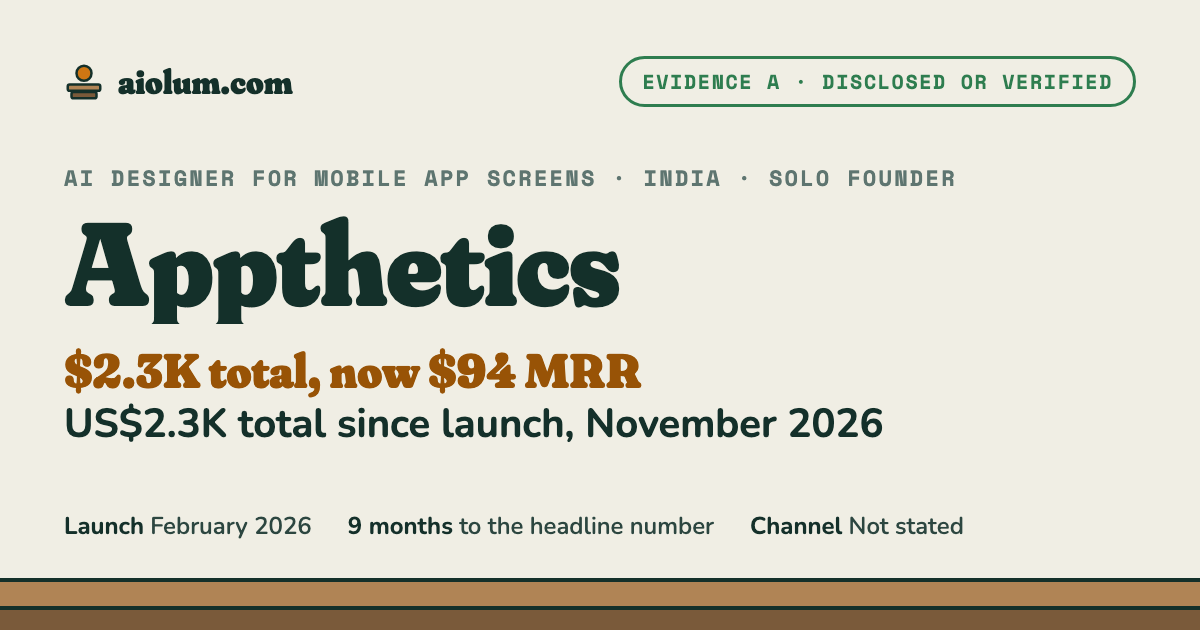
Appthetics (AI designer for mobile app screens, India): US$2.3K total since launch, November 2026. Evidence grade A: disclosed by a company or a filing, or verified by a payment processor. Team: 1 founder (solo founder on his founder.page profile); no employees named in any source. Launched February 2026; still running, revenue falling.Added 6 November 2026
- Outcome
- US$2.3K total since launch, November 2026Revenue falling
- Evidence
- A disclosed by a company or a filing, or verified by a payment processor
- Launch
- February 2026
- Status
- Still running
- Team
- 1 founder (solo founder on his founder.page profile); no employees named in any source
- Outside funding
- None reported
- Main channel
- Not stated
Appthetics is an AI design tool for mobile apps. The user writes a prompt, a plain-language description of the app, and the tool generates high-fidelity screens, which means screens that look like the finished app, with real colors, text and images, not grey boxes. The screens can be edited, exported to Figma or handed to AI coding tools, and turned into App Store screenshots. One founder, Aditya (@AdityaShips on X), a solo founder from Mumbai, India, builds it. The site was live with a paid plan of US$19 a month on 4 February 2026.
TrustMRR, a site that reads a startup's revenue directly from its payment provider through an API key, shows verified revenue from Polar and Dodo Payments of US$2,331 in total by 6 November 2026, with US$108 in the last 30 days, a monthly recurring revenue (MRR, the subscription revenue that repeats each month) of US$94, and 8 active subscriptions. The best month was February 2026, with US$428. Two revenue directories, Arrfounder and IdeaWave, show a much larger figure, US$2.3K of MRR; the payment records do not support that figure, and it is shown on this page only as a disputed claim.
So this is a grade A story about a small business: real paying customers every month since February 2026, but revenue of about US$100 to US$400 a month and falling in October 2026. It is shown because the numbers are verified, and because it is a clear example of a solo founder entering a crowded field of AI app designers with a narrow product.
How much revenue does Appthetics make?
Each row shows the evidence grade and the source numbers from the list at the end of this page. The grades are explained in How Aiolum verifies.
| Fact | Value | Grade | How we know | Sources |
|---|---|---|---|---|
| Total verified revenue, 6 November 2026 | US$2,331 | A | TrustMRR, Verification Sources: Polar and Dodo Payments through API keys, last synced 6 November 2026. The last-12-months figure is the same, so all revenue came in 2026. | [1] |
| Monthly recurring revenue, 6 November 2026 | US$94 | A | TrustMRR metric snapshot. MRR growth over the last 30 days: -63.3%. | [1] |
| Revenue in the last 30 days, 6 November 2026 | US$108 | A | TrustMRR. Growth over the last 30 days: -73.0%. The largest single day in that period was US$20. | [1] |
| Active subscriptions, 6 November 2026 | 8 | A | TrustMRR metric snapshot. | [1] |
| Revenue by month, 2026 | Feb US$428, Mar US$361, Apr US$264, May US$179, Jun US$92.73, Jul US$333, Aug US$152, Sep US$375, Oct US$137 | A | TrustMRR monthly revenue timeline. November had US$10.35 by 6 November. | [1] |
| Average revenue per month, February to October 2026 | about US$258 | calc | Calculated: the nine full months above add up to US$2,321.73; divided by 9. | [1] |
| Profit margin, last 30 days | 75.0% | A | TrustMRR metric snapshot. How costs were entered is not shown. | [1] |
| Self-reported MRR in revenue directories | US$2.3K (ARR US$27.6K) | D | Arrfounder product record extracted 3 November 2026 (its page rounds this to US$2K a month and US$28K a year); the record is marked as AI-extracted and the founder as not verified. IdeaWave repeats it as "self-reported by the founder via ARRFounder", last checked 6 November 2026. Contradicted by the payment records above. | [2, 3] |
| Founded | 2 February 2026 | C | Founder-written TrustMRR profile. A Wayback copy shows the site live with a paid plan on 4 February 2026. | [1, 4] |
| First price | US$19 a month, shown as down from US$29, 50 credits a month | C | Wayback copy of the home page, 4 February 2026. One credit per generated screen; unused credits roll over. | [4] |
| Current prices | Lite US$9 a month, Pro US$20 a month, Lifetime US$79 one-time | C | Founder-written TrustMRR profile text. | [1] |
| Team | 1 founder | C | founder.page profile: "Solo founder", Mumbai, India. Arrfounder and TrustMRR list one founder. | [5, 1, 2] |
| Founder's audience on X | 17,847 followers | C | Shown on the TrustMRR profile. | [1] |
| Payment providers | Polar and Dodo Payments | A | TrustMRR Verification Sources. Merchant of record: no. | [1] |
| Outside funding | none reported | C | No source mentions funding. | [1, 2, 5] |
| Time from launch to the November 2026 figure | 9 months | calc | Calculated: February 2026 to November 2026. | [1, 4] |
How to read this table: a grade A value comes from TrustMRR's "Verification Sources" section, read from Polar and Dodo Payments through API keys. A grade C value is written by the founder (his own site, his TrustMRR profile text). A grade D value is a directory figure from one founder claim. A "calc" value was computed on this page.
| Plan | Per month, billed yearly (US$) | Per month, billed monthly (US$) | Limit |
|---|---|---|---|
| Lite (called Plus on the site) | 9 | credits for AI generation | |
| Pro | 20 | credits for AI generation | |
| Lifetime (bring your own key) | 79 one-time | AI usage paid to Vercel AI Gateway by the customer | |
| Standard, February 2026 (old) | 19 | 50 credits a month; launch offer, shown as down from US$29 |
The site's machine-readable pages say there are Plus and Pro subscriptions, monthly or yearly, with credits for AI generation, a Lifetime plan that uses the customer's own AI key, and credit top-ups. The founder's TrustMRR text names the cheaper plan Lite, not Plus; yearly prices were not found. With the Lifetime plan, Vercel bills the AI model usage to the customer directly. The February 2026 plan is shown for comparison and is no longer offered.
When did Appthetics launch, and how did it grow?
From a US$19 launch plan in February 2026 to a rebuilt product with a lifetime plan and screenshot studio by August 2026. Each entry carries its grade.
- 2 February 2026AFounding date on the founder's TrustMRR profile. Verified revenue in February: US$428, the best month so far. [1]
- 4 February 2026CWayback copy: the home page sells one Standard plan at US$19 a month with 50 credits, and exports HTML and Tailwind code. It says to contact the founder on X, AdityaShips. [4]
- 15 May 2026CChangelog v1.0.0, "AI App Design Studio", described as the first release: prompt-to-screen generation, editable designs and an App Store Screenshot Maker. [6]
- 16 June 2026CBlog guide for Lifetime BYOK buyers: AI usage runs through the customer's own Vercel AI Gateway key. [7]
- 11 July 2026AChangelog v2.0.0: rebuilt editor, better Figma export, and a Lifetime plan. July revenue rises to US$333. [6, 1]
- 1 August 2026CChangelog v2.3.0: App Store screenshot design made with GPT Image 2. [6]
- 6 November 2026APayment records: US$2,331 in total, MRR US$94, 8 active subscriptions, revenue down 73% over 30 days. [1]
Why did Appthetics work?
Four causes, in the order they mattered. Each one is a reusable lesson.
A narrow niche
The product does mobile app screens and launch assets only, for people who build apps but do not design. Its own blog compares it with general UI tools and says to pick it for mobile-first screens, Figma export and App Store screenshots.
Hand-off to the tools buyers already use
Version 1.1 added export to AI coding tools such as Claude, Codex and v0, and version 1.2 added export to Figma as editable layers. The design is a first step before the code, not a separate design project.
Two ways to pay for AI costs
Subscriptions include credits, so the founder pays the model costs and limits them by credits. The Lifetime plan moves the model costs to the customer, who connects a Vercel AI Gateway key; Vercel bills that usage separately. This makes a one-time price possible.
Many search pages
The sitemap lists comparison pages against eleven competitors (Sleek Design, AppAlchemy, AIDesigner, UX Pilot, Figma AI, Uizard, Google Stitch and others) and dozens of blog guides. No source says how many customers came from search.
How it was built
These details come from the founder's TrustMRR profile, the product's own pages and its changelog. They are grade C except the payment providers, which TrustMRR verifies. [1, 7, 6, 8]
- Next.js, TypeScript and Tailwind CSS for the front end; Convex for the back end (TrustMRR tech stack list).
- Payments through Polar and Dodo Payments, both connected to TrustMRR with API keys.
- AI models through Vercel AI Gateway: Lifetime customers paste a Gateway API key, "not an OpenAI key, Anthropic key, Google key".
- App Store screenshot artwork is made with GPT Image 2, an OpenAI image model (changelog v2.3.0).
- The site serves machine-readable Markdown pages (llms.txt, blog.md, changelog.md) for AI agents.
- Seven releases from v1.0.0 (15 May 2026) to v2.3.0 (1 August 2026).
Tools named in the sources
Each one opens its page in the Tools tab, with every story that uses it.
Who tried this before Appthetics, and why did they fail?
Five companies in our database of failed startups tried to close the gap between app design and working code, or to automate design. The values below are from that database and are not independently verified.
Pixate
The promiseNative mobile app prototypes for designers, without writing code.
Why it diedGoogle bought it and stopped developing it on its own; Figma's cloud tools took the market.
The Grid
The promiseWebsites designed automatically by artificial intelligence.
Why it diedThe AI of the time could not make designs of steady quality, and polished site builders won.
Pagedraw
The promiseTurn design files into React code.
Why it diedIt was built on Sketch while designers moved to Figma, and developers still preferred to write the code by hand.
Haiku
The promiseHigh-fidelity animations and prototypes that become code directly.
Why it diedFigma and Adobe XD added prototyping features, and the 2020 downturn ended it.
Invision
The promiseInteractive, high-fidelity prototypes and design hand-off for teams.
Why it diedFigma's real-time collaboration took its users.
The failed startups come from our database of 1,749 dead startups, retold here in our own words. Its entries are AI-assisted summaries of public sources, so these cards carry no evidence grade.
What changed
The five predecessors needed a designer to draw the screens first, or used AI that was not yet good enough, and each lost to Figma or to tools that Figma's owner or rivals added. Appthetics uses today's language and image models to draw the screens from a sentence, so the buyer does not need to be a designer, and it exports to Figma instead of competing with it.
What has not changed is the competition. The same models are available to every competitor, and many funded and solo products now sell the same promise. The payment records show that Appthetics has found paying customers every month, but not yet a growing number of them.
Can one person copy Appthetics now?
Yes, it is easy to copy. Making it grow is the hard part.
One founder built and runs it on rented AI models, a hosted back end and a payment provider, with no capital. That also means a competitor can do the same, and many have. The verified revenue of about US$258 a month on average shows that a working product in this field is not enough on its own.
Where it is still open: Narrower parts of the same workflow that general tools do poorly: store listing assets in many languages, app icons, onboarding screens, and design checks before an app is submitted.
- 1Pick one narrow user (here: developers who cannot design) and one output (mobile screens).
- 2Export to the tools that user already has: Figma, and AI coding tools.
- 3Offer a lifetime plan where the customer brings his own AI key, so the one-time price does not carry model costs.
- 4Connect the payment provider to a public revenue page, so the numbers can be checked.
What could go wrong for Appthetics?
The risks are the mirror image of the causes above.
Directory figures do not match the payment records
Arrfounder (record extracted 3 November 2026, marked AI-extracted, founder not verified) and IdeaWave ("self-reported by the founder via ARRFounder", checked 6 November 2026) give US$2.3K of MRR. TrustMRR's payment records on 6 November 2026 show MRR of US$94 and US$2,331 in total revenue since launch. The directory figure is close to the all-time total, but no source says that the two were confused; this page uses only the verified figures.
Revenue is small and falling
Revenue over the last 30 days fell 73% and MRR fell 63% (TrustMRR, 6 November 2026). October brought US$137, against US$375 in September and US$428 in February.
Founding date and first release disagree
The founder's TrustMRR profile gives 2 February 2026 as the founding date, and payments start that month, but the changelog calls v1.0.0 of 15 May 2026 "the first Appthetics release". The February version may have been an earlier product under the same name; no source explains it.
Competition
The site has several stories in the same field with more revenue: Sleek (US$20.5K a month), AIDesigner (US$8.6K MRR) and AppAlchemy (US$118.6K in 12 months); Appthetics's own sitemap lists comparison pages against eleven competitors, including Google Stitch and Figma AI.
Dependence on model providers
Generation runs through Vercel AI Gateway (blog guide, 16 June 2026), and App Store artwork uses OpenAI's GPT Image 2 (changelog v2.3.0). A price rise or a change in these services would change the cost of every subscription credit. The models themselves are not named for the screen generation.
Other products and blog topics
The founder also builds NotchOwl, a Mac notch app, which founder.page lists at US$130 a month self-reported. The blog sitemap lists UI-pattern articles about well-known apps, among them OnlyFans and the Tea app; only the URLs were read, and the product itself does not make adult content.
Sources
The grade next to each source is the best grade that the source can support. "Read in full" means that the text of the page was downloaded and the numbers were checked in it.
- A TrustMRR: Appthetics (markdown profile), synced 6 November 2026Read the markdown profile. Revenue, MRR, subscriptions, monthly timeline and payment providers from the Verification Sources section (grade A); founding date, prices, tech stack and description are founder-written (grade C).
- D Arrfounder: Appthetics product pageRead in full, with the page's embedded product record (MRR 2,300, ARR 27,600, extracted 3 November 2026, source marked "ai", founder not verified). The site's disclaimer says its data are self-reported and collected mainly from X.
- D IdeaWave: Appthetics revenueRead the summary, the FAQ and the daily-check table. It states that the figure is self-reported via ARRFounder.
- C Appthetics home page, Wayback Machine copy of 4 February 2026Read in full. Source for the first plan, price, credits and code export.
- C founder.page: Aditya Jaiswal (@adityaships)Read in full. Source for "Solo founder", the city and the founder's other product.
- C Appthetics changelog (v1.0.0, v2.0.0, v2.3.0 and the index)Read the Markdown index and the three release pages in full. Source for the release dates and features.
- C Appthetics blog, 16 June 2026: How to Add Your Vercel AI Gateway Key to ApptheticsRead in full. Source for the Lifetime BYOK plan and the model billing.
- C Appthetics home page and llms.txt, read 6 November 2026Read the Markdown home page, llms.txt and the sitemap in full. The HTML pricing section loads by script and could not be read.
- C Appthetics blog, 22 June 2026: The Best AI Mobile App Design Generators in 2026Read the sections on Appthetics. The founder's own comparison with other tools.
- C Database of failed startups, local exportLocal export. AI-written summaries, not independently verified. Source for the failed predecessors.
Run this company? Send corrections or a verified figure to aiolum@livyden.com